Poetry and Prose by #1 Amazon Bestselling Author of Nature Speaks of Love and Sorrow, Co-Author of #1 Amazon Bestseller, Wounds I Healed: The Poetry of Strong Women, and Jan/Feb 2022 Spillwords Press Author of the Month
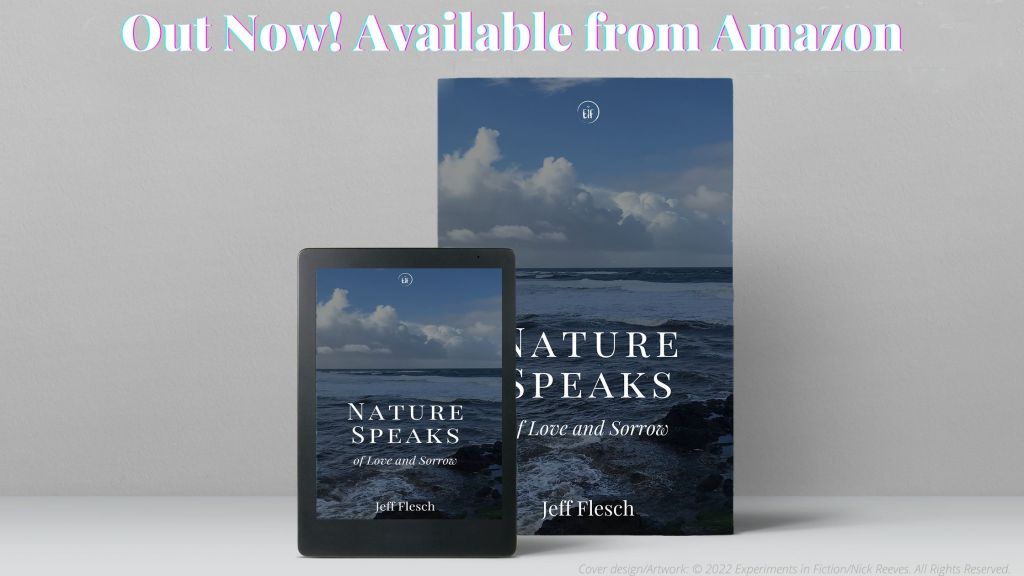
After some much needed rest following the book launch last week, I have chosen a new event for the month of September to celebrate #1 Amazon New Realease Nature Speaks of Love and Sorrow and each of you.
Here is my invitation to you.
Beginning today, and lasting until September 23, I am inviting you to submit a poetic response to your favorite poem from Nature Speaks of Love and Sorrow. The poetic response must be in the written word, and can be a poem or a piece of prose.
Please submit your poetic response to jeffflesch.com@gmail.com
In your email, please include the following:
Your name, or Pename.
Your website URL, and/or social media username.
The title of your favorite poem from Nature Speaks of Love and Sorrow.
The title of your poetic response.
Your poetic response. Please add your poetic response to the body of the email. No written word attachments, please. You may, however, submit a photo to accompany your poetic response. Please include the photo credit with the image.
Once received, I will, for a timespan of 30 days and up to 30 poetic responses, post your pieces on my blog. I am accepting these poetic responses on a first-received basis.
It is my intention to post everyday for 30 days, yet there may be times, due to other obligations, where I need to miss a day, and post two or more poetic responses on the following day. Either way, I will post your 30 poetic responses to this blog in 30 days.
I will let you know at least 24 hours prior to the posting of your poetic response, so you know when it will be published.
Though I know all of your submissions will resonate with me, at the end of the 30 days, I will select the 5 poetic responses that resonated with me most, and send these poets/writers a signed copy of Nature Speaks of Love and Sorrow.
This event will also serve as the basis for a weekly prompt idea I have, which will launch at the conclusion of this collaboration.
Remember, submissions open today, and will remain open for two weeks, closing at 11:59 PM PT (USA) on September 23.
I will begin posting your submissions on September 24.
I look forward to reading your poetic responses.
If you have questions, please email me at the email address listed above.
A couple of weeks ago I gave a talk about connection. More specifically, it was titled, the Year of Continued Connection. The talk was delivered at our Community Education Instructor Forum. An event we’ve been planning and delivering for, well, almost three years now.
After the talk, I continued to reflect upon the conversation with the instructors, and the concepts they brought up, and just how important connection is in our lives. In many ways, it is the bedrock of many concepts we cherish, such as relationships, engagement, an open heart, kindness, care, and yes, compassion.
When we are deeply connected to our own humanity, we get a larger picture of our shared humanity, which increases the humility and compassion we have for ourselves, and everyone else.
In this post, I would like to elaborate on a few of the concepts outlined above as I understand them in their relation to connection. Ready? Good. Here we go.
Relationships – as I’ve written about many times, all of our relationships start with the relationship we have with ourselves. The connection we have with ourselves is the same connection we will have with the people in our lives. It just works that way. There was a time when I wondered why it was that my relationships weren’t as strong as I would have liked them to be; bottom line? The relationship I had with myself was not strong. Simple.
Engagement – when we are in relationship with ourselves, and then the people we surround ourselves with, it means that we are engaged. Engagement in this context means we have easy and difficult conversations. Both. When we hold ourselves accountable, we will do the same for everyone else, which makes navigating our relationships harder. Though harder, when we hold ourselves accountable, we get back relationships that have a deeper connection. Why? Because we are real, we are speaking our truth. That’s it.
Open Heartedness – when we are in engaged relationships there will be difficult times. For us, and for the people we love. However, when we are engaged, we won’t run, we will stand by their side, and stand for those we love, just as we stand for ourselves. And, when we are standing, we are being open to all that life gives us. We don’t pick and choose the times we are engaged and willing to stand for ourselves and the people we love. We do it all the time. Without thinking. It just happens. We create more openness within ourselves because we are living through experiences that we may have run from before; and, when we stand through all of the stormy times, our connection to ourselves and the people we love deepens even further.
Kindness – with our hearts more open in these engaged relationships, we develop more kindness for ourselves and everyone else. It happens as a result of continuing to navigate all of life’s triumphs and challenges. In essence, we become a kinder human being, because we’ve been through more challenges. We’ve become more vulnerable; and, when we become more vulnerable, yes, we get stronger, and we get kinder. All of which also creates a more intense connection with ourselves and the people we love.
Care – when we are kind, engaged, and open-hearted in our relationships, we develop more care. We have a better understanding of the human condition, and what it takes to stand for ourselves and the people we love. Every day. And, as we do this work, a deeper awareness develops within ourselves, which includes a deeper connection of care to everyone and everything.
I also like to think about connection in regard to three other concepts. Here they are.
Safety – when we stand for ourselves and other human beings, we stay engaged, regardless of the situation. A result of increased engagement is safety. When we know we won’t run at the first sight of trouble, people feel safe. And, when people feel safe with you, they will be much more connected.
Security – as a sense of safety develops in your relationships, a sense of security also develops. It has to. When we feel safe, we also feel secure. Secure in the knowledge that our relationships are a place where we don’t have to worry or create anxiety over people leaving us, or being upset with us. Now, that doesn’t mean there will never be disagreements, or even arguments; what it does mean is that people will respect each other, and speak their truth, without fear of reprisal. That’s security.
Stability – and, when we feel safe and secure, we also feel stable. The relationship we have with ourselves is more stable, which means all of our relationships are more stable.
When we have safety, security, and stability in our relationships, we have a deeper connection to those we love. It also means that we know when a relationship is not going to work. Whereas this is difficult, we stay true to our truth. The knowing we have of the kind of relationship we are creating, and want to have. Therefore, we are much more clear on the people we allow into our lives. In fact, we have much more clarity about humanity in general. Beautiful.
With more clarity about our own humanity, we are much more clear on all humanity. I’ve written this sentence differently many times. Yet, it is such an important part of deepening our connection with ourselves and the people we love.
When we have authentic relationships, we are working hard on them all the time. And, as we do the hard work, we go through many challenges. These challenging times show us more about our own humanity, and then our collective humanity.
For instance, we can read every book ever written on being vulnerable, yet the only way to really know about vulnerability is to practice being vulnerable. It is the only way. Without the practical experience of being vulnerable, vulnerability is just information in our heads; we leave our hearts behind.
Yet, when we are open to all of the experiences life gives us, we get to learn so much more. And, it is inside of these learnings where we further deepen our connection with ourselves and everyone else.
As we deepen our connections, we also develop more compassion. We develop more compassion, because as we go through more challenges, we develop a new understanding of how hard life can be; and with this new experiential knowledge, the compassion we have for ourselves and everyone else deepens.
When we are more compassionate, we are also more patient, and have more love for people when they are struggling, because we can see ourselves in them. And, for me, one of the most magical experiences of my practice of self-inquiry over the past four years has been seeing myself in other people. It is a beautiful experience.
Remember, every connection we have in life starts with the one we have with ourselves. When we have a deep connection with ourselves, we will have a deeper connection with the people we love, and we will also become a more compassionate human being. And, guess what?
An Exploration of 4 Years Inside A Non Credit Department at the Local Community College
Linn-Benton Community College, Albany, Oregon
As I continue to reflect upon the last 4 years in the position I hold at the College, I learn more about myself, and about being a human being on this planet.
It is funny to think that leading a team at a small community college in Albany, Oregon, would provide insights of this kind, and yet, they do. Why?
Because no matter where you lead, it’s you doing the leading, for one, and two, all contexts to some extent are the same. Yes, the challenges, people, systems, and structures, are different, yet you are there, and you are always getting to know, and developing yourself and other people. Same.
After spending time in leadership in the private sector, and now having done so in the public sector, there are several things that we will discuss in this new series that are similar; and, in some ways, mirror each other.
In this first installment in this new series, I will lay out a brief outline, if you will, of the posts to come. It will be a way to set the stage for the concepts we will discuss, unpack, and walk through together.
I’m going to frame this first entry, and the following entries, by year, which will provide us a base from which to work through the narrative to follow. Ready? Alright, here we go.
I remember well when the job description for the position I currently hold, Director of Extended Learning at Linn-Benton Community College, landed on my desk. I was working in a program at the college, which was struggling, and in threat of being eliminated. In fact, the program has been eliminated.
I looked over the position description, talked to my wife, friends, and family, and took a walk with a colleague, who asked me this question. Are you an operations man, Jeff? Whoa. Was I?
I was very unsure, and needed to think about it. Here are some of the considerations I made previous to applying to the position, which, I think, are quite generalizable.
Reflecting upon my work and academic career.
Reflecting upon what I would bring to the position.
Doing research about the position.
Having conversations with the hiring supervisor.
Having conversations with staff in the department.
There were more, bet you get the idea. It is important when making a life change to make all of the considerations and reflections we feel necessary. What happened? Well, I ended up saying this to my then wife.
If it was meant to be, we will know by getting the offer; and, if not, then not.
Of course, you know that I got the offer, and have been in the position for almost 4 years. And, what was the first year like? Hell and heaven all rolled into one. Kinda like life.
2017-18
The first year, especially the first six months, was extremely painful. One of the most painful experiences of my life. Why? Because all day every day, I was outside of my comfort zone. I was also, at this time, not treating my mind and body very kindly.
Here is what the first year looked like.
Breakdown central.
Remembering who I am.
Development outside of the college.
Life coach.
Breakdown to breakthrough becomes a reality.
Relationship development, with myself, and the team.
I say often when talking about that first year, that that was the year of relationships. Yes, we did other things, which I’ve written about in other posts, yet the basis for almost every action that year was developing deeper relationships with ourselves and each other. Painful in many ways, yes, and beautiful in many more.
In the second year, things started to move. Meaning, we began to move, well, almost like a team. We were getting closer, and yet, had a lot more work to do.
Here is what the second year looked like.
Process and system improvement.
People in the right positions.
Vision, mission, goals.
Developing priorities.
Metrics and measurement.
Internal advocacy.
External relationships.
As we then moved into year 3, the team became more aligned, and we began to get traction in all areas of our business. As a matter of fact, in the fall of 2019 we were on pace to grow our service to the local communities by another 10%. Amazingly fun.
2019-20
Then, as we moved from fall to winter, we continued our alignment trajectory, and, of course, you all know what happened in early 2020. Yep. A pandemic.
Here is what that looked like.
Team alignment.
Gaining traction.
Filled classes, growth, sustainability.
Pandemic?
Reprioritizing.
Creating 5 new business models.
Community response.
Initially, we were wrestling with questions, such as could we deliver completely remote classes. At that time, we did not have remote offerings, so there were no processes or systems to draw upon. Yet, we ended up taking all 5 business models completely remote, and the community response was stellar.
As we entered year 4, all 5 programs were either creating and delivering remote classes and training, or would be by the fall of 2020. And, there was a lot of work to do to continue the momentum we created earlier that year.
Here is what that looked, and well, is like.
Creating all new processes and systems.
From disruption to sustainability.
Filled classes, growth, sustainability.
Engagement, relationships, conversion, process and priorities.
Planning for the future.
10 business models?
And for next year? Well, I’ve actually been reflecting upon this question quite a bit. Someone asked me recently, what do you see for our work as we, at some point, begin to offer in-person classes again. First, I think offering in-person classes again is still in the distant future, yet I do have some thoughts.
What’s Next?
As we move into the second-half of the 2020-21 school year, we are offering new classes and training, and filling them up with local community members.
I see a 2 to 3 year slow progression from completely remote classes and training, to what I think will be a hybrid-model of both remote and in-person classes and training in the future.
What will the percent mix be of remote and in-person classes in the future? I don’t know. I do think, however, that, unlike when the pandemic started here locally, it will not be sudden. It will take time.
And, that’s okay. There is no rush. We will meet the community needs as they change. That’s part of what we do, and what we do well.
Alright, that completes the overview of the Leading From Within series. I look forward to future posts, where I can share, in more detail, how each of these years has impacted me as a leader, and, even more importantly, as a human being.
As I was pondering the next developmental moment, and was considering influence as a topic, I had to stop, and reflect upon the past three years. What to say about influence?
Well, as with most things in my life today, an insight did occur, which will now come out through me and to you. Fun.
Alright, so influence is an important topic when you are leading teams; and, well, I do believe it is an important topic in everyone’s development, regardless of their iteration of self-development, or their interest in leadership. Why?
Because, we all will, at some point, apply for a job, need to grow our network, and, or, seek new areas of self-expression. And, to be fully self-expressed, or, rather, to self-express yourself fully, it is nice to understand the concept of influence. Let’s do just that then. Take a look at how I interpret the concept of influence.
Ready? Good. Here we go.
influence
verb /ˈɪnfluəns/
to have an effect on the way that someone behaves or thinks, especially by giving them an example to follow.
influence something, influence how, where, etc. to have an effect on a particular situation and the way that it develops.
Alright, so here’s what we have for influence; to have an effect on a particular situation and the way it develops, or the way that someone behaves or thinks, especially in regard to providing them an example to follow.
Now let’s discuss influence in two different ways. Let’s take a look at internal influence, and external influence. Both are important, and both are needed. Here we go.
When I write the phrase internal influence, I am referring to your influence within the business, organization, or institution in which you work.
Understanding influence as an opportunity to build cultural capital inside of the business, organization, or institution in which you work is important for a leader to consider. If your influence wanes, it may be hard, for example, to garner political support on a project your team is working on.
However, if your influence is strong, or even adequate, garnering support will be easier. Pretty simple.
What I’ve found to be most true about internal influence is that being who you really are is of utmost importance. Meaning, to be the authentic leader you know yourself to be.
Yes, we all have to make concessions at times, and, yet, we all have the creative power to effect change. And, this is true, even when our influence is bourgeoning.
A quick aside. Influence, like most things in life, lives along a spectrum. Meaning, that influence is not binary. You gain influence over time; and, it takes time.
Maybe you’re asking yourself, okay, well, how do we create influence, and effect change. Here are a few important considerations for those interested in increasing their internal influence.
Relationships – as I’ve written many times, everything starts with relationships. The one we have with ourselves, yes, and then with everyone else. Being in a relationship means having easy and difficult conversations. Remembering this truth is important in leadership.
Questions – asking questions is always an important step in creating influence. Often, people shy away from asking the tough questions. Ask them. It is important to your own development, and that of your teams.
Creativity – being open, flexible, and innovative, is an important aspect of influencing the future. Without creativity, the past is the future, a stamped reproduction. Thus, being open to new ideas, those from your peers, and your team is essential.
Integrity – doing what we say we are going to do is important to all aspects of our lives, and there is no exception in creating influence. If we are unable to make it to a meeting, or are going to be late, communicate. Open communication ensures that we are always keeping everyone in the conversation, and keeping our integrity intact.
Authenticity – be who you are. You are just as you are supposed to be, so embrace your unique-self, and let that shine. There is only one you, which means there’s not another person on the planet that can create influence, or anything else for that matter, just like you. When we are authentic, people know, and respect our truth. And, if they don’t? Remember, that’s their issue. Not yours. Be who you are.
Alright, there are five examples, and considerations for you, on how to create influence within a business, organization, or institution. Remember, influence takes time to cultivate. It’s kind of like gardening. You must water your relationships, questions, creativity, integrity, and authenticity, and, when you do, you will see your influence grow.
External influence is similar to internal influence, and yet, also different. You can use the five considerations aforementioned with those clients, students, or customers, that are external to your business, organization, or institution. And?
There are a couple more strategies for you to consider. Here we go.
Engagement – being fully engaged at all times with those you serve is important. Meaning, that it is important to create an engagement system that you can rely upon, which will ensure your engagement is, well, like a drum beat. Your clients, students, or customers need to rely upon your engagement pattern. I write about developing my LinkedIn engagement system in the post, A Blogger’s Diary 12/27/20: On Writing, Goal-Setting, Systems, and the Holidays, which can serve as one of many examples to draw upon.
Consistency – a drum beat, or pattern, on which your clients, students, or customers can rely. Important. There are lots of ways to ensure you stay on track with your engagement. You can calendar your engagements, enter them into a project management software system, or keep them in a planner. The tool matters far less, than the output of making sure to engage regularly and consistently.
Reciprocity – relationships are built upon many things, and reciprocity is one. Being in relationships means sharing yourself with your clients, students, or customers. And doing so in a genuine way. Remember, people know when we are inauthentic. They can see, hear, and feel it. Just be who you are, and reciprocate.
Value – our clients, students, or customers want to know they are valued. They would like value, and to know they are valued. Both. Providing value comes in many forms, and it’s not always, actually rarely, monetary. It’s about being there for your clients, students, or customers. Taking care of them, treating them with kindness, and valuing their needs.
Service – in the end, it’s all about service. All of it. The service we give ourselves, and the service we give out to our clients, students, or customers. When we value our service, we are always looking for, and creating, new ways to serve. Whether that is through a new business model, a new product, or a new service. Really. Ultimately, it’s about understanding the need, reflecting on that need, and creating a bridge for that need.
Internal and external influence matter. It’s not about ego. We are leaving ego at the door. It’s about service. About taking care of people. Finding out what they need, and working with them to fill that need.
When we are in relationship with people, we are in a unique position to serve.
And, as we continue to serve, our influence grows. Influence grows as we grow and deepen our relationships. The relationships we have with those we serve. Ultimately, it’s our peers, teams, clients, students, and customers that let us know about our influence.
When we have movement in our relationships, we can see it and feel it; and, when we have traction, we know, because reciprocity flourishes as we enter into new relationships each day. And, as we enter into more relationships, our service grows; and, yes, we also grow. Fun.
Well, it’s been 3 months since I started blogging, and I’ve learned some, and have so much more to learn. Phew, so much.
How did I get started?
As I’ve written in other posts, when COVID-19 sent everyone home, a byproduct of the pandemic was more time. Though I continued to work, the business was/is much slower than normal. In fact, the business is completely different today, and will continue to be so.
As I was looking for another outlet for the additional time, my oldest son and I had a conversation about COVID-19, discussing if future history books would show a large increase in creativity during the pandemic. Not sure, yet it is fun to think about.
What I do know is that it got me thinking about creating a site where I could get out my own creativity, and could also invite others to do the same. Though the latter hasn’t been fully realized, the former has been, and in ways that I never anticipated.
At the time, I had no idea how far it would go, and it pleasantly surprised me for sure. Pretty cool.
I’ve actually integrated the blogging into my normal daily workflow. They are very relevant to each other, and in many ways, they feed on each other. Fun.
What have I learned?
Phew, so many things. Here are a few.
How to create, manage, update, and maintain a website – lots of work, was a steep learning curve for me. Yet, like anything, once you get into it, starting moving work forward, you learn, read other blogs, and adjust as needed.
How to connect social media accounts to websites – actually not difficult. The difficulty is in managing the social media accounts. Making the time to learn how to use them, as they are all very different. Lots of work.
How to manage my time differently – even though there was/has been more time since COVID-19 began, I had to strategically create time each day to move the work forward.
How to differentiate writing from working on the site – both are needed. I write everyday, and, at first, worked on the site everyday. Now, I still write everyday, yet only work on the site once or twice a week. Not sure if that is a proper balance, as I do know updating the site is very important.
How to follow and interact with other bloggers – much fun. I have greatly enjoyed reading other blogs, asking questions, and giving my perspective on other topics. Fun.
How to connect videos to websites – about a month ago I wrote this blog, How We Learn, and Why it’s Important to Understand, and after reflecting upon it, it occurred to me that creating videos would be super fun, and would be another way to engage with people.
How to market your blog – learning more here every day. Lots of ways to market and engage people. I will say, however, that being active and consistent is super important.
How to sign up and write regularly on medium – I had never even heard of medium before beginning to blog. You can follow me here.
I’ve learned so much, and have so much more to learn, which is why I thought this new diary series would be super fun to write.
Let’s take a look at how my blogs have iterated in the past three months.
Lots of development over the past three months. A wonderful journey thus far, and I have every intention of continuing to write in this medium.
Here are some of the topics I’ve covered in the past three months.
Relationships
Mindfulness
Sociology
Psychology
Human Development
Self-Development
Writing
Social Action
Business
Letters
Inspiration and Imagination
Possibilities
The Sound of
That’s actually a pretty inclusive list. The letters category is really new, it was just created last week. There is only one blog in there now, which is the one about my father passing, Letters: For My Dad.
Corvallis, Oregon
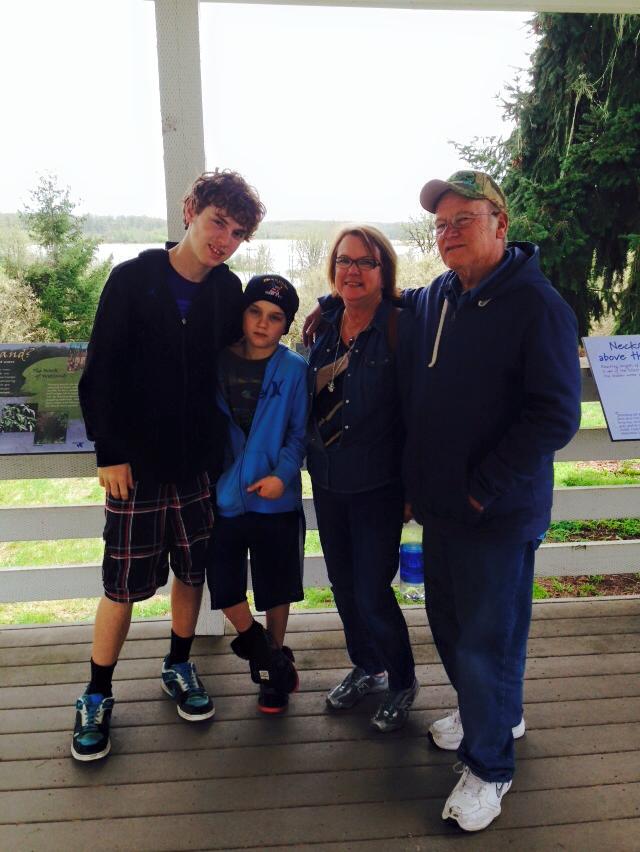
That was a tough one to write, and has me in tears now. Phew. I miss him.
What’s next?
Continue to write, and learn. I’ve got a long list of topics to write about, much more than the time to get them all written anytime soon. And, you know, that’s totally okay.
I see blogging as something that will continue to be a part of my life forevermore. I’m not interested in the short game, only in the long one.
I also see my work in higher education and blogging, as something that will continue to converge. Actually, I’ve just recently added coaching services to the website, which I am super excited about. You can check them out here.
Why is it important to understand how we learn best? It has to do with our own ability to relate with ourselves, first, and to others, second. Do you know how you learn best? Not sure? That’s pretty normal.
Though deep down you know, as I once did, most people don’t actively think about it. And, neither did I. It was not until I went back to school in my early 30’s that I fully understood how I learned best.
Alright, let’s take a look at the top 4 learning styles, and see what style resonates with you most. I also invite you to think about how else you can use these learning styles in your life. Ready? Good, here we go.
Learning Styles
Visual
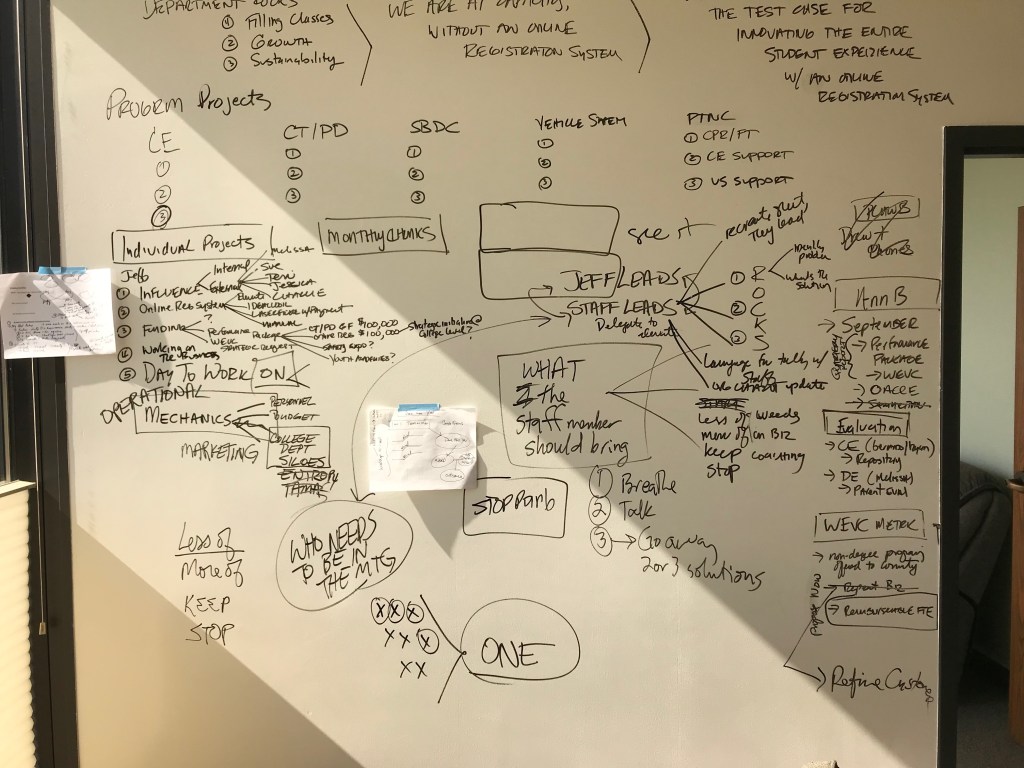
Visual learners like to see what they are learning. These learners are interested in the visualization of the work they are engaged with. Think whiteboards, flow charts, and large post-it boards.
They must see the work in order to fully take the information in, process it, and provide a meaningful response. Some people don’t know they are visual learners. If you are not sure, I suggest writing out your next project on one of the aforementioned tools, and see what happens.
As I am visual, I can provide an example here.
I don’t expect this visual to make sense, and in fact, it may shock or startle some of you. What you are looking at is how someone that is hyper-visual thinks.
The importance of getting those ideas out of one’s mind and into reality, via any tool really, is extremely important to someone that is a visual learner. Without the ability to do so, the person may get stuck. I know, I’ve been there.
Aural
Someone that learns best through sound is in the aural category. Think about someone that chooses to listen to audio books, or someone that must have someone explain a particular task or project to them through verbalizing the steps. Our youngest son is an aural learner.
For those that learn best this way, having tasks or projects written out or in visual format, as in the above whiteboard example, will not work. Or, rather, visual and written instruction will not work as effectively. Sound is the key.
This is a video I created for the blog, 3 Reasons Why Avoidance is an Ineffective Strategy, and I am using it as an example of aural learning, as I am talking through a strategy in this clip. Helpful. What would not work for an aural learner, would be the written out steps to the associated diagram without the spoken explanation.
Verbal
Verbal learners need to read that which they are to work on or engage with. Being able to read instructions, for example, is imperative for a verbal learner. Think about putting something together, not with a picture in mind, but with a list of steps, 1, 2, 3.
Being able to internalize the written instruction or steps, is important for a verbal learner. What would help the above video clip for a verbal learner? Yep, that’s it. If I were to write out a list of the steps that I am talking the viewer through. That would be helpful. Think of an ordered system. More comfortable for a verbal learner.
Kinesthetic
Those that learn best with their bodies are kinesthetic. These learners like to actually do something with what they are learning. They need to actually touch, feel, and practice the new information.
Though the below picture is not the best quality, it gives you an idea of a practical tool that was created intentionally to engage those that learn best by doing something with new information.
Alright, so can the learning styles be combined? Do some people learn best with a combination of the aforementioned learning styles? And, can people’s learning styles change over time?
Do some people learn best when learning styles are combined?
Yes. I am a great example of this fact. I learn best, by seeing, reading, and then hearing information. I also like to practice new information by either utilizing a worksheet, or more likely a whiteboard. I love whiteboards. I have a whiteboard wall in my work office. Excellent.
Yet, this is only how learning works best for me. I know people that need to have information explained first. A must. Then they can interact with visuals, and other types of learning styles. Why is knowing this important?
When we know how the people we are in relationship with learn best, we can support them in their learning and life. Important. And, when we assume we know, and offer support, that support, while well-intentioned, may not work.
It’s also important to know, as we have discussed, that some people may not know how they learn best. Asking them, in these instances, may not help. What can you do? You can offer them different approaches to learning, and see what fits them best.
Do learning styles change over time?
Yes. Here are a couple of reasons why learning styles change.
Because as we develop we learn new ways to process and operationalize information. We may add new learning styles to our approach to learning, and may even need to let go of approaches that no longer work.
Different contexts require different learning approaches, so in these contexts, you may need to adapt your learning style while incorporating new tools. Think of a new job, going to college, or graduate school.
You may learn, in school or at work, about a new way to learn that was previously not available to you. And, in this new learning, you may adopt a new learning style that fits you better.
Why is it important to understand how we learn?
It’s important to our own development. When we know how we learn best, we can employ strategies at home and at work that align with our learning style, which can help our retention of information and mastery of all that we do.
As I’ve mentioned in this post, I am a hyper-visual learner, therefore it will probably not surprise you to know that I have not one, nor two, but, rather, three whiteboards in my little apartment. Yep, three. Needed.
It is also important to understand how other people learn best. When we understand how our friends, family, and coworkers learn best, we can support them by advocating for, and providing learning contexts that adhere to their learning style.
We all learn differently, yet the learning process is very similar regardless of the style that fits best.
And, why did I write this post? Good Question.
Because it occurred to me that it is also important to someone that is engaging others through digital media – you, me, and many, many other people.
Whether that is via a website, social media, a blog, or some other medium. Understanding how people learn is a critical component of engagement.
In order to create the most engaging context, as many learning styles as possible should be considered, addressed, and included when possible. As I continue to develop the COVID-19 Creativity website, I will employ more strategies that include each learning style to ensure that everyone has a quality experience.
Alright, we’ve addressed the top learning styles, walked through their significance, and connection to self-development, relationship-development, and the importance of using these styles to create more engaging contexts.
Now I’m interested to learn how you’ve used learning styles in your personal and/or professional life to create more engaging contexts. What have you done; and how did it work for you, and your audience?
















 Develop. Inspire. Transform.