Creating and Maintaining Relationships Part 4: The Relationship System

Photo by Nick Owuor (astro.nic.visuals) on Unsplash

Have you ever thought about how relationships work? I mean how they function within the systems and spheres that we move through? It is an interesting question, and one that we will explore in this post.

In my first post on relationships, Creating and Maintaining Relationships: What else is there?, I write about how all relationships start with you, and go outward. Here is the diagram from that post.
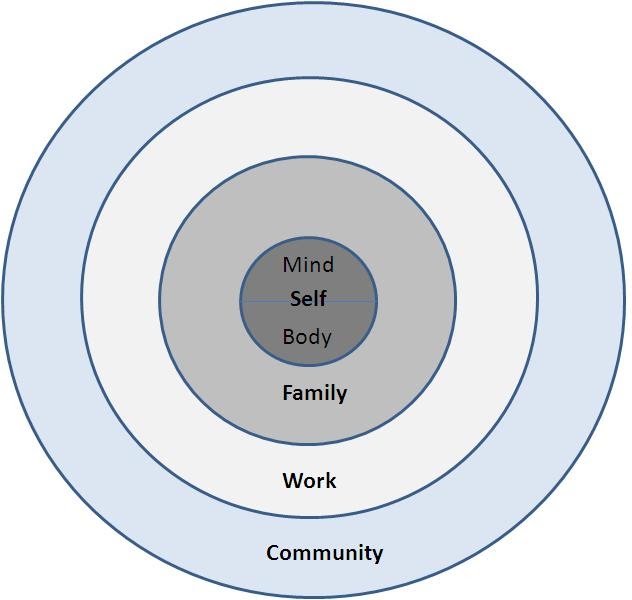
Now, in this post, we are going to expand on this simple relationship diagram, so we can see the movement that occurs through each of these relationship spheres. Let’s start with the relationship we have with ourselves, as it really does all start there.

Relationship with ourselves

In the post, The Self-Development Tips Series 1: The Art of Loving Yourself, I write about the importance of developing a highest-quality relationship with ourselves. That, in fact, learning how to love ourselves is the very first step in having other high-quality relationships. It is a must. Really.

Without a high-quality relationship with ourselves, we cannot create high-quality relationships with others. Why? Because if we don’t know how to take care of ourselves, to love ourselves, we cannot give care and love out to others. Not in a sustainable way.

We must first develop deep care and love for ourselves, then that same deep care and love will go out from us to others.

Photo by Alex Block on Unsplash

Relationships with Family

Once we have a high-quality relationship with ourselves, we can truly be there for our family. In being there, I mean have open, honest, and loving communication with each other; developing those high-quality relationships along the way.

In the post, Creating and Maintaining Relationships Part 3: Understanding Our Emotions and Strengthening Our Relationships by Slowing Down, I write about the importance of noticing when we are being inattentive to how we feel. Important.

When we are inattentive to our emotions, and are reacting without pausing, there is a higher likelihood that arguments with our partners will become more common. These pauseless reactions also function the same way with and toward our children.

It is important to note that we are not reacting to our environments in this way intentionally. Fully understanding how we are reactive, includes learning about our “triggers.” What are they, whom are they with, and why do we have them? Once we know, we can create space to pause, think and reflect, and then choose a different action.

All of which when combined with having a loving relationship with ourselves, free of blame and shame, creates whole new possibilities with the relationships we have with our family.

Photo by Tyler Nix on Unsplash

Relationships at Work

In the post, Three Transformational Leadership Skills, I write about developing high-quality relationships at work. Developing these relationships, like the ones we have with family, also starts with ourselves.

Once we are clear on who we are, and how we think and feel, we can develop work relationships that are strong and long-lasting. In the article I note three essential skills all leaders should develop in order to create these high-quality relationships.

  1. Authenticity – knowing who we are is the first step, then being who we are all the time is the next.
  2. Safety – creating a safe environment with the team you lead, or work on, is essential. People will not be authentic with you unless you are also authentic, and they feel safe.
  3. Transparency – being forthright about the state of the business, and issues that arise, are also important. Sharing with the people you work with is important for them to feel included, and valued.

These three skills, of course, are also important for us to develop in our personal lives. It works like that. What we develop for ourselves, we end up developing for everyone around us.

Relationships with the Community and The Greater World

How we develop ourselves, and our relationships then goes out from us and into the community, and, yes, the greater world. When we create a focus on our inner development, people around us develop, and the community also develops. That is movement.

The movement is part of the way the relationship network, or system works. Here is a simple illustration that goes a bit further than the above referenced system image, showing that we are connected through everyone we know, ultimately, to all people.
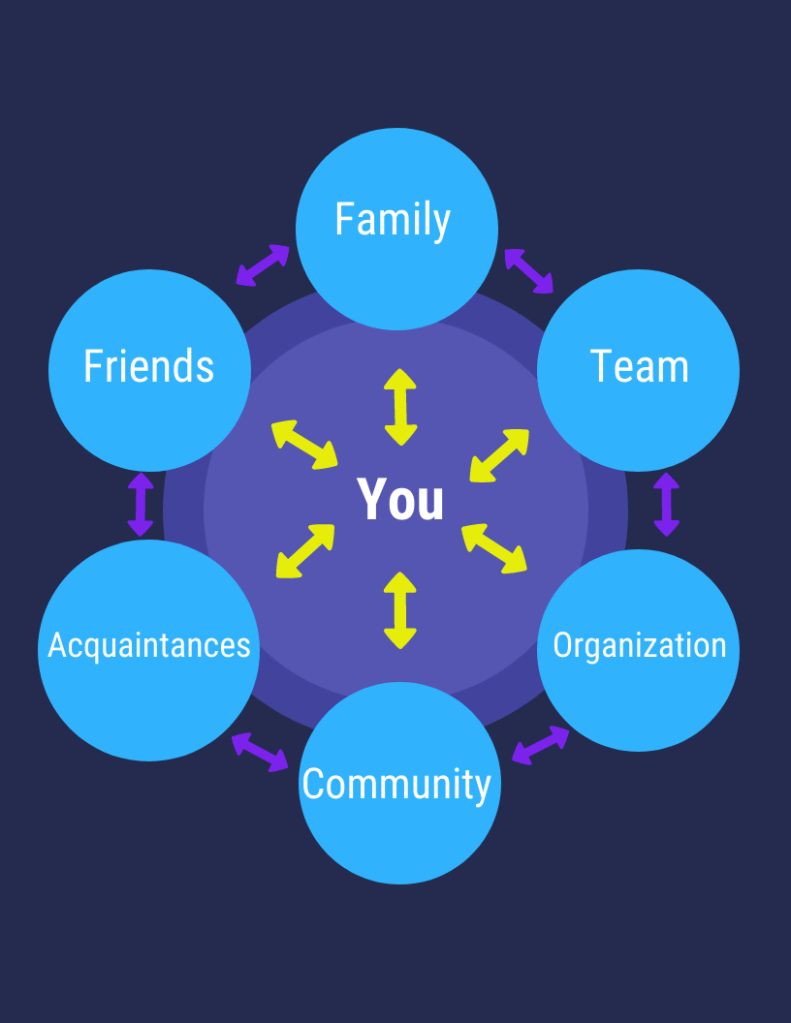
By continuing to add more contexts into the above illustration, you can create more complexity in how the relationship system is interwoven.

Ultimately we are connected to everyone, and everything, and what we give out, comes back to us. All contexts are also connected, sometimes directly, and sometimes indirectly, as the above illustration also shows.

Whether the connection is direct or indirect matters less, than the realization that all that we do on this planet as human beings touches each other in some way. Important.

Relationships are so important. Really. The relationship we have with ourselves is the starting point, and, as you can see, it is only the beginning of how we, as human beings, end up touching everyone and everything around us. Even when we don’t know about it.

These relationships and all that we give and get from them are crucial to moving society forward. Without them, there would be no movement.

Know that every action you take to develop and grow yourself also grows your family, friends, teams, organizations, communities, and the greater world.

Develop well.

#authenticity, #community, #connection, #developingourselves, #development, #developmentandgrowth, #emotionalintelligence, #grwoth, #leadership, #loveeachother, #loving-yourself, #relationships, #relationshipsystems, #safety, #theworld, #transparency, #weareallconnected, #workrelationships

Blind Spots: How Knowing About Them Can Help Move You, Those You Know, and All of Humanity Forward

Photo by Taras Chernus on Unsplash

Have you ever considered your blind spots? No? Probably not, seeing as we are blind to them. What in the world are they, and how do they function; and, even more importantly, what can we do about them? Alright, let’s take a look.

What is a blind spot; and, how do they function?

You know what you know, right? Okay. Let me write it this way. You are aware of all those things that you know about, yes? Yes, good. How about those things that you know you don’t know. Yes? Good. Last one. How about those things that you don’t know you don’t know? Hm. A little different, right. Yep. That’s right. That’s your blind spot.

We all have them. And, they are all different. Meaning, that we all have different things that we don’t know we don’t know. Phew. A little semantical, I know. Hm. Let’s do a whiteboard real quick to show you. I also feel another video coming.

July 13, 2020

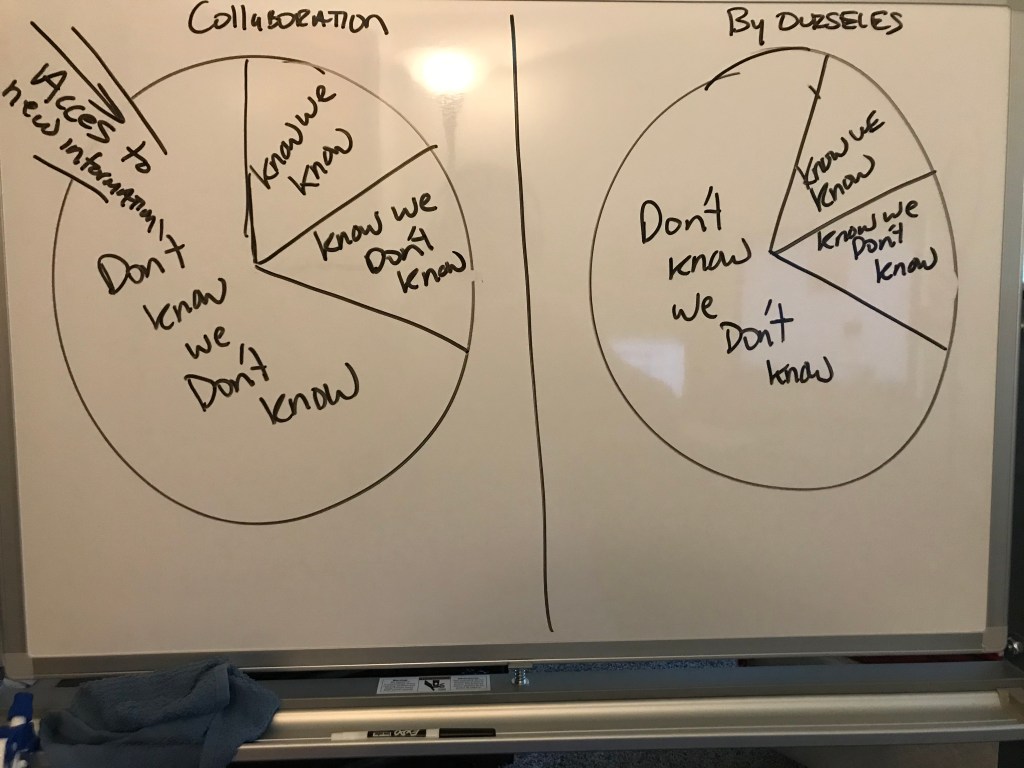
There we go, better. Let’s say that the circle encompasses all that is knowable. Got it, okay. Now, as you can see, the sections of that which we know we know, and know we don’t know, are much smaller than all that we don’t know we don’t know. A very important distinction. Why?

Because what this simple illustration shows, and what I am pointing to in this post is that there is a vast amount of information (knowing) that is available to all of us, yet is not accessible to most people. Why? Because that which we don’t know we don’t know lives in our blind spot. What can we do?

What can we do?

First, we can become aware. Check. Now what? Well, we can create access to those blind spots. How, you ask? By being open to those that we are surrounded by.

Yep. It is those people that surround us inside of an open communication system where we can learn about our blind spots. Important. Here is another whiteboard to illustrate.

July 13, 2020

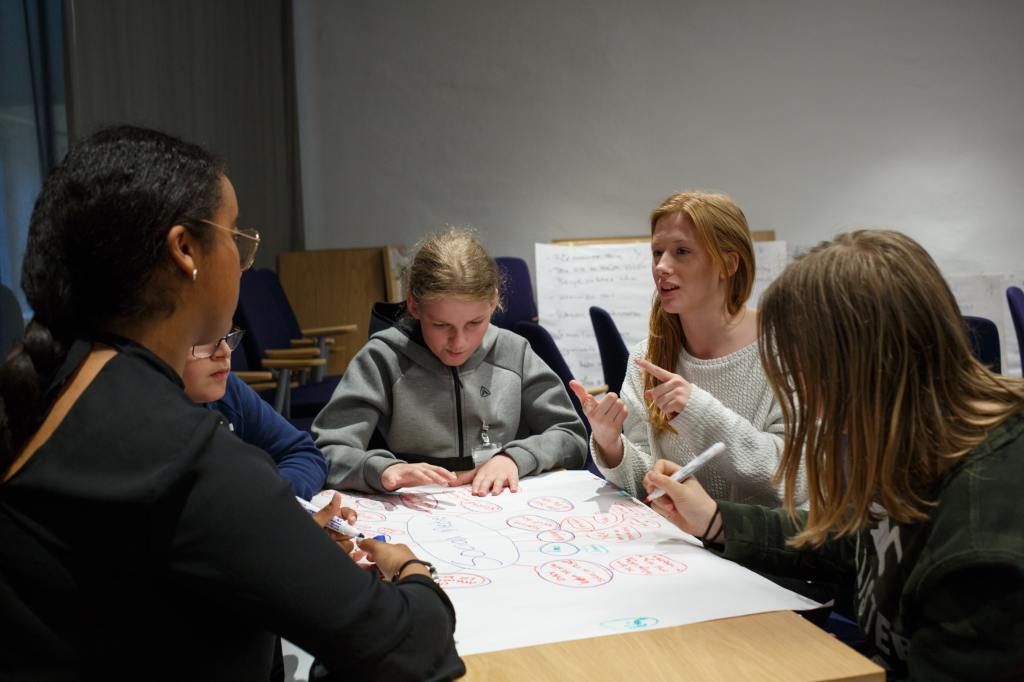
What this whiteboard creates is an important distinction that I’ve written about quite extensively on this website, and in many other contexts. Relationships and the interdependent nature of those relationships equals collaboration; and collaboration is where the access is. Yep.

As a matter of fact, the Monday message that went out to the team I work with today, was all about relationships, and just how important they are in all of our lives.

It is through these relationships that we can gain access to our blind spots. Don’t have those kinds of relationships? That’s okay.

You can create them. Really. You can. Why wait. There are so many people on this planet that are interested in the things that you are interested in.

Photo by alexandra lammerink on Unsplash

And, guess what?

You know things about your interest, and so will they. And, I can guarantee you that you will both learn from each other. Uncovering blind spots for each other along the way. No matter what the topic.

What we are discussing in this post has been written about for thousands of years. Here is an example.

“True wisdom comes to each of us when we realize how little we understand about life, ourselves, and the world around us.” -Socrates (469-399 B.C.)

Goalcast

I love this quote. There are many others like it, written similarly across all cultures. When we recognize that we know way less than there is to learn, and know, we immediately become open to new experiences, and new perspectives.

When we are open, and are in conversation and relationships with people that are interested in our growth, as we are in theirs, our blind spots are regularly pointed out. That is learning. It is the best kind of learning.

Ever heard of the socratic method? Here’s a snippet.

“In the Socratic method, the classroom experience is a shared dialogue between teacher and students in which both are responsible for pushing the dialogue forward through questioning.”

Edited by CTL Associate Director Mariatte Denman
Photo by Edvin Johansson on Unsplash

I too love this quote, however, I’m going to offer you a new way to think about it. Consider that the world is your classroom, and that everyone you meet, and are in relationships with can be the person that you share this kind of learning experience with. Truly.

When we are open, interested in learning from someone more than expounding on that which we know, we can learn something from almost anyone we meet.

Really. It is a beautiful experience.

Of course, we must be willing to, in a way, let go of that which we know. Let it go, and start listening, and taking in that which other people know. In the end, guess what? We end up knowing more. Yep.

When, however, we aren’t open, guess what? We get to keep that which we know, yes; yet, we miss out on the opportunity to add to that which we know. A truly missed opportunity.

My invitation to you

Don’t let those learning opportunities pass you by. Grab them while they are here. And, offer them back to those that you meet. For, they, like you, have something to learn from you.

We all have something to learn from each other. And, when we approach our relationships and interactions with that attitude. Phew. We can learn so much. You can learn so much. Start today.

Ask questions, listen, and believe. Believe in your ability to add to that which you know, and to contribute to someone else’s knowledge base. You can.

That is movement. Movement for yourself, for those you are in relationships with, and for all of humanity.

Learn, know, and reciprocate well.

#blindspots, #collaboration, #development, #growth, #growthanddevelopment, #knowing, #knowledge, #learning, #learningmore, #reciprocallearning, #relationships, #socrates, #socraticmethod, #theworldisyourclassroom

The Blog + Video Series #3: Finding Comfort in Being Uncomfortable: Part 1

July 12, 2020

There are countless quotes, books, and movies about “living outside of your comfort zone.” What this actually means, however, is open to great interpretation, and, I think, changes for people over time.

How you view the idea of living outside of your comfort zone is a product of how you were raised, how you think, the context you live and work in, and those that you surround yourselves with.

Further, the idea and actually experience of a comfort zone, and the corresponding uncomfortableness that comes with being outside of it is different for everyone.

As there are over 7.5 billion people on the planet, we can actually say that there are over 7.5 billion different comfort zones.

Growth is the byproduct or result of living outside of your comfort zone. In fact, the only real growth there is is found outside of your comfort zone. There is never any growth inside of a comfort zone.

Photo by Kyle Glenn on Unsplash

This may seem like common sense, and it is, however, most people have a hard time realizing this truth. Why? Simple. If feels really good inside of our comfort zones.

Who would want to intentionally create situations or contexts that challenged this comfortability? Really, not many. Most people are perfectly content inside their comfort zones.

Yet, if these people were to examine themselves on the inside, they would find that this contentment is covering up other issues.

Sometimes being outside of your comfort zone happens unintentionally, which can happen when we are faced with a very stressful situation or life event that we didn’t see coming. If we are open to it, there is also growth in these experiences.

Photo by Hello I’m Nik 🎞 on Unsplash

Learning how to find comfort in being uncomfortable is manifested by doing things that we find uncomfortable often. When we are open to getting outside of our comfort zones often, there is a comfort that comes as a byproduct of the continual practice of being uncomfortable.

As with most everything else, it takes practice to realize this kind of comfort in the uncomfortable. By practice, I simply mean creating intentional contexts that we find uncomfortable, and engaging in these contexts until they no longer feel as uncomfortable.

Ultimately, until they feel comfortable.

If you are reading this and thinking, nope, not me, I like my comfort zone and have no need to create intentional contexts of uncomfortability. Very well, that is your choice.

If, however, you are thinking, maybe, or yes, sign me up. Then go out and do one thing today that you’ve been avoiding or putting off because it makes you feel uncomfortable, and see what happens.

If it’s anything like the many experiences I’ve had, yes, you can count on being uncomfortable.

Yet, you can also count on that experience providing you a whole lot more, which is only possible by doing things that you find uncomfortable.

Until next time….

#comfortzones, #creatinggrowth, #development, #growth, #growthanddevelopment, #individualdevelopment, #personaldevelopment, #selfdevelopment

7 Keys to Highly Effective Relationships

Photo by Henri Pham on Unsplash

This week I’ve been thinking more about relationships in general, and also more about the ones in my life. Relationships are so important. I’ve written several posts about relationships, and the importance of all of our relationships. Even the ones we don’t typically consider, or think about often.

Well, let’s consider them all; and, what makes up a highly-effective relationship. Do you know?

I think deep down we all know, yet, we often get confused in our relationships. Swayed by commitment, personal ties, expectations, memories we have, and emotions we feel.

Sometimes, then, we stay in relationships, against our best interest. Yep. Most of you reading this know about that, as do I. Happens to us all.

Let’s then consider some of the keys to highly-effective relationships. A guide of sorts. Now, there are many keys to highly-effective relationships. Dependent on your standpoint, some of these may resonate with you more than others. Yet, I’m sure you will see yourself, or someone you know in some of these.

7 Keys to Highly Effective Relationships

Reciprocity

Being in a relationship that is mutually reciprocal is important. Why? Because too often there are balance-issues in relationships. Meaning that one person is adding more value in the relationship than the other. What happens then?

When this happens, people can become resentful. This is especially true if the people in the relationship believe they must stay in the relationship at all costs. For some of you this might sound odd. Yet, believe me, people stay in relationships all the time that are not healthy, that are even toxic. Not helpful. Rather destructive.

Boundaries

The most effective relationships are those where there are clear distinctions between the two I’s that make up the relationship. In effect, in every relationship, there are three relationships. The one’s each individual has with themselves, and then the one they have together. 3 relationships.

And, all 3 of these relationships are important. When the relationship someone has with themselves is sacrificed for the partnered relationship, there is likely to be resentment, anger, and frustration. Again, not helpful.

Development

When in a relationship we should support our partners growth and development. Too often, however, relationships are founded on a set of principles, ideas, and expectations, that prohibit, or at least mitigate growth and development.

When this happens, it means that the people in the relationship are, in effect, limiting themselves, and each other without knowing it. And, when one of the individuals in the relationship embarks on a developmental trajectory that upsets this previously created foundation, there can be pain and discomfort. Difficult.

Integrity

Integrity is important in any highly-effective relationship. Integrity simply means doing what you say. Being your word. And, if you are out of integrity, to say so. You actively create a context, and conversation to let the people you are in relationship with know that you are out of integrity. That’s it.

It is important because humans are often out of integrity. Happens to us all. Think about a time you committed to be at a meeting, and you were late; or, committed to be at a restaurant at a certain time, yet were late. Two simple examples. And, they happen to us all.

Being out of integrity does not automatically mean that there is a problem or an issue; what it means is that there is a need to communicate about a change to the commitment that was made. Think of the two aforementioned examples, to continue to be “in integrity” a call about being late is all that is needed. Pretty simple, really.

Inspiration

How does it feel when you are inspired? Pretty good, right? Yep. Well, as I’ve written about in other posts, inspiration comes from within. It is our job to create inspiration; and, being in relationship with someone that lives an inspired life can create more inspiration.

If someone you are in relationship with is not living this way, it can lead to confusion, conflict, and possible resentment. Better to be clear about this from the outset.

Further, it doesn’t mean that you will both find the same things inspirational; maybe, yet not necessarily. Being with someone that leads an inspired life, is less about being mutually inspired by the same things, though that is possible. It is more about understanding what living an inspired life is about. Looking for ways to grow individually and together. Fun.

Communication

How important is communication in your life? Yep, pretty important. In fact, it is one of the most important keys to a highly-effective relationship. Why? Because when we are communicating, we are in a relationship; and, when we are not communicating, we are not in a relationship. Simple.

And, when I write communication, I am not talking about saying good morning, and good night. Or, even, how was your day. That’s not it. Communication means you are talking about your hopes and dreams, and having hard and difficult conversations about how to move them forward.

These conversations can be very difficult; yet, being in relationship with someone is not supposed to be easy. If your relationships are easy, chances are you are simply living each day as you did the previous one; and, this is not a judgement. I lived this way for most of my life, which is why I know the difference.

Being in relationship with someone, means being in communication with them. A must.

Authenticity

It is also important to be who you are. When we are in a relationship where we have to be someone other than who we are, think of performance, there will be a tendency for disagreement, unhealthy conflict, and resentment.

We all change over time, even if we are not interested in change. Change is a part of being human. When we are interested in change, we may change even more. Regardless, being in a relationship where you can be who you are, at whatever stage of development you are is important.

Being who you are doesn’t mean that you are always in agreement in your relationship. In fact, there may be disagreement often. It does, however, mean that you are supported, and advocated for. Important.

In Closing

Know that there are many important aspects to highly-effective relationships. Yep, some of the ones you are thinking about did not make the list. Maybe they’ll make a future list. Don’t know.

What is more important is to know that the 7 in this post are important; and, if you’ve never considered one or more of them as important, you can now do so, if you choose. Your choice.

Now, how to put them into action? A few examples.

Putting the 7 Keys into Action in Your Life

  • Reciprocity
    • Notice when your relationship is not reciprocal. When it is out of balance, ask why, first of yourself, and then of your partner. What can be done to create more balance? Again, first of yourself, and then of your partner. Asking these questions will create a context for open communication.
  • Boundaries
    • Create them, and talk about them. We all need our own time, away from all things and everyone. When you’ve created a boundary, you must talk about it, or else your partner will not know about it. And, when it is transgressed, by you, or your partner, get back on track and put the boundry back in place.
  • Development
    • Openly communicate about the support you need. As often as needed. And, if you are not getting the support you need. First question yourself. Are you supporting yourself and your partners development? If you are, ask for that same support. If you are not, start there.
  • Integrity
    • When you are out of integrity, talk about it. Openly communicate when things change, or get in the way. Don’t hide from it. And, if you do, make sure to talk about it at some point. Better to be open and openly communicate than hold something that is causing confusion or a possible misunderstanding.
  • Inspiration
    • Create inspiration for yourself, first, and always. Ask questions of your partner – what inspires them? How do they find their inspiration? And, what do they do with that inspiration? And, share your inspiration. Once known, inspiration can become something that is talked about often.
  • Communication
    • Create contexts for open communication often. Especially when a difficult conversation is needed. Hiding from a difficult conversation will only make it more difficult for everyone. Communicate openly and often.
  • Authenticity
    • Be who you are, in whatever iteration you are in. Remember, being in a relationship is a choice. A choice for you, and your partner. Sometimes, it will be best to leave the relationship than sacrifice your true self.

As you think about your relationships, always remember that we are in many relationships in our personal and professional lives. Some of these keys may resonate more with you from a professional perspective, and some more from a personal one.

Either way, if you feel stagnated in your relationship, try one of these keys. If not these, then try something new. For, it is in the trying and doing of something new that we can create the change we feel we need, yet are often unsure of how to achieve.

Try, do, be, and live well.

#authenticity, #boundaries, #communication, #development, #highly-effective-relationships, #inspiration, #integrity, #reciprocity, #relationships, #taking-action

Living a Transformational Life: Authenticity and Vulnerability

Photo by Kyle Glenn on Unsplash

This week I’ve been reflecting upon authenticity and vulnerability and their relationship with transformation. Though I’ve been reflecting upon authenticity, vulnerability, and transformation in regard to the team I work with, it is impossible to consider these concepts without considering the individual. They are completely interconnected. You cannot have one without the other. They reinforce each other.

I spent many years thinking I was authentic and vulnerable, however, that authenticity and vulnerability were always lived out within a limited framework. When things got too scary, I would withdraw, or hide. Know that many people live this way, some are aware, some are not. I was not aware for a long time.

Being authentic means living in all of your contexts the same way. Where you show up the same no matter what you are doing. Many people have performances for work, for home, for friends, etc. Just like I did. However, to live a completely authentic life, you perform the same way in every context. You are the you that you know yourself to be everywhere and with everyone.

Of course, being authentic in this way, can be uncomfortable for you, and for those around you. Especially if the people around you have a particular view of you that they are attached to, and you are not showing up as they expect you to. However, when you are living an authentic life, and are being true to yourself, you are beginning to live a life without limits.

Limitations are superimposed by ourselves on ourselves when we are trying to live up to a standard that someone else has set for us, whether that be parents, caretakers, partners, or peers. When you remove these limits, by living authentically, you create new possibilities for your life. And, you also create new possibilities for those around you.

Know that those around you may not always want to partake in these new possibilities, especially if they are living in the past, waiting for you to show up in the performance of you that they expect of you. However, that is their expectation, and need not be yours. You can live an authentic life. It is not easy, yet it is there to be lived, and it is transformational.

Living a transformational life, opens you up to a whole new possibility. The possibility of stepping out into the world knowing that there is far more to learn than you could ever know. More, it is actively seeking contexts where you can experience the many things you don’t know. Especially when that learning makes you uncomfortable, which, for me, is the height of being vulnerable.

When we are vulnerable we provide ourselves the opportunity to learn as much as we can while we are living on this planet. And, we also create the possibility that those closest to us also get to live a life full of that same possibility. A life without limitations.

Again, those closest to us may not want to live a life without limitations. For a life without limitations can also be difficult. When you are open to all new things, new ideas, new ways of being and doing, you develop and iterate as an individual. And, when you are around people that do not develop with you, you can find it harder to be compatible with those people, and they you. Difficult.

Yet, this difficulty, is also transformational. It is transformational because through these difficulties you will learn a lot about who you are, and who other people are. I am grateful for those people in my life that actively resist the person I am today. They help me understand more about myself, more about them, and more about humanity in general.

You will also have those people in your life that want to develop with you. Also a transformational experience. Getting to see people develop around you is one of the most exceptional experiences I’ve ever had. It is inspiring, and insightful.

And, when you are around people that are interested in your development, actively participate in it, and develop themselves alongside you, you also get to develop together. Reciprocal development like this, breeds transformation.

Living an authentic and vulnerable life can be difficult, however, the experience you get out of living this kind of life is more than worth while. In fact, I would say that the difficulty, uncomfortability, pain, and uneasiness in venturing into the unknown is really what living life is all about.

For, it is in the experiences we have where our heart rate increases, and sweat beads on our brow, where we know we are truly living. Living an authentic, vulnerable, and transformational life. And, that life awaits you. You just have to take that first step.

#authentic-life, #authenticity, #development, #inspiration, #self-development, #transformation, #transformational-life, #vulnerability