Creating Movement in Your Team, Business, or Organization: 3 Steps in 3 Minutes

This image has an empty alt attribute; its file name is jon-davey-0jbfvxvolwk-unsplash.jpg
Photo by Jon Davey on Unsplash

I recently wrote 3 Steps and 9 Keys to Creating Safety on a Team in 5 Minutes, and today, I’m going to focus on creating movement. Have you ever felt stuck? Like you and your team, business, or organization are not moving, have not, maybe, moved in some time. Instead, you find that each day seems the same. A reproduction of the previous? Happens to us all.

Let’s take a look at 3 steps you can take to get moving again.

Step 1: Create Time

We are all inundated with email, all day long. In the first year in my current position, I checked email often; and, there were times when I was more focused on keeping my email in check than doing my actual job. However, email is not the job; it is a tool, nothing more.

3 suggestions for creating time by managing email

  • Check periodically – morning, afternoon, and before close of business. Set this time aside. Add it to your calendar if needed. However, when you are not in your “check email time”, leave it alone.
  • Prioritize the need – sounds funny, yet prioritizing your email is very important. Often, I get emails that I might not respond to for several days. Why? It’s not needed. Not every email needs a response right away, and some never need a response.
  • Organize as needed – in the past three years, I’ve reorganized my email countless times. As the business changes, your calendar will change, and so should how you organize your email. Reorganizing your email so that it mirrors the current iteration of your team, business, or organization will save you the time of searching endlessly for emails to follow up on.
Photo by Jon Tyson on Unsplash

Step 2: Create Balance

I’ve found that finding time to work on the business (strategic thinking), instead of in the business (the weeds) is one of the hardest skills to develop. Why? Because we live in a reactive society, and work within reactive organizations.

Though you are working very hard, if you continue to work hard mostly on day-to-day operations, you will not spend the time needed on creating future plans, goals, and objectives. You will stay stuck. You must create the time to strategically think about the direction of your team, business, or organization.

3 strategies for balancing the weeds and strategic thinking

  • Manage time – I’ve used multiple different time management systems in the past three years; and, what I’ve come to realize is that continuing to change how you organize yourself is okay, even needed. If the way you are organizing yourself today is not working, let it go, and try something new.
  • Delegate – I’m one of those people who likes to do everything, and I have a hard time asking for help. Yet, letting your team assist you is necessary and needed. Delegating work is always essential, and is even more essential to ensure you have the time you need to create strategy.
  • Slow down – I love to be in action. Simple. Yet, there are times when you need to slow down. Let some of the day-to-day operations wait, so you can just sit and think about your team, business, or organization’s trajectory; and, what you want to create as its next step.

Photo by Javardh on Unsplash

Step 3: Create Strategy

Once you’ve created more time, and have more balance, you can now effectively work on the business. Very important.

3 strategies for creating strategy and gaining traction

  • Get your ideas out – often we think about what we want to create, yet we are so busy doing other things, that we don’t get these ideas out; and, when our ideas stay within us, we cannot use them. Write them down, put them on a whiteboard, put them in a document. It matters less how you get them out, than it does that you do so, and have the time to reflect upon them.
  • Invite considerations – collaborative teams and organizations talk about strategy. If you are on that kind of team, or in that kind of business or organization, invite people to consider your ideas. What do they think? Incorporate the best ideas into your ideas. If you work on a team, or in a business or organization that does not collaborate, invite people to consider your ideas anyway. Create collaboration.
  • Create an action plan – once your ideas are out, you’ve invited feedback, and have had time to reflect, it’s time to create an action plan. I always work backwards. Meaning, if you are creating a strategy for next year, work those goals backward to each quarter, month, and week, and create objectives that align with the yearly goals.
Photo by Felix Mittermeier on Unsplash

With your new action plan, you can begin to create the traction you’ve been looking for. Remember, you are not alone. Most teams and organizations are in the same place. They feel stuck. That you are aware of it, is the first step. Now you can mobilize the steps outlined here, and create movement for your team, business, or organization.

Also remember, that sometimes your team, business, or organization may have to move “backward” to once again move “forward.” I’m not a fan of labeling movement, because all movement is important and needed.

For instance, COVID-19 has created a “backward” momentum for teams, businesses, and organizations all across the globe. Now what matters most? Not being concerned about moving backward. Instead, create from where you are, and you will move forward.


#acitonplans, #brainstorming, #collaboration, #createstrategy, #creatingactionplans, #creatingbalance, #creatingmovement, #creatingtime, #delgation, #development, #leadership, #leadershipdevelopment, #managingemail, #managingtime, #organization, #prioritization, #slowingdown, #strategicplanning, #strategicthinking, #teambuilding

3 Steps and 9 Keys to Creating Safety on a Team in 5 Minutes

This image has an empty alt attribute; its file name is perry-grone-lblgffladry-unsplash-2.jpg
Photo by Perry Grone on Unsplash

A couple of weeks ago I wrote Three Transformational Leadership Skills; and, creating safety was on of the three. This week, let’s take a deeper look at creating safety among those you work with, and lead. What does it take to create safety? And, how important is creating safety? I believe it is always important, and is even more so now amidst the COVID-19 pandemic, and will continue to be in the next few years, as we all learn about our new realities.

Creating Safety

What does it mean to work in a safe environment, where you feel like you can act and be who you really are, without fear of reprisal? Well, it means exactly that. That those on the team, in the work office, or that are a part of the organization, can be who they are. Meaning, they can act and say what is needed about the direction of the team, without fear of someone lashing out at them, and defending or justifying why their opinion is more important than theirs. The latter, doesn’t work well.

What works well? Creating an environment where people can actively question each other, even be critical of each other, yet know that they are safe. It is a big deal. If you are on a team that can act in this way, you will gain more traction on your goals and objectives.

Why?

Because you are actively talking about the issues that matter most. And, when you are talking about, and creating action plans to resolve those issues, you are creating movement. And, movement is needed and necessary to create traction.

Photo by Jason D on Unsplash

Step 1: Understand the keys to creating safety

I’m sure there are many ways to create safety on a team, or within an organization, yet I can only speak to the ones that have worked in the contexts in which I’ve worked. And, these keys, I think, can be utilized across multiple contexts, across different teams, and across many organizations.

Three keys to creating safety
  • Building relationships – developing high-quality relationships is important to creating safety on any team. Making the time to get to know each person on the team, their hopes and dreams, as well as their strengths and opportunities. Knowing each of them well is necessary to understand their perspective, and to build trust. Trust is akin to safety.
  • Fostering individual perspectives – when people have a say in how things work, and how the team moves forward, more comfort and more safety is created. People want to participate, to collaborate, to draw upon their talent, and to provide their individual perspectives on issues the team faces. Foster these perspectives.
  • Creating support systems – think safety net. People need to understand how they will get the support they need. Support can be delivered many different ways. What is important is that there is a support system in place, and that the team knows how it works.
Photo by Kiana Bosman on Unsplash

Step 2: Understand the keys to your role

As I’ve discussed in other posts, everything you do within your team and organization starts with you. The way that you develop yourself, and lead from within, will determine how you lead without. Same. Taking the time to develop skills that will move yourself forward, hence, the team, is important.

Three keys to your role
  • Being open – one thing that helps foster a safe environment is being open and available. When the team knows you are open, meaning open to new suggestions and ways of doing things, they will feel more appreciated, and more safe.
  • Being available – will also signal the team, that spending time with them is of utmost importance. I’ve always found that open environments foster the most innovation and safety.
  • Being authentic – leading with authenticity creates the possibility that the people on the team will also demonstrate authenticity. And, authentic environments foster contexts where people can give candid and honest feedback about how the team is doing, and what they see as necessary improvements.
Photo by Shane Rounce on Unsplash

Step 3: Understand the keys to the team’s role

Once you are clear on your role, you will have developed the ability to understand the team’s role. And, understanding the team’s role, including each person’s role on the team is important to foster momentum, movement, and traction.

Three keys to the team’s role
  • Individual engagement – creating ways to engage each individual team member at their developmental stage is important to their growth both personally and professionally. And, opportunities for developmental growth is critical to moving teams forward.
  • Team engagement – developing ways to engage the team, and for the team to engage with each other is important to creating safety. People that don’t know each other well, don’t general trust each other, nor will they feel safe with each other.
  • Connecting the individual to the team – fostering individual development while also building the team’s development is a very important component to creating a team that knows how to move, develop, and gain traction in their work every day.

Movement and Traction

Implementing the aforementioned strategies within your team will increase the possibility of creating movement, and gaining traction. And, as the team moves forward, finding new ways to ensure that the safe environment you’ve fostered, and the team has created, is continuously redeveloped is important. Contexts change, organizations grow, they shrink, and they move forward. The ability to develop new strategies to create safety as things change is critical.

The COVID-19 pandemic is, unfortunately, a great example of a change that no one saw coming that has increased anxiety and decreased safety throughout the workforce. Now is the time to create, and recreate safety. Creating safety is an essential leadership skill, and it is also essential to growing, moving, and gaining traction on teams.

Originally posted on servantleadershipcoaching.com

#beingauthentic, #beingopen, #buildingrealtionships, #businesses, #connectingindividualstotheteam, #creatingmovementandtraction, #creatingsafety, #creatingsupportsystems, #fosteringindividualperspectives, #individualengagement, #leadership, #leadershipdevelopment, #leadershipinaction, #leadershipmindset, #leadershipprinciples, #teamdevelopment, #teamengagement, #traction

Three Transformational Leadership Skills

This image has an empty alt attribute; its file name is jon-tyson-r9t0lzv8xwq-unsplash.jpg
Photo by Jon Tyson on Unsplash

Where we start matters, much more than where we end up. For, it is in the starting of something that matters. The action, not the result. Let us embark, then, on a simple foray into leadership essentials.

What are those essentials, and why do they matter? And, do they matter only for leaders, or do they matter for everyone on a team, in a family, or in a relationship? Hm. Good questions. Let’s take a look.

Being Authentic

One of the most important leadership skills, is the ability to know oneself. Understanding who you are, what your strengths and weaknesses are, is critical to effective leadership.

It is an impossibility to effectively lead a team, when you are disconnected from yourself, or are hiding from yourself. Impossible.

What is possible, is to be honest about who you are, and to be authentic. Being anything other than authentic will come off fake. The team will know when you are not being authentic, and traction with the team will elude you.

When you are authentic about who you are, you create the possibility of openness. When you are open to all that is around us, you also show that you are vulnerable. And, when you are vulnerable, you openly admit that you do not, could not, know all of the answers. No one can.

The opposite of authenticity and vulnerability is rigidity. Being rigid, pretending you know things you do not, will shut people down, close doors to new possibilities, and decline moral.

Practicing authenticity and vulnerability starts with you. You are the only one that can be authentic, and vulnerable. It can be frightening, as I share often with the team I work with, to be out on a ledge before the unknown.

However, that is where all the great stuff awaits you.

Photo by Nicholas Sampson on Unsplash

Creating Safety

Creating a safe environment where people can be who they are, while knowing that they are safe to do so, is important to building trust. And, building trust with those you work with, reciprocally creates more safety.

I believe that the ability for a leader to create safety, is one of the most important leadership skills.

That is my bias. However, know that without trust, developing the investment, or buy-in, from team members on what you are looking to create is impossible. They must trust you completely. And, trust will only come when the environment is a safe one.

When you have created a safe and trusting environment, you have the opportunity to innovate because people are willing to trust in each other and be vulnerable. Safety increases the likelihood that people will be who they really are, authentic and vulnerable.

And, being vulnerable is one of the keys to creating innovative teams.

Photo by Sharon McCutcheon on Unsplash

Include Transparent Communication

Being open with your team, includes being transparent. In the first year working with the team I am currently working with, there were people that were surprised when I would discuss the financials with them. They had never had open conversations about the finances. They were simply told to hit a number, or were told nothing.

You may get results this way, however, I am here to tell you that those results will not last, or will be limited.

People that don’t understand the financials, cannot understand all that is possible. And, similarly, only knowing a number, is only one piece of the whole. People need to have access to all of the information, so they can grow.

When people grow, the team grows. And, when the team grows, you grow. Simple. Growth will only come when you have created an environment that welcomes growth.

Welcoming growth, which includes creating opportunities for individual and team development, are keys to building an innovative and dynamic team.

Photo by LUM3N on Unsplash

Developing High-Quality Relationships

Being authentic and vulnerable, while creating a safe and trusting environment, which includes transparent communication is all about creating high-quality relationships. And, it is inside of the development of these relationships where reciprocity flourishes.

Building and fostering relationships that are reciprocal, means that it is always a team effort. Always. As a leader, you lead and set the tone, including practicing all of which we’ve discussed, however, it is the entire team that creates traction that is sustainable.

And, as they grow, you grow, and as you grow, they grow. Transformational.

The leadership skills we’ve discussed in this post are not limited to work teams. These leadership skills can be used in any relationship. And, you can get transformational results from any of your relationships by employing these leadership skills.

Relationships that are transformational have no limits. People in these relationships, whether it is a work team, family, marriage, partnership, or any other relationships, live without limits, without fear of the unknown, at the edge of what is known.

As a leader, it is your choice. What will you choose to create with your team and in your relationships?

Originally posted on servantleadershipcoaching.com

#authenticity, #authenticityandleadership, #creatingsafetyonteams, #developinghighqualityrelationships, #developingteams, #highqualityrelationships, #leadership, #leadershipdevelopment, #leadershipessentials, #leadershipinaction, #leadershipmindset, #leadershipprinciples, #safetyandleadership, #teamdevelopment, #transformationalleadership, #transparentcommunication, #vulnerability, #vulnerabilityandleadership

Creating a Big Hairy Audacious Goal: The Creation of the BHAG

This image has an empty alt attribute; its file name is s-o-c-i-a-l-c-u-t-6iyb1bwwbv0-unsplash.jpg
Photo by S O C I A L . C U T on Unsplash

Alright, phew, what a busy couple of weeks. So much change. As I continue to prepare for the merger of my two websites, I am going to continue to post new material to this site, which was originally created for servantleadershipcoaching.com.

I am excited about the merger, and about reformatting this website. 🙂

Hopefully, you will enjoy these new additions! Here then is:

Creating a Big Hairy Audacious Goal: The Creation of the BHAG

What in the world is a BHAG, and why does it matter? A BHAG (Big Hairy Audacious Goal) is a way to get out of the weeds, and create a distinction between working in the business and working on the business. Creating a BHAG is also a way to take all of the smaller goals you have and connect them to a higher level mega-goal – the BHAG. Not sure if a BHAG is for you? That’s okay. I invite you to read the following list before making a choice.

Do any of these sound like a day you’ve experienced recently?

  • Working in the business more often than working on the business – this is an important distinction, and means that you are working on the day-to-day operations of the business more than you are the long-range planning and vision for the business.
  • Reacting to the daily business needs, more often than working purposefully, and wondering if those reactions are in any way connected to the vision of the business.
  • Spending more time at a computer screen than a whiteboard.
  • Feel like you are going in multiple directions all at the same time, while wondering if these multiple directions are connected to each other, and your other long-term goals.
  • You have multiple competing goals, and are unsure how to connect them.
  • You are unsure how to connect your metrics to the day-to-day business operations, AND, your long-term goals.

If you experienced any of the above, then creating a BHAG is for you. Where did the term BHAG come from? Here is an excerpt from Built to Last: Successful Habits of Visionary Companies by James Collins and Jerry Porras.

Boeing Corporation is an excellent example of how highly Visionary companies often use bold missions – or what we prefer to call BHAGs (pronounced bee-hag, short for “Big Hairy Audacious Goals”)– as a particularly powerful mechanism to stimulate progress.

One of the coolest things about creating a BHAG, outside of the progress that lives inside of that creative experience, is that you can create them for your personal and professional lives.

Let’s look at the creation of a BHAG through a real life example – mine.

After 6 months in my current position, Director of Extended Learning at Linn-Benton Community College, in Albany, Oregon, I was wondering exactly what I had committed to. Has that happened to you before? It happens to all of us.

Anyway, I was working hard, very hard. And, most of that work was focused on working in the business, not on the business. As I’ve mentioned earlier in this post, and in other posts, if all you do is work in the business, you will simply get the same result you got the day before – the same thing, everyday. Why? Because you are doing the same tasks everyday. Simple. It’s not that you don’t desire to grow, and do more, however, you are effectively stuck in yesterday.

However, if you can shift to working both in the business, and on the business, watch out.

After over a year of working in the business, I went to a strategic thinking training, led by Terri Houde, which was where I first experienced the BHAG. I believe we were first asked to work through some of our goals, to identify them, and write them out. Then we were asked to go out on a ledge, and create a goal that was at the limits of what is possible – the BHAG.

Here is the one I created.

Becoming the State recognized leader in noncredit education

Creating a BHAG is a life changing experience, because in one moment you create in language a goal that is so big, it is visionary. And, what do we know about working inside of a vision, rather than working outside of a vision?

“Having a vision provides a sense of purpose and direction for the business. Your vision will help you define your short and long-term goals, and guide the decisions you make along the way. A leader has the vision and conviction that a dream can be achieved…” ~ Ralph Lauren

Okay. I’ve created a BHAG, now what? Don’t know. I didn’t either. Here, however, is what happened.

Once the BHAG was created, it was time to inform the staff about the vision. I created a very simple presentation, which I delivered at a team building training at the end of 2018. Why is standing before your team and delivering a vision needed and necessary? It is important, so they can see you, AND themselves inside of the vision. When we can see ourselves as part of a vision, we are going to act in accordance with that vision.

In fact, I told the team often then that the BHAG came through me, however, it was a part of everyone of them. I can see each of them in the vision.

I should also mention that when the vision was created, we were also implementing Traction, which is a way to systematize your business operations (Wickman, 2012). The timing was perfect, because we were able to make connections to the 10-year vision (BHAG). We then created the following.

  • 5-year priorities and goals
  • 3-year priorities and goals
  • Yearly goals and priorities
  • Quarterly goals and priorities
  • Weekly and monthly next actions

All of which were connected to the 10-year BHAG!

Working inside of a vision the past two years has been a wonderful learning experience. We’ve achieved some of the goals we’ve set out to accomplish, and have many more to achieve. However, we are all pointed in the same direction, focusing on the same things, and have a shared language around a vision that was created from a one-day training experience where a BHAG was created.

Now we find ourselves in a very new situation – COVID-19. Well, in the next post, we will discuss what you do when your BHAG is severely disrupted. Can you guess? Yes, no?

You create another BHAG!

Yep, that’s right. You can have a BHAG that lives inside of another BHAG. I’d share that one with you, however, it is very new, and the team hasn’t even seen it yet. Next time, promise.

Remember, when you are interested in taking your business, organization, team, self, to the next level, create a BHAG. Then work backwards and connect that vision to this year, quarter, month, week, and day. Then you’ll know that every action you take is moving you closer to your ultimate vision, mega-goal, or BHAG!

References

Collins, James C., and Jerry I. Porras. Built to Last: Successful Habits of Visionary Companies. New York: HarperBusiness, 1997.

Wickman, Gino. Traction Get a Grip on Your Business. Publisher: New York : BenBella Books, Inc., 2012. URL.

You can reach Jeff Flesch at fleschj@linnbenton.edu and Terri Houde at houdet@linnbenton.edu.

Originally posted on servantleadershipcoaching.com

#10-yearvision, #bhag, #bighairyaudaciousgoal, #covid-19, #creatingstrategy, #creatingvision, #disruptionbhag, #disruptionvision, #leadership, #leadershipdevelopment, #leadershipessentials, #leadershipinaction, #leadershipmidset, #leadershipprinciples, #strategicplanning, #strategicthinking, #strategy, #vision, #visionandstrategy

Leadership in Practice Series Part 2: Creating 90-Day Priorities Inside of a 10-Year Vision

This image has an empty alt attribute; its file name is matt-noble-bptmnn9jsmq-unsplash.jpg
Photo by Matt Noble on Unsplash

Once your vision is created, then what? Regardless of whether it is a 10-year, 5-year, or 3-year vision, you will need to put plans in place that will connect the daily work to that vision. That is how your 10-year vision will become a reality.

What, then, are the first steps to ensure that your weekly, monthly, and quarterly work connects to the long-term vision?

In this article we will walk through the process we went through to connect the 10-year vision to our 90-day priorities. First, another question.

Where does a leader start when they want to ensure that everyone’s daily work on the team, or in the business or organization they belong to is contributing to the long-term goals?

Let’s take a look.

Start with the 10-year Vision and ask yourself a couple of questions.

  • What are the goals of the 10-year vision?
  • What are the metrics of the 5-year plan?
  • What will the current year look like?

Let’s look at each question, one at a time.

What are the goals of the 10-year vision?

Once the vision is created, it’s time to create the goals that will drive all of the work. However, before you move on to creating those goals, which will drive the objectives and priorities, ask yourself what your vision will look like in reality.

What will the revenue and service look like, what will the staffing model look like, will you add positions between now and then?

Once you’ve asked yourself these questions, or ones that are more important to your particular vision, start to build out what that vision will look like in reality. Here is an example, vision first, then what it will look like in reality.

Here is the vision

This image has an empty alt attribute; its file name is img-2774.png

Here is what it will look like

This image has an empty alt attribute; its file name is img-2775.png
Note that the word profit in this instance is referring to department reinvestment funds.

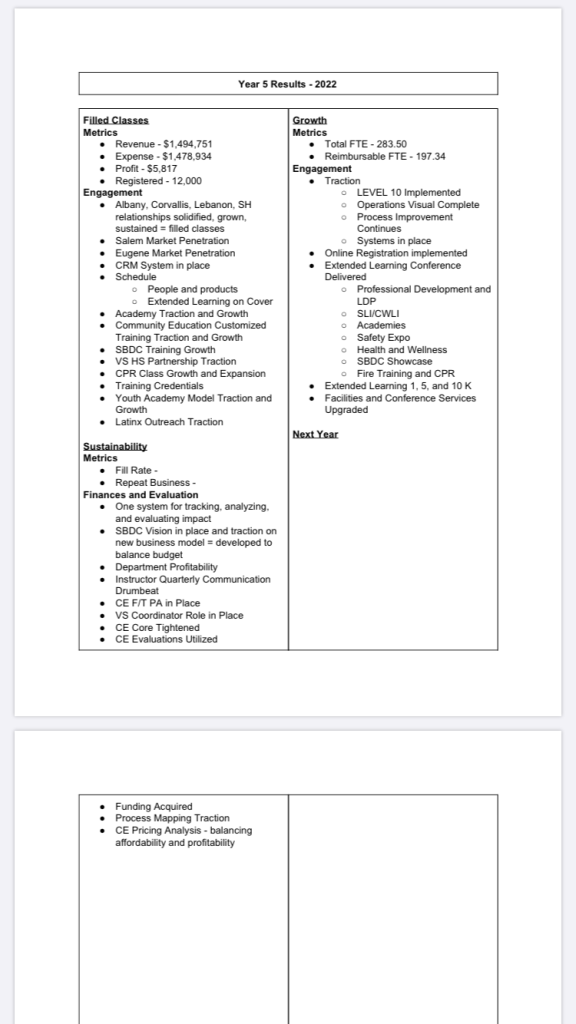
Once you’ve created the 10-year vision, and also know what it will look like, you are ready to work backward. When I went through this exercise last year, I started this part of the planning session with year 5. I looked at the previously designated metrics and asked myself what they would look like in reality. For instance, what would revenue look like, and how many people would we serve.

What are the metrics of the 5-year plan?

Here is what that looked like

This image has an empty alt attribute; its file name is img-2777.png

It is a wonderful exercise to start with the larger 10-year vision and to work backward to the 5-year plan, creating more clarity as you go. It is how you begin to connect the 10-year vision with the work you need to do today.

Once you’ve worked backward to year 5, you are ready to work backward once again to year 3, or whatever the current year is for your team, business, or organization. It is important to continue to get clearer on what the future reality will look like.

What will the current year look like?

Year 3 Department Objectives

This image has an empty alt attribute; its file name is img-2780.png

As you continue to work backward from the 10-year vision to year 5, to the current year you are planning for, in this example, year 3, the objectives that will lead the team to that 10-year vision do become more clear. Important.

And, as these objectives become more clear, so will the priorities that will drive each person’s work. For instance, in our year 3, we had 1-year objectives, which we executed on in 90-day chunks. Meaning that we focused on moving forward our yearly objectives with 90-day priorities that would shift as needed, yet the objectives would remain the same.

Year 3 Staff Objectives

This image has an empty alt attribute; its file name is img-2776-1.png

Once you get to 90-day priorities, it is time to create a coaching model that will mirror all of the aforementioned. Fully discussing this coaching model is for another article, yet I would like to share with you the simple template we created, so you can see how a 10-year vision can connect to a staff member’s daily work.

Coaching Model Template

This image has an empty alt attribute; its file name is img-2782.png

Though you can only see a portion of the form, you can see the overall process, where the yearly objectives (on the left) are connected to the department objectives (on the left in bold), while the specific priorities and actions to move that work forward are on the right. Fun.

A couple of weeks ago, I wrote the following article, One BHAG, Two BHAG, and Creating a Disruption Vision, in which we discussed the possibility of creating a disruption vision or BHAG inside of a 10-year vision. And now, the planning process we’ve walked through in this article is being recreated. The difference?

Because there is so much change right now, we have a 1-year BHAG, which lives inside of the 10-year vision, and 30-day priorities, instead of 90. I am in the process right now of re-instituting one-with-ones so that we can discuss, plan, and create our next actions one month at a time. Allowing us the pivotability, and flexibility needed.

Very well. There you have an example, with tools, on how you can connect your team, business, or organizations’ 10-year vision to the work that needs to be done daily to ensure that the 10-year vision will live in reality.

Be well, and lead well.

You can reach Jeff Flesch at fleschj@linnbenton.edu

Originally published on servantleadershipcoaching.com

#10-yearvision, #creating90-daypriorities, #creatingavision, #developmentandgrowth, #goalsetting, #howtocreatevision, #leadership, #leadershipdevelopment, #leadershipinaction, #leadershipinpractice, #long-termvision, #strategicplanning, #strategicthinking, #strategy, #team, #teambuilding, #vision, #visionandstrategy