The Social Construction Series Part 1: 7 Reasons Why Understanding Social Constructions Is Important

Photo by Jon Moore on Unsplash

Have you ever heard of the phrase a social construction? Maybe? Well, I hadn’t heard of it until I went back to school in my early 30’s. I was in a class on gender, and the professor said something like, gender is socially constructed.

At first, I was like, wait, what? I had no idea what the professor was talking about. Nope, not at all. As the professor continued to explain the concept, I almost fell out of my chair. Seriously. I was so baffled, confused, and interested, all at the same time.

I grew up in a family where ideas like social constructs were unavailable. Not a judgment, just reality. And, it’s okay. There are many, many families across this country that don’t have access to these kinds of ideas, and knowledge. Part of my passion and mission. Dissemination. Here we go.

Let’s define social constructionism.

“Social constructionism is a general term sometimes applied to theories that emphasize the socially created nature of social life. Of course, in one sense all sociologists would argue this, so the term can easily become devoid of meaning. More specifically, however, the emphasis on social constructionism is usually traced back at least to the work of William Isaac Thomas and the Chicago sociologists, as well as the phenomenological sociologists and philosophers such as Alfred Schutz. Such approaches emphasize the idea that society is actively and creatively produced by human beings. They portray the world as made or invented—rather than merely given or taken for granted. Social worlds are interpretive nets woven by individuals and groups.

Oxford Reference

Alright, so the basic idea is that all of life, all if it, is socially constructed. Meaning, simply, that all that we know is created again and again by people. These creations are then shared between and within groups. Shared meaning is derived from these created social constructs, or concepts. What concepts you ask?

Tree. Sun. Love. Life. Health.

Photo by Miha Rekar on Unsplash

All things we see and know. They are all socially constructed. Sometimes groups share and agree on their meaning across cultures, sometimes there are variations specific to particular cultures or geographies.

Why does it matter?

Because if everything we see and know is socially constructed, then all that we argue about, disagree about, and sometimes fight about is based upon ideas and ideals that are created. Created by people.

Understanding that the world is socially constructed is very important.

Important to individuals and how they internalize and understand their place in the world; and, it is also important to how groups understand their relation to each other.

When we know that everything is socially constructed, we have freedom from ideas and concepts, because we know they are not naturally occurring.

You may say, well, love is love and I know what that is, and how it feels to be in love. Yes. And, I am saying that love, even though you feel it, and know it, is still a concept. It is a concept associated with a particular way of being and feeling.

Photo by Tyler Nix on Unsplash

And, guess what? Naturally occurring, or biological concepts, are also social constructions. Tree. Yep. Biological, right? Yet, a tree is still a concept. Believe me. There was a time when a tree was not called a tree. A tree is a concept.

Alright, let’s look at 7 reasons why understanding social constructions is important.

  1. Gives us freedom from concepts.
  2. Creates access to new knowledge and power.
  3. Provides us a new perspective on how the world occurs.
  4. Empowers us to understand why we internalize concepts as real, even when they are not.
  5. Helps us understand each other on a deeper level.
  6. Assists groups in understanding each other; either how they relate, or how they differ.
  7. Creates an important distinction about language. How we use it, and how it affects how we see and experience ourselves, each other, and the world.

How can you use this information?

Question everything. Important. Here is a quote about questioning that I love.

“We awaken by asking the right questions. We awaken when we see knowledge being spread that goes against our own personal experiences. We awaken when we see popular opinion being wrong but accepted as being right, and what is right being pushed as being wrong. We awaken by seeking answers in corners that are not popular. And we awaken by turning on the light inside when everything outside feels dark.”  -Suzy Kassem

Awaken the Greatness Within

You can find quote after quote online about asking questions. Really. Asking questions is that important. Questioning that which others take for granted as real, or right, or wrong, gives you an immediate advantage. How?

Because most people won’t ask. They believe in what they see, hear, feel, and think they know. Why? It’s easier. More comfortable. Not a judgment. It’s okay not to question.

However, when we ask our questions, and actively participate in the contexts we are living in, we get back much more. Much, much more.

My invitation to you is to ask questions. You know, the ones that you’ve been holding onto for years. You know they’re there. And, it’s okay. It’s even okay to hold onto them, if you want to. However, it is way more fun to ask them. Way more. 🙂

Alright, that concludes the first part of the social construction series. Next time? Funny you should ask. I’ve already come up with it.

The social construction of knowledge. Will be fun.

Until then, question.

#concepts, #groupdevelopment, #individualdevelopment, #internalization, #knowledge, #language, #learning, #newperspective, #philosophy, #power, #poweroflanguage, #social-construction, #socialconstruct, #sociology

A Journey from Breakdown to Breakthrough

Photo by Rafael Pol on Unsplash

For most of my life I associated breakdowns with something to be avoided. An issue? Not necessarily. However, consider that breakdowns always lead to breakthroughs. And, without breakthroughs there is no movement. Movement, you ask?

I mean you cannot move your life into new realms of understanding and experience when you avoid breakdowns. Not possible. However, when you are open to an understanding that includes breakdowns and the associated breakthroughs as part of the human experience, you can move your life into new realms. Really.

Before we go further, let’s take a look at the definition of breakdown.

breakdown

Translate breakdown into Spanish

NOUN

  1. A mechanical failure.‘breakdowns could totally disrupt production’
  2. A failure of a relationship or system.‘a breakdown in military discipline’
    1. 2. A sudden collapse in someone’s mental health.‘Heather had a breakdown following the death of her sister’
  3. The chemical or physical decomposition of something.‘the breakdown of ammonia to nitrites’
    1. 3. An explanatory analysis, especially of statistics.‘a detailed cost breakdown’
  4. A lively, energetic American country dance.

Alright, let’s use 1.2 for the purposes of this conversation.

You may then ask, well, how do I become open to breakdowns as part of my regular daily experience? Ah, good. Let’s take a look at three things you can do every day that will ensure that you fully experience your breakdowns and the associated breakthroughs.

Photo by James Sutton on Unsplash

1. Welcome the Breakdowns

Often human beings avoid doing something new because we believe we need to look good and be right. Seriously. Take a moment right now, and really sit inside of this concept for a minute. And? Yep.

If you are really open to this conversation, you will agree that you too often avoid new experiences, because to be vulnerable and admit we don’t know is hard. Really hard.

Let me write that again. Being vulnerable and admitting we don’t know about something is hard. Really hard.

It is okay to acknowledge that; to admit this truth. It is. Admitting this truth simply means you are now aware that new experiences frighten people. With this new awareness you can now work from a space that allows for more openness. A paradox. Yep.

Actually becoming aware of this truth immediately opens you up. Right away. How? Because when we are no longer avoiding something about ourselves that we don’t like, and we embrace reality as it is, we create a new space within ourselves to know ourselves better, and to learn.

What to do?

The next time you are invited to take on something new that you don’t know much about, or have tried in the past and failed, try it again. Why?

Because inside of your new awareness about breakdowns, you have a new understanding; that breakdowns are normal. We need them to move ourselves forward. We need them to get to breakthroughs. Welcome the breakdowns. It simply means you are on the right track.

Photo by Neil Thomas on Unsplash

2. Ask for Help

Another thing hard for many humans to do is ask for help. Why? Because like trying new things, admitting that we need help, makes us fearful. When we act with a need to look good and be right, there is no space to ask for help. We see it as a weakness. Again a paradox. Why?

Because as I’ve written about in other posts, the idea that we know everything there is to know about any topic is silly. No matter how many degrees you have, or how much practical experience you have, there is always something to learn. Always.

Within this context, asking for help is normal. And, it is. Very normal. Does that mean asking for help is easy? No. Admitting we don’t know, need help, no matter what it is we are doing is hard. Very hard.

However, like understanding that breakdowns are normal, having this new understanding about asking for help, immediately opens you up. Opens you up to understanding the true nature of your humanity. And, in this space, you have the opportunity to learn more, be more, and know more. Awesome.

What to do?

When you are in breakdown, stay there. Yep, that’s right. Stay inside of that breakdown, and really feel it. Then, if you get a breakthrough, great. If not, ask for help. There is everything right about asking for help. Think about it like this. If you don’t ever ask for help, you are not expanding that which you know.

And, when we stop expanding what we know, we are limiting ourselves, and our human potential. Your potential is vast. It already is. If you experience that vastness, wonderful. If you’ve yet to experience it, don’t worry. Follow the steps in this post, and you will begin to experience it. Really.

Photo by Lucas Gallone on Unsplash

3. Capture the Breakthroughs

You will never know when a breakthrough will come. Sometimes you will get a breakthrough right on the other side of a breakdown. Sometimes it will be later. It’s okay. Normal.

What’s important is to capture your breakthroughs. In the moment you have a breakthrough, you may not even be sure what it is related to; and, that’s okay. Write it down anyway. Hold onto it. You will see where it belongs eventually.

Once you know where your breakthrough insight belongs, you can make plans to implement it into that area of your life. Sometimes you will choose to do this right away; and, sometimes you will wait. Both are fine. It matters less when you implement your breakthrough, than it is that you stay open to adopting it in some way. Why?

Because that breakthrough is a direct result of a breakdown you had. Whether you can trace the breakthrough back to a breakdown, it is related. Important. And, why it is so important to track and capture your breakthrough in some way.

Let’s now take a look at the definition of breakthrough.

breakthrough

Translate breakthrough into Spanish

NOUN

  1. A sudden, dramatic, and important discovery or development.‘a major breakthrough in DNA research’
    1. 1. An instance of achieving success in a particular sphere or activity.as modifier ‘the band’s breakthrough album’

Alright, we’ve now discussed a journey from breakdown to breakthrough. Though there is much more to discuss about breakdowns and breakthroughs, we covered enough to keep you moving.

When I started seeing my lifecoach 3 years ago, she once asked me this question:

Can you limp along a little while longer?

At that time in my life, a concept like a journey from breakdown to breakthrough was not available to me. Well, it was, however, I was not paying attention, nor was I in touch with myself. When we are out of touch with our own humanity the conversation we just had is harder to put into action.

However, what I’ve come to realize in the past three years, is that with guidance and persistence, the journey from breakdown to breakthrough can become a reality for everyone.

A reality that includes welcoming our breakdowns, a willingness to ask for help, and a system we can use to capture our breakthroughs so we can learn, and move ourselves forward.

Definitions retrieved from Oxford Languages

#askforhelp, #breakdowntobreakthrough, #breakthrough, #creatingyourlife, #emotional-intelligence, #fear, #humanpotential, #keepmoving, #learning, #movingfromstucktounstuck, #natureofhumanity, #openness, #vulnerability

Developing and Managing Your Resilience During COVID-19

This image has an empty alt attribute; its file name is gia-oris-5dt-joxsl78-unsplash.jpg
Photo by Gia Oris on Unsplash

I’ve been reflecting a lot about developing and managing my own resilience this week; and, just how important both are right now. So important. What is resilience you ask? Good question. Here is the definition.

Resilience

(also resiliency)
Pronunciation /rəˈzilyəns/ /rəˈzɪljəns/
Translate resilience into Spanish

NOUN
1. The capacity to recover quickly from difficulties; toughness.‘the often remarkable resilience of so many British institutions’

2. The ability of a substance or object to spring back into shape; elasticity.‘nylon is excellent in wearability and resilience’

Oxford Languages

Essentially resilience is our ability to face adversity, walk through it, learn, and repeat. Again, and again.

I’ve also been thinking about a video I’m going to do soon on resilience for my Developing Servant Leaders site. The idea looks something like this.

First

What we are facing right now is a huge gap between that which we once knew to be our reality, and the current COVID-19 reality. A large gap. Inside of this gap, we are all being asked to face ourselves and each other in new ways, with new tools, in entirely new contexts. Hard.

This image has an empty alt attribute; its file name is img-2993.jpg
August 1, 2020

For those that are less resilient, even harder. Resiliency, like all developmental traits, lives upon a continuum. It is not that someone has resilience or does not. Everyone has some, some have more. Alright, next.

Second

When you connect the four points of the above whiteboard, you can see the space that we are being asked to navigate and step into. A distinction. Stepping into reality is different from hiding, and running from reality.

It means taking the action you know is there to take, even, maybe especially, when it is hard.

This image has an empty alt attribute; its file name is img-2994.jpg
August 1, 2020

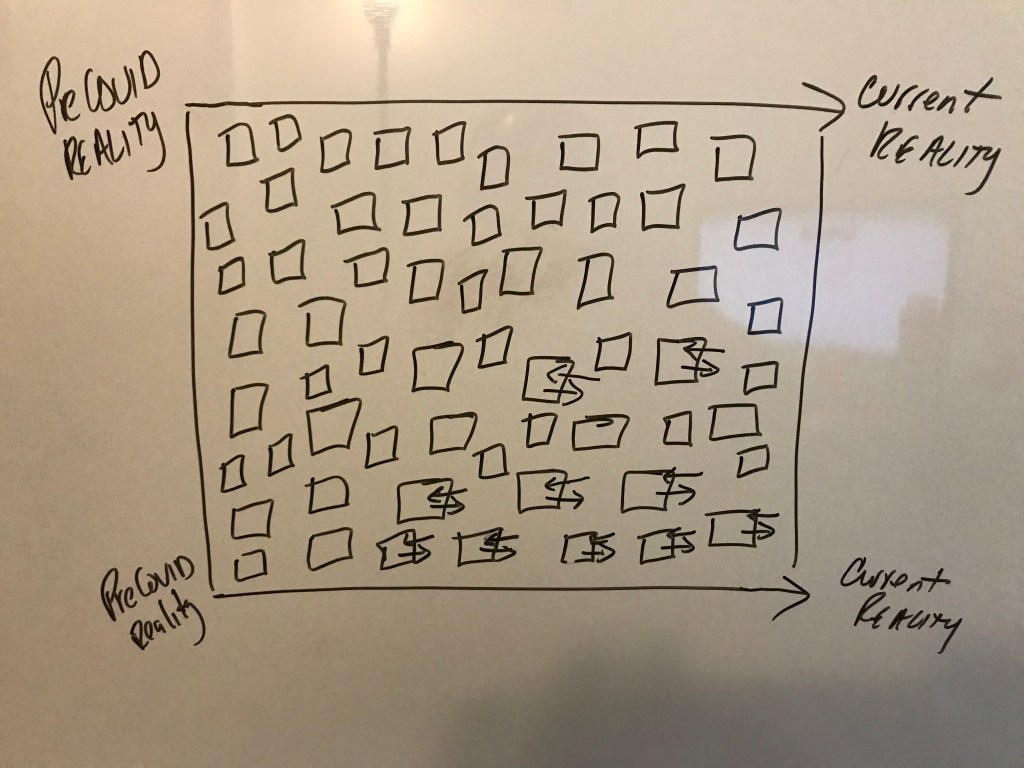
Now, you can see the above box, yes? Alright, then within that, let’s call it the COVID-19 developmental box, there are lots of other little boxes, which represent each of us and our comfort zones.

Yep. Meaning that as we interact with, and bump into each other, we are continuously floating in the COVID-19 developmental box. Then how, you may ask, do we develop our resiliency?

Third

We step outside of our box and into the reality that is in front of us. What is stepping outside of your box? It is doing. Again, and again.

Learning, practicing, falling down, failing – AND, getting back up again. Every time.

Know that we don’t have to continuously live outside of our box, or comfort zone. We can, what a friend of mine calls it, blip out, and blip back. Here you go.

This image has an empty alt attribute; its file name is img-2995.jpg
August 1, 2020

And, guess what? Everytime we go outside of our box, represented above by arrows, and do something that we consider uncomfortable, we grow. Yep, our box or container gets bigger. Here is one more illustration.

This image has an empty alt attribute; its file name is img-2996.jpg
August 1, 2020

As you can see from the above illustration, some people will grow, boxes labeled with a G are now larger, some will not. It’s not a demerit, or a problem if there is no growth. It is, however, a missed opportunity to learn more about yourself and being human. Alright, last section.

Fourth

Also know, especially when you are feeling overwhelmed, that all there is to know and to be experienced in this world, is much larger than this present moment. The COVID-19 moment. Last illustration.

This image has an empty alt attribute; its file name is img-2998.jpg
August 1, 2020

Let us say that the entire whiteboard is what is knowable. Got it. Okay. Then consider that the super small box you see is what we’ve been calling the COVID-19 developmental box or gap. Yep. Pretty small in the proper scale.

Remember this distinction when you are confronted with uncomfortableness; and, remember it when you are feeling overwhelmed.

Though today COVID-19 feels like everything there ever was to know, on a universal and historical scale, there is far more to know and experience. Seriously remember that.

There are countless opportunities to develop your resilience today. More opportunities than most people would care to have. Really. And, believe me when I tell you that there are days when I feel the same way. Really. It’s hard.

Yet, like all of life, it is a paradox. Because the opportunity to develop and to learn how to manage our resilience is also a wondrous process. Yep. Hard and wonderful. A paradox.

Develop well.

#comfortzone, #comfortzones, #covid-19, #covid-19growht, #covid-19growth, #development, #developmentandgrowth, #develping-resilience, #growing, #growth, #humandevelopment, #learning, #managingresilience, #perspective, #resielnce, #selfdevelopment, #uncomfortable

The Blog + Video Series #6: COVID-19 and the Art of Possibility

Possibility: Noun – a thing that may happen or be the case.

I’ve been thinking more about possibility this week. What’s possible in our new landscape? Are the same things possible today, as were possible 6 months ago?

Not sure? Me either, so let’s take a look.

The Art of Possibility is about creating a context. A context specific to new ways to think about old and or new problems or issues. It is about letting go of preconceived notions of what is possible in a given situation.

The psychology of possibility is rather simple. Let go of the past, be in the present, and create the future from where you stand today, seeing reality as it is.

Not how we think it is, rather how it really is.

Seeing reality as it really is means being aware of our thinking patterns, and knowing when we are limiting ourselves by presuming or assuming we know all there is to know about a problem, issue, or situation we are faced with. Factually, humans know very little – if you don’t believe this blogger, read a little Socrates.

Photo by Jez Timms on Unsplash

The sociology of possibility involves creating traction with those around us in the art of possibility. As I’ve written elsewhere, humans are social animals, and rely upon connections with other humans.

It is only natural then that groups will function in accordance with the language they use to describe their shared reality. If that language is about limitation then limitation is what they will see and create.

If, however, that language is about possibility, then possibility is what they will see and create.

The possibility of possibility is about remaining open to new ideas, new understanding, and letting go of the notion that we know. Seems simple, yet can be difficult, as human beings are in some ways programmed to think they know more than they do, which is where vulnerability comes in.

Being open means being vulnerable.

Be vulnerable today in some way. Create and share a possibility with someone in your context, and, or create and share a possibility here. Either way, create and share. What else is there, really?

#covid-19, #creativity, #knowing, #learning, #possibilities, #possibility, #psychology, #sociology, #theartofpossibility, #vulnerability, #vulnerable

Blind Spots: How Knowing About Them Can Help Move You, Those You Know, and All of Humanity Forward

Photo by Taras Chernus on Unsplash

Have you ever considered your blind spots? No? Probably not, seeing as we are blind to them. What in the world are they, and how do they function; and, even more importantly, what can we do about them? Alright, let’s take a look.

What is a blind spot; and, how do they function?

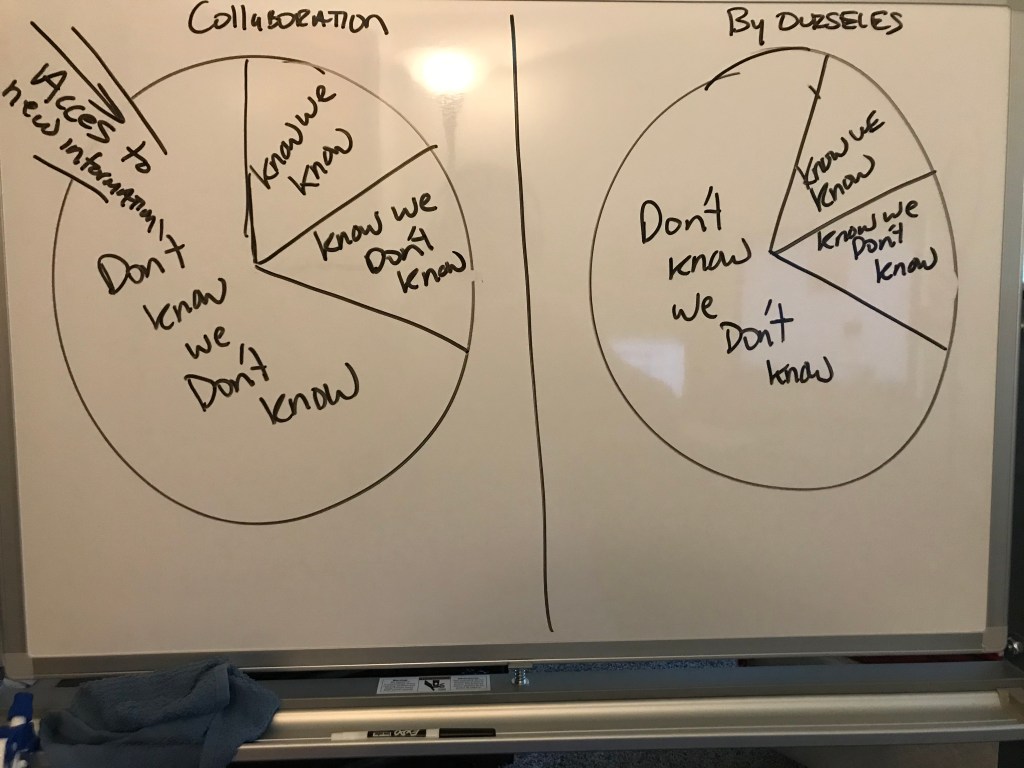
You know what you know, right? Okay. Let me write it this way. You are aware of all those things that you know about, yes? Yes, good. How about those things that you know you don’t know. Yes? Good. Last one. How about those things that you don’t know you don’t know? Hm. A little different, right. Yep. That’s right. That’s your blind spot.

We all have them. And, they are all different. Meaning, that we all have different things that we don’t know we don’t know. Phew. A little semantical, I know. Hm. Let’s do a whiteboard real quick to show you. I also feel another video coming.

July 13, 2020

There we go, better. Let’s say that the circle encompasses all that is knowable. Got it, okay. Now, as you can see, the sections of that which we know we know, and know we don’t know, are much smaller than all that we don’t know we don’t know. A very important distinction. Why?

Because what this simple illustration shows, and what I am pointing to in this post is that there is a vast amount of information (knowing) that is available to all of us, yet is not accessible to most people. Why? Because that which we don’t know we don’t know lives in our blind spot. What can we do?

What can we do?

First, we can become aware. Check. Now what? Well, we can create access to those blind spots. How, you ask? By being open to those that we are surrounded by.

Yep. It is those people that surround us inside of an open communication system where we can learn about our blind spots. Important. Here is another whiteboard to illustrate.

July 13, 2020

What this whiteboard creates is an important distinction that I’ve written about quite extensively on this website, and in many other contexts. Relationships and the interdependent nature of those relationships equals collaboration; and collaboration is where the access is. Yep.

As a matter of fact, the Monday message that went out to the team I work with today, was all about relationships, and just how important they are in all of our lives.

It is through these relationships that we can gain access to our blind spots. Don’t have those kinds of relationships? That’s okay.

You can create them. Really. You can. Why wait. There are so many people on this planet that are interested in the things that you are interested in.

Photo by alexandra lammerink on Unsplash

And, guess what?

You know things about your interest, and so will they. And, I can guarantee you that you will both learn from each other. Uncovering blind spots for each other along the way. No matter what the topic.

What we are discussing in this post has been written about for thousands of years. Here is an example.

“True wisdom comes to each of us when we realize how little we understand about life, ourselves, and the world around us.” -Socrates (469-399 B.C.)

Goalcast

I love this quote. There are many others like it, written similarly across all cultures. When we recognize that we know way less than there is to learn, and know, we immediately become open to new experiences, and new perspectives.

When we are open, and are in conversation and relationships with people that are interested in our growth, as we are in theirs, our blind spots are regularly pointed out. That is learning. It is the best kind of learning.

Ever heard of the socratic method? Here’s a snippet.

“In the Socratic method, the classroom experience is a shared dialogue between teacher and students in which both are responsible for pushing the dialogue forward through questioning.”

Edited by CTL Associate Director Mariatte Denman
Photo by Edvin Johansson on Unsplash

I too love this quote, however, I’m going to offer you a new way to think about it. Consider that the world is your classroom, and that everyone you meet, and are in relationships with can be the person that you share this kind of learning experience with. Truly.

When we are open, interested in learning from someone more than expounding on that which we know, we can learn something from almost anyone we meet.

Really. It is a beautiful experience.

Of course, we must be willing to, in a way, let go of that which we know. Let it go, and start listening, and taking in that which other people know. In the end, guess what? We end up knowing more. Yep.

When, however, we aren’t open, guess what? We get to keep that which we know, yes; yet, we miss out on the opportunity to add to that which we know. A truly missed opportunity.

My invitation to you

Don’t let those learning opportunities pass you by. Grab them while they are here. And, offer them back to those that you meet. For, they, like you, have something to learn from you.

We all have something to learn from each other. And, when we approach our relationships and interactions with that attitude. Phew. We can learn so much. You can learn so much. Start today.

Ask questions, listen, and believe. Believe in your ability to add to that which you know, and to contribute to someone else’s knowledge base. You can.

That is movement. Movement for yourself, for those you are in relationships with, and for all of humanity.

Learn, know, and reciprocate well.

#blindspots, #collaboration, #development, #growth, #growthanddevelopment, #knowing, #knowledge, #learning, #learningmore, #reciprocallearning, #relationships, #socrates, #socraticmethod, #theworldisyourclassroom

A Bloggers’ Diary: On Blogging, 3 Months In

Photo by Emma Matthews Digital Content Production on Unsplash

Well, it’s been 3 months since I started blogging, and I’ve learned some, and have so much more to learn. Phew, so much.

How did I get started?

As I’ve written in other posts, when COVID-19 sent everyone home, a byproduct of the pandemic was more time. Though I continued to work, the business was/is much slower than normal. In fact, the business is completely different today, and will continue to be so.

As I was looking for another outlet for the additional time, my oldest son and I had a conversation about COVID-19, discussing if future history books would show a large increase in creativity during the pandemic. Not sure, yet it is fun to think about.

Photo by Will van Wingerden on Unsplash

What I do know is that it got me thinking about creating a site where I could get out my own creativity, and could also invite others to do the same. Though the latter hasn’t been fully realized, the former has been, and in ways that I never anticipated.

At the time, I had no idea how far it would go, and it pleasantly surprised me for sure. Pretty cool.

I’ve actually integrated the blogging into my normal daily workflow. They are very relevant to each other, and in many ways, they feed on each other. Fun.

What have I learned?

Phew, so many things. Here are a few.

  • How to create, manage, update, and maintain a website – lots of work, was a steep learning curve for me. Yet, like anything, once you get into it, starting moving work forward, you learn, read other blogs, and adjust as needed.
  • How to connect social media accounts to websites – actually not difficult. The difficulty is in managing the social media accounts. Making the time to learn how to use them, as they are all very different. Lots of work.
  • How to manage my time differently – even though there was/has been more time since COVID-19 began, I had to strategically create time each day to move the work forward.
  • How to differentiate writing from working on the site – both are needed. I write everyday, and, at first, worked on the site everyday. Now, I still write everyday, yet only work on the site once or twice a week. Not sure if that is a proper balance, as I do know updating the site is very important.
  • How to follow and interact with other bloggers – much fun. I have greatly enjoyed reading other blogs, asking questions, and giving my perspective on other topics. Fun.
  • How to connect videos to websites – about a month ago I wrote this blog, How We Learn, and Why it’s Important to Understand, and after reflecting upon it, it occurred to me that creating videos would be super fun, and would be another way to engage with people.
  • How to market your blog – learning more here every day. Lots of ways to market and engage people. I will say, however, that being active and consistent is super important.
  • How to sign up and write regularly on medium – I had never even heard of medium before beginning to blog. You can follow me here.

I’ve learned so much, and have so much more to learn, which is why I thought this new diary series would be super fun to write.

Let’s take a look at how my blogs have iterated in the past three months.

Here is the first one, Creativity During COVID-19, and here is the most recent one, The Blog + Video Series 2: Writing and Life Series #4 – On Pain and Healing Through Writing.

Lots of development over the past three months. A wonderful journey thus far, and I have every intention of continuing to write in this medium.

Here are some of the topics I’ve covered in the past three months.

  • Relationships
  • Mindfulness
  • Sociology
  • Psychology
  • Human Development
  • Self-Development
  • Writing
  • Social Action
  • Business
  • Letters
  • Inspiration and Imagination
  • Possibilities
  • The Sound of

That’s actually a pretty inclusive list. The letters category is really new, it was just created last week. There is only one blog in there now, which is the one about my father passing, Letters: For My Dad.

Corvallis, Oregon

That was a tough one to write, and has me in tears now. Phew. I miss him.

What’s next?

Continue to write, and learn. I’ve got a long list of topics to write about, much more than the time to get them all written anytime soon. And, you know, that’s totally okay.

I see blogging as something that will continue to be a part of my life forevermore. I’m not interested in the short game, only in the long one.

I also see my work in higher education and blogging, as something that will continue to converge. Actually, I’ve just recently added coaching services to the website, which I am super excited about. You can check them out here.

Photo by Austin Distel on Unsplash

I’ve got a deep passion for personal and professional development, and have been working in this field all my life. Fun.

I also get very excited about new ways to engage, and new topics to write about, which I continue to reflect upon.

Alright, that’s all for this entry. However, before I go, I would like to thank each of you.

Thank you for reading, liking posts, commenting on posts, engaging me in however you did. You are appreciated.

#blogging, #blogs, #coaching, #covid-19, #engagement, #learning, #managetime, #marketing, #medium, #personal-and-professional-development, #socialmedia, #videos, #websitedevelopment, #writing

How We Learn, and Why it’s Important to Understand

Photo by Element5 Digital on Unsplash

Why is it important to understand how we learn best? It has to do with our own ability to relate with ourselves, first, and to others, second. Do you know how you learn best? Not sure? That’s pretty normal.

Though deep down you know, as I once did, most people don’t actively think about it. And, neither did I. It was not until I went back to school in my early 30’s that I fully understood how I learned best.

Alright, let’s take a look at the top 4 learning styles, and see what style resonates with you most. I also invite you to think about how else you can use these learning styles in your life. Ready? Good, here we go.

Learning Styles

Visual

Visual learners like to see what they are learning. These learners are interested in the visualization of the work they are engaged with. Think whiteboards, flow charts, and large post-it boards.

They must see the work in order to fully take the information in, process it, and provide a meaningful response. Some people don’t know they are visual learners. If you are not sure, I suggest writing out your next project on one of the aforementioned tools, and see what happens.

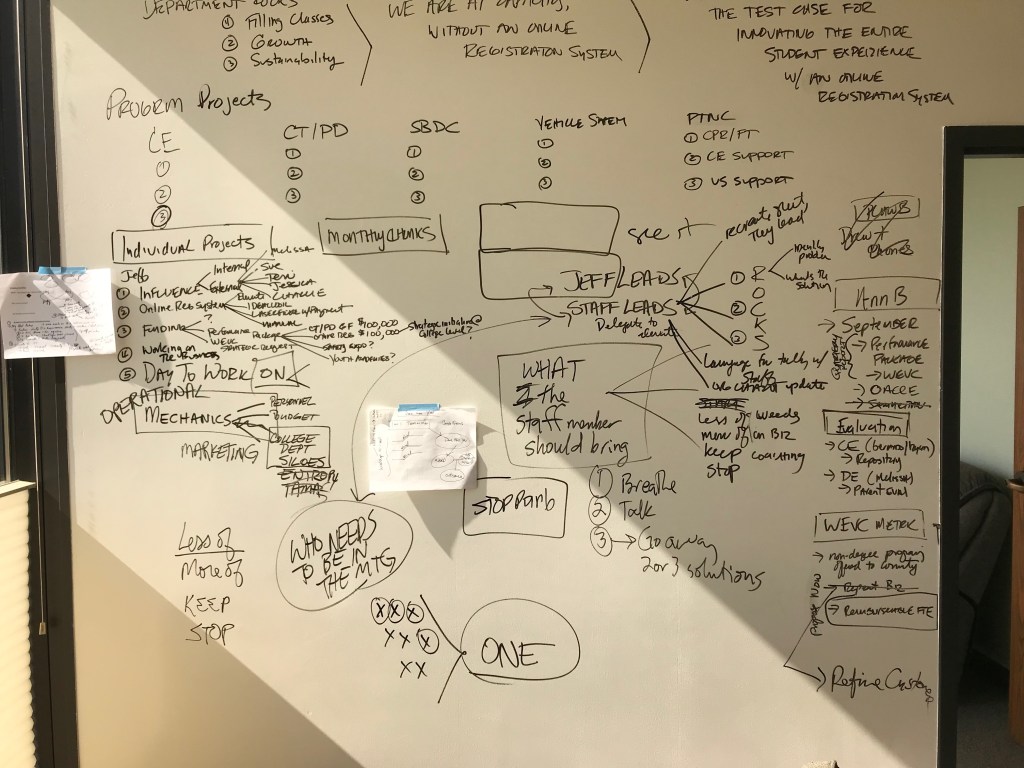
As I am visual, I can provide an example here.

I don’t expect this visual to make sense, and in fact, it may shock or startle some of you. What you are looking at is how someone that is hyper-visual thinks.

The importance of getting those ideas out of one’s mind and into reality, via any tool really, is extremely important to someone that is a visual learner. Without the ability to do so, the person may get stuck. I know, I’ve been there.

Aural

Someone that learns best through sound is in the aural category. Think about someone that chooses to listen to audio books, or someone that must have someone explain a particular task or project to them through verbalizing the steps. Our youngest son is an aural learner.

For those that learn best this way, having tasks or projects written out or in visual format, as in the above whiteboard example, will not work. Or, rather, visual and written instruction will not work as effectively. Sound is the key.

Here is an example.

Jeff Flesch on YouTube

This is a video I created for the blog, 3 Reasons Why Avoidance is an Ineffective Strategy, and I am using it as an example of aural learning, as I am talking through a strategy in this clip. Helpful. What would not work for an aural learner, would be the written out steps to the associated diagram without the spoken explanation.

Verbal

Verbal learners need to read that which they are to work on or engage with. Being able to read instructions, for example, is imperative for a verbal learner. Think about putting something together, not with a picture in mind, but with a list of steps, 1, 2, 3.

Being able to internalize the written instruction or steps, is important for a verbal learner. What would help the above video clip for a verbal learner? Yep, that’s it. If I were to write out a list of the steps that I am talking the viewer through. That would be helpful. Think of an ordered system. More comfortable for a verbal learner.

Kinesthetic

Those that learn best with their bodies are kinesthetic. These learners like to actually do something with what they are learning. They need to actually touch, feel, and practice the new information.

Though the below picture is not the best quality, it gives you an idea of a practical tool that was created intentionally to engage those that learn best by doing something with new information.

Alright, so can the learning styles be combined? Do some people learn best with a combination of the aforementioned learning styles? And, can people’s learning styles change over time?

Do some people learn best when learning styles are combined?

Yes. I am a great example of this fact. I learn best, by seeing, reading, and then hearing information. I also like to practice new information by either utilizing a worksheet, or more likely a whiteboard. I love whiteboards. I have a whiteboard wall in my work office. Excellent.

Yet, this is only how learning works best for me. I know people that need to have information explained first. A must. Then they can interact with visuals, and other types of learning styles. Why is knowing this important?

When we know how the people we are in relationship with learn best, we can support them in their learning and life. Important. And, when we assume we know, and offer support, that support, while well-intentioned, may not work.

It’s also important to know, as we have discussed, that some people may not know how they learn best. Asking them, in these instances, may not help. What can you do? You can offer them different approaches to learning, and see what fits them best.

Do learning styles change over time?

Yes. Here are a couple of reasons why learning styles change.

  • Because as we develop we learn new ways to process and operationalize information. We may add new learning styles to our approach to learning, and may even need to let go of approaches that no longer work.
  • Different contexts require different learning approaches, so in these contexts, you may need to adapt your learning style while incorporating new tools. Think of a new job, going to college, or graduate school.
  • You may learn, in school or at work, about a new way to learn that was previously not available to you. And, in this new learning, you may adopt a new learning style that fits you better.

Why is it important to understand how we learn?

It’s important to our own development. When we know how we learn best, we can employ strategies at home and at work that align with our learning style, which can help our retention of information and mastery of all that we do.

As I’ve mentioned in this post, I am a hyper-visual learner, therefore it will probably not surprise you to know that I have not one, nor two, but, rather, three whiteboards in my little apartment. Yep, three. Needed.

It is also important to understand how other people learn best. When we understand how our friends, family, and coworkers learn best, we can support them by advocating for, and providing learning contexts that adhere to their learning style.

We all learn differently, yet the learning process is very similar regardless of the style that fits best.

And, why did I write this post? Good Question.

Because it occurred to me that it is also important to someone that is engaging others through digital media – you, me, and many, many other people.

Whether that is via a website, social media, a blog, or some other medium. Understanding how people learn is a critical component of engagement.

In order to create the most engaging context, as many learning styles as possible should be considered, addressed, and included when possible. As I continue to develop the COVID-19 Creativity website, I will employ more strategies that include each learning style to ensure that everyone has a quality experience.

Alright, we’ve addressed the top learning styles, walked through their significance, and connection to self-development, relationship-development, and the importance of using these styles to create more engaging contexts.

Now I’m interested to learn how you’ve used learning styles in your personal and/or professional life to create more engaging contexts. What have you done; and how did it work for you, and your audience?

#aural, #engagement, #individual-learning, #kinesthetic, #learning, #learning-and-engagement, #learning-styles, #relationship-development, #self-development, #verbal, #visual