Blind Spots: How Knowing About Them Can Help Move You, Those You Know, and All of Humanity Forward

Photo by Taras Chernus on Unsplash

Have you ever considered your blind spots? No? Probably not, seeing as we are blind to them. What in the world are they, and how do they function; and, even more importantly, what can we do about them? Alright, let’s take a look.

What is a blind spot; and, how do they function?

You know what you know, right? Okay. Let me write it this way. You are aware of all those things that you know about, yes? Yes, good. How about those things that you know you don’t know. Yes? Good. Last one. How about those things that you don’t know you don’t know? Hm. A little different, right. Yep. That’s right. That’s your blind spot.

We all have them. And, they are all different. Meaning, that we all have different things that we don’t know we don’t know. Phew. A little semantical, I know. Hm. Let’s do a whiteboard real quick to show you. I also feel another video coming.

July 13, 2020

There we go, better. Let’s say that the circle encompasses all that is knowable. Got it, okay. Now, as you can see, the sections of that which we know we know, and know we don’t know, are much smaller than all that we don’t know we don’t know. A very important distinction. Why?

Because what this simple illustration shows, and what I am pointing to in this post is that there is a vast amount of information (knowing) that is available to all of us, yet is not accessible to most people. Why? Because that which we don’t know we don’t know lives in our blind spot. What can we do?

What can we do?

First, we can become aware. Check. Now what? Well, we can create access to those blind spots. How, you ask? By being open to those that we are surrounded by.

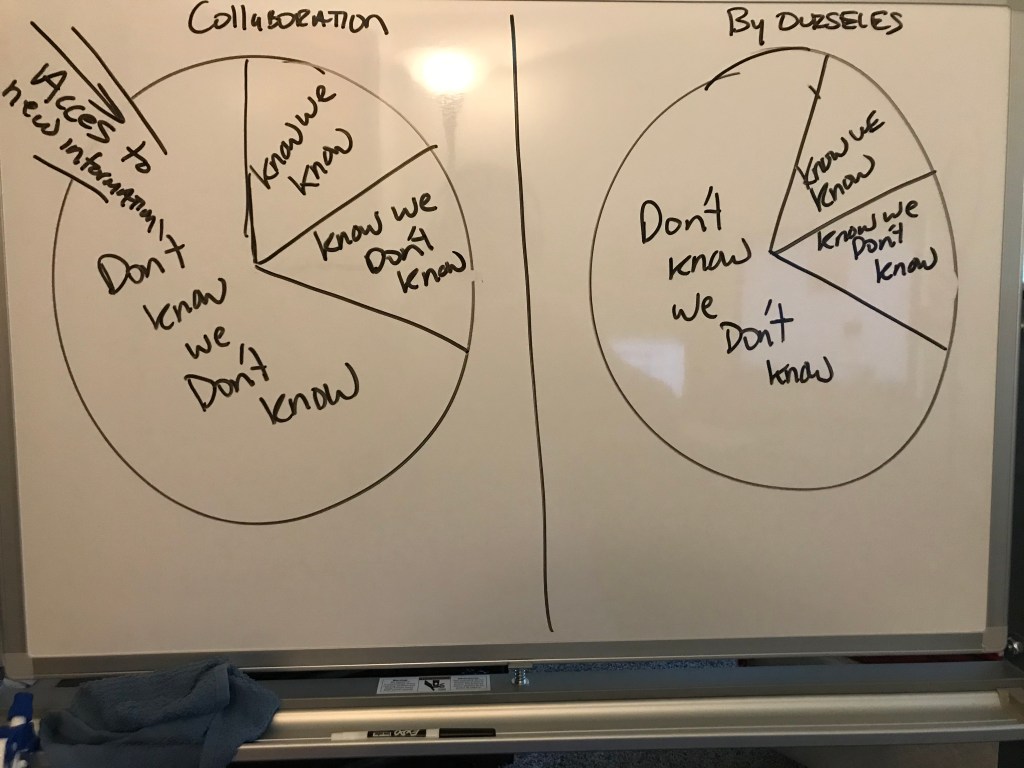
Yep. It is those people that surround us inside of an open communication system where we can learn about our blind spots. Important. Here is another whiteboard to illustrate.
July 13, 2020

What this whiteboard creates is an important distinction that I’ve written about quite extensively on this website, and in many other contexts. Relationships and the interdependent nature of those relationships equals collaboration; and collaboration is where the access is. Yep.

As a matter of fact, the Monday message that went out to the team I work with today, was all about relationships, and just how important they are in all of our lives.

It is through these relationships that we can gain access to our blind spots. Don’t have those kinds of relationships? That’s okay.

You can create them. Really. You can. Why wait. There are so many people on this planet that are interested in the things that you are interested in.

Photo by alexandra lammerink on Unsplash

And, guess what?

You know things about your interest, and so will they. And, I can guarantee you that you will both learn from each other. Uncovering blind spots for each other along the way. No matter what the topic.

What we are discussing in this post has been written about for thousands of years. Here is an example.

“True wisdom comes to each of us when we realize how little we understand about life, ourselves, and the world around us.” -Socrates (469-399 B.C.)

Goalcast

I love this quote. There are many others like it, written similarly across all cultures. When we recognize that we know way less than there is to learn, and know, we immediately become open to new experiences, and new perspectives.

When we are open, and are in conversation and relationships with people that are interested in our growth, as we are in theirs, our blind spots are regularly pointed out. That is learning. It is the best kind of learning.

Ever heard of the socratic method? Here’s a snippet.

“In the Socratic method, the classroom experience is a shared dialogue between teacher and students in which both are responsible for pushing the dialogue forward through questioning.”

Edited by CTL Associate Director Mariatte Denman
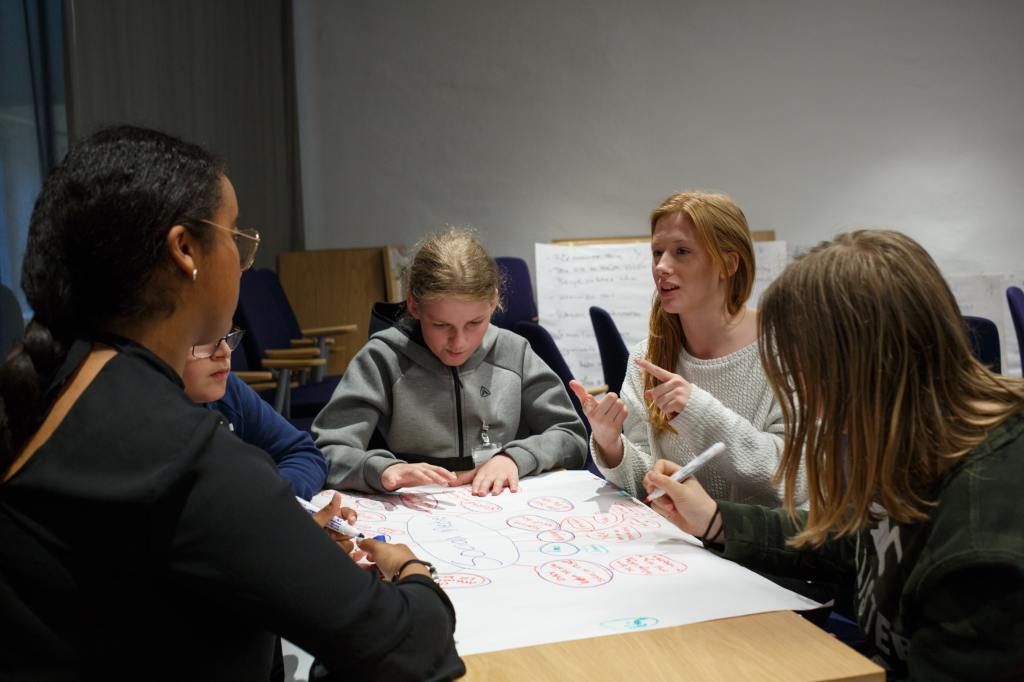
Photo by Edvin Johansson on Unsplash

I too love this quote, however, I’m going to offer you a new way to think about it. Consider that the world is your classroom, and that everyone you meet, and are in relationships with can be the person that you share this kind of learning experience with. Truly.

When we are open, interested in learning from someone more than expounding on that which we know, we can learn something from almost anyone we meet.

Really. It is a beautiful experience.

Of course, we must be willing to, in a way, let go of that which we know. Let it go, and start listening, and taking in that which other people know. In the end, guess what? We end up knowing more. Yep.

When, however, we aren’t open, guess what? We get to keep that which we know, yes; yet, we miss out on the opportunity to add to that which we know. A truly missed opportunity.

My invitation to you

Don’t let those learning opportunities pass you by. Grab them while they are here. And, offer them back to those that you meet. For, they, like you, have something to learn from you.

We all have something to learn from each other. And, when we approach our relationships and interactions with that attitude. Phew. We can learn so much. You can learn so much. Start today.

Ask questions, listen, and believe. Believe in your ability to add to that which you know, and to contribute to someone else’s knowledge base. You can.

That is movement. Movement for yourself, for those you are in relationships with, and for all of humanity.

Learn, know, and reciprocate well.
#blindspots, #collaboration, #development, #growth, #growthanddevelopment, #knowing, #knowledge, #learning, #learningmore, #reciprocallearning, #relationships, #socrates, #socraticmethod, #theworldisyourclassroom

The Blog + Video Series #3: Finding Comfort in Being Uncomfortable: Part 1

July 12, 2020

There are countless quotes, books, and movies about “living outside of your comfort zone.” What this actually means, however, is open to great interpretation, and, I think, changes for people over time.

How you view the idea of living outside of your comfort zone is a product of how you were raised, how you think, the context you live and work in, and those that you surround yourselves with.

Further, the idea and actually experience of a comfort zone, and the corresponding uncomfortableness that comes with being outside of it is different for everyone.

As there are over 7.5 billion people on the planet, we can actually say that there are over 7.5 billion different comfort zones.

Growth is the byproduct or result of living outside of your comfort zone. In fact, the only real growth there is is found outside of your comfort zone. There is never any growth inside of a comfort zone.

Photo by Kyle Glenn on Unsplash

This may seem like common sense, and it is, however, most people have a hard time realizing this truth. Why? Simple. If feels really good inside of our comfort zones.

Who would want to intentionally create situations or contexts that challenged this comfortability? Really, not many. Most people are perfectly content inside their comfort zones.

Yet, if these people were to examine themselves on the inside, they would find that this contentment is covering up other issues.

Sometimes being outside of your comfort zone happens unintentionally, which can happen when we are faced with a very stressful situation or life event that we didn’t see coming. If we are open to it, there is also growth in these experiences.

Photo by Hello I’m Nik 🎞 on Unsplash

Learning how to find comfort in being uncomfortable is manifested by doing things that we find uncomfortable often. When we are open to getting outside of our comfort zones often, there is a comfort that comes as a byproduct of the continual practice of being uncomfortable.

As with most everything else, it takes practice to realize this kind of comfort in the uncomfortable. By practice, I simply mean creating intentional contexts that we find uncomfortable, and engaging in these contexts until they no longer feel as uncomfortable.

Ultimately, until they feel comfortable.

If you are reading this and thinking, nope, not me, I like my comfort zone and have no need to create intentional contexts of uncomfortability. Very well, that is your choice.

If, however, you are thinking, maybe, or yes, sign me up. Then go out and do one thing today that you’ve been avoiding or putting off because it makes you feel uncomfortable, and see what happens.

If it’s anything like the many experiences I’ve had, yes, you can count on being uncomfortable.

Yet, you can also count on that experience providing you a whole lot more, which is only possible by doing things that you find uncomfortable.

Until next time….

#comfortzones, #creatinggrowth, #development, #growth, #growthanddevelopment, #individualdevelopment, #personaldevelopment, #selfdevelopment

A Bloggers’ Diary: On Blogging, 3 Months In

Photo by Emma Matthews Digital Content Production on Unsplash

Well, it’s been 3 months since I started blogging, and I’ve learned some, and have so much more to learn. Phew, so much.

How did I get started?

As I’ve written in other posts, when COVID-19 sent everyone home, a byproduct of the pandemic was more time. Though I continued to work, the business was/is much slower than normal. In fact, the business is completely different today, and will continue to be so.

As I was looking for another outlet for the additional time, my oldest son and I had a conversation about COVID-19, discussing if future history books would show a large increase in creativity during the pandemic. Not sure, yet it is fun to think about.

Photo by Will van Wingerden on Unsplash

What I do know is that it got me thinking about creating a site where I could get out my own creativity, and could also invite others to do the same. Though the latter hasn’t been fully realized, the former has been, and in ways that I never anticipated.

At the time, I had no idea how far it would go, and it pleasantly surprised me for sure. Pretty cool.

I’ve actually integrated the blogging into my normal daily workflow. They are very relevant to each other, and in many ways, they feed on each other. Fun.

What have I learned?

Phew, so many things. Here are a few.

  • How to create, manage, update, and maintain a website – lots of work, was a steep learning curve for me. Yet, like anything, once you get into it, starting moving work forward, you learn, read other blogs, and adjust as needed.
  • How to connect social media accounts to websites – actually not difficult. The difficulty is in managing the social media accounts. Making the time to learn how to use them, as they are all very different. Lots of work.
  • How to manage my time differently – even though there was/has been more time since COVID-19 began, I had to strategically create time each day to move the work forward.
  • How to differentiate writing from working on the site – both are needed. I write everyday, and, at first, worked on the site everyday. Now, I still write everyday, yet only work on the site once or twice a week. Not sure if that is a proper balance, as I do know updating the site is very important.
  • How to follow and interact with other bloggers – much fun. I have greatly enjoyed reading other blogs, asking questions, and giving my perspective on other topics. Fun.
  • How to connect videos to websites – about a month ago I wrote this blog, How We Learn, and Why it’s Important to Understand, and after reflecting upon it, it occurred to me that creating videos would be super fun, and would be another way to engage with people.
  • How to market your blog – learning more here every day. Lots of ways to market and engage people. I will say, however, that being active and consistent is super important.
  • How to sign up and write regularly on medium – I had never even heard of medium before beginning to blog. You can follow me here.

I’ve learned so much, and have so much more to learn, which is why I thought this new diary series would be super fun to write.

Let’s take a look at how my blogs have iterated in the past three months.

Here is the first one, Creativity During COVID-19, and here is the most recent one, The Blog + Video Series 2: Writing and Life Series #4 – On Pain and Healing Through Writing.

Lots of development over the past three months. A wonderful journey thus far, and I have every intention of continuing to write in this medium.

Here are some of the topics I’ve covered in the past three months.

  • Relationships
  • Mindfulness
  • Sociology
  • Psychology
  • Human Development
  • Self-Development
  • Writing
  • Social Action
  • Business
  • Letters
  • Inspiration and Imagination
  • Possibilities
  • The Sound of

That’s actually a pretty inclusive list. The letters category is really new, it was just created last week. There is only one blog in there now, which is the one about my father passing, Letters: For My Dad.

Corvallis, Oregon

That was a tough one to write, and has me in tears now. Phew. I miss him.

What’s next?

Continue to write, and learn. I’ve got a long list of topics to write about, much more than the time to get them all written anytime soon. And, you know, that’s totally okay.

I see blogging as something that will continue to be a part of my life forevermore. I’m not interested in the short game, only in the long one.

I also see my work in higher education and blogging, as something that will continue to converge. Actually, I’ve just recently added coaching services to the website, which I am super excited about. You can check them out here.

Photo by Austin Distel on Unsplash

I’ve got a deep passion for personal and professional development, and have been working in this field all my life. Fun.

I also get very excited about new ways to engage, and new topics to write about, which I continue to reflect upon.

Alright, that’s all for this entry. However, before I go, I would like to thank each of you.

Thank you for reading, liking posts, commenting on posts, engaging me in however you did. You are appreciated.

#blogging, #blogs, #coaching, #covid-19, #engagement, #learning, #managetime, #marketing, #medium, #personal-and-professional-development, #socialmedia, #videos, #websitedevelopment, #writing

The Blog + Video Series 2: Writing and Life Series #4 – On Pain and Healing Through Writing

How many of you write as a release? Write to get the ideas, thoughts, concerns, dreams, wishes, and hopes out of your head and into a format that you can read and reflect upon. Yes, no? Maybe?

For most of my life, I didn’t. I didn’t regularly write out any of the aforementioned. Not because I wouldn’t have found it beneficial, more because I didn’t really know how. Sounds funny. It is true though.

I would tinker with writing here and there, yet never really developed a system to do so. What I realize now is that having a systematic way you write, or enter into any creative process is, at least for me, very helpful.

It is how I can continue to do so. To write through my pain and heal.

I find that writing of any kind, on a whiteboard, in a journal, in a computer document, anything, is very therapeutic. Why? Because you can then study what you are thinking, instead of simply thinking about it.

There is an important distinction here.

If you only ever think about something, you don’t really do anything with it, with the exception of maybe obsessing over it or worrying about it. Which, in the end, does nothing to move you forward as a human being.

This image has an empty alt attribute; its file name is anh-nguyen-v-nbxj3yv5o-unsplash.jpg
Photo by Anh Nguyen on Unsplash

What are some of the writing strategies I use to work through my pain and heal?

I have several different ways that I get ideas out of myself and into the world. And, all of them work well. For, it is really less about the strategy, than that you develop the habit of writing through any situation or context that you find yourself in. From pain toward healing.

Here are some strategies I use daily.

  1. Whiteboards – I have three at home, and many at work, which include a complete whiteboard wall in my office. Very helpful. And, yes, there is also pain and healing that happens at work. It’s not just in our personal life that we need a release for our pain, whether that is frustration or some other emotion we are working through. I actually think that it is in the writing, considering, and working through the pain that healing occurs.
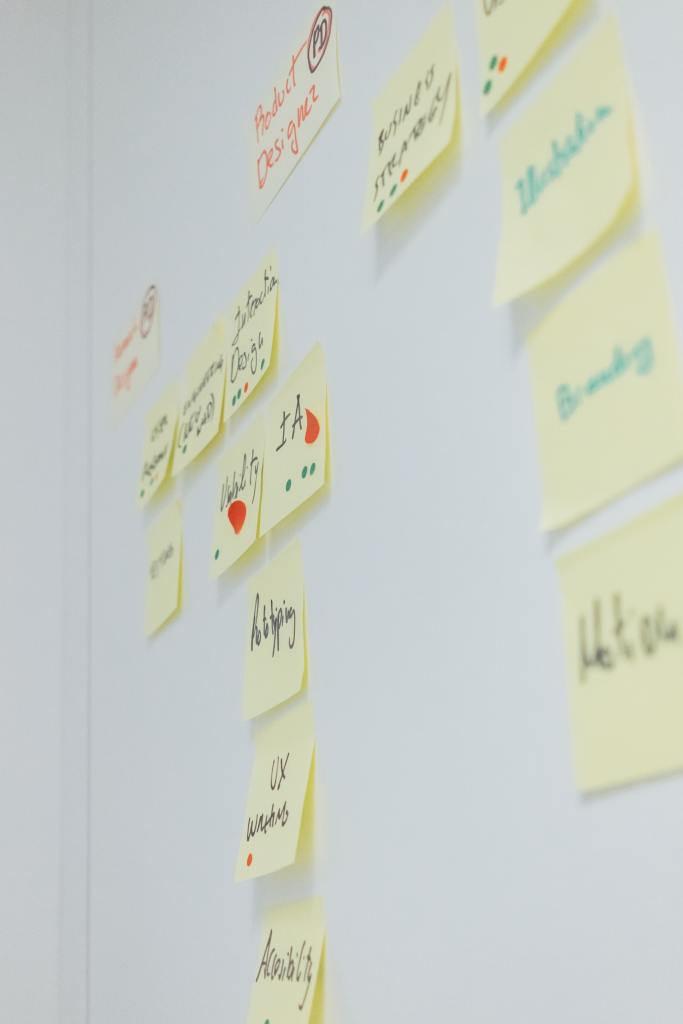
  2. Post-its – on the go, these work very well. I will typically then collect them on a piece of paper, or tape them to a larger 2’x3′ post-it, so that I can play with the ideas. See what’s there, and what possibilities I can see for moving forward.
  3. Journaling – I don’t write in a journal as often today, yet it is still a strategy that I recommend. Especially if you are new to writing about your own pain.

Those are the top three I’ve used, and use daily. And, they all work well, and can be used in combination. Example.

I will also tape post-it’s to pieces of paper, and put them on my magnetic whiteboard. Good visual, and easy to move around, and play with.

This image has an empty alt attribute; its file name is paul-hanaoka-4zah0dggomi-unsplash.jpg
Photo by Paul Hanaoka on Unsplash

Why write through your pain to heal?

Because we all need the release. When we hold all of our pain inside, we cannot heal. It will reside within us, and actually make us ill. Not helpful.

Moving forward from pain, especially deep pain, requires visiting that pain often. Understanding it, working on it, and eventually releasing it. Carrying it around is unnecessary, though many people live this way.

Writing opens us up, and is a safe way to get out that which resides within. There are many different ways to write about pain. You can simply write about the pain, or you can create poems, or other stories about the pain.

What matters more than the writing medium you use, is that you provide yourself the opportunity to heal. Very important.

This image has an empty alt attribute; its file name is jude-beck-j7jocq7lkay-unsplash.jpg
Photo by Jude Beck on Unsplash

Know also that it takes time to heal. You may write about something that is causing you pain, and not know healing from that pain for some time. For me, it also takes reflecting upon the pain in my writing.

When I can sit and contemplate that pain, I can see more, and have new insights. It is common for me to go back to something I’ve written several times before I can see a pathway to healing. Very normal.

How can you get started?

Start writing. Write on anything and at any time. Get your pain out of you and into the world so you can actually see it, and work on it. Important.

If you leave your pain inside of you, that is where it will always remain. Literally.

Choose times that work best for you, and create a habit of writing often. For it is in the healthy habit that you create to write about your pain often, that you have the best opportunity to know healing from that pain, and all pain.

Developing a healthy writing habit that is honest and reflective of the pain that lives inside of you creates a connection between your mind and your heart. And, it is inside of the connection between the two that all healing lives.

Write well and heal well.

#healing, #health, #internal-work, #introspection, #mindfulness, #pain, #self-development, #wellbeing, #writing, #writing-habits

Letters: For My Dad

Corvallis, Oregon

One year ago today my father passed away. It was sudden. He was 71. There was still a lot of life left in my dad when he died. Today is difficult, and will be even more so for my mother.

I will cry, I am crying now. Yet, what I want to do in this post, is to remember my dad as he lived.

Remember the times that he was there for me. The times that he stood for me, when I was lost. Lost inside of myself, and in the greater world.

Photo by Franck V. on Unsplash

The first memories I have of my dad are of him in dress clothes, heading off to work. Work that he liked, and didn’t, yet went anyway, every day, because it was expected and needed. Expected of himself, by himself.

I remember the first time we played catch, which may sound awfully cliche, yet it was an important moment in my life. Knowing that my dad would make time to spend with me, regardless of other pressing priorities, was an important learning for me as a child.

A learning in dedication and love.

He loved movies. I remember watching all kinds of movies with him as a child, teengaer, and adult. Spending time with him. Talking with him about movies that were upcoming, getting excited, and sharing in that joy with him.

Photo by Georgia Vagim on Unsplash

And, yes, popcorn. I loved popcorn as a kid. We would also often add powdered parmesan cheese to the popcorn. Loved that.

I remember him bringing me home hot wheels once after work. Oh my. I was so excited.

The idea that he would take time to purchase something for me, think of me like that, made a huge impression on me.

He also loved music. One of the things I miss the most about my dad is hearing him play the guitar. Was lovely. Now, I often listen to the songs that he played most often. I feel very connected to him at these times.

Photo by Jefferson Santos on Unsplash

My dad loved people. Loved conversation. I learned so much from him about being with people. Though my dad was an extrovert, like me, he also had a large introvert living inside of him, also like me, and most of us.

He also loved to read. I remember wondering about what he was reading when I was little. I learned later in life that some of his reading included self-development books. Didn’t know that for a long time.

Now his only son’s professional career revolves around personal and professional development. Special.

The holidays were always a special time growing up. I still love them today. And, though he had to work sometimes, especially when my sisters and I were little, he always made time to put a bike together for us, even if that meant staying up super late after working all day.

Photo by Denise Johnson on Unsplash

I learned a lot from my dad about difficult conversations. I didn’t learn until later, that he would strategically engage me in these conversations. Why?

To help me grow and develop. Though it didn’t feel like it at the time, that is what love really looks like.

He also taught me that running from things that make you uncomfortable does no one any good. And, though I hid from that part of myself for a long time, it has resurfaced with wonder. I owe a piece of that part of myself to my dad.

As a teenager, my dad and I didn’t get along all that well. We were at odds often. Yet he was always there. Always. He never wavered in his dedication to his family.

My dad has a huge family, and he deeply loved all of his brothers and sisters, as he did his mother and father. Lots of love.

My dad would often talk about not having much growing up in Los Angeles. Helping me see and understand that appreciating what you have today, in this moment, is super important.

Olvera Street Plaza, Los Angeles

And, that when we want to create a new way forward, we must rely upon ourselves to do so. Though my dad didn’t always language his persistence and grit this way, he didn’t need to. He was a living example.

He also loved cars. Boy, did he. My dad and his brothers, usually his older brother, would go to car shows often. He loved to look at them, hear them, see them run, and to talk about them.

Photo by Terence Burke on Unsplash

His dedication and love for his family extended to his grandchildren, of which there are several. Our sons loved their grandpa, and they miss him. My dad would always make time to talk with his grandchildren, always. He loved them so much.

Flagstaff, Arizona

There are so many things I miss about my dad. So many. What is written here is but one brushstroke of the many brushstrokes that are a living painting that my dad created with his contributions, time, dedication, persistence, and love for life and his family.

My dad’s sudden death last year reminds me of the necessity for all of us to make sure to tell those people in our life how much they mean to us. To tell them we love them, and value them. And, most importantly to show them that love.

Maybe especially when that love might not look like love to them. Such an important learning from a father to his son. Important.

My dad and I didn’t always get along, even as an adult. Yet, what transcended those disagreements was the love that we shared for each other. A love that for most of my life went unspoken.

However, about two years ago I went through a transformative experience, and during that time I told him and my mother how much I appreciated and loved them. Not something that we really said to each other at all. What did he say?

He said, well, I love you too son. Wow. Was one of the most powerful moments in my life. Why?

Because though I knew that my father loved me, we didn’t really say it. And, I was actually nervous about telling him that I loved him. I am so glad that I made that call. So glad.

Now I am a father to two beautiful boys. I am one of the luckiest people on the planet to have been given this wonderful gift. As my dad was, I am so proud of both of them; and, I see so much of my dad in each of them. I love them more than words can possibly express.

I always miss my dad, and I miss him even more today. For all of those that my dad touched and loved, know that I am thinking about him and all of you today.

That I am with you in kindred spirit through the love that we shared for my father, and the love that he shared with us.

For everyone else reading this, thank you. Thank you for sharing a very special moment with me, on a very difficult day.

Love, live, and be well.
#cars, #dedicationandlove, #family, #fathersandsons, #growth, #letters, #lifelessons, #living, #losangeles, #loveandloss, #makingtime, #movies

Force and Flow: What’s the Difference and What Do They Have to do With Persistence?

Photo by Maico Pereira on Unsplash

What is the difference between force and flow; and, what do they have to do with persistence? An important distinction, and question. What do you think? When you think of force, do you think of persistence? You might. Many people do.

However, in this article we will pull force and persistence apart, so we can see how being in the flow is actually more solidly connected to persistence. Ready? Excellent, let’s go.

Force and Resistance

People often confound force as being persistent. Yet, when you think about force, what comes to mind? Is it flexibility and adaptability? Probably not. Yet, we continue to think about persistence as the ability to withstand our environment. Not so.

When you look at those things that are persistent, they are working with the environment, not against it. Important. Imagine a tree sprout that makes its way through a crack in an asphalt blacktop.

Photo by Lucas Myers on Unsplash

That sprout is not resisting its environment, it is using the environment to its advantage. Flexibility and adaptability create persistence, not force.

When we use force, we are resisting that which we are confronted with. The lack of flexibility and adaptability is resistance. And, you may persist for a little while by using force, however, you will not stand the test of time. Persistence over time is not possible when we use force. Why?

Because when we apply force to situations and events, we are basically refusing to accept our current reality. And, when we are in denial about our current reality, we are living in resistance.

What to do?

Flow and Persistence

We can recognize and acknowledge that when we are resisting our environment and current reality, we are being resistant. That is first. Once we are aware, we can shift our focus and attention to accepting our environment and current reality for what it is. It just is. That’s all.

And, you don’t get a demerit for being resistant. We are all, at times, resistant. It is part of being a human being. It’s okay. Really feel that. It is okay. Please remember that. Why?

Because when we get frustrated and upset about being resistant, we will use more force. We will try to force a reality to appear that we want more than the current reality. Happens all the time. Why is this an issue?

Because, when we expound that much energy on resisting, and are forcing, we will typically find that we don’t feel all that well. Maybe we aren’t sleeping well. Or, we are feeling even more frustrated and upset. Not helpful. And, not sustainable. Not over time.

Yet, when we go with the flow, or are flexible and adaptable to our environment and current reality, we can continue to create the reality we want to manifest. And, we can do that with much less mental, physical, emotional, and spiritual effort.

Photo by Nathan Anderson on Unsplash

We can actually get more out of the reality we are living in, and can be more creative than we can if we continue to resist and use force. Really.

Can you think of a practical example of how these conceptual ideas play out? I’m sure you can. For now, let me give you an example from my life.

I work in education. And, the work I do involves experiential learning. Think the arts, fitness, professional and personal development, and small business development.

Well, we typically offer about 300 in-person classes a term. Since COVID-19, however, we’ve reduced those offerings to 50 remote classes this past spring, and about 80 remote classes this summer. A big difference.

And, we increased the offerings for summer, because I tasked the team with creating more classes, and then even more classes for fall.

However, what I missed, and missed big, was that the community need wasn’t offering more and more classes.

That was the old business model. What was I doing? Inadvertently, I was resisting the current reality. Yep. Not intentionally, not at all.

Often we resist our current reality out of habit, or a deep desire to, as we’ve discussed, create the reality we deeply want – resistance. What happened?

Well, I had a huge insight as I was working through all of the summer classes we were going to have to cancel. What was that insight?

I was actively resisting and trying to force an old way of doing things onto a totally unrelated and new context. That context, the current reality, where the old model doesn’t fit.

Photo by Slidebean on Unsplash

Once I was aware, I began to create plans with the team of focusing on core classes, and using the freed up time to create new ways to engage the community. A big deal. Phew. Was a huge insight.

Alright, so we’ve covered the concepts of force and flow and also looked at a practical example. And now, you might be wondering what you can do to move from force and into the flow?

  • Notice when you are resistant – Don’t judge yourself, or be hard on yourself. It is normal to be resistant at times.
  • When you are aware, you can shift from resistance to acceptance – Inside of this shift, you will create more flexibility and adaptability, as you begin to accept your current reality.
  • And, once you are in acceptance, you can shift to persistence – A state that allows you to be open, flexible, and adaptable in a sustainable way. In the flow. Accepting what comes, and creating from inside of what is there. Right in front of you.

Alright. I’ve written several pieces on persistence this week. I am more present to the need for persistence as all of us, all of humanity, continue to wonder. Wonder about when life will return to some sense of “normalcy.”

I do believe that what we once knew as normal is gone forevermore. When will there be a new normal?

Don’t know. I do know that the need to be flexible, adaptable, and have the ability to create within high-levels of change has never been more needed than today.

Well, then, together we can wait and watch. Notice when we are forcing situations. And, when we notice force, we can shift our attention and focus to acceptance, which is where we will all find the flow.

#change, #covid-19, #creating-reality, #flow, #force, #force-and-flow, #persistence, #persisting-through-change, #resistance, #resistance-to-persistence, #resisting-our-environment, #resisting-reality, #working-with-change

The Self-Development Tips Series 1: The Art of Loving Yourself

Photo by Annie Spratt on Unsplash

I’ve been thinking a lot about relationships this week. In fact, I am always thinking about relationships in some way, as I do believe they are one of the most important things in life. So very important.

Yet, when you think of relationships, what is your first thought?

Is it of yourself, or someone else? Most people will say someone else. Why? Because, I think, we are in many ways programmed to think externally first.

However, it is always, and will forever be, the ways in which we look internally first that we will then be able to turn our gaze outward.

Meaning that how we think about and treat ourselves is exactly how we will think about and treat other people. What to do?

We must learn to take care of ourselves, love ourselves, be good to ourselves, and find ways to make time for ourselves.

Photo by Dennis Ottink on Unsplash

It is very common, however, to think that by taking care of others we are, in effect, taking care of ourselves. Not so. When we “take care” of others at the expense of our own self-care, or at the expense of their own development, we help no one; and, no one grows.

What can we do?

We can begin to develop a healthy relationship with ourselves now. Today.

It is through developing a relationship with ourselves that we can begin to love ourselves for the human beings that we are. And, guess what? As we develop a loving relationship with ourselves, our external relationships will become more stable, and loving.

It is then that everyone in our sphere, starting with ourselves, has the ability to grow and develop. Does this mean that our relationships will be easy? No. It might mean that some of them will be more difficult.

Especially if we have created relationships with people that have superseded our own relationship with ourselves.

However, once we begin to look inward, and make choices about what’s best for ourselves, we can begin to move ourselves forward.

And, create that loving relationship with ourselves that is absolutely necessary and needed in order to have healthy relationships with anyone.

Alright, so how and where do we begin? And, what strategies can you use to get in touch with yourself, and begin to create, develop, and maintain the most important relationship in your life?

Let’s take a look at a few that I use daily.

Quiet Time

Until about three years ago, I was always on the go. Always. I didn’t ever really stop until it was time for bed. And then, I would not sleep well. When I started to incorporate quiet time into my day, I immediately noticed the health benefits.

If quiet time was so beneficial, why didn’t you incorporate it into your life earlier?

Because I didn’t know how. When you live one way, that is what you know. Sounds silly. It is, however, very true. Unless someone else shows you another way, you will continue to do things that are not beneficial for you.

All the while, there is another way, you just don’t have access to it yet.

If you are always running, I suggest building in quiet time into your day. How? Any way you can. Know that when I write quiet time, I mean any time you can get away from technology and other people.

As much as I love people, and all of my relationships, as I’m sure you also do, we all need a break from the constant stimulation. Needed.

Photo by Kristina Flour on Unsplash

Journaling and Writing

Journaling and writing are also helpful. As I’ve written in other posts, I’ve been writing for some time, however, I only began to write introspectively these past couple of years.

Writing about how you are feeling, what your hopes and dreams are, and how you intend to achieve them is a totally different type of writing.

When we write as a way to understand ourselves better, we open up the possibility of actually getting to know ourselves better. And, to have a quality relationship with ourselves, and everyone else, we must know who we are. Very important.

When we get to know ourselves, really know ourselves, diving deep into why we feel as we do, and getting clearer on the things that have happened in our past, which we are still holding onto, we can begin to heal.

And, it is inside of this healing where our deepest and most profound transformation can occur. Learning to love the person we were, are, and will be. Special.

Photo by Eye for Ebony on Unsplash

Meditation

I’ve written about my meditation practice in several posts now, and, indeed, on this topic it is no different. The health benefits I’ve experienced from learning how to mediate, and to incorporate meditation into my daily routine have been, and are, profound. Why?

Because it is your time. Just for you. A time for introspection, to learn about yourself. What makes you, you, and how your humanness works. When you sit, you get to know more about how your mind and body work, and how they work together.

And, inside of a learning like this, you have more access to understand yourself and all of humanity in a whole new way.

In the article, Creating a Meditation Practice: 3 Steps in 4 Minutes, I write about some simple steps you can take to create a meditation practice. It takes time, dedication, and creating the habit. If you are a beginner, it is also helpful to have someone coach you along the way.

What is most important? Taking the time you need to begin a meditation practice if it is something you’ve been interested in. Why wait?

Photo by Le Minh Phuong on Unsplash

Dietary Needs

For the longest time I didn’t focus on my diet. In fact, it was one of those things that bothered me terribly, as I was very overweight, yet, I continued to eat poorly.

Not loving myself for a long time.

It is important to eat well. What we put into our body has direct implications for how our mind and body functions. Really. When I began to focus on my diet, which started slowly, I would take one thing out of my diet at a time that was unhealthy for me. Then, I would take something else out. Takes time.

The amount of clarity you gain by removing foods loaded with artificial ingredients and high levels of sugar is profound. Not something I ever really understood or knew about. It is loving yourself to create a diet that is rich in nutrients.

A high-quality diet will fuel your mind, body, and soul. Believe me.

There are plenty of articles out there about creating a healthy diet, and you can also work on your diet with your doctor. What do I know? That eating more naturally produced foods, vegetables, beans, fruits, and nuts has been very beneficial for me.

My diet has been totally plant-based for almost a year now, and I wouldn’t change a thing. Well, except, the change that comes from continuing to learn about new ways to purchase and prepare new foods.

Photo by Stéphan Valentin on Unsplash

Exercise

I’ve always believed in exercise, and through most of my life have enjoyed walking. However, I never really developed a healthy exercise habit until about 2 years ago. Exercise is important. We all need it.

Further, exercise also gives you time for yourself. Time to explore your own needs when it comes to being with your body. You can develop a healthy exercise habit or routine by simply creating the space in your day to do so.

I know. It sounds easy, and yet it can be difficult. Understood. Many people ask or wonder about how to develop the motivation to keep up a regular exercise routine. In the article, Motivation: Is it an inside or outside job?, I write about the fact that motivation comes from within.

Motivation comes from the doing of that which you want to do regularly. Simple. People often say they aren’t motivated, so they can’t get to the gym, or that they are too busy, so there is not time to go for a walk. Normal.

However, the only way to become motivated is to actually go to the gym, or make the space in your day for a walk. That’s it. And, after you’ve done so, and continue to do so, in time, you will find your motivation.

You will also have developed another healthy habit, and routine. Loving yourself.

Photo by Jonathan Borba on Unsplash

Sleep Well

Sleep is so important, yet in the United States in particular, we often disregard our sleep in favor of other activities. Though I sleep better than ever before, I still struggle in this area.

It’s like that though. You develop yourself, loving yourself, a little at a time. You learn, you create new habits, some old habits hang around longer than others, then they also eventually go away. All the while I am inviting you to persist.

Persist in loving yourself, and allowing yourself the time needed to recuperate from your day. So very important. When we do not give ourselves that time, we will not be our best the next day. It’s just not possible to be your best when you are tired.

Believe me, I know. I spent many years sleeping poorly. Staying up very late, drinking too much, and sleeping, well, like you would imagine. Not well.

And, like the rest of this article, it takes creating the healthy habit of loving yourself enough to ensure that you get the rest you need.

When you are fully rested, you have the opportunity to be your best the next day. For yourself, first, and then for all of those around you.

Photo by Kinga Cichewicz on Unsplash

Alright, there we have it. There are 6 different tips that when worked on, over time, can bring you more time, energy, rest, peace, and overall well being.

And, inside of increasing our overall well being, we are practicing the art of loving ourselves.

For, it is inside of the love that we show to ourselves first, that we can really begin to love other people. When we don’t show ourselves the love we deserve, by taking care of ourselves, we cannot really love other people. Not really.

Loving starts with the love you show yourself. Show yourself love today, then, by taking up a healthy habit you’ve been avoiding or putting off.

It takes creating the time, and taking action. Remember, developing your new healthy habit will take time. Yet, I am inviting you to persist in your quest to develop your healthy habit. Why?

Because you are worth it. Learning to love yourself is one of the greatest gifts you can give yourself. And, it is also one of the greatest gifts we can give to each other, and all of humanity.

#exercise, #healthy-diet, #healthy-habits, #journaling, #loving-yourself, #meditation, #motivation, #personal-development, #quiet-time, #relationships, #self-development, #sleep, #well-being, #writing

The Blog + Video Series: 3 Reasons Why Avoidance is an Ineffective Strategy

This image has an empty alt attribute; its file name is priscilla-du-preez-nqtphr4pr60-unsplash.jpg
Photo by Priscilla Du Preez on Unsplash


As some of you may know, I am now also creating videos to accompany some of my blogs. Here, then, is a blog I wrote a few weeks ago, and a video that was created to engage with you in a different way. Some might also find having access to both narrative and video formats helpful. Be well.

3 Reasons Why Avoidance is an Ineffective Strategy

Avoid much? We all do. However, some of us avoid more than others. Might that be you? It was me for a long time. Why do you imagine avoidance is an ineffective strategy? Not sure. Let’s take a look at three reasons why.

1. It is not healthy

When we avoid things, we are, in effect, continuing to hold those things within us. Continue to do that, and you will be carrying around a lot of unnecessary baggage. Tiring.

You would think that by avoiding things we are uncomfortable with, do not want to do, or face, that we are creating more space within us. However, that is not the way it works. It’s the idea of the situation we are faced with that will continue to haunt us. Especially, if we believe deep down that we should be doing that thing, or facing that situation.

Let me give you an example

For a long time, I did not pay attention to my calendar. Now, in the position I am currently in, that ineffective strategy will not work for long. At that time, I knew that I should be paying more attention to my calendar, working to schedule myself more effectively, however, I ignored it. Why?

I simply didn’t want to take the time needed to work through it. Simple. Instead, I avoided it at all costs. What happened? People began to ask why my calendar was such a mess. Nice. I love when those we trust inquire, and make us think. Helpful. As was digging into my calendar and making the necessary adjustments.

Before doing the work in my calendar, it bothered me every time I looked at it. However, by organizing and prioritizing my calendar, I traded a fixed amount of time to do the work, with a continuous mental distraction. More effective.

2. It keeps you stuck

When we spend our mental energy on avoiding things, we have less mental capacity to try and do new things. Essentially, we sacrifice some of our creative potential. How much is sacrificed?

Depends on how much you avoid things. If you avoid often, then your creative potential will be severely impacted.

And, being stuck is no fun. Often, people are not even aware that they are stuck; nor do they recognize that they are avoiding things. The years I spent avoiding, I was aware of some of my avoidance, most I was not.

Here is another example

As I’ve written about in other posts, there was a time when I drank a lot. Too much. I knew that there was an issue, however, I made justifications and excuses for my behavior. Sort of a double burden. As my avoidance of the real issue, which at the time I was unaware of, was compounded by creating excuses and justifications. Exhausting. Really.

And, ultimately not helpful. Not physically, mentally, or spiritually. When living this way, you end up on the proverbial hamster wheel.

Doing the same thing every day, knowing you are doing it, making excuses and justifications for doing so, all the while staying in place. No movement.

3. You cannot grow

When we are avoiding, we are not moving; and, if we are not moving, we are not growing. Simple.

Growth is such an important part of the human experience. Some growth just comes our way. We didn’t invite it, yet it shows up on our doorstep. Some growth we actively seek out. We look for the opportunity.

Either way, having experiences that help us grow is one of the most wonderful things about being human.

Yet, when we spend large amounts of time avoiding things, we are limiting our ability to grow. Why? Because, when we spend that much time avoiding things, we have no capacity to seek out growth opportunities. We are too busy. Too busy avoiding, and making excuses and justifications for why we are avoidant.

Final Example

When I was working in the private sector, I took on a new assignment with a new sales team, and within 6-months, I was exhausted, and heavily avoidant. I went from a top-performing team, to a team that was in need of development. As was I.

Instead of welcoming the growth opportunity, however, I avoided it, and actually ended up leaving the company within another 3 months. Why?

I was exhausted. That is true. Yet, why I was exhausted had less to do with the work, and more to do with my mental attitude.

I was avoiding the opportunity to grow, and making excuses and justifications for why it wasn’t working. Well, the only thing that wasn’t working was my thinking. And, that is okay. It is not a judgement. It happens to people all the time.

The point is to become aware of these types of opportunities. Being aware of how we avoid things creates the opportunity to better understand ourselves, and all of those around us.

It also provides us the opportunity to grow, if we choose to engage with ourselves, inquire into our avoidance, and do something about it.

This image has an empty alt attribute; its file name is carl-heyerdahl-ke0nc8-58mq-unsplash.jpg
Photo by Carl Heyerdahl on Unsplash

What can you do?

Here are three strategies I use to get out of my avoidance, and into action.

  1. Notice when you are avoiding something, and write it down – wiring it down creates more awareness about whatever it is that you are avoiding.
  2. Create time to reflect and contemplate – create the time necessary to better understand why you are avoiding the task or situation. Until you really know why, you will probably not move forward in that area of your life.
  3. Take an action – once you are clear on why you are avoiding something, take an action. Create a context to make some progress on the task or situation. It doesn’t mean that it will be complete, or solved, however, you will have moved forward.

When we are less avoidant, we have more time, more creative capacity, and more energy to do more things. Essentially, we can hold more. And, when we can hold more, and do more, we can be more.

Remember, we are all at times avoidant. Yet, if you find yourself more avoidant than you’d like to be, try some of the strategies outlined above, and get yourself moving again.

#avoidance, #getting-unstuck, #growth-and-development, #personal-development, #reflection, #self-development, #taking-action, #writing

Writing and Life Series #4: On Pain and Healing Through Writing

Photo by Toa Heftiba on Unsplash

How many of you write as a release? Write to get the ideas, thoughts, concerns, dreams, wishes, and hopes out of your head and into a format that you can read and reflect upon. Yes, no? Maybe?

For most of my life, I didn’t. I didn’t regularly write out any of the aforementioned. Not because I wouldn’t have found it beneficial, more because I didn’t really know how. Sounds funny. It is true though.

I would tinker with writing here and there, yet never really developed a system to do so. What I realize now is that having a systematic way you write, or enter into any creative process is, at least for me, very helpful.

It is how I can continue to do so. To write through my pain and heal.

I find that writing of any kind, on a whiteboard, in a journal, in a computer document, anything, is very therapeutic. Why? Because you can then study what you are thinking, instead of simply thinking about it.

There is an important distinction here.

If you only ever think about something, you don’t really do anything with it, with the exception of maybe obsessing over it or worrying about it. Which, in the end, does nothing to move you forward as a human being.

Photo by Anh Nguyen on Unsplash

What are some of the writing strategies I use to work through my pain and heal?

I have several different ways that I get ideas out of myself and into the world. And, all of them work well. For, it is really less about the strategy, than that you develop the habit of writing through any situation or context that you find yourself in. From pain toward healing.

Here are some strategies I use daily.

  1. Whiteboards – I have three at home, and many at work, which include a complete whiteboard wall in my office. Very helpful. And, yes, there is also pain and healing that happens at work. It’s not just in our personal life that we need a release for our pain, whether that is frustration or some other emotion we are working through. I actually think that it is in the writing, considering, and working through the pain that healing occurs.
  2. Post-its – on the go, these work very well. I will typically then collect them on a piece of paper, or tape them to a larger 2’x3′ post-it, so that I can play with the ideas. See what’s there, and what possibilities I can see for moving forward.
  3. Journaling – I don’t write in a journal as often today, yet it is still a strategy that I recommend. Especially if you are new to writing about your own pain.

Those are the top three I’ve used, and use daily. And, they all work well, and can be used in combination. Example.

I will also tape post-it’s to pieces of paper, and put them on my magnetic whiteboard. Good visual, and easy to move around, and play with.

Photo by Paul Hanaoka on Unsplash

Why write through your pain to heal?

Because we all need the release. When we hold all of our pain inside, we cannot heal. It will reside within us, and actually make us ill. Not helpful.

Moving forward from pain, especially deep pain, requires visiting that pain often. Understanding it, working on it, and eventually releasing it. Carrying it around is unnecessary, though many people live this way.

Writing opens us up, and is a safe way to get out that which resides within. There are many different ways to write about pain. You can simply write about the pain, or you can create poems, or other stories about the pain.

What matters more than the writing medium you use, is that you provide yourself the opportunity to heal. Very important.

Photo by Jude Beck on Unsplash

Know also that it takes time to heal. You may write about something that is causing you pain, and not know healing from that pain for some time. For me, it also takes reflecting upon the pain in my writing.

When I can sit and contemplate that pain, I can see more, and have new insights. It is common for me to go back to something I’ve written several times before I can see a pathway to healing. Very normal.

How can you get started?

Start writing. Write on anything and at any time. Get your pain out of you and into the world so you can actually see it, and work on it. Important.

If you leave your pain inside of you, that is where it will always remain. Literally.

Choose times that work best for you, and create a habit of writing often. For it is in the healthy habit that you create to write about your pain often, that you have the best opportunity to know healing from that pain, and all pain.

Developing a healthy writing habit that is honest and reflective of the pain that lives inside of you creates a connection between your mind and your heart. And, it is inside of the connection between the two that all healing lives.

Write well and heal well.

#healing, #introspection, #journaling, #mind-and-heart, #mindfulness, #self-development, #self-inquiry, #strategies-for-healing-from-pain, #writing, #writing-about-pain, #writing-to-heal

An Inquiry and Invitation Series 2: The Art of Conversation?

Photo by Christina @ wocintechchat.com on Unsplash

Have you ever considered what makes up a good conversation? I’ve been thinking about it some this week, so am going to inquire and see what I get, and also invite you to participate. Here we go.

Let’s ask some questions first to guide the inquiry.

  1. What are some of the different types of conversations?
  2. What types of contexts do conversations take place in, and how do contexts contribute to the quality of a conversation? Or do they?
  3. Is it possible to gain conversational expertise, or are conversations always byproducts of organically created contexts? Or, is it both?

Alright, let’s consider these questions, and then see if more questions arise as we inquire into the art of conversations.

1. What are some of the different types of conversations?

I have never really considered this question before. For most of my life, I generally assumed that conversations were generally the same. Yes, the context does contribute to the conversation, which we will look at next.

However, I’ve never really separated out different types of conversations. How many can we come up with?

  • Individual conversations – not sure if conversing with ourselves counts, yet we all do it in some iteration, so it seems like it should make the list.
  • Two-person conversations – common. Conversations with one other person. Maybe, the most common?
  • Tripartite conversations – a different dynamic. Many different kinds of things can occur in these conversations, from mutual agreement, to dissention, and even chaos.
  • Group conversations – more than three people. Group conversations can be unwieldy, and also cohesively arranged. An apparent paradox, yet maybe not.
  • Familial conversations – more intimate, and known. More comfortable for some, however, for others maybe more uncomfortable. Depends on the family, and the people in the various relationships. Lots of dynamics here.
  • Team conversations – a different type of conversation altogether. Conversations that happen on teams can vary, from individual, to two-person, tripartite, and even in some contexts familial. All kinds of possibilities here.

Now that we’ve looked at different types of conversations, let’s take a look at how contexts change the nature of these conversations.

Photo by You X Ventures on Unsplash

2. What types of contexts do conversations take place in, and how do contexts contribute to the quality of a conversation? Or do they?

There are many types of contexts that conversations take place in. How many can you think of? It may seem a bit weird to consider this, however to me, that means that it should be considered. For it is inside those things that we often do not consider that new insights may be hiding.

Here are some contexts.

  • Home – we have various conversations at home, with ourselves, our kids, partners, neighbors, and friends. All of which contribute to the people we are. Yep. Have you ever thought about a conversation that way? They do. We all have a little bit of those around us living inside of us. Inevitable.
  • Work – we also have various conversations at work. Some are with our peers, direct reports, other colleagues, and customers and clients. Each of these contexts is quite different. Very similar to conversations we have at home. And, yes, these conversations and the people in them also contribute to who we are.
  • Traveling – we also have conversations when we are out in the world, doing whatever it is we do. Even simple erranding can provide a context ripe for conversation. Depends on where you are going, and what you are doing. When we are on vacation, or on a trip, we also have conversations. They may be simple and transactional, or they may be more meaningful. Also depends.

There are a few contexts then that support various types of conversation. And, each of these contexts and the people in them do contribute to the quality of the conversation, and to the context that is developed in that conversation. Both.

I’ve written several posts about creating and maintaining relationships; and quality conversations are a product of the relationships we have, and the contexts we navigate. Both.

Further, as was aforementioned, the people that we are in conversation and relationship with also contribute to the people we are. Has always been that way, and will always be that way.

It is one reason why the relationships we have, and the conversations we create in those relationships are so very important.

Photo by Alesia Kazantceva on Unsplash

3. Is it possible to gain conversational expertise, or are conversations always byproducts of organically created contexts? Or, is it both?

We are all involved in both organically created contexts where conversations just occur, as well as contexts that we create to engage in conversation. It is definitely both. Here is a fun question.

Which conversations are the most productive and enjoyable – those that are organic, or those that are intentionally created?

Depends. Really. Recently I was shopping at the local market, and out of nowhere someone asked me whether I liked a particular plant-based “yogurt” over another. For me, it was a simple question, simple answer.

However, the other person was seeking more information, quality insights. They recently switched to a plant-based diet, and were wondering which was truly the best.

In this example, the conversation takes on two distinct perspectives. For one person, me, the conversation was simple. Question and answer. I didn’t get much and didn’t expect much from the conversation.

However, the other person was taking the conversation much more seriously. For them, they were seeking to better understand something they had little expertise in; and, they trusted, because I was buying one of the plant-based “yogurts,” that I might provide insight.

An interesting thing to think about. Conversations then are also a product of how we perceive them, and a product of what we want or need to get out of them.

Photo by Mimi Thian on Unsplash

And, some people in a conversation may not perceive the conversation as valuable, while others may find the conversation highly valuable. Interesting.

I do believe it is possible to gain conversational expertise inside of your own development if that is something you are working on. Yes. Becoming a better conversationalist is really all about practice.

The more you practice conversing with people, in all contexts, the more comfortable, and seasoned you will become. More robust conversations will follow.

Good conversations then are a product of several different things.

  • Your own perspective about the conversation.
  • What you want to get out of the conversation.
  • The context of the conversation.
  • The people in the conversation.
  • The type of conversation.

I believe that a “good conversation” really depends on the context and the people in that conversation.

How do we perceive it, what do we want or need to get out of it, did we get what we expected, or did we maybe get more?

Alright, that’s what we’ve discovered thus far, yet I know there is more. Here then is my invitation to you.

An Invitation

I will ask a few questions to get you started, however, please feel free to create and answer a question that strikes you as more important in regard to good conversations.

  • What do you consider a good conversation?
  • What contexts do you have the best conversations in?
  • What types of conversation do you enjoy most?

And, here is where I say adieu. Have a wonderful day, and live, love, and be well.

#conversation, #conversation-tips, #conversational-contexts, #conversational-expectations, #conversational-expertise, #conversations-at-home-and-at-work, #good-conversations, #high-quality-conversations, #inquiring-into-conversations, #organic-conversations, #relationship-conversations, #types-of-conversations, #work-conversations