An Inquiry and Invitation Series 1: Imagination, Innovation, and Sociology?

Photo by Alejandro Benėt on Unsplash

Have you ever thought about how the imagination works? I’ve not considered it overmuch, yet have been considering it more recently.

With the current COVID-19 pandemic, the whole world is working to conceptualize new businesses, lifestyles, relationships, organizational structures, and staffing models.

There really is no safe haven from the need to innovate continuously right now. If you find yourself in a situation where creating new ways to conceptualize the aforementioned is unnecessary, I believe you are in the minority.

If you find yourself in the situation, like many, where the need to continuously innovate is your ever present reality. Breathe.

I’m thinking that a cursory look at imagination and innovation within a sociological context is an important inquiry. And, I think this inquiry is more important today than ever before. Why?

Because innovation is hard work. You can find yourself, as happens to me often, feeling frayed around the edges, and very tired. Yet, you must continue to persist.

Why? Because persistence inside of innovation is necessary and needed. The imagination, you ask? The imagination makes it all work.

Alright, so what does sociology have to do with the imagination?

As we’ve discussed in other posts, sociology is the study of group behavior. It is the study of how groups, and people within those groups, understand their place in a social and or cultural context. How they move, or are limited in movement, how they adapt, change, grow, work, and live.

Inquiring into imagination and innovation from a sociological perspective means taking a look at how innovation and imagination works in groups. Here are a couple of questions to get our inquiry started?

  • How do groups use their collective potential to utilize imagination in unique and innovative ways?
  • What are some strategies people can use to get the most out of their own imagination; and, harness the groups they belong to, to create innovative possibilities?
  • What does sociology have to do with imagination and innovation?

Okay, let’s start with these, and see what we get.

How do groups use their collective potential to utilize imagination in unique and innovative ways?

Though I can only speak to groups I’ve been a part of, I believe they probably function quite similarly, with some variance in the amount of creative output dependent on the members of the group.

For instance, in my current workgroup, we went from somewhat creative, to more creative in about 2 years, to very creative in year 3, and now, hyper-creative. Why the latter? Necessity.

As I’ve mentioned, the current state of reality right now demands it. You must stay on top of innovation, and your own personal and professional imagination is the gateway.

Here are some ways groups use their collective potential to imagine and innovate.

  • Share ideas with each other, all of them – often people are shy or fearful about sharing their creative potential, their own imagination to innovate. Don’t be. Share, and create, it is an awesome process.
  • Take people’s ideas further – when you are working with someone on a project, and they have an idea, take it further if you can. Step outside of timidness, and give all of your imaginative power to the project. You will get more innovation this way.
  • Step into ideas that live at the edge of what’s possible – live in a limitless space when you are imagining and innovating. Stay away from limits. Putting limits on your imagination, limits the project’s possibility.
  • Continue to reflect – even when you are not directly working on the project, continue to reflect upon the last conversation. You may get more imaginative insights, which will make your project more innovative.

What are some strategies people can use to get the most out of their own imagination; and, harness the groups they belong to, to create innovative possibilities?

There are many strategies you can use to kickstart your imagination. And, there are also various strategies to keep your imagination moving. Meaning, strategies to keep you open to more possibilities in the realm of the project you are working on. Let’s take a look at some of these.

  • Just get those ideas out – any way you can, get your ideas out of yourself, and into the world, somewhere, anywhere. Where and how matters less, than simply getting them out. An aside – once my oldest son came into my office, which was plastered with very large whiteboard post-its, and both white board walls were also full. He felt a little uneasy. He is now at a local company doing a computer science internship, and just recently shared with me that he understands the process of pouring forth your imagination in a whole new light. Get your ideas out.
  • Invite others to give you their insights – when you have your ideas out, have other people give you their insights. I find collaboration inside of imagination and innovation highly productive. You will find that they will take some of your ideas further, and then, guess what? You will take their additions to your ideas even further. A wonderful gift.
  • Let the ideas sit for a little while – one strategy I employ everyday inside of using my imagination to innovate is to let the newest ideas sit. Then I take time to reflect upon the ideas to see what other insights I get. Fun. I always get more insight after the initial creative output and collaboration.
  • Create a plan – as I’ve written about in many other posts, in order for your imaginative output to actually create innovative results, you must create a plan to bring the ideas into the world. Create a 30-day, 60-day, or 90-day plan, step 1, 2, 3, etc., to bring the project into the world.
  • Take action – once you have your plan in place, take at least one action a day. In order for a plan to actual bring forth your ideas, you will have to create time to actually work on the project. Too often projects fail, even with great ideas, because the actions to bring the project to life are not followed through on.

There are five very pragmatic strategies that, when used on a daily basis, will bring your imaginative potential to bear, and create more innovation within whatever context you are wanting to develop new possibilities.

What does sociology have to do with imagination and innovation?

How important is it to understand well those people you are in a relationship with? Yep, very. It is equally important to understand the groups you belong to just as well.

You must understand who in the group is the most imaginative and innovative. Why? Because you will know where to go for collaborative insight into the projects you are working on. Important.

And, to understand groups, it is important to understand how groups work, how they function within the greater context that the group belongs to.

Photo by Franck V. on Unsplash

For instance, if you are on a team within a larger organization, you need to know what are the limits on your creative possibilities. How is the group looked upon within the organization? Are they seen as an innovation center? Or, are they required to work within a more strict protocol?

After working on my current team, I can tell you that a mandate for any future endeavor will have to include the ability to imagine, innovate, and create. A must. A dealbreaker for me if it is missing.

However, if you are not thinking about these questions and concepts before taking on a new job, or project, and you are an imaginative and innovative person, you may get stuck in a situation that limits your potential. Not helpful, and can feel quite limiting and restricting.

I should add here that we are all imaginative and innovative. Sometimes that imagination and innovation gets covered up with concepts like adulthood and being grown up. Sad, and unnecessary.

The most productive and timeless contributions to history are made by those with no limits. Who take on their work and their projects with a sense of play.

Creating possibilities through their imagination and innovative ideas, while also bringing those around them into the conversation to take their playful ideas even further. Wonderful, exciting, and really being alive.

An Invitation

Alright, your turn. I know well that we all think differently, and use different strategies to imagine and innovate, so I would love to hear from you. And, here is a question you can play with, or feel free to create your own, which would be very much in line with this post.

What do you think about imagination and innovation, and their relation to sociology, and understanding well the groups we work with?

#creativity, #group-behavior, #imagination, #innovation, #innovative-possibilities, #innovative-strategies, #inquiry, #invitation, #play-at-work, #possibilities, #sociology, #work-as-play

Persistence Without Resistance: Getting Outside of Your Comfort Zone

This image has an empty alt attribute; its file name is alex-wong-l5tzv1alcps-unsplash.jpg
Photo by Alex Wong

The past two weeks, I’ve been reflecting a lot upon persistence.

What does it take to continue to persist in the things we want and wish to do, when there is so much change happening all around us?

Think COVID-19. So much change, so much unknown.

Upon my reflection, I went back and read a post I wrote some time ago, Persistence without Resistance. It seems very timely, so I am posting it again here now.

What is the difference between conceptual thinking and execution? And, what lives in between the two? Let’s take a look.

A concept is considered an idea, intention, or plan to do something. Though conceptual thinking is needed and necessary, without the execution behind the idea, intention, or plan to do that something, nothing real will exist in the world.

I often think that people do very well at the thinking part of leading a concept or idea into a planning phase, yet often times during the planning and the following execution phases of a project, traction falters, and the project either stalls, or drops completely. Why is this?

I believe it has to do with the myriad of stimuli we find ourselves dealing with every day, combined with the habit of continually firefighting in whatever business we find ourselves in.

Two years ago I went to an all day strategic thinking training, which included people from all spectrum’s of work, from line workers, and administrative and operations personnel to company presidents.

And, what did all of these people, including myself, have in common? Every one of us was spending more time working in the business rather than working on the business.

When you spend more time working in the business, you are reacting, and firefighting, which, in effect, keeps you on track to reproduce the same outputs and outcomes that you’ve already been producing. You are effectively treading water.

If you feel this way about your work right now, you are not alone.

I learned a lot from that strategic thinking training, and one of the most important takeaways was that I was not alone. We are all trying to work on our businesses, or our marriages, or our relationships, yet we continually, without being aware of it, reproduce the same results every day, which keep us stuck in the same place we were yesterday.

To become unstuck, you must not only think, or conceptualize a different future, you must then actively create it. One step, or action, at a time. Otherwise you will continue to get the same results as you’ve always gotten.

And, what did Einstein say about that.

“The definition of insanity is doing the same thing over and over and expecting different results.”

We cannot attain different results without “getting out of our lane.” We must remove the blinders that keep us in the same lane, and venture out into unknown territory. Uncomfortable, yes.

Yet, these are where the jewels of life reside.

The rare and wondrous moments of growth, are when we stop reproducing the same thing we had yesterday, with the same result, and take a different action, or set of actions, giving us different results.

Conceptual thinking and execution are both needed. When you have both, you have the ability to create new future realities. And, inside these new realities, you have the opportunity to live life in new ways. Ways that were previously unknown and unavailable to you. Regardless of the context.

How do you do this?

First, you must be prepared to be uncomfortable, as the journey to creating new realities through new conceptualizations and corresponding new executable actions will be new territory for you. Because humans feel most comfortable inside their already created patterns or habits, living outside of them is uncomfortable.

If you are prepared for such discomfort, the process is not altogether difficult, and must also include an openness to all that is happening, and all those around you. Meaning that things will happen that get in the way of the actualization of your created concept, or you may forget about it at times.

The most important thing to remember is that because things happen that get in the way does not mean that you cannot still attain that goal. Building a new habit around a new goal is difficult, yet people do it all the time.

Persistence without resistance is key. Meaning that when things get in the way, know that these things are there for a reason, and that it is okay. Don’t resist what is happening, and continue to persist.

For instance, I’ve wanted to learn another language for a long time. And, have created the opportunity to do so, yet for the past two weeks, I’ve not studied very much.

Now, I could get frustrated, effectively resisting reality, and give up. Or, I can accept reality as it is, reserving all of that time and energy spent on being frustrated, and put that time and energy into studying.

In order for anything to exist in the world, there must be both concepts and actions that execute on those concepts.

And, to do both requires an understanding of how most human beings typically operate, which is inside of their comfort zones.

A comfort zone that will produce results that are similar to the results they’ve produced in the past. And, there is nothing wrong with that.

However, if you are looking to produce extraordinary results, you need to be prepared to conceptualize and execute outside of your comfort zone. In that territory that is unknown to you, until it is known.

And to know that once that territory is known, it will be time to create something outside of your now larger comfort zone. This is the process of growth, and you are never too young or too old to grow.

#being-uncomfortable, #comfort-zone, #conceptual-thinking, #execution, #get-outside-your-comfort-zone, #living-with-change, #persistence, #persistence-without-resistance, #resistence, #strategic-thinking, #working-in-the-business, #working-on-the-business

The Sound of Series #6: The Sound and Sights of Nature

Photo by Jeremy Bishop on Unsplash

Growing up in Los Angeles meant that I could go to the beach, the desert, and the mountains. We didn’t spend a lot of time at the latter two, however, as I’ve written about in The Sound of Series #1: The Sound of the Ocean, I did spend a lot of time at the beach as a kid. And, my affinity for the ocean is vast.

Yet, in the past 12 years, we’ve now lived in two other geographies where access to desert and mountain landscapes, and soundscapes, are readily available. Let’s take a look at a few of these and the sights and sounds that I’ve most enjoyed.

The Desertscape

There are a couple of different desertscapes that I’ve lived in. When we were in Phoenix, there was the Valley, which is full of hills and desert plateaus, which are often hiked. There is a certain majesty to desertscapes. Not something that I had ever noticed, nor really connected with prior to living in the Valley.

On the trails, you get to see many different types of cacti, low bushes and shrubbery. You also get to see wildlife, such as snakes, scorpions, and rabbits. They are rather common. Though, thankfully, snakes don’t come around often, at least not when I was hiking. Which, I was grateful for.

The sound of the desert is a quiet that is a bit different than the quiet of the mountains. The granular sound of dust as it is kicked up as you traverse the trails, getting all over your shoes, and all over you, really. Fun.

Photo by Brian Erickson on Unsplash

Rabbits moving here and there, swishing through the brush, in search of their prey, or simply avoiding you. The wind, as it howls through the Valley, whistling through the shrubbery and low bushes, brushing your face and body. Enjoyable, and feels so good, especially on hot days, of which there are many in the Valley.

The sound of lizards as they scurry across the trail, moving ever so fast, avoiding you as you continue up and around the bends in the trails. Birds moving from one rock and tree to another, perching themselves, sitting, and waiting; looking, and calling other birds in the area.

What I didn’t know a lot about before moving to Arizona, was just how different the Valley was from the northern part of the state. Though considered high-desert, it is really a completely different landscape, with similar, and yet very different sights and sounds.

The High-Desertscape

The high desert in Northern Arizona is full of trees, many of them, especially in Flagstaff. A vast pinetree forest. You can get lost in there quite easily, and it is fun. Much of Northern Arizona, however, is mostly desert, like the valley, though the weather is quite different. Cooler, and of course lots of snow in the winter.

I remember being on a hike when we first moved to Flagstaff, just around the apartment where we were living at the time. I was on a trail and was looking down, noticing all of the lovely flowers to my left and right, and when I picked my head up, there was a huge stag about 50 yards from me.

Photo by Kinsey on Unsplash

Heart racing, I began to slowly back away from the animal, back the way I came, looking toward the stag to ensure it didn’t follow or run at me. I was completely unaware at the time, that running into a giant deer was even possible. Remember, I grew up in Los Angeles. You have to travel to see that kind of beauty in LA. Phew. What an experience.

I especially liked hiking in the winter. There’s something quite tranquil about being out on a hike, when everything is white with snow, melting and dripping in the afternoon sun. Quite lovely.

Of course, the Grand Canyon is also in Northern Arizona. Majesty. I’ve only been once or twice, and I have to say, looking out over the canyon is one of the most awe inspiring sights I’ve ever seen. It is so vast. Amazing. And, there really is no sound. Not needed. It’s as if time stands still as you look out over the vast gorge. Phew. The coolest thing.

The Willamette Valley Scape

Have you ever been to the Willamette Valley? I hadn’t either until about 12 years ago. It is located in Western Oregon, and is very green. The first time I flew into Portland, we were living in Phoenix at the time, I didn’t know geography could be that green. I remember looking out the window from the plane, and being in awe of all the green. Everything was green.

When we moved to the Valley about 8 years ago, I remember thinking about the rain a lot. Would I be able to handle all of the rain? Was very unsure. Turns out, there’s been only one year, about 2 years ago, when there was so much rain, and lack of sunshine, that I thought moving might be best. Mostly, throughout the year, you get sun here and there, and, yes, you get a lot of rain. It’s part of living here.

Photo by Dale Nibbe on Unsplash

With the rain, you also get the opportunity to get out and into nature. Easily. Trails, and hiking abound, where you can, dependent on the time of year, get hard pack trails, or muddy and slippery trails. You have to be careful. You also get tons of moss. Moss grows everywhere, and is on everything. Seriously, moss is also part of living in the Pac Northwest.

You also get deer. Friendly deer. Meaning, that they come down from the hills at certain times of year, usually during spring and summer, and they love to eat your flowers and vegetables. Be careful. A couple of years ago, I had three awesome looking tomato plants when I left for work, and when I got home, they were gone. Really. Gone. All that was left were a few stubs. Kind of funny actually.

There are also lots of waterfalls in the Valley. Hiking plus waterfalls equals a super cool experience. There is something quite exhilarating about the sound and sight of water rushing towards a precipice, then falling, falling, down to the water awaiting below. Separate, yet connected. Super cool.

Photo by Cristofer Jeschke on Unsplash

You also get the coast in Oregon. Lots of coast to visit. As was aforementioned, I’ve previously written about the sound of the ocean, yet mentioning the sight and sound of the ocean here also seems appropriate.

The sound of the ocean reminds me of our own breathing. The coming in of the waves, the going back out of the waves. Waves that are also seemingly separate, yet completely connected. Lovely. There is also something quite special about looking out over the vastness of the ocean. Just looking. That’s it. That’s all. Love it.

The sounds and sights of nature are everywhere, even where I grew up in Los Angeles. One of the things I loved about the sights and sounds of nature in LA, was that of the crickets during summer time. I love that sound. I remember laying in my bed as a child, listening to that sound, thinking and dreaming about the next day.

Crickets singing, singing the song of summer in Los Angeles, to a boy that was ready to create something anew each day. To play, live, and have fun. All the while the sights and sounds of nature surrounded him, as they surround you now. All you have to do is stop, listen, and take them all in.

#desertscape, #flagstaff, #hiking, #los-angeles, #nature, #northern-arizona, #phoenix, #sights-of-nature, #sounds-of-nature, #waterfalls, #willamette-valley

Our Darkest Hour: A Poem

Photo by Charles Deluvio on Unsplash

Have you ever written a piece of poetry? Though I’ve only written a few, there is something wonderfully vulnerable about the process of creating a poem. It’s different from traditional forms of writing. Very. There is a nakedness in the crafting of a poem. As if the soul is being bared and shared with those on the other end. Vulnerable.

Let’s share in this vulnerable moment together. Here is a poem I created this afternoon, after a few days at the coast. It occurred to me on my afternoon walk. Actually I wrote it on that walk, and it is now that I share it with you.

Our darkest hour is nearly here
Hold onto what you hold dear, as
There will be a prescient light,
Which you can call upon tonight

Though pain is life,
And life is pain,
Know
There is no other way

Through strife and hardship
We must fight
to know the life
that’s been brought to light

A journey,
Our right, so
Don’t fear, and
Take flight

In those times
Of Darkened night,
When the soul is stretched beyond,
And there’s fright

Take solace
Dear friends
And don’t
Give up the light

Be true to you,
Also take care, and
Please don’t despair

Though alone you feel,
Alone you are not
As we all share the same
Birthright

For in our shared humanity
Is where
Your connection will flourish
And last

Through the connections we share
The brighter the light becomes
As we can all understand
Both passion and strife

They are equals you see
Both necessary for life

Take care of yourself
And love long this life
By sharing yourself among those
With more plights

Remember always their plights
Are sources for all
And share with them the resourcefulness
You know

#creative-process, #humanity, #life, #lifes-journey, #love-and-life, #passion-and-strife, #poems, #shared-humanity, #the-darkness-and-the-light, #the-soul, #vulnerability

Tears of Clarity: Why Being in Touch With Your Emotions, and Learning How to Cry is Important

Photo by Aliyah Jamous on Unsplash

I’ve lived the majority of my life believing that crying was something I’m not supposed to do. See, when something is not modeled for you as a child, and you are actively told not to do that same thing, you don’t know how to do it. May sound funny. Not knowing how to cry, yet believe me when I tell you that many, many people do not know how to cry. What about you?

And, what does crying really have to do with our lives? I mean, are we missing something when we don’t allow ourselves the opportunity to cry? Or, is the idea of crying as beneficial, just more psychobabble? Not sure. I wasn’t either for 40 years. Yet, today, I have some ideas, so let’s take a look.

Why cry?

If we want to live a life of openness and possibility, then crying is something we must learn how to do. And, while crying during a sad movie is beneficial, especially for someone that doesn’t know how to really access their tears, when I refer to crying in this context, I am talking about getting in touch with pain that is deep within us. And, learning how to release it through our tears.

I’m talking about the kind of crying where we ache all over, shudder with pain, grief, remorse, anger, frustration, and sadness. The kind of cry that will bring you to your hands and knees in the middle of the night. That’s different. And, a very different experience.

For 40 years, I held all of my tears inside of me. They would leak out during a sad movie, or sad event, yet I could not just sit and cry. Nope. Was not possible for most of my life. And, what happens when you don’t know how to release those tears that you know are there?

For me, it created more anger, frustration, and deep pain. I was a mess. Really, I was. The slightest thing would “make” me angry, and then my emotions would erupt out of me. Why? Because I hadn’t learned how to let these emotions out in positive ways.

Photo by Alessandro Bellone on Unsplash

We hear all the time that young boys, especially in the US, learn, and are taught, that crying is not something that “men” are supposed to do. Social conditioning of this kind is so harmful. Very damaging.

And, while I knew this type of socialization was extremely damaging, I only really understood this intellectually. Really, just a theory for me at the time, yet I didn’t even know it. Why? Because to really know something you must have lived it, practiced it. The only real way. And, I had not done that with my emotions.

In essence I was the walking epitome of hyper-masculine socialization; even more so, because I actually talked about how much of a problem this is for young boys in the US. Yet, it was also myself I was speaking about. Totally unaware.

Then about 3 years ago I was shown a new way. A way that included the positive acknowledgement of my emotions, a way to handle them, and a way to release them. As you can imagine, dealing with my emotions one way for 40 years, and then living through them in a new way has been difficult, yet extremely empowering, insightful, and beneficial. And, I am still learning.

What are some of the health benefits of learning to cry?

I understand that the question above may seem silly, or even ridiculous to some, yet to me, it makes perfect sense. When you don’t know how to do something, you must learn. And, learning to cry, to release that which is, and always has been, inside of you, is no different.

Here are a few of the health benefits I’ve experienced from learning to cry.

  • The dissipation of anger and frustration – as you can imagine, living for such a long time without the ability to cry, means there was a lot of crying to do, and still is. And, with that release, the anger and frustration that seemed to plague me daily, has dissipated. It has dissipated a lot.
  • More overall well-being – with the release of the anger and pent up frustration, has come more overall well-being. Frustration and anger don’t really feel all that great. Not when they’ve been held onto for so long. Meaning that I feel lighter today. I’m not carrying so much of that anger and frustration around. I’ve gotten in touch with a lot of it, and released it.
  • Higher levels of patience – I used to always label myself as someone with little patience. Not a helpful strategy to begin with. And, how can one really be patient when they are holding onto their anger and frustration? Not possible. My patience has increased tremendously with my ability to cry as needed.
  • A better understanding of myself – when you get in touch with your emotions, really begin to understand them, and how they work, you also get the added benefit of understanding yourself better. Simple. You work on your emotions, and they work for you, instead of against you.
Photo by Aleksandr Ledogorov on Unsplash

And, the biggest benefit of all, increased clarity.

One of the biggest benefits of learning to cry, and crying often, is that I have more clarity. Really. It actually makes perfect sense. When you are holding onto your emotions, not because you want to, but because you don’t know what else to do with them, you are carrying around years of baggage. How can you see clearly through all of that? You can’t.

However, when you get in touch with your emotions, and actively inquire into why you feel as you do, your clarity about yourself, and the world around you increases tremendously. Super helpful.

And, when you are more clear, your focus, and intuition bloom. You can see where you are stuck, and inquire into the root issue, and become unstuck. Sometimes it takes time to get to the root issue, however, if you stick with it, it will become clear.

For instance, I’ve learned over the past couple of years that one of the personas I’ve taken on in my life is that of the hero. Wanting to save everyone from everything. Not helpful. Why?

Photo by Esteban Lopez on Unsplash

Because, when people don’t have the ability to fail, they don’t learn. Simple. Saving someone from failure is the worst thing you can do. People that identify with the hero, will be confused about this, which I understand. I was confused too.

However, through every failure, people learn a new skill, or have a new insight. These are important. They are the gems of being a human being. And, people need to experience them. Even when they are painful.

The insight I had about performing the hero was that it all stems from a desire I’ve had since I was little, which was a desire to save my dad from his pain and anguish. A stunning insight for me. Because I was unable to see the root of my own hero attachment, I always acted out the hero. Didn’t know any better.

Yet, by working on, and understanding my emotions, I can see that clearly. Very clearly. And, that branch of understanding is connected to many others that span my whole life. A wonderful thing to see and understand.

What can you do if you’ve not been taught to understand your emotions, and you are unable to cry?

You can start today. Start by making a choice to get in touch with your humanity, of which emotions are a very large part. Here are a few things you can do to get in touch with your emotions, which may assist you in learning how to cry.

  • See someone – as I’ve mentioned in other posts, I’ve been seeing someone regularly for 2.5 years now, and the insights that have come from these conversations have been life changing, and are irreplaceable. The techniques employed in these sessions are grounded in Eastern Spirituality, which I have found the most beneficial.
  • Find a quiet space – we all need our own space. And, to inquire into your emotions, and release them, you need space to do so. Find a way to create a space for yourself, and make it a requirement that you are not bothered during these times.
  • Inquire into your feelings – when emotions arise, ask questions about them, and see what happens. In my case, there are many layers of understanding associated with my emotions, so where I used to ask the questions, such as why am I angry at this moment? Today, the reason usually arises without the question. If you’ve never done anything like this before, start by questioning your feelings. You may find that what is bothering you is something simple, right on the surface, or it may be something deeper, which will require more investigation.
  • Write out how you feel – important. Writing down how you feel is a strategy I highly recommend. It has served me very well. I write my feelings down during my inquiry, so that I can see them. And, doing this has created even more insight for me. There is something about writing your feelings down that allows you to better connect with them, and understand them.
  • Let the cry happen – I can remember so many times when I desperately wanted to cry, to release that which was inside of me, yet there was always a barrier there. If you’ve lived this way, it will take some time to let those tears out. Yet, know that they will come in time. A little here, and there. And, eventually a flood. Remember, it is okay. Better language, it is wonderful.
Photo by Claudia Wolff on Unsplash

Once you’ve worked on your emotions for a while, it does become easier. Like anything, it takes time. And, it is time well spent. Believe me.

Our emotions are needed and necessary. Yet, for many, being in touch with these emotions is out of reach. It’s a simple fact. And, it is a sad one. When you are in touch with your emotions, you learn to cry for yourself first. Then you will learn to cry for others. And, at some point you will learn to cry for all of humanity. Why?

For the pain and suffering that plagues human beings. The pain and suffering that comes from being detached from one’s emotions. And, it’s not because there is no other way to live. It is because most people don’t yet have access to an alternative way.

Yet, I have hope that there will be a day when people will have more access to their emotional selves, and the ability to release that which they’ve been holding onto for so long.

For, in understanding ourselves better, we can understand each other better. And, when we understand each other better, there is a greater likelihood of us showing more love and compassion for our fellow human beings. And, with more love and compassion will come more peace. More peace for each of us, and more peace on this planet.

#being-in-touch-with-your-emotions, #benefits-of-crying, #clarity, #emotional-development, #emotional-intelligence, #emotional-self, #emotions, #health, #health-and-wellness, #health-benefits, #learning-to-cry, #tears

Purpose and Life: How to Create Purpose in Each Moment of Your Life

Photo by Mark Fletcher-Brown on Unsplash

A purpose-driven life. What does that mean? Any idea? Okay, well, as with most things, there is no one way to think about purpose, or life. Lots of ways to think about these concepts. And, for sure, they are just that, concepts. As humans we often become confused about the meaning we derive from concepts. Why?

Because we create meaning to make sense of the world. And, we create concepts or stories with the language we use to describe our experience. I’ve written about this in other posts, yet it is also instructive here. Why? Because searching for purpose is something that humans spend a lot of time, and money on. Is it necessary? Not sure? Let’s take a look.

What does purpose have to do with life?

How many times have you heard someone utter the phrase, I found my purpose! Yep, me too. And, I’ve uttered that phrase myself. What’s the issue with this way of thinking?

One issue is that if we find purpose outside of ourselves, then it can be taken away. Make sense? Sometimes people land the job they’ve always wanted, and believe the job, or the company, will deliver the purpose they’ve been looking for.

I lived the majority of my life this way. Yep. True. Yet, what I’ve come to realize in the past three years, is that purpose, like all concepts that are created in language, live inside of us. Period. Then what does that mean for people that are in search of purpose?

It means that they will never find it in the world. Not until they find it within themselves. There really is no other way. What we create within us, can never be taken away. Why? Because we’ve created it, and it lives within us. Not accessible to others, unless we choose to invite them.

This may be hard to believe for some, and for others may make perfect sense. We create purpose in our lives. Period.

We are the active agents in creating purpose, and all other concepts that are derived from language. They come from within. Has always worked this way, and will always continue to work this way. What about people who say they’ve found their purpose, and that their purpose lives in the outside world? Depends.

If they’ve created that purpose from within, then when circumstances change their purpose will remain. However, if their purpose is attached to something that lives in the world, and does not live within them, then that purpose may fade. Why is this so?

Because life is full of change. The world, everything around us and within us, is always in a constant state of change. Constant. And, what happens with change?

Photo by Jeremy Thomas on Unsplash

Where there is constant change, it is only a matter of time before that which we’ve attached our purpose to also changes. And, when it does, there goes our purpose. Extremely painful. Let me give you an example.

When I was first married, we lived in a couple of different apartments in Los Angeles. After a few years, we were ready to buy a home. Hard to do in LA. However, we persisted, and found one. A lovely little home.

In the time we searched for this house, many people told me things like, owning a home is the best, it is everything people say and more. Because my parents were homeowners, I believed that homewoning was a requirement. Owning a home became my purpose at that time in my life.

It was perfect. Our sons were very little, and we were on our way to homeownership. The issue, you ask? Well, this was in 2004. And, what happened in 2007 and 2008? Yep. The housing crash.

Though we ended up selling the house in LA, and purchasing one in AZ, we ended up foreclosing on that house in 2007. That was one of the most painful experiences of my life. Tons of tears. It was as if a part of me had been ripped right out of me. Why?

Because the purpose I had created in language, lived outside of me. When the house foreclosed, then, it was a visceral experience of loss. Losing something so dear, and so important to me. Really was painful. And, why was it so painful?

Because the concept of purpose that I created was that being a homeowner was not only the next step in my life, but was also a step that would bring me peace and security.

What followed? A ton of shame about foreclosing on that house. Shame followed naturally because I had created a purpose that lived outside of me, and that purpose was attached to a particular way of being, and result. Painful. Yet not the only way to create purpose. There is a different way. Let’s take a look.

How can we create purpose in our lives?

When purpose is created from within, it’s never about what’s outside of you. Not ever. Purpose is derived from the actions you take inside of the manifold things that you do. Period.

The main difference for me, is that I don’t have a particular purpose, outside of living my life fully in every moment. This moment, then the next, then the next. And, the purpose that is derived from within is generalizable to all contexts.

A walk on the beach; a conversation with a friend or loved one, a meeting at work, writing this post. Same. They all feel similar to me today. Was not always the case.

When you have a purpose that starts inside of you, the world looks and feels different. Why? Because you are more present to each moment, and all of the wonder that lives there.

Photo by Jake Weirick on Unsplash

When we are able to get outside of our minds continuous longing to be busy, to find purpose, we can be more still. And, in that stillness, purpose is actually kind of a funny concept. What purpose does one really need in this life, but to live; and, live well?

How do you create purpose? Well, that is up to you. You can look, and be on a continuous quest for something that is already inside of you. Many people, including myself for most of my life, live that way.

Or, you can begin to understand that we are the active agents and creators of our purpose. And, in each moment a purpose can be created from within you, no matter what you are doing. Anything, at any time.

For instance, I am now at the coast for a couple of days. Nice. Upon arriving, I walked on the beach for a little while. Just walked. Was beautiful. Then I came back to the tiny, and I mean tiny, room I’m staying in, and meditated for 30-minutes. Now I’m finishing up this post. Then, I’ll get dinner, and then, don’t know.

Doesn’t matter. What comes in each moment will come; and I’ll see it as it comes. Life is actually quite exhilarating that way. No conceptualization of how it will be, or what I’m supposed to be doing. Just doing. That’s all.

What actions can you take to create purpose in each moment?

  • Live life fully – whatever you are doing, be present to that context, and fully enjoy each moment. When we are not present, and are thinking about other things, we miss our opportunity to create our inner purpose in that moment.
  • Be the best iteration of yourself – when we give everything we have in every moment, regardless of what we are doing, we are living purposefully. Give your all, always.
  • Create your purpose from within – create your purpose from within you, and create it again, and again. Each moment, of every day. That’s living a full life.
  • Be who you really are – your inner purpose will come from who you really are, not a performance based upon who others think you are. Be who you are, and your purpose will show up.
  • Stay engaged with all that you do – we have so many things that we can do, and contribute to. Phew, so much to do. And, being engaged in all that you do, is important to creating that inner purpose. Engagement means getting the most out of everything you do. Important.
  • Let go of expectations you have – when we have expectations about how things are supposed to go, we set ourselves up for disappointment. And, there is no purpose in disappointment. Don’t expect, just be present and do.

Alright, there are a few actions you can take to begin to create that inner purpose. Funny. It’s already there, you just need to slow down, be present, appreciate everything that is in front of you, and experience the life that is there to be lived.

Let go of the life you think you should be living, and live the one that is right in front of you. You will see, feel, and believe in your new found purpose, whatever it is.

#being-who-you-are, #creating-purpose, #letting-go, #life, #living-a-full-life, #living-in-the-moment, #purpose

7 Keys to Highly Effective Relationships

Photo by Henri Pham on Unsplash

This week I’ve been thinking more about relationships in general, and also more about the ones in my life. Relationships are so important. I’ve written several posts about relationships, and the importance of all of our relationships. Even the ones we don’t typically consider, or think about often.

Well, let’s consider them all; and, what makes up a highly-effective relationship. Do you know?

I think deep down we all know, yet, we often get confused in our relationships. Swayed by commitment, personal ties, expectations, memories we have, and emotions we feel.

Sometimes, then, we stay in relationships, against our best interest. Yep. Most of you reading this know about that, as do I. Happens to us all.

Let’s then consider some of the keys to highly-effective relationships. A guide of sorts. Now, there are many keys to highly-effective relationships. Dependent on your standpoint, some of these may resonate with you more than others. Yet, I’m sure you will see yourself, or someone you know in some of these.

7 Keys to Highly Effective Relationships

Reciprocity

Being in a relationship that is mutually reciprocal is important. Why? Because too often there are balance-issues in relationships. Meaning that one person is adding more value in the relationship than the other. What happens then?

When this happens, people can become resentful. This is especially true if the people in the relationship believe they must stay in the relationship at all costs. For some of you this might sound odd. Yet, believe me, people stay in relationships all the time that are not healthy, that are even toxic. Not helpful. Rather destructive.

Boundaries

The most effective relationships are those where there are clear distinctions between the two I’s that make up the relationship. In effect, in every relationship, there are three relationships. The one’s each individual has with themselves, and then the one they have together. 3 relationships.

And, all 3 of these relationships are important. When the relationship someone has with themselves is sacrificed for the partnered relationship, there is likely to be resentment, anger, and frustration. Again, not helpful.

Development

When in a relationship we should support our partners growth and development. Too often, however, relationships are founded on a set of principles, ideas, and expectations, that prohibit, or at least mitigate growth and development.

When this happens, it means that the people in the relationship are, in effect, limiting themselves, and each other without knowing it. And, when one of the individuals in the relationship embarks on a developmental trajectory that upsets this previously created foundation, there can be pain and discomfort. Difficult.

Integrity

Integrity is important in any highly-effective relationship. Integrity simply means doing what you say. Being your word. And, if you are out of integrity, to say so. You actively create a context, and conversation to let the people you are in relationship with know that you are out of integrity. That’s it.

It is important because humans are often out of integrity. Happens to us all. Think about a time you committed to be at a meeting, and you were late; or, committed to be at a restaurant at a certain time, yet were late. Two simple examples. And, they happen to us all.

Being out of integrity does not automatically mean that there is a problem or an issue; what it means is that there is a need to communicate about a change to the commitment that was made. Think of the two aforementioned examples, to continue to be “in integrity” a call about being late is all that is needed. Pretty simple, really.

Inspiration

How does it feel when you are inspired? Pretty good, right? Yep. Well, as I’ve written about in other posts, inspiration comes from within. It is our job to create inspiration; and, being in relationship with someone that lives an inspired life can create more inspiration.

If someone you are in relationship with is not living this way, it can lead to confusion, conflict, and possible resentment. Better to be clear about this from the outset.

Further, it doesn’t mean that you will both find the same things inspirational; maybe, yet not necessarily. Being with someone that leads an inspired life, is less about being mutually inspired by the same things, though that is possible. It is more about understanding what living an inspired life is about. Looking for ways to grow individually and together. Fun.

Communication

How important is communication in your life? Yep, pretty important. In fact, it is one of the most important keys to a highly-effective relationship. Why? Because when we are communicating, we are in a relationship; and, when we are not communicating, we are not in a relationship. Simple.

And, when I write communication, I am not talking about saying good morning, and good night. Or, even, how was your day. That’s not it. Communication means you are talking about your hopes and dreams, and having hard and difficult conversations about how to move them forward.

These conversations can be very difficult; yet, being in relationship with someone is not supposed to be easy. If your relationships are easy, chances are you are simply living each day as you did the previous one; and, this is not a judgement. I lived this way for most of my life, which is why I know the difference.

Being in relationship with someone, means being in communication with them. A must.

Authenticity

It is also important to be who you are. When we are in a relationship where we have to be someone other than who we are, think of performance, there will be a tendency for disagreement, unhealthy conflict, and resentment.

We all change over time, even if we are not interested in change. Change is a part of being human. When we are interested in change, we may change even more. Regardless, being in a relationship where you can be who you are, at whatever stage of development you are is important.

Being who you are doesn’t mean that you are always in agreement in your relationship. In fact, there may be disagreement often. It does, however, mean that you are supported, and advocated for. Important.

In Closing

Know that there are many important aspects to highly-effective relationships. Yep, some of the ones you are thinking about did not make the list. Maybe they’ll make a future list. Don’t know.

What is more important is to know that the 7 in this post are important; and, if you’ve never considered one or more of them as important, you can now do so, if you choose. Your choice.

Now, how to put them into action? A few examples.

Putting the 7 Keys into Action in Your Life

  • Reciprocity
    • Notice when your relationship is not reciprocal. When it is out of balance, ask why, first of yourself, and then of your partner. What can be done to create more balance? Again, first of yourself, and then of your partner. Asking these questions will create a context for open communication.
  • Boundaries
    • Create them, and talk about them. We all need our own time, away from all things and everyone. When you’ve created a boundary, you must talk about it, or else your partner will not know about it. And, when it is transgressed, by you, or your partner, get back on track and put the boundry back in place.
  • Development
    • Openly communicate about the support you need. As often as needed. And, if you are not getting the support you need. First question yourself. Are you supporting yourself and your partners development? If you are, ask for that same support. If you are not, start there.
  • Integrity
    • When you are out of integrity, talk about it. Openly communicate when things change, or get in the way. Don’t hide from it. And, if you do, make sure to talk about it at some point. Better to be open and openly communicate than hold something that is causing confusion or a possible misunderstanding.
  • Inspiration
    • Create inspiration for yourself, first, and always. Ask questions of your partner – what inspires them? How do they find their inspiration? And, what do they do with that inspiration? And, share your inspiration. Once known, inspiration can become something that is talked about often.
  • Communication
    • Create contexts for open communication often. Especially when a difficult conversation is needed. Hiding from a difficult conversation will only make it more difficult for everyone. Communicate openly and often.
  • Authenticity
    • Be who you are, in whatever iteration you are in. Remember, being in a relationship is a choice. A choice for you, and your partner. Sometimes, it will be best to leave the relationship than sacrifice your true self.

As you think about your relationships, always remember that we are in many relationships in our personal and professional lives. Some of these keys may resonate more with you from a professional perspective, and some more from a personal one.

Either way, if you feel stagnated in your relationship, try one of these keys. If not these, then try something new. For, it is in the trying and doing of something new that we can create the change we feel we need, yet are often unsure of how to achieve.

Try, do, be, and live well.

#authenticity, #boundaries, #communication, #development, #highly-effective-relationships, #inspiration, #integrity, #reciprocity, #relationships, #taking-action

How We Learn, and Why it’s Important to Understand

Photo by Element5 Digital on Unsplash

Why is it important to understand how we learn best? It has to do with our own ability to relate with ourselves, first, and to others, second. Do you know how you learn best? Not sure? That’s pretty normal.

Though deep down you know, as I once did, most people don’t actively think about it. And, neither did I. It was not until I went back to school in my early 30’s that I fully understood how I learned best.

Alright, let’s take a look at the top 4 learning styles, and see what style resonates with you most. I also invite you to think about how else you can use these learning styles in your life. Ready? Good, here we go.

Learning Styles

Visual

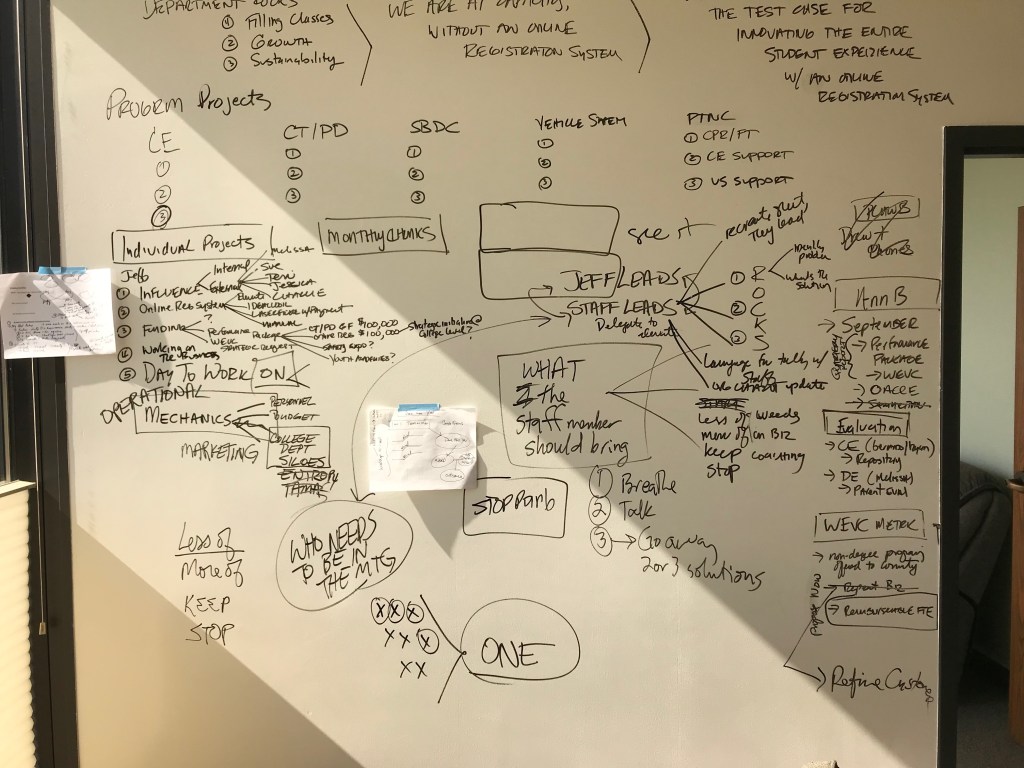
Visual learners like to see what they are learning. These learners are interested in the visualization of the work they are engaged with. Think whiteboards, flow charts, and large post-it boards.

They must see the work in order to fully take the information in, process it, and provide a meaningful response. Some people don’t know they are visual learners. If you are not sure, I suggest writing out your next project on one of the aforementioned tools, and see what happens.

As I am visual, I can provide an example here.

I don’t expect this visual to make sense, and in fact, it may shock or startle some of you. What you are looking at is how someone that is hyper-visual thinks.

The importance of getting those ideas out of one’s mind and into reality, via any tool really, is extremely important to someone that is a visual learner. Without the ability to do so, the person may get stuck. I know, I’ve been there.

Aural

Someone that learns best through sound is in the aural category. Think about someone that chooses to listen to audio books, or someone that must have someone explain a particular task or project to them through verbalizing the steps. Our youngest son is an aural learner.

For those that learn best this way, having tasks or projects written out or in visual format, as in the above whiteboard example, will not work. Or, rather, visual and written instruction will not work as effectively. Sound is the key.

Here is an example.

Jeff Flesch on YouTube

This is a video I created for the blog, 3 Reasons Why Avoidance is an Ineffective Strategy, and I am using it as an example of aural learning, as I am talking through a strategy in this clip. Helpful. What would not work for an aural learner, would be the written out steps to the associated diagram without the spoken explanation.

Verbal

Verbal learners need to read that which they are to work on or engage with. Being able to read instructions, for example, is imperative for a verbal learner. Think about putting something together, not with a picture in mind, but with a list of steps, 1, 2, 3.

Being able to internalize the written instruction or steps, is important for a verbal learner. What would help the above video clip for a verbal learner? Yep, that’s it. If I were to write out a list of the steps that I am talking the viewer through. That would be helpful. Think of an ordered system. More comfortable for a verbal learner.

Kinesthetic

Those that learn best with their bodies are kinesthetic. These learners like to actually do something with what they are learning. They need to actually touch, feel, and practice the new information.

Though the below picture is not the best quality, it gives you an idea of a practical tool that was created intentionally to engage those that learn best by doing something with new information.

Alright, so can the learning styles be combined? Do some people learn best with a combination of the aforementioned learning styles? And, can people’s learning styles change over time?

Do some people learn best when learning styles are combined?

Yes. I am a great example of this fact. I learn best, by seeing, reading, and then hearing information. I also like to practice new information by either utilizing a worksheet, or more likely a whiteboard. I love whiteboards. I have a whiteboard wall in my work office. Excellent.

Yet, this is only how learning works best for me. I know people that need to have information explained first. A must. Then they can interact with visuals, and other types of learning styles. Why is knowing this important?

When we know how the people we are in relationship with learn best, we can support them in their learning and life. Important. And, when we assume we know, and offer support, that support, while well-intentioned, may not work.

It’s also important to know, as we have discussed, that some people may not know how they learn best. Asking them, in these instances, may not help. What can you do? You can offer them different approaches to learning, and see what fits them best.

Do learning styles change over time?

Yes. Here are a couple of reasons why learning styles change.

  • Because as we develop we learn new ways to process and operationalize information. We may add new learning styles to our approach to learning, and may even need to let go of approaches that no longer work.
  • Different contexts require different learning approaches, so in these contexts, you may need to adapt your learning style while incorporating new tools. Think of a new job, going to college, or graduate school.
  • You may learn, in school or at work, about a new way to learn that was previously not available to you. And, in this new learning, you may adopt a new learning style that fits you better.

Why is it important to understand how we learn?

It’s important to our own development. When we know how we learn best, we can employ strategies at home and at work that align with our learning style, which can help our retention of information and mastery of all that we do.

As I’ve mentioned in this post, I am a hyper-visual learner, therefore it will probably not surprise you to know that I have not one, nor two, but, rather, three whiteboards in my little apartment. Yep, three. Needed.

It is also important to understand how other people learn best. When we understand how our friends, family, and coworkers learn best, we can support them by advocating for, and providing learning contexts that adhere to their learning style.

We all learn differently, yet the learning process is very similar regardless of the style that fits best.

And, why did I write this post? Good Question.

Because it occurred to me that it is also important to someone that is engaging others through digital media – you, me, and many, many other people.

Whether that is via a website, social media, a blog, or some other medium. Understanding how people learn is a critical component of engagement.

In order to create the most engaging context, as many learning styles as possible should be considered, addressed, and included when possible. As I continue to develop the COVID-19 Creativity website, I will employ more strategies that include each learning style to ensure that everyone has a quality experience.

Alright, we’ve addressed the top learning styles, walked through their significance, and connection to self-development, relationship-development, and the importance of using these styles to create more engaging contexts.

Now I’m interested to learn how you’ve used learning styles in your personal and/or professional life to create more engaging contexts. What have you done; and how did it work for you, and your audience?

#aural, #engagement, #individual-learning, #kinesthetic, #learning, #learning-and-engagement, #learning-styles, #relationship-development, #self-development, #verbal, #visual

Creating Social Change by Taking One Action at A Time

Photo by Clay Banks on Unsplash

I’ve written about taking action, and creating change in other posts. And, how that it is one action at time that creates change. It starts with each of us. One action at a time, over time. What is fascinating is that inside of taking action, we change, and those around us have the opportunity to also change. Choice.

First, what is social change?

Social change, in sociology, [is] the alteration of mechanisms within the social structure, characterized by changes in cultural symbols, rules of behaviour, social organizations, or value systems.

Encyclopedia Britannica

Though there are various theories on how to create social change, what is more clear to me than ever before, is that it is inside of the changes we make within ourselves that we have the opportunity to effect social change. There really is no other way.

What, then, does that look like over time. For instance:

  • How do we know that we are creating social change?
  • And, is it necessary for us to know that change is happening?
  • Or, is it enough to act, and be content with that?

Good questions, and I’m sure you have many others. For now, let’s look at the three listed above.

How do we know that we are creating social change?

We may not. Fact. Why? Because there may be a lag between the social actions people take, and the change that may occur inside of the social and or cultural systems. Such a time lag is common, and may contribute to people remaining inactive.

What are some of the other reasons why people remain inactive?

  • Fear – people are afraid of what they don’t know and don’t understand. If fear is keeping them inactive, it may continue to do so.
  • Comfort – people like being comfortable, and even though they may disagree with something, may not act.
  • Someone else – people, especially today, often think someone else will do it; so there is no need to act.

Most people have a little of each of these constraints to action within them, which, when combined, can be immobilizing. Not a justification, just a reality. Add when people confuse taking action with the result of that action, you get even more immobilization.

Is it necessary for us to know that change is happening?

Though we would like to know that every action we take is creating change, it is not our responsibility to know. As was aforementioned, it is not even possible to know that change will occur, as it may not happen for years from the time we took the action.

Here is a quote about actions and results that is important.

It’s the action, not the fruit of the action, that’s important. You have to do the right thing. It may not be in your power, may not be in your time, that there’ll be any fruit. But that doesn’t mean you stop doing the right thing. You may never know what results come from your action. But if you do nothing, there will be no result.” -Gandhi

Goalcast

Within this context, it is not our job to worry about the results of our actions. When we get caught up in worrying about, or focusing on results, we become disempowered. Why?

Because we can get frustrated when we don’t see change right away, which can further immobilize us. Disempowerment.

However, please remember, that it is in the actions we take that we grow, change, and create the possibility to change ourselves and the world. Not the result. That is the knowing, and that is empowerment. You are a seed of change when you act, even if you don’t see the sprout, or the eventuality of that spout.

Is it enough to act, and be content with that?

Yes. Think about the current situation. People are acting. Simple. They are standing for something and someone – many someone’s, and the end of systematic racism. That is the action. Period. Now, that doesn’t mean people don’t want to see system-wide change.

However, staying focused on the present actions is how system-wide change has the best opportunity to occur. Actions combined, again and again, over time. One step, then another, then another. Simple. Yet, complex. A paradox.

Action devoid of a present result is not wasted effort. Think about any of the largest social changes in history, and they are all predicated on, and connected to, actions someone else took earlier in history. All of them.

Taken together, then, you have a cascade of actions over space and time, which are all connected, and interdependent. And, they DO add up, and they do create change.

What can you do?

Take action. One. Then another. Then another. How?

I taught a social justice class for a time, and the final project for that class was to create a plan for how you, as the student, were going to create local change. Where would you start?

Many of the students were confused about the task. They thought about social change as something that happens in an instant on a grand scale. While this is definitely possible, it is not as likely as social change that occurs over time. When they were clear about the task, they came up with some amazing social projects.

They were local grassroots projects, which is how most social change occurs. Why? Because local people decide to take action. And, inside of that action, as we’ve discussed in this post, there is the possibility that others will follow, and take action, changing with you. Beautiful.

When you are wondering how to get involved, how to create change, start by looking at what you want to change within yourself.

Once you have discovered that thread, pull on it a little, and take action. Then another. Then another. You may find along the way that you are creating the social change you’ve been searching for.

#black-lives-matter, #change-over-time, #creating-change, #social-change, #social-justice, #social-systems, #systematic-racism, #taking-action

3 Reasons Why Avoidance is an Ineffective Strategy

Photo by Priscilla Du Preez on Unsplash

Avoid much? We all do. However, some of us avoid more than others. Might that be you? It was me for a long time. Why do you imagine avoidance is an ineffective strategy? Not sure. Let’s take a look at three reasons why.

3 reasons why avoidance is an ineffective strategy

1. It is not healthy

When we avoid things, we are, in effect, continuing to hold those things within us. Continue to do that, and you will be carrying around a lot of unnecessary baggage. Tiring.

You would think that by avoiding things we are uncomfortable with, do not want to do, or face, that we are creating more space within us. However, that is not the way it works. It’s the idea of the situation we are faced with that will continue to haunt us. Especially, if we believe deep down that we should be doing that thing, or facing that situation.

Let me give you an example

For a long time, I did not pay attention to my calendar. Now, in the position I am currently in, that ineffective strategy will not work for long. At that time, I knew that I should be paying more attention to my calendar, working to schedule myself more effectively, however, I ignored it. Why?

I simply didn’t want to take the time needed to work through it. Simple. Instead, I avoided it at all costs. What happened? People began to ask why my calendar was such a mess. Nice. I love when those we trust inquire, and make us think. Helpful. As was digging into my calendar and making the necessary adjustments.

Before doing the work in my calendar, it bothered me every time I looked at it. However, by organizing and prioritizing my calendar, I traded a fixed amount of time to do the work, with a continuous mental distraction. More effective.

2. It keeps you stuck

When we spend our mental energy on avoiding things, we have less mental capacity to try and do new things. Essentially, we sacrifice some of our creative potential. How much is sacrificed? Depends on how much you avoid things. If you avoid often, then your creative potential will be severely impacted.

And, being stuck is no fun. Often, people are not even aware that they are stuck; nor do they recognize that they are avoiding things. The years I spent avoiding, I was aware of some of my avoidance, most I was not.

Here is another example

As I’ve written about in other posts, there was a time when I drank a lot. Too much. I knew that there was an issue, however, I made justifications and excuses for my behavior. Sort of a double burden. As my avoidance of the real issue, which at the time I was unaware of, was compounded by creating excuses and justifications. Exhausting. Really.

And, ultimately not helpful. Not physically, mentally, or spiritually. When living this way, you end up on the proverbial hamster wheel. Doing the same thing every day, knowing you are doing it, making excuses and justifications for doing so, all the while staying in place. No movement.

Photo by Jeremy Bishop on Unsplash

3. You cannot grow

When we are avoiding, we are not moving; and, if we are not moving, we are not growing. Simple.

Growth is such an important part of the human experience. Some growth just comes our way. We didn’t invite it, yet it shows up on our doorstep. Some growth we actively seek out. We look for the opportunity. Either way, having experiences that help us grow is one of the most wonderful things about being human.

Yet, when we spend large amounts of time avoiding things, we are limiting our ability to grow. Why? Because, when we spend that much time avoiding things, we have no capacity to seek out growth opportunities. We are too busy. Too busy avoiding, and making excuses and justifications for why we are avoidant.

Final example

When I was working in the private sector, I took on a new assignment with a new sales team, and within 6-months, I was exhausted, and heavily avoidant. I went from a top-performing team, to a team that was in need of development. As was I.

Instead of welcoming the growth opportunity, however, I avoided it, and actually ended up leaving the company within another 3 months. Why? I was exhausted. That is true. Yet, why I was exhausted had less to do with the work, and more to do with my mental attitude.

I was avoiding the opportunity to grow, and making excuses and justifications for why it wasn’t working. Well, the only thing that wasn’t working was my thinking. And, that is okay. It is not a judgement. It happens to people all the time.

The point is to become aware of these types of opportunities. Being aware of how we avoid things creates the opportunity to better understand ourselves, and all of those around us. It also provides us the opportunity to grow, if we choose to engage with ourselves, inquire into our avoidance, and do something about it.

Photo by Carl Heyerdahl on Unsplash

What can you do?

Here are three strategies I use to get out of my avoidance, and into action.

  1. Notice when you are avoiding something, and write it down – wiring it down creates more awareness about whatever it is that you are avoiding.
  2. Create time to reflect and contemplate – create the time necessary to better understand why you are avoiding the task or situation. Until you really know why, you will probably not move forward in that area of your life.
  3. Take an action – once you are clear on why you are avoiding something, take an action. Create a context to make some progress on the task or situation. It doesn’t mean that it will be complete, or solved, however, you will have moved forward.

When we are less avoidant, we have more time, more creative capacity, and more energy to do more things. Essentially, we can hold more. And, when we can hold more, and do more, we can be more.

Remember, we are all at times avoidant. Yet, if you find yourself more avoidant than you’d like to be, try some of the strategies outlined above, and get yourself moving again.

#avoidance, #becoming-unstuck, #creativity, #growth-and-development, #health, #mindfulness, #slef-development, #strategy, #taking-action, #well-being