

#creatingchange, #development, #developmentalgrowth, #growing, #growth, #leadership, #leadershipdevelopment, #leadershipinaction, #leadershipmindset, #leadershipprinciples, #personaldevelopment, #professionaldevelopment, #teamdevelopment, #transformation, #transformationalgrowth
Category Archives: leadership
One BHAG, Two BHAG, and Creating a Disruption Vision

Two weeks ago, I wrote the post Creating a Big Hairy Audacious Goal: The Creation of the BHAG. In that post, I wrote about the possibility of creating a BHAG that lives inside of another BHAG. Having two BHAGs makes sense, especially right now in the midst of the COVID-19 pandemic.
I termed the BHAG that, at the time was just being created and not yet delivered, a disruption BHAG. And, seeing as the team I work with will get that BHAG Monday morning, I thought writing this piece made good sense. Plus, I made a promise. So, let’s go.
Here are 3 keys to creating a disruption BHAG.
Key #1: Let go of yesterday
To create a disruption BHAG, you must be open to creating from where you stand right now, at this moment. Meaning, you must be willing to let go of what you’ve done up to this point in your team, business, or organization. ALL of it. Especially those things that have worked well. They will not work the same in the future. Let them go.
Letting pieces of a business model, or a process or system go is not easy. Especially when they have worked well. However, you must be willing to let them go. Why? Because if you do not, you will not be able to visualize and put into practice new business models, processes, and systems. And, they are needed.
During the COVID-19 pandemic, many of us were forced to let go of things we were doing, whether they worked well or not. And, now I am inviting you to not only let go of those things, but to also create new ways of working with your team, running your business, or developing your organization. A must.

Example #1
We create about 300 classes and training opportunities per quarter. They are all in-person. When COVID-19 began to take hold locally, we had to pivot, AND, let go of all the things we had done previously that had worked well for us. Difficult. However, that is the only way to envision a new future. Otherwise, you are always tethered to what was. And, in what was, or the past, there is no future to create. You are simply reproducing yesterday.
Reality check. We went from 300 in-person classes and training opportunties to about 50. Yet, those 50 offerings paved the way for 73 the next quarter, which is now paving the way to our goal of 150 this fall. Movement.
That was the first step in creating the possibility of getting to a disruption vision. Letting go. What was next?
Key #2: Create processes and systems to support the new work
Once you’ve let go of how your team, business, or organization was doing business, you will now begin to create a new business model, and inside of this new business model, you will need new processes and systems to support it.
- First – get clear on the need, and the new components of the business model.
- Second – create those new components, move them forward.
- Third – get clear on the processes and systems needed to support the new business model.
- Fourth – solidify those processes, systematize them, and document them.
It is important to not get stuck in creating processes or systems until you have developed the business model. Why? Because if you get stuck in thinking about developing a process without understanding the need, and the associated business offering, you will not move forward. The process and systematization will come through creating the new model.
Don’t forget to document the new processes and systems. Very important. Why? Because these are now a part of your business model, and may always be. I know for all of the new business components we’ve added to our business model, they will stay, and will continue to be offered. Let’s look at another example.

Example #2
Once we created the remote, online, and remote classes, we began to ask the process and system question. And, as was aforementioned, some of these new processes and systems organically developed along the way.
For instance, in developing these new classes, and pivoting our business model 180 degrees, we knew that communicating with the local community was imperative. We filled this need by creating a communication process, and a system, which was also documented to ensure we were regularly communicating with all of our clients, students, and partners. Important.
Key #3: Create the Disruption BHAG
Once you’ve let go of the way you were doing business, and have created new ways to do business, which include new processes and systems that are documented, you are ready to create the new BHAG. How?
3 simple steps
- Brainstorm – or, as I’ve termed this in other posts and videos, get your ideas out. It seems very simple when reading, I know, yet, I also know that it is not that easy for everyone. Especially when we are inundated with day-to-day operations. Yet, creating time to think is a needed and necessary strategy for every leader.
- Connect them to the larger BHAG – once your ideas are out, see which ones connect naturally to your team, business, or organizations BHAG. Then play with those ideas, and ask yourself a few questions:
- Where are we going?
- Why are we going there; and,
- How are we going to get there?
- When you can answer these questions about the larger BHAG, and can see how your new ideas fit into that BHAG, you are almost ready to create the disruption BHAG. Yet before you do, I invite you to reflect.
- Reflect and contemplate – let the ideas sit for a little while. And, continue to reflect and contemplate until you are clear on the disruption BHAG. Once you are clear, write it down.
Once you have the disruption BHAG written down, I suggest letting it sit for a little while. I let the one I created recently sit for a couple of weeks. I continued to play with the language and the concepts, and am clearer on the BHAG for doing so. And, the clearer you are, the clearer your team, business, or organization will be.

The invitation
Now that you have your new disruption BHAG ready-to-go, it is time to invite the team, business, or organization that you work with to this new vision. You can do this in many different ways. Yet, I do recommend connecting deeply with the people you work with about this new BHAG. They must see themselves inside this new vision, and you are the one to show them this possibility.
Example #3
Alright, we are still in the midst of COVID-19, and the team is still remote. How do I invite them to this new BHAG vision? Hm. Not sure? I wasn’t either. Until I had a conversation with a colleague. They said, “you should do a video.” Wait, what? I’ve never done a video before. Uh, oh.
Well, that is exactly what I did. Cut to many takes later, and hours worth of time spent learning how to upload a video correctly – use YouTube, please, very easy, will save you time – and I have a 6-minute video. Phew. Was awesome.
The email, video, and worksheet will go out Monday morning. I am super excited.
I believe that people are moved by their hearts. You must pull them from there to create anything that will last; and, because I was not able to create the BHAG with them, the video, I do believe, is the next best thing. Looking forward to Monday.
Remember, you can create an additional BHAG inside of the one you currently have. Actually, I think this is the best time to create a new BHAG. A disruption BHAG. Having a new BHAG will create a context that is specific to this next year. As we all know, all teams, businesses, and organizations will be different this next year. Why?
Because, due to the COVID-19 pandemic, we’ve all changed. And, it is inside of this change that you can create new momentum for your team, business, or organization. And, you can do this by connecting with people in a new way through a disruption BHAG, which can live inside of the longer-term BHAG already in existence.
Creating Movement in Your Team, Business, or Organization: 3 Steps in 3 Minutes

I recently wrote 3 Steps and 9 Keys to Creating Safety on a Team in 5 Minutes, and today, I’m going to focus on creating movement. Have you ever felt stuck? Like you and your team, business, or organization are not moving, have not, maybe, moved in some time. Instead, you find that each day seems the same. A reproduction of the previous? Happens to us all.
Let’s take a look at 3 steps you can take to get moving again.
Step 1: Create Time
We are all inundated with email, all day long. In the first year in my current position, I checked email often; and, there were times when I was more focused on keeping my email in check than doing my actual job. However, email is not the job; it is a tool, nothing more.
3 suggestions for creating time by managing email
- Check periodically – morning, afternoon, and before close of business. Set this time aside. Add it to your calendar if needed. However, when you are not in your “check email time”, leave it alone.
- Prioritize the need – sounds funny, yet prioritizing your email is very important. Often, I get emails that I might not respond to for several days. Why? It’s not needed. Not every email needs a response right away, and some never need a response.
- Organize as needed – in the past three years, I’ve reorganized my email countless times. As the business changes, your calendar will change, and so should how you organize your email. Reorganizing your email so that it mirrors the current iteration of your team, business, or organization will save you the time of searching endlessly for emails to follow up on.

Step 2: Create Balance
I’ve found that finding time to work on the business (strategic thinking), instead of in the business (the weeds) is one of the hardest skills to develop. Why? Because we live in a reactive society, and work within reactive organizations.
Though you are working very hard, if you continue to work hard mostly on day-to-day operations, you will not spend the time needed on creating future plans, goals, and objectives. You will stay stuck. You must create the time to strategically think about the direction of your team, business, or organization.
3 strategies for balancing the weeds and strategic thinking
- Manage time – I’ve used multiple different time management systems in the past three years; and, what I’ve come to realize is that continuing to change how you organize yourself is okay, even needed. If the way you are organizing yourself today is not working, let it go, and try something new.
- Delegate – I’m one of those people who likes to do everything, and I have a hard time asking for help. Yet, letting your team assist you is necessary and needed. Delegating work is always essential, and is even more essential to ensure you have the time you need to create strategy.
- Slow down – I love to be in action. Simple. Yet, there are times when you need to slow down. Let some of the day-to-day operations wait, so you can just sit and think about your team, business, or organization’s trajectory; and, what you want to create as its next step.

Step 3: Create Strategy
Once you’ve created more time, and have more balance, you can now effectively work on the business. Very important.
3 strategies for creating strategy and gaining traction
- Get your ideas out – often we think about what we want to create, yet we are so busy doing other things, that we don’t get these ideas out; and, when our ideas stay within us, we cannot use them. Write them down, put them on a whiteboard, put them in a document. It matters less how you get them out, than it does that you do so, and have the time to reflect upon them.
- Invite considerations – collaborative teams and organizations talk about strategy. If you are on that kind of team, or in that kind of business or organization, invite people to consider your ideas. What do they think? Incorporate the best ideas into your ideas. If you work on a team, or in a business or organization that does not collaborate, invite people to consider your ideas anyway. Create collaboration.
- Create an action plan – once your ideas are out, you’ve invited feedback, and have had time to reflect, it’s time to create an action plan. I always work backwards. Meaning, if you are creating a strategy for next year, work those goals backward to each quarter, month, and week, and create objectives that align with the yearly goals.

With your new action plan, you can begin to create the traction you’ve been looking for. Remember, you are not alone. Most teams and organizations are in the same place. They feel stuck. That you are aware of it, is the first step. Now you can mobilize the steps outlined here, and create movement for your team, business, or organization.
Also remember, that sometimes your team, business, or organization may have to move “backward” to once again move “forward.” I’m not a fan of labeling movement, because all movement is important and needed.
For instance, COVID-19 has created a “backward” momentum for teams, businesses, and organizations all across the globe. Now what matters most? Not being concerned about moving backward. Instead, create from where you are, and you will move forward.
3 Steps and 9 Keys to Creating Safety on a Team in 5 Minutes

A couple of weeks ago I wrote Three Transformational Leadership Skills; and, creating safety was on of the three. This week, let’s take a deeper look at creating safety among those you work with, and lead. What does it take to create safety? And, how important is creating safety? I believe it is always important, and is even more so now amidst the COVID-19 pandemic, and will continue to be in the next few years, as we all learn about our new realities.
Creating Safety
What does it mean to work in a safe environment, where you feel like you can act and be who you really are, without fear of reprisal? Well, it means exactly that. That those on the team, in the work office, or that are a part of the organization, can be who they are. Meaning, they can act and say what is needed about the direction of the team, without fear of someone lashing out at them, and defending or justifying why their opinion is more important than theirs. The latter, doesn’t work well.
What works well? Creating an environment where people can actively question each other, even be critical of each other, yet know that they are safe. It is a big deal. If you are on a team that can act in this way, you will gain more traction on your goals and objectives.
Why?
Because you are actively talking about the issues that matter most. And, when you are talking about, and creating action plans to resolve those issues, you are creating movement. And, movement is needed and necessary to create traction.

Step 1: Understand the keys to creating safety
I’m sure there are many ways to create safety on a team, or within an organization, yet I can only speak to the ones that have worked in the contexts in which I’ve worked. And, these keys, I think, can be utilized across multiple contexts, across different teams, and across many organizations.
Three keys to creating safety
- Building relationships – developing high-quality relationships is important to creating safety on any team. Making the time to get to know each person on the team, their hopes and dreams, as well as their strengths and opportunities. Knowing each of them well is necessary to understand their perspective, and to build trust. Trust is akin to safety.
- Fostering individual perspectives – when people have a say in how things work, and how the team moves forward, more comfort and more safety is created. People want to participate, to collaborate, to draw upon their talent, and to provide their individual perspectives on issues the team faces. Foster these perspectives.
- Creating support systems – think safety net. People need to understand how they will get the support they need. Support can be delivered many different ways. What is important is that there is a support system in place, and that the team knows how it works.

Step 2: Understand the keys to your role
As I’ve discussed in other posts, everything you do within your team and organization starts with you. The way that you develop yourself, and lead from within, will determine how you lead without. Same. Taking the time to develop skills that will move yourself forward, hence, the team, is important.
Three keys to your role
- Being open – one thing that helps foster a safe environment is being open and available. When the team knows you are open, meaning open to new suggestions and ways of doing things, they will feel more appreciated, and more safe.
- Being available – will also signal the team, that spending time with them is of utmost importance. I’ve always found that open environments foster the most innovation and safety.
- Being authentic – leading with authenticity creates the possibility that the people on the team will also demonstrate authenticity. And, authentic environments foster contexts where people can give candid and honest feedback about how the team is doing, and what they see as necessary improvements.

Step 3: Understand the keys to the team’s role
Once you are clear on your role, you will have developed the ability to understand the team’s role. And, understanding the team’s role, including each person’s role on the team is important to foster momentum, movement, and traction.
Three keys to the team’s role
- Individual engagement – creating ways to engage each individual team member at their developmental stage is important to their growth both personally and professionally. And, opportunities for developmental growth is critical to moving teams forward.
- Team engagement – developing ways to engage the team, and for the team to engage with each other is important to creating safety. People that don’t know each other well, don’t general trust each other, nor will they feel safe with each other.
- Connecting the individual to the team – fostering individual development while also building the team’s development is a very important component to creating a team that knows how to move, develop, and gain traction in their work every day.
Movement and Traction
Implementing the aforementioned strategies within your team will increase the possibility of creating movement, and gaining traction. And, as the team moves forward, finding new ways to ensure that the safe environment you’ve fostered, and the team has created, is continuously redeveloped is important. Contexts change, organizations grow, they shrink, and they move forward. The ability to develop new strategies to create safety as things change is critical.
The COVID-19 pandemic is, unfortunately, a great example of a change that no one saw coming that has increased anxiety and decreased safety throughout the workforce. Now is the time to create, and recreate safety. Creating safety is an essential leadership skill, and it is also essential to growing, moving, and gaining traction on teams.
Originally posted on servantleadershipcoaching.com
Three Transformational Leadership Skills

Where we start matters, much more than where we end up. For, it is in the starting of something that matters. The action, not the result. Let us embark, then, on a simple foray into leadership essentials.
What are those essentials, and why do they matter? And, do they matter only for leaders, or do they matter for everyone on a team, in a family, or in a relationship? Hm. Good questions. Let’s take a look.
Being Authentic
One of the most important leadership skills, is the ability to know oneself. Understanding who you are, what your strengths and weaknesses are, is critical to effective leadership.
It is an impossibility to effectively lead a team, when you are disconnected from yourself, or are hiding from yourself. Impossible.
What is possible, is to be honest about who you are, and to be authentic. Being anything other than authentic will come off fake. The team will know when you are not being authentic, and traction with the team will elude you.
When you are authentic about who you are, you create the possibility of openness. When you are open to all that is around us, you also show that you are vulnerable. And, when you are vulnerable, you openly admit that you do not, could not, know all of the answers. No one can.
The opposite of authenticity and vulnerability is rigidity. Being rigid, pretending you know things you do not, will shut people down, close doors to new possibilities, and decline moral.
Practicing authenticity and vulnerability starts with you. You are the only one that can be authentic, and vulnerable. It can be frightening, as I share often with the team I work with, to be out on a ledge before the unknown.
However, that is where all the great stuff awaits you.

Creating Safety
Creating a safe environment where people can be who they are, while knowing that they are safe to do so, is important to building trust. And, building trust with those you work with, reciprocally creates more safety.
I believe that the ability for a leader to create safety, is one of the most important leadership skills.
That is my bias. However, know that without trust, developing the investment, or buy-in, from team members on what you are looking to create is impossible. They must trust you completely. And, trust will only come when the environment is a safe one.
When you have created a safe and trusting environment, you have the opportunity to innovate because people are willing to trust in each other and be vulnerable. Safety increases the likelihood that people will be who they really are, authentic and vulnerable.
And, being vulnerable is one of the keys to creating innovative teams.

Include Transparent Communication
Being open with your team, includes being transparent. In the first year working with the team I am currently working with, there were people that were surprised when I would discuss the financials with them. They had never had open conversations about the finances. They were simply told to hit a number, or were told nothing.
You may get results this way, however, I am here to tell you that those results will not last, or will be limited.
People that don’t understand the financials, cannot understand all that is possible. And, similarly, only knowing a number, is only one piece of the whole. People need to have access to all of the information, so they can grow.
When people grow, the team grows. And, when the team grows, you grow. Simple. Growth will only come when you have created an environment that welcomes growth.
Welcoming growth, which includes creating opportunities for individual and team development, are keys to building an innovative and dynamic team.

Developing High-Quality Relationships
Being authentic and vulnerable, while creating a safe and trusting environment, which includes transparent communication is all about creating high-quality relationships. And, it is inside of the development of these relationships where reciprocity flourishes.
Building and fostering relationships that are reciprocal, means that it is always a team effort. Always. As a leader, you lead and set the tone, including practicing all of which we’ve discussed, however, it is the entire team that creates traction that is sustainable.
And, as they grow, you grow, and as you grow, they grow. Transformational.
The leadership skills we’ve discussed in this post are not limited to work teams. These leadership skills can be used in any relationship. And, you can get transformational results from any of your relationships by employing these leadership skills.
Relationships that are transformational have no limits. People in these relationships, whether it is a work team, family, marriage, partnership, or any other relationships, live without limits, without fear of the unknown, at the edge of what is known.
As a leader, it is your choice. What will you choose to create with your team and in your relationships?
Originally posted on servantleadershipcoaching.com
Creating a Big Hairy Audacious Goal: The Creation of the BHAG

Alright, phew, what a busy couple of weeks. So much change. As I continue to prepare for the merger of my two websites, I am going to continue to post new material to this site, which was originally created for servantleadershipcoaching.com.
I am excited about the merger, and about reformatting this website. 🙂
Hopefully, you will enjoy these new additions! Here then is:
Creating a Big Hairy Audacious Goal: The Creation of the BHAG
What in the world is a BHAG, and why does it matter? A BHAG (Big Hairy Audacious Goal) is a way to get out of the weeds, and create a distinction between working in the business and working on the business. Creating a BHAG is also a way to take all of the smaller goals you have and connect them to a higher level mega-goal – the BHAG. Not sure if a BHAG is for you? That’s okay. I invite you to read the following list before making a choice.
Do any of these sound like a day you’ve experienced recently?
- Working in the business more often than working on the business – this is an important distinction, and means that you are working on the day-to-day operations of the business more than you are the long-range planning and vision for the business.
- Reacting to the daily business needs, more often than working purposefully, and wondering if those reactions are in any way connected to the vision of the business.
- Spending more time at a computer screen than a whiteboard.
- Feel like you are going in multiple directions all at the same time, while wondering if these multiple directions are connected to each other, and your other long-term goals.
- You have multiple competing goals, and are unsure how to connect them.
- You are unsure how to connect your metrics to the day-to-day business operations, AND, your long-term goals.
If you experienced any of the above, then creating a BHAG is for you. Where did the term BHAG come from? Here is an excerpt from Built to Last: Successful Habits of Visionary Companies by James Collins and Jerry Porras.
Boeing Corporation is an excellent example of how highly Visionary companies often use bold missions – or what we prefer to call BHAGs (pronounced bee-hag, short for “Big Hairy Audacious Goals”)– as a particularly powerful mechanism to stimulate progress.
One of the coolest things about creating a BHAG, outside of the progress that lives inside of that creative experience, is that you can create them for your personal and professional lives.
Let’s look at the creation of a BHAG through a real life example – mine.
After 6 months in my current position, Director of Extended Learning at Linn-Benton Community College, in Albany, Oregon, I was wondering exactly what I had committed to. Has that happened to you before? It happens to all of us.
Anyway, I was working hard, very hard. And, most of that work was focused on working in the business, not on the business. As I’ve mentioned earlier in this post, and in other posts, if all you do is work in the business, you will simply get the same result you got the day before – the same thing, everyday. Why? Because you are doing the same tasks everyday. Simple. It’s not that you don’t desire to grow, and do more, however, you are effectively stuck in yesterday.
However, if you can shift to working both in the business, and on the business, watch out.
After over a year of working in the business, I went to a strategic thinking training, led by Terri Houde, which was where I first experienced the BHAG. I believe we were first asked to work through some of our goals, to identify them, and write them out. Then we were asked to go out on a ledge, and create a goal that was at the limits of what is possible – the BHAG.
Here is the one I created.
Becoming the State recognized leader in noncredit education
Creating a BHAG is a life changing experience, because in one moment you create in language a goal that is so big, it is visionary. And, what do we know about working inside of a vision, rather than working outside of a vision?
“Having a vision provides a sense of purpose and direction for the business. Your vision will help you define your short and long-term goals, and guide the decisions you make along the way. A leader has the vision and conviction that a dream can be achieved…” ~ Ralph Lauren
Okay. I’ve created a BHAG, now what? Don’t know. I didn’t either. Here, however, is what happened.
Once the BHAG was created, it was time to inform the staff about the vision. I created a very simple presentation, which I delivered at a team building training at the end of 2018. Why is standing before your team and delivering a vision needed and necessary? It is important, so they can see you, AND themselves inside of the vision. When we can see ourselves as part of a vision, we are going to act in accordance with that vision.
In fact, I told the team often then that the BHAG came through me, however, it was a part of everyone of them. I can see each of them in the vision.
I should also mention that when the vision was created, we were also implementing Traction, which is a way to systematize your business operations (Wickman, 2012). The timing was perfect, because we were able to make connections to the 10-year vision (BHAG). We then created the following.
- 5-year priorities and goals
- 3-year priorities and goals
- Yearly goals and priorities
- Quarterly goals and priorities
- Weekly and monthly next actions
All of which were connected to the 10-year BHAG!
Working inside of a vision the past two years has been a wonderful learning experience. We’ve achieved some of the goals we’ve set out to accomplish, and have many more to achieve. However, we are all pointed in the same direction, focusing on the same things, and have a shared language around a vision that was created from a one-day training experience where a BHAG was created.
Now we find ourselves in a very new situation – COVID-19. Well, in the next post, we will discuss what you do when your BHAG is severely disrupted. Can you guess? Yes, no?
You create another BHAG!
Yep, that’s right. You can have a BHAG that lives inside of another BHAG. I’d share that one with you, however, it is very new, and the team hasn’t even seen it yet. Next time, promise.
Remember, when you are interested in taking your business, organization, team, self, to the next level, create a BHAG. Then work backwards and connect that vision to this year, quarter, month, week, and day. Then you’ll know that every action you take is moving you closer to your ultimate vision, mega-goal, or BHAG!
References
Collins, James C., and Jerry I. Porras. Built to Last: Successful Habits of Visionary Companies. New York: HarperBusiness, 1997.
Wickman, Gino. Traction Get a Grip on Your Business. Publisher: New York : BenBella Books, Inc., 2012. URL.
You can reach Jeff Flesch at fleschj@linnbenton.edu and Terri Houde at houdet@linnbenton.edu.
Originally posted on servantleadershipcoaching.com
Leadership in Practice Series Part 3 – Community and Continuing Education and COVID-19: A Brief Exploration

Have you ever heard of community and continuing education, or noncredit education? Yes, no? Either way, that’s okay. Most people know very little about the breadth, accessibility, and availability of community and continuing education.
Before taking my current position, as the Director of Extended Learning at Linn-Benton Community College, I knew very little about community and continuing education. Sure, I’d heard of community classes, yet they were not something I had access to growing up.
Learning, then, that community and continuing education, of which corporate training, professional development, and small business development are also a part, are far more accessible and available than I knew, and many people know was enlightening. And, right now, access to these classes is needed more than ever.

Community and Continuing Education
Why?
Now more than ever people need a place to connect with other people. Humans are social beings. Regardless of whether you consider yourself an introvert or an extrovert, people need to be with other people. And, right now, that’s hard. Really hard.
Community and continuing education provides such a space. Yep, even right now. Though, for sure, COVID-19 has presented unprecedented challenges for educators all across the country, some organizations have found ways to continue to serve. How?
Creating new ways to deliver education that is typically considered and associated with an in-person experience. Prior to COVID-19 becoming a local reality, the Extended Learning Department at Linn-Benton Community College had only a handful of remote classes and training. Starting this fall?

What?
The Department will have over 120 Community Education classes, 4 cohorts (all full with a winter term waitlist) of Professional Development training, at least one Driver Education class, and over 10 Small Business Development Center classes and workshops. And, yep, they are all remote. Phew. Unprecedented change. Why does it matter?
Though taking a class or a training during a massive pandemic may seem like the wrong time, it is exactly the right time. There has never been a more “right” time to be connected with other human beings. Never been a more right time to continue to learn, to grow, to move ourselves and everyone around us forward. It is just so. The right time.
How?
Easy. You sign up for a class or training you want to take, and take it. Simple. Now, we’ve experienced lots of technological challenges in delivering these new remote classes. A wonderful learning experience. And, like anything, there is really only one way to learn something, and that is to do it. Simple.
“Fill your life with experiences. Not things. Have stories to tell, not stuff to show.” -Anonymous
Awaken the Greatness Within
If you are unsure where to look, take a look at the local community college, University, or Parks and Recreation department where you live. Will they have remote classes? Don’t know. However, many have been offering remote classes, and I think more will follow. And, if you don’t have access? Well, you can always reach out to Extended Learning at Linn-Benton Community College. Yep.
It is most important to know that there are classes and training happening right now. Whether it is in the community you live in, or in another community miles away. Because these classes and training are remote, the miles matter less, than knowing that they are available and accessible.
For more information on how to access Linn-Benton Community College Extended Learning classes and training you can email Jeff Flesch at fleschj@linnbenton.edu.
Leadership in Practice Series Part 2: Creating 90-Day Priorities Inside of a 10-Year Vision

Once your vision is created, then what? Regardless of whether it is a 10-year, 5-year, or 3-year vision, you will need to put plans in place that will connect the daily work to that vision. That is how your 10-year vision will become a reality.
What, then, are the first steps to ensure that your weekly, monthly, and quarterly work connects to the long-term vision?
In this article we will walk through the process we went through to connect the 10-year vision to our 90-day priorities. First, another question.
Where does a leader start when they want to ensure that everyone’s daily work on the team, or in the business or organization they belong to is contributing to the long-term goals?
Let’s take a look.
Start with the 10-year Vision and ask yourself a couple of questions.
- What are the goals of the 10-year vision?
- What are the metrics of the 5-year plan?
- What will the current year look like?
Let’s look at each question, one at a time.
What are the goals of the 10-year vision?
Once the vision is created, it’s time to create the goals that will drive all of the work. However, before you move on to creating those goals, which will drive the objectives and priorities, ask yourself what your vision will look like in reality.
What will the revenue and service look like, what will the staffing model look like, will you add positions between now and then?
Once you’ve asked yourself these questions, or ones that are more important to your particular vision, start to build out what that vision will look like in reality. Here is an example, vision first, then what it will look like in reality.
Here is the vision

Here is what it will look like

Once you’ve created the 10-year vision, and also know what it will look like, you are ready to work backward. When I went through this exercise last year, I started this part of the planning session with year 5. I looked at the previously designated metrics and asked myself what they would look like in reality. For instance, what would revenue look like, and how many people would we serve.
What are the metrics of the 5-year plan?
Here is what that looked like
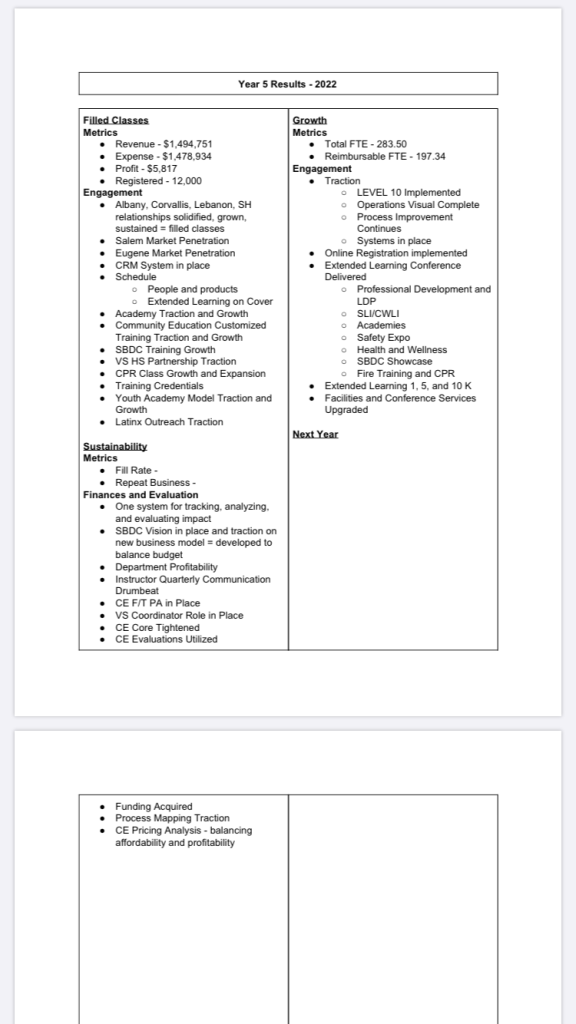
It is a wonderful exercise to start with the larger 10-year vision and to work backward to the 5-year plan, creating more clarity as you go. It is how you begin to connect the 10-year vision with the work you need to do today.
Once you’ve worked backward to year 5, you are ready to work backward once again to year 3, or whatever the current year is for your team, business, or organization. It is important to continue to get clearer on what the future reality will look like.
What will the current year look like?
Year 3 Department Objectives

As you continue to work backward from the 10-year vision to year 5, to the current year you are planning for, in this example, year 3, the objectives that will lead the team to that 10-year vision do become more clear. Important.
And, as these objectives become more clear, so will the priorities that will drive each person’s work. For instance, in our year 3, we had 1-year objectives, which we executed on in 90-day chunks. Meaning that we focused on moving forward our yearly objectives with 90-day priorities that would shift as needed, yet the objectives would remain the same.
Year 3 Staff Objectives

Once you get to 90-day priorities, it is time to create a coaching model that will mirror all of the aforementioned. Fully discussing this coaching model is for another article, yet I would like to share with you the simple template we created, so you can see how a 10-year vision can connect to a staff member’s daily work.
Coaching Model Template

Though you can only see a portion of the form, you can see the overall process, where the yearly objectives (on the left) are connected to the department objectives (on the left in bold), while the specific priorities and actions to move that work forward are on the right. Fun.
A couple of weeks ago, I wrote the following article, One BHAG, Two BHAG, and Creating a Disruption Vision, in which we discussed the possibility of creating a disruption vision or BHAG inside of a 10-year vision. And now, the planning process we’ve walked through in this article is being recreated. The difference?
Because there is so much change right now, we have a 1-year BHAG, which lives inside of the 10-year vision, and 30-day priorities, instead of 90. I am in the process right now of re-instituting one-with-ones so that we can discuss, plan, and create our next actions one month at a time. Allowing us the pivotability, and flexibility needed.
Very well. There you have an example, with tools, on how you can connect your team, business, or organizations’ 10-year vision to the work that needs to be done daily to ensure that the 10-year vision will live in reality.
Be well, and lead well.
You can reach Jeff Flesch at fleschj@linnbenton.edu
Originally published on servantleadershipcoaching.com
Leadership in Practice Series Part 1: Getting into Action, Keeping Relationships Strong, and Iterating Your Business Model to Stay Relevant During COVID-19

I’ve written about leadership on this site a few times, so I’m doing something new over the next few days. I’ll be posting some articles I’ve written on leadership. New content on this site, and a conversation that is relevant and important right now. Enjoy. 🙂
Leadership in Practice Series Part 1
What do leaders do when everything they’ve prepared themselves and their teams for is suddenly, within hours, less relevant than ever before? Less relevant as a massive health pandemic, COVID-19, crosses the Atlantic Ocean and shows up in the United States. Not sure? Though I’ve lived it for these past three months, I’m not sure either. So, let’s take a look at what happened, and some of what I’ve learned these past three months.
COVID-19 Takes Root Locally
In early March I received an ominous email from by boss, which read something like this: if the College suddenly needs to close with little to no notice, what is your plan to continue service? Wait, what? At the time, I was admittedly ignorant about the scope of the COVID-19 health crisis in the United States, and the speed at which the virus was making its way towards the West Coast. What to do?
Well, I acted as I would have under any other circumstance. I sent the team the query, gave them a due date for feedback, which was extremely short, and gathered the information. I then rolled the information up into a document to share with my boss. We did this all within 48 hours.
I’ll be the first to admit that the plan was extremely basic, as our business model is one that requires, at least I thought so then, an in-person experience. Within two weeks of creating that plan, we found out that the College was going completely online to finish the Winter Term. Because, at the time, we did not have online or remote classes or training, we cancelled the last week of Winter Term to ensure the safety of our students and clients.
Get this. You are in your third term of the academic year, you just cancelled the last week of the term, and you are actively registering for spring, which is typically the strongest term of the year. And, your sales volume is up about 30% over the previous year. Now what do you do?
Get Into Action and Start Creating
In the next two weeks, it became very clear that the College would also be completely online and remote for Spring Term. What did we do? We started creating.
Here are some of the things we did.
- We emailed all 200 instructors and asked if they would teach their in-person class remotely – note, at the time we had no systems or processes in place to offer these classes.
- We moved all of our Professional Development on-campus training to Fall Term.
- We communicated with all of our instructors, clients, partners, and students, letting them know about the College’s direction. We also inquired with other Colleges as to their plans, which was a very helpful decision. It gave us sight that other Colleges were also going remote, if they had the capability and financing.
- We created an operations plan out of thin air. Here are a few examples of that plan.
- Daily remote operations check-in’s.
- Remote one-with-one’s as needed.
- Twice-a-week remote registration staff meetings.
- Weekly remote all-staff department meetings.
- Bi-weekly program meetings.
- Each staff member identified their top three remote work priorities.
- We created many new processes, which included new ways to:
- Register students and clients
- Interact with all of our instructors, and clients
- Track student enrollment
- Process payment
- Engage and market our products and services to the community
The point is, we did not sit back and wait for someone to explain the “how to” of the COVID-19 health crisis. There is no such thing. There never was, and never will be. You create on the fly, you do the best you can, and you serve.
You create possibilities where none ever existed before. You listen to your team, and to every idea they have. And, you take action on the best ones – the ones with the most impact.
You also continue to foster, and grow the team, which ensures you are continuing to grow the relationships with your instructors, students, and clients – those relationships are everything.
Keeping Relationships Strong
I’ve always said that relationships are everything. Really, they are. Nothing happens without high-quality relationships. Nothing. Everything is predicated on the strength of the relationships you have with those around you. However, working and living inside of the COVID-19 health crisis has taken my thinking and belief that relationships are everything to another level entirely.
Let’s take a look at a couple of the things we did to ensure that our relationships stayed strong during this most uncertain time.
- Continue Creating Safety
- Your team must feel safe to pursue the unknown with you. I believe this is true all the time, yet when your entire business model gets thrown out the window by a pandemic, and everyone is also concerned about their own physical safety, it is even more true. Having and continuing to create safety for your team is of utmost importance.
- Create Even More Consistency and Structure
- Another thing that was/is important, is the ability to create structure and consistency. When you are living in a highly unstable time, where change happens sometimes on a daily basis (hourly even), creating a consistent operations communication plan is critical. People must be able to depend on regularity, especially with so much uncertainty.
- Create New Ways to Engage With Your Clients and Students
- When we learned that the print schedule, which lists all of our experiential classes, was irrelevant, as all the in-person classes advertised were now in the process of being converted to remote classes, or were being cancelled, we pivoted and created a new digital schedule format. We then created processes to ensure we were collecting information needed, to digitally communicate with our students.
Now, let’s take a look at a couple of things you can do when your current business model, which was functioning well, is no longer relevant.
Recreating and Iterating Your Business Model
As was aforementioned, when COVID-19 began locally, our business model was functioning well, yet would become irrelevant if we did not act quickly. Here are a couple of the things we did to stay relevant.
- Let Go of What Worked in the Past
- One of the things we recognized very early on, was that we would have to create several entirely new business models – and, that work continues today. It can be hard to let go of a business model that is profitable. You must, however, when you are faced with a situation where that business model is no longer relevant or sustainable. If you don’t, your competition will pass right by you, and you will be out of business.
- Create New Business Models that Fit the Current Reality
- When we began to pivot our business models, we created on the fly, and, as was aforementioned, got all of our instructors into the conversation very early. Having strong relationships with our more than 200 instructors created the possibility that we could begin to deliver remote classes, something we had never done before.
- Continue to Iterate the Business Models as Needed
- We continued to iterate the business models as needed, and have continued to add new components, and take out others, as we’ve learned what has worked best. As humans, we have a desire to want to implement something that will be effective, and then stand back and watch it work. However, it’s not always that simple. Often it is not, in fact. Especially during such an uncertain time. So, when something is not working, get rid of it, and try something new. We’ve done that, are doing it now, and will continue to do it as often as needed.
All of the aforementioned sounds simple, and it was not. There was also a ton of uncertainty, fear, and anxiety that went with the plans and actions we’ve created and taken these past three months. Within myself, and within the team. However, we did not let that fear and anxiety stop the work that needed to get done.
Additionally, we have wonderful instructors. They are the main reason why we were able to offer 43 remote classes in Community Education spring term, and 73 for summer. The College was also extremely supportive, allowing us the space we needed to innovate.
The lessons I’ve learned in leadership these past three months are just now starting to surface. I feel very lucky to have had the opportunity to learn more about myself, and our team these past three months. I knew they were a resilient bunch, yet their level of resilience surpassed even my expectations.
Now as businesses start to reopen, we are continuing to consider what our next steps will be. No one can ever know the future, and, sometimes, as the COVID-19 health crisis proved, the best laid plans can go asunder. However, if you are up to the task, you can thrive in an environment that is completely unknown to you. You take one step at a time. You continue to foster your relationships, be who you are, and create anew over and over again; and, you watch and learn from all of the wonderful people around you.
Questions for you
- What have you done to stay in action in your business (or life) during the past 6 months?
- How have you kept relationships strong through all of the recent changes?
- How have you iterated your business (or life) model to stay relevant and grow during COVID-19?
Look forward to hearing your stories!
Originally posted on servantleadershipcoaching.com
 Develop. Inspire. Transform.