Poetry and Prose by #1 Amazon Bestselling Author of Nature Speaks of Love and Sorrow, Co-Author of #1 Amazon Bestseller, Wounds I Healed: The Poetry of Strong Women, and Jan/Feb 2022 Spillwords Press Author of the Month
Anyone can create a why, right? You get a prompt, why do you do what you do? You answer. Yet, that’s not quite it. If your why is disconnected from your authentic-self, people will not be attracted to it; why?
Because they will know/feel that you are being inauthentic.
It is, then, super important when creating our whys to be the authentic human being you know yourself to be. Let go of preconceived notions of who you think other people believe you are, and write your why from the space of who you know yourself to be. Important.
See, creating a why, or a purpose statement, is not about pleasing someone else, it’s about you. About the person you are today, the person you are creating yourself to be tomorrow.
When you get clear on your purpose, and convey your why from a place of authenticity, people will be attracted to it. They will see themselves in you. And, when someone shares their why with you, you’ll know if they’re being authentic, and, if they are, you will probably be attracted to them.
I’ve been following more and more sites the past couple of weeks, and have been truly inspired by all that I’ve read. From food recipes to articles on grief and trauma.
In the event someone hasn’t told you recently, you are making a difference in the world. Each one of you.
Human connection is such a wonderful experience, and to connect with each of you, though distanced we are, is such a joy, and honor.
My cousin literally just sent me a new message via LinkedIn, and shared with me a beautiful story about the Good Night Lights. Have you ever heard of this? I hadn’t. Take a look. Beautiful, and moving.
Good Night Lights
I went to the site and was moved to tears. Why? Well, it is, yes, a beautiful story. And, then, it got me thinking about each of you, and the work you continue to do on your individual websites.
See, it isn’t about moving an entire population of people, or providing them access to you and your ideas, all at the same time. It’s about touching one person at a time.
One person, then becomes two people, which eventually becomes thousands, as many of you can attest to; and, thousands can become millions.
You are an inspiration, and I thank you for the opportunity to know you in the way I do today.
Here are three quotes on authenticity that I love.
A Quote
“Authenticity is a collection of choices that we have to make every day. It’s about the choice to show up and be real. The choice to be honest. The choice to let our true selves be seen.” Brene Brown
“As I began to love myself. I found that anguish and emotional suffering are only warning signs that I was living my own truth. Today I know this is authenticity.” Charlie Chaplin
I’ve written a lot about vulnerability lately. Why? Well, for many years, I avoided vulnerability at all costs. Really, I did. I was not interested. Actually, I was disinterested to the point of high levels of anxiety. Today? Not the case.
Today I believe that, although being vulnerable is hard work, it is where all the wonders of being a human being live.
Wonders like innovation, resilience, love, compassion, and much more.
In fact, writing an article like this just a short two years ago would have been impossible. Too vulnerable, too much unknown, too much anxiety. We can pretend, or feel as if, anxiety is only our issue. Let me tell you unequivocally, it is not.
Many, many people all across the world suffer from anxiety. An aside, real quick, promise.
I was once in a therapist’s office, and they were talking to me about anxiety levels, and I said something like, I believe the entire population of the United States suffers from low-grade anxiety. What did they say? Yep, that’s true.
Now, I could write more about that, however, I’d like to get back to the current topic. Vulnerability.
I believe that vulnerability is important to our individual development. Showing us where we have growth opportunities if we choose, to be vulnerable, and grow into and eventually out of these opportunities. That’s development.
I also believe that vulnerability is a transformational space, which anyone can enter. Of course, of their choosing, when they are ready. What happens, you ask, when you are vulnerable on a regular basis?
Well, many things. However, I think there are 4 things that are distinct to being vulnerable where we get back much more by being vulnerable than we do by making the choice to not be vulnerable.
The 4 C’s of Vulnerability: Why Vulnerability is Transformational
1. Connection
There is something about being vulnerable that exposes us to more of our own humanity. And, when we are exposed to more of our humanity, we get to know more about everyone else’s humanity. It works that way.
And knowing both about our own humanity, while also knowing about everyone else’s, gives us more sight about our shared humanity.
Connecting more deeply to the similarity of those around us. When we can connect with others in that way, we get more out of our relationships. Really.
Think about the relationships you have. Are you able to be vulnerable? Hm. If not, well, you may want to rethink those relationships. Why?
Because to be vulnerable you must be in a context that is safe, and with people that you trust. If you are not, vulnerability is way too scary, and rightfully so.
When we are vulnerable, we are exposing parts of ourselves that we don’t normally expose. And, it takes safety and trust to get there. It does.
Therefore if you are in relationships with people where vulnerability is out of the question, I would question the need for those relationships. Hard. Yet, might be needed.
When we are in a safe space, with people we trust, we can be more open, and inside of that openness, being vulnerable becomes more available.
And, as was aforementioned, when we get to share that vulnerable space with someone else, we transform that relationship into something quite different. Beautiful.
2. Compassion
Another quite lovely byproduct of being vulnerable is the opportunity to develop more compassion.
See, when we are vulnerable, we have the opportunity to experience grace for ourselves in doing something that makes us either nervous, fearful, or anxious.
We may not always extend ourselves that grace and the accompanying compassion, yet it is there. As was aforementioned, I was actively disinterested in vulnerability for many years. Over 20 in fact.
However, that does not mean I was never vulnerable. I was. And, inside of those vulnerable moments, some of which were long moments, I did not extend myself grace, nor the accompanying compassion. Nope.
Yet, know that developing more compassion for yourself inside of being more actively vulnerable, is possible. How do I know? Because I am actively vulnerable on a regular basis today. Every day in fact.
Anyone that participates in contexts and experiences that stretch them, that make them feel vulnerable, deserves grace and compassion; and, I can provide both to myself today. Growth.
Another opportunity inside of being vulnerable more often, and developing more compassion for yourself, is that you will also develop more compassion for others. It works that way.
Anytime we can extend ourselves more of something, we can now also extend it to others. And, believe me, everyone can use more grace and compassion today. Seriously.
Inside the space, you create to be more vulnerable, while extending to yourself and everyone else around you more grace and compassion, you have transformed yourself and that relationship.
In those precious moments, our shared humanity is realized, and we can recognize ourselves in each other. It is a beautiful experience. Connecting with another human being on that level is transformation.
It takes courage to be vulnerable often; and, when we are more often vulnerable, we get to develop more courage and resilience. Often, I think, people believe that some people have courage and resilience and others do not. Not true.
Like any other skill set, courage and resilience can be developed.
You can grow yourself into a more courageous and resilient self by doing things that are outside of your comfort zone.
And, it just so happens that being vulnerable is outside of most people’s comfort zone. I would actually argue that it is outside of everyone’s comfort zone. That is the nature of vulnerability inside of being human.
When we create the opportunity to grow into a more courageous and resilient self, we also get to model that behavior for people around us.
Family, friends, coworkers, acquaintances, and, yes, even people we don’t know at all. Inspiring.
And, inside of creating more inspiration in this world by being more open and vulnerable, developing ourselves, while also showing others that developmental growth is possible for them too, you get transformation.
Transformation for yourself, yes; and, transformation for those that choose to journey with you into vulnerable situations and contexts, which are created by stepping out of your comfort zone and into spaces that are vulnerable.
When we have deeper connections with ourselves, and likewise, with people close to us, built upon safety and trust, there is an increased likelihood of more collaboration. Fun.
Though I think I’ve always naturally gravitated towards collaborative contexts and people that share a collaborative spirit with me, I was not always available to these types of contexts or people.
Remember, I actively avoided and resisted my own vulnerability for a long time, which also means that I, in many ways, missed out on deeper relationships with people where collaboration was more possible.
Now, I am surrounded by these types of contexts and people.
Even with people that I at one time did not share this type of connection, that connection is more apparent today. And, it can be for you too.
When we are available to a natural human inclination within us to share ourselves with others, to connect with them deeply, and to share all that we have to offer, we are or have become natural collaborators. Really. At that moment, or in those moments, it is true.
A byproduct of entering into collaborative contexts more regularly also means that there is a higher likelihood for innovation to occur. And, inside of innovative contexts transformation is regularly apparent. Why?
Because when we are vulnerably collaborating, we are out on a limb, deeply connected to others in that safe and trusting context, where courage flourishes, as does innovation. And, what often follows innovation is transformation.
In closing, I will also offer that where there is the possibility of developing more of a vulnerable self, there is also the possibility of developing less nervousness, fear, and anxiety.
What I’ve learned in the past three years, is that avoiding and resisting things that make us uncomfortable only brings more nervousness, fear, and anxiety. An example? Sure.
When I was working in the private sector, before going back to University at 33, I worked for several large corporations; and, at one of them, I wanted desperately to be promoted into a leadership role.
Well, at that time, I had a great supervisor and mentor, and that goal became a reality.
As many of you know, when you are in leadership roles, the need to speak in front of groups, your team, business, or organization is rather mandatory. It’s part of it. How did I feel about that? Horribly anxious. Really. Sky-high anxiety.
I remember the first time being in front of the group, I would eventually lead, at a district meeting. I had a 5-minute speech to give. 5-minutes, that’s all. Might as well have been an hour. Phew.
I was so anxious that the paper I was using for a guide, actually I was reading directly from it, was shaking like a leaf in my hand. Actually, my whole body was shaking like a leaf. Really.
Well, I continued to take on small parts in the meetings, 5 minutes became 10, and 10 developed, over time, into giving entire 1 to 1.5-hour district meetings to the group by myself. The point?
It took time. One step at a time. Bite-sized chunks, as they say, within a context where safety and trust were present.
And, yep, I developed more courage, resilience, much deeper connections with that team, and we did become highly collaborative. Fun.
Since that time, I’ve led several teams, including the team I am on right now and have taught at University. Transformation.
And, you can also be a part of a vulnerable transformation. It’s not complicated, yet it is, as we’ve discussed. Difficult.
Yet, when you take it one step at a time, one action at a time, knowing that it is a process, not a light switch, you can rest in ease knowing that if you persist you will be doing vulnerability more often.
And, guess what? Without even knowing it you will have developed deeper connections, more compassion, and courage, and you will probably find yourself in collaborative contexts more often.
Vulnerability is transformational, and you can partake in it if you choose. Choose well.
Who are you, and what do you do? How much do you enjoy a typical exchange like this with another human being? Oh, hello, my name is, insert any name you like here, who are you; or, what do you do? Sound familiar?
We get these types of questions all the time. And, did you know that how you answer this question is, well, rather powerful? Why?
Because when we describe ourselves in language, we are, in effect, solidifying our identity as the person we are today.
Yet, what you may or may not know, or have only general cursory knowledge about, is that your identity, my identity, all identities are socially constructed.
Meaning that they are a product of socialization; they are productions caught in a particular time and place. Bound, if you will, in language to ideas we have about who we believe we are, about who we were told, and or are told we are.
Yet, because identities, like all things, are constructed in language, and are embedded in particular geographic, cultural, and societal contexts, they are not fixed. Again, they are not fixed.
They are, rather, fluid, and understanding this fact is important to everyone’s development, and, yes, to our lives as well. Why? Well, many reasons, however, for now, let’s take a look at
7 Reasons Why Understanding Your Identity as A Social Construction is Important to Your Life
Empowered – when we understand that our identities, like all of life and the world, are socially constructed, we are immediately empowered. Empowered to let go of preconceived notions of who we were told we are, are told we are, or think we are. When we subscribe to a fixed identity, instead of one that is socially constructed, we are limited. And, limitation is stressful. However, when we subscribe to the idea that our identities are socially constructed, we are unlimited, able to create the identity and person we dream to be.
Engaged – when we let go of our previously conceived ideas about who we are, we also let go of the types of people that we are “supposed” to engage with, be friends with, and partner with. Also limited. Yet, when we let go of those limitations, we free ourselves to engage with anyone that sparks our interest. Anyone.
Unlimited – when we get clear on our identity, both the identity we were handed, and the one that we created around that identity, we break the limitations that were handed to us, and the ones that we’ve created for ourselves. The only limitations we have are the ones we continue to believe in and the ones we continue to create for ourselves.
Reality – reality becomes more clear. We can see where social institutions, like the family, government, and educational system, have placed limitations on our lives. And, we can make choices to break free from these pre imposed limitations. How? By creating a new life, a new way to conceive of the human being we are today, and the one that we want to become.
Freed – when we can clearly see the limitations we’ve been living within, bound by stories we have about who we are as a human being, we can make different choices. Make different choices to free ourselves from those stories. When we are free from these stories, we can act in new ways, and become new. Seriously. We become a new iteration of the human being we’ve always been, living free from the constraints we were given, or created.
Energized – when we let go of the ideas we have about who we are, we can create a more energized life. A life that is present to all that we have, and want to create. In this kind of life, you will be more often tired, yet, overall, you will have more energy, and feel more regularly energized.
Loved – when we realize that we are not the human being someone has always told us we must be, we are free to love ourselves for the human being we are right now, and the human being we are going to become. And, guess what? When we begin to love ourselves more deeply, we can love others more deeply. We get deeper connections with those we choose to have in our lives. Pretty special.
Phew, that went quick. Obviously, there are many more to add to this list, yet those are some of the most powerful reasons why understanding that your identity is socially constructed is important to your life.
You may be asking, okay, now what?
Well, you can, right now, begin to get clear on the fact that everything you know to be true about the world has been handed to you.
Handed to you by the various social institutions that make up any society or culture, such as parents, educators, friends, churches, healthcare, and the government, to name a few.
When we understand that all knowledge, thus all identities, are socially constructed, we have the power to let go, and create, learn, and recreate.
Let go of ideas and concepts that don’t help move us forward as human beings, and create, learn, and recreate new ideas and concepts that do move us forward as human beings. Fun.
Hard work? Yep, for sure.
Letting go of ideas and concepts we’ve held onto for years is extremely difficult. Yet, know that the reason it is so hard is that we, as humans, like habit, like patterns. We are comfortable with the known.
And, what we know, is how we think, and then act. Yet, when we act from a space of outdated ideas and concepts that no longer serve us, it is time to let go. And, guess what?
Though it is difficult, it does get easier. And, after time, you will wonder why you hadn’t made the choice to let go of those stories, ideas, and concepts much earlier.
What is the difference between courage and humility? Hm. Well, if you look courage up in a thesaurus, you will find that humility is an antonym for courage. Meaning different, yet is it, really?
I think they are more similar than they are different. And, I think understanding this similarity is important to our lives. Ready to take a look? Good, let’s go.
Hm. At this moment, I’m actually quite surprised about how similar these definitions are. More similar than I would have even predicted.
Do you see it? Either way, it’s okay, let’s take a deeper look at both courage and humility and see what we get.
7 Things You Can do to Develop Courage and Humility
As I’ve written about previously, people often mistakenly believe that there are people that have courage and there are people that don’t. Like it is a developmental trait that some have and others don’t.
However, courage is like any other skill set. Meaning that it can be developed. Yep, it’s true. And, guess what? As you develop courage, you also develop humility. Yep, also true.
Here, then, are 7 ways you can develop courage.
Develop a growth mindset – meaning, be available and open to learning all there is to learn. When you have a growth mindset you realize that there is much more to learn than is known, and you are eager to learn. The opposite of a growth mindset is a fixed mindset. Meaning unavailable and closed to learning. Think flexible versus rigid. When we are flexible, we go with the flow, receive what others have to give us, and then we give what we have back to them. When we are eager to develop a growth mindset, courage follows because contexts where growth mindsets flourish are about development and transformation.
Grow your comfort zone – continuing to practice getting outside of your comfort zone is important. Important to your development, and to the development of courage. When we are outside of our comfort zone, in that moment, we are doing and modeling courage.
Embrace and practice vulnerability – I’ve written several articles recently about vulnerability. Like your comfort zone, when you embrace your own vulnerability and practice being vulnerable, you are immediately being courageous. And, guess what? The more you practice vulnerability, the more courageous you become.
Practice collaboration – collaborative contexts are naturally vulnerable contexts as they are about being open and flexible, learning, and development. When you are collaborating, really collaborating, you are practicing courage; and, the more collaborative contexts you engage in, the more courageous you will become.
Create innovation – innovation and courage go hand in hand. They have to, because innovative contexts are imbued with vulnerability, growth, collaboration, and transformation. Innovative contexts are courageous in nature. The more innovation you create, the more you are being courageous, and the more your courage will grow.
Take risks – though humans like predictability and habit, risk-taking is needed and necessary. Taking risks ensures you develop into the iteration of yourself where you can give the most back to the world. Really. Because humans like predictability and habit, risk-taking feels scary, so when you take risks you will develop courage. The more risk, the more courage will develop.
Face your fears – every human on this planet is afraid. Yes, there is a continuum of fearfulness, yet know that you are not alone in being fearful of things. Fear is a natural part of being a human. However, when you face your fears, you develop courage. And, like risk-taking, or any of the others on this list, the more you face your fears, the more courageous you will become.
Alright, there we have 7 ways you can develop courage. Now, let’s make the connection to humility, shall we.
7 Reasons Why Developing Courage Will Also Develop Your humility
Growth mindset – as you develop a growth mindset, you will become more present to just how little humans really know; and, conversely, just how much there is to learn. It is vast, and humbling.
Comfort zones – getting outside of your comfort zone is hard work. Really. At times, very hard. As you get outside of your comfort zone, you will realize how tiring and depleting it can be. Rewarding absolutely, and very, very tiring, and humbling.
Vulnerability – being vulnerable is extremely hard. Of all the items on this list, maybe the hardest. Oftentimes, just being vulnerable once in a different way will cause you to experience great humility.
Collaboration – connecting with other human beings through true collaboration is lovely, and is also an experience where you get to see other humans in action, being vulnerable, developing themselves in new ways, being courageous, taking risks, and transforming. It is a wondrous sight, and very humbling.
Innovation – any and all innovation is humbling. Just the idea of creating something new is a humbling experience. When I created the first iteration of this site, which took a long time, and was totally out of my range of expertise, I was tremendously humbled by the experience.
Risk-taking – like being vulnerable, taking risks is scary. And, if you take risks often, especially while working alongside others, you will experience a whole new level of humbleness.
Fears – facing our fears is extremely difficult; and, when you face them often, you become more humble. You sort of wake up to the reality that facing fears is hard for everyone, so when you witness someone do it, it can actually bring tears to your eyes. Shared humanity.
Alright, there are 7 ways you can develop courage, and 7 reasons why developing courage will also result in more humility.
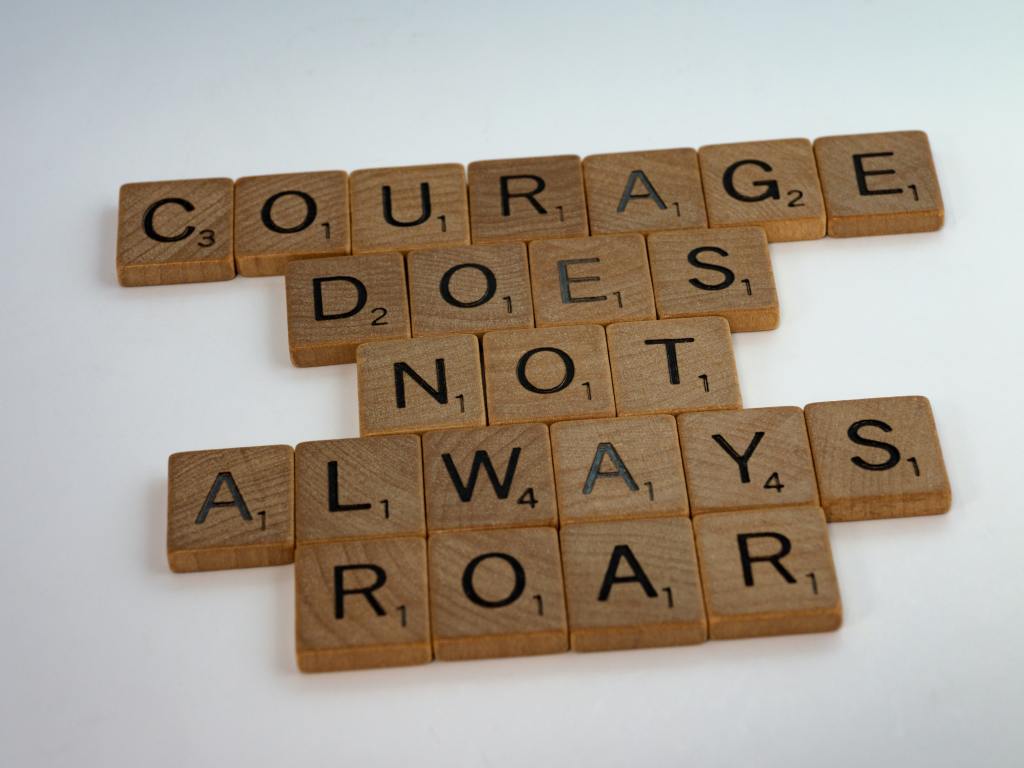
In the event you’ve been wondering, I picked the introduction picture intentionally. Why?
Because developing courage by doing any of the 7 listed above is about being in action, doing things, living your life the best way you know how by giving your all every day.
Sometimes people conflate courage with iconic pictures of the hero saving the day, which is very dramatic. Yet, I want to offer you a different way to think about courage.
Courage is about being human. Recognizing our fears, the current limits of our knowledge, and doing something to face them, and grow ourselves. When we recognize where we have opportunities to develop, we can then take the necessary actions to create opportunities for ourselves to grow.
And, yes, if you like, to even transform. What does it take?
A willingness to set aside the ego, a little at a time, one step at a time, and take a different action. Take an action you’ve never taken before, and see what you get back. I think you’ll be pleasantly surprised.
It’s been a couple of weeks since I’ve created a video. Was fun to be back in front of you in this medium. The importance of reconsidering how we think about vulnerability is important. Here, then, is the 4 C’s of Vulnerability: Why Vulnerability is Transformational.
Last week I wrote the article, Vulnerability A Paradox, for the blog, Lampelina, which I really enjoy. Writing this article got me thinking more about vulnerability.
As I was finishing these posts, and reflecting upon all of these articles, I realized there was more to say. Specifically, more to say about vulnerability and resilience. Let’s take a look, shall we.
Vulnerability and Resilience
What do vulnerability and resilience have to do with each other? Maybe it is readily apparent to you; yet, for me, the insight on these two just came this past week. Really. Funny how insight works. Fun.
Alright, before we get into our discussion, let’s define our terms. Important.
Now, though I disagree with the above definition of vulnerability, it works in this particular conversation when we consider resilience as a counterpoint to vulnerability.
Counterpoint meaning that the more vulnerable you are, the more resilient you will become. We must add here, however, that being vulnerable must be done within a context where you are safe and there is trust. Imperative.
When you are in a context that has both safety and trust, being vulnerable suddenly becomes a possibility. Not easy, no. Yet possible.
And, within this possibility, there is space, yes, for development and growth, and yep, for transformation as well; and, there is also space to develop resilience.
You see, when we are open, meaning open to new things, new experiences, new unknowns, we are vulnerable. We have to be. Anytime someone says, you know, I don’t know the answer to that, or don’t know, they are immediately being vulnerable.
Think about how often you say, I don’t know. Humans do not like to not know. Period. We like to know, like to believe we have control, and that we look good and are often right.
However, within a context of looking good and being right, there is no room for growth, no room for vulnerability. You cannot be vulnerable if you know everything.
And, guess what? Even those that say they know, don’t know. Not everything. Not possible. The greatest minds of all time knew this truth.
Really, they did. Let’s take a look at one of them now. Here you go.
“Real knowledge is to know the extent of one’s ignorance.” Confucius
A great quote. What confucius is pointing to in this quote is that when we know the limit of our own knowledge, we are immediately open to learning. Right away.
This then is the real knowledge Confucius is talking about. Knowing that we don’t know everything. Knowing also that to own we don’t know, to be open to learning is being vulnerable. Wise.
When we, however, act as if we know when we don’t, we are closed, and are also closed to learning. Simple. Unwise.
When we are open to being vulnerable, we can enter into contexts where we can learn more. More from people around us that are willing to share of themselves, as we are ready to share with them.
As we enter these vulnerable contexts, which can cause fear and anxiety, we begin to develop our resilience. Really. Right away.
Sometimes people think that being vulnerable means doing something way outside of our comfort zone. That’s possible, yet what is more probable is that we enter into vulnerable contexts, one step or action at time.
Taking small steps is important. And, guess what? Gradually those steps will become larger. Yep. Why?
Because as we develop and grow, what we know grows, just like our resilience, as does our comfort zone. Yep. And, when our comfort zone grows, we feel more comfortable being vulnerable more often.
Remember, however, that it takes time. Development is not a light switch. It is a process. One step and time.
What Can You Do?
When you are ready, take a step outside of your comfort zone into the land of vulnerability. You get to choose the size of that step.
Remember, it’s not about the size of the step, it’s about taking that step; and, taking that step when you are ready.
If you are not yet ready, that’s okay. It is. It’s not about the right or wrong time. It’s about sharing with each other that which we have to share; and moving ourselves and the people around us that we love forward. Doing so when we are ready.
And, you know what?
Know matter what other people have told you, you can do it. You are strong. You are powerful. You are beautiful. You are vulnerable and resilient.
And, that it is possible through vulnerability to transform ourselves and the contexts that we navigate on a regular basis.
Right now, I am working on another post on vulnerability, going deeper on resilience and vulnerability; and, it occured to me that there are a few more things to say about embracing vulnerability. Here we go, then.
Have you ever looked at the definition of vulnerability? Yes, no? Alright, well, either way let’s take a look, shall we. Let’s go.
Ah, very good. Now, do you see what I see? According to this definition, vulnerability is associated with being weak and easily hurt. Hm. I’m not wild about this definition.
Here is a different way to think about vulnerability.
“Vulnerability is not winning or losing; it’s having the courage to show up and be seen when we have no control over the outcome. Vulnerability is not weakness; it’s our greatest measure of courage.” -Brené Brown
I actually believe that vulnerability is the birthplace of all innovation, and, like Brené, is more akin to courage and strength, which is why I believe learning to be vulnerable is important to our development.
Alright, let’s take a look at 10 reasons why vulnerability is important to your development.
10 Reasons Why Embracing Vulnerability as a Strength is Important to Your Development
All of these reasons teach us something about the human being we are now, and, the human being we want to become.
First, let’s take a look at the 4 C’s. Here they are.
Connection – being vulnerable more often creates connection with other human beings. When you are vulnerable with others, you create a much deeper connection. It just happens. There’s something about exposing yourself, being outside of your comfort zone, in the land of vulnerability that creates a deep connection with others. You can see your own vulnerability in them; and, they in you. Pretty cool.
Compassion – being vulnerable often also means that we are able to notice when others are vulnerable; and, when they are, we can show them love and kindness for their commitment to being alive as a human being. We are living the fullest life possible when we embrace our own vulnerability and can see that vulnerability in others, and extend them gratitude and compassion.
Courage – to be vulnerable takes courage; and when you are vulnerable often you develop more courage. It works like that. The more we invest in our development by practicing vulnerability, the more we get back. And, courage is no exception to this rule. In fact, people often think that there are people that are courageous and people that are not. Not so. Courage can be developed like any other skill set. You can be more courageous through experiencing and embracing your own vulnerability.
Collaboration – as we will discuss in a moment, innovation is a huge boon of being vulnerable often. And, where there is innovation, there is collaboration. Therefore, when we are more often vulnerable, we will naturally find ourselves more often in collaborative contexts. Really, it’s true. And, when we are in these collaborative contexts, we get to experience being vulnerable with other people, which we’ve discussed. A powerful experience.
Comfort – we are always developing, even when we are not intentional about it. Yep. True. And, when we set our intention to develop, of course, we are aware of that growth and can grow more. When we venture into spaces where we feel vulnerable, we learn the current limit of our comfort zone. Then? We have a choice. Proceed into the land of vulnerability, or withdraw. Either way we choose, we get to see where we are comfortable and maybe not so comfortable. Important to our development.
Humility – intentionally putting ourselves in vulnerable situations teaches us more about ourselves and our shared humanity. We get to learn through, oftentimes uncomfortableness, the extent to which people throughout history have embraced their own vulnerability to create new things in this world. In those most vulnerable moments, we get a glimpse into a new world. A world where people understand and care for each other more.
Strength – like courage, when we embrace and practice vulnerability, we also become stronger. Vulnerability is hard work. It is. And, everytime we are vulnerable, we grow, yep, and develop, yes, and become a stronger human being. It does not happen all at once, it is a process. Know though, as you venture into vulnerability, when you are at your most fearful or anxious, you are, in that moment, becoming a stronger iteration of you.
Resilience – and, akin to strengthening ourselves, we also develop resilience by practicing vulnerability. As you practice being vulnerable more often, the fear of it goes down. It does. It is still hard, yet that hardness becomes more tolerable as your resilience goes up. Through vulnerability, we become a more resilient human being, able to do more and be more.
Innovation – innovation is impossible without vulnerability. Seriously. To innovate and create, you have to be willing to be vulnerable. When you are innovating, you know you don’t know all of the answers, and that there is always more to learn. A vulnerable space. Human beings don’t like it much, yet look at quotes from the brightest minds throughout history, and you will see that they understand that vulnerability is a necessity for innovation to occur.
Knowledge – whenever we do something we’ve never done before, which is a vulnerable space, we get to learn. And, when we learn, we know more. One of the coolest things about practicing vulnerability, is getting to learn more, and then to know more, both intellectually and practically. Both.
Alright, there are 10 reasons why vulnerability is important to your development. Remember, development and growth are hard work. They are. They aren’t supposed to necessarily feel good.
The idea of developing yourself is to get outside of our comfort zone, which is uncomfortable. It is important to acknowledge this truth. Why?
Because it is inside of being uncomfortable that we become more comfortable. Yep. True. When we first venture into vulnerable situations, it will feel uncomfortable. Know, however, that over time, these situations will feel more comfortable.
And, you know what? You can do it. You can. You are stronger than you know. You are. Next time you are faced with a new growth opportunity, one where you would have normally excused yourself, or said no, give it a try.
Open yourself up to the possibility that you too can develop, grow, learn more, know more, and be more. You can. How?
One step at a time, one action at a time. Remember, development is a process, not a light switch. Give yourself grace and compassion. Start with one growth opportunity at a time. Go slow, be vulnerable, learn and know more, and be alive more.
We’ve all heard the term lonely, or loneliness, yes? Of course, right. Well, how often do you find yourself feeling lonely? Often, maybe? Especially right now, feeling lonely is probably more present for more of humanity than at any other time in recent history. Hm.
Alright, so let’s take a look at loneliness, shall we.
I want to better understand why it is that people associate loneliness with something negative, or rather with a negative emotional state. Sound familiar?
Yep, humans have a habit of turning certain emotions, like loneliness, into something that is negative, which is not at all helpful. Really. Example? Sure.
How often have you had someone ask you in a concerning way, if everything is okay, when you are emoting happiness? Sure, not often.
Now, how often have you had someone ask you in a concerning way, if everything is okay when you are emoting sadness? Yep. Exactly.
Why do we do this? Many reasons, some of which we will explore in a moment. Before we do, however, let’s define loneliness. Will be helpful for our inquiry. Here we go.
loneliness
noun /ˈləʊnlinəs/ /ˈləʊnlinəs/[uncountable]
a feeling of being unhappy because you have no friends or people to talk to
the fact of a period of time being sad and spent alone
Right, there we go. What do you notice? Hm. I notice a few things. Okay, let’s pull these definitions apart a little and see what we get, shall we. Alright, let’s go.
Human beings have a very hard time with certain emotions. Yep, you know. Sadness, grief, depressed, anxious, and desperate, to name but a few; and, yep, loneliness is also a part of this list.
Now, why do you imagine this is the case? Is it that there are certain emotions that we are “supposed” to feel, while there are others that we are not supposed to feel? Hm.
Well, let’s keep in mind that you cannot have happiness without sadness, yet we concentrate so hard on happiness, that often, I think, it eludes people. Why?
Because we are so desperate for it to occur; and conversely, desperate for sadness to not occur.
Yet, as was aforementioned, there is another way to think about and to know our emotions. For instance, to know that sadness must occur for happiness to occur. Literally. That is not a figure of speech, as they say. It is truth.
Without knowing the depths of sadness, you cannot know the heights of happiness. They go together. Always have, and always will.
If someone tells you that they don’t experience sadness, or that they are happy all the time. They are mistaken. It’s just not humanly possible. We can know more avoid sadness than we can loneliness.
Loneliness, like sadness, or any other negatively ascribed in language emotion, is not a problem. It’s not. Loneliness will occur, and when it does it doesn’t mean that you are a problem, or having an issue because you are experiencing loneliness. It doesn’t. Another possibility? Yep.
It is possible to subscribe to a different way to think about any emotion deemed negative or an issue in language. It is.
We can subscribe to a world where emotions that we are socialized to avoid or resist are accepted.
Acceptance of all emotions is freedom. Freedom from dogma about certain emotions being “good” and certain emotions being “bad.” Emotions are not good or bad, they just are. Yet, at times, some might feel better than others.
However, know that emotions you typically associate with negative feelings can actually feel very therapeutic. Now, know that I did not live the majority of my life experiencing my emotions this way.
Most of my life I experienced emotions like many people.
Avoiding and resisting the emotions that we typically associate with being a problem, or an issue, like sadness and grief.
It’s only been in the past couple of years that I’ve been able to truly experience these emotions and the feelings that follow.
And, I can tell you that is possible to emote and feel sadness and grief, and to do so in a way that also feels like a release and an unburdening of your entire self. That may sound a little dramatic, yet it is true.
When we decouple emotions like loneliness, sadness, or grief, from the typical ways people think about (and define) them, and socialize future generations to think about them, we are living in a new realm with new possibilities.
A realm where
experiencing all of your emotions is okay, is accepted, even embraced.
you are actually strength personified when you allow yourself to feel and experience all of your emotions and associated feelings in the way they happen.
future generations are socialized to understand their emotions in new ways, honoring the entire emotional spectrum as healthy and positive.
As I’ve written, happiness and sadness go together. The occurence of one is dependent on the occurrence of the other. Okay. What does that really mean?
It means that we don’t have to subscribe to the notion that because we are experiencing loneliness that we are unhappy. Really. Even though sadness and unhappiness are part of the definition of loneliness, it does not mean that we have to experience our loneliness this way.
Better language might be that, though we may experience unhappiness or sadness about being lonely, it does not follow that we will always feel the same way. Further, when we are unhappy or sad about being lonely, it’s okay. Being unhappy and sad are part of being human.
Really feeling and experiencing loneliness and every emotion that comes with being lonely makes being with people that more wondrous. It does.
Right now all across the world people are alone more than, in some cases, like mine, they ever have been before. And, yes, there is loneliness, and sadness, and, yep, unhappiness; and, there is also companionship, happiness, and joy.
It is really important to feel our emotions, and to accept them. All of them. It is being alive. When we desire certain emotions over others, we set ourselves up for disappointment. And, an expectation that certain emotions will show up more than others is not realistic.
It’s not how the world works, and it is not how being a human works.
When we release ourselves from the expectation, for instance, that we must be surrounded by people and be happy all the time, we have freedom.
Freedom from an expectation that is inconsistent with being a human being. And, inside of this freedom, we have the opportunity to create a new way to feel our emotions, on our terms and in our own unique way.
Companionship and Loneliness
Just like happiness and sadness, there is companionship (or friendship) and loneliness. And, just like happiness and sadness, companionship and loneliness function similarly, yet are just as important to consider. Ready? Alright, here we go.
Can you think of a time when you had lots of companions, and still felt lonely? Ah, very good. Me too. Therefore we can actually make the argument that having companions does not mean that you will not at times also feel lonely.
You will, I will, we all will. Again, being lonely sometimes is part of being human.
And, just like being with people and also feeling lonely, it is also possible that you will at times feel lonely, and not experience unhappiness and sadness. It’s true.
Even though the definition of loneliness spells out quite clearly that unhappiness and sadness are a byproduct of being lonely, it is not always the case.
Emotions and associated feelings are quite complex and simple at the same time. They occur. And, they don’t always occur the same way. They’re not supposed to.
In my estimation there are a couple of things we can all do to avoid traps associated with expecting to feel certain emotions one way versus another. Here are a few of those.
Expect emotions to occur and know that they will always occur differently. If you always experience them the same way, it could be that you expect them to occur that way.
Relieve yourself of the notion that emotions are supposed to occur how they always have, or how someone else has told you they should.
Decouple negative feelings from negative emotions. They don’t always occur this way.
Know that it is okay to be lonely sometimes. Actually, it is necessary. Really experiencing loneliness, and all the other emotions and associated feelings that come with being lonely, will ensure your experience of companionship will be that more wonderful.
Embrace all of your emotions. Resisting and avoiding emotions, like loneliness, or sadness, will only ever get you more of that emotion. It works that way.
Alright, we’ve inquired into loneliness, and along the way also, sadness, happiness, greif, and companionship. Remember emotions and the associated feelings that come with them, just are. They are not good or bad, or right or wrong.
You will experience emotions at times as you expect. Yet, if you are open to the possibility that emotions will occur differently, and that they will also feel differently, you may be surprised at what you get back.
I am saddened with the worlds loss of Ruth Bader Ginsburg (RBG). I am reposting a short post I created a few weeks ago in honor of RBG.
Rest in peace, Ruth.
An Insight, An Inspiration, and A Quote: On Ruth Bader Ginsburg (RBG)
A couple of weeks ago I watched the movie, On the Basis of Sex. The movie is about the early career of Ruth Bader Ginsburg (RBG). There were several insights and inspirations that came from watching this movie, which I am sharing with you now.
Insight
There is a moment late in the movie where RBG has a choice. Choose to stand, embrace vulnerability, walk through it, and give the District Court Justices all she had. Wow. Was a pivotal point.
It reminds me that we all have choices. When we are confronted with difficulty, people telling us we can’t, we’re not good enough, not pretty enough, not thin enough, not insert here whatever you’ve been told. We have a choice.
We can allow these people to have power over us by accepting and holding onto the reality they are creating; or, we can create a different reality. One that gives us the space to love ourselves for exactly who we are. Right now, in this moment.
We must first accept ourselves, both our “weaknesses” and our “strengths.” Every aspect of who we are. Why? Because when we resist aspects of ourselves, they actually grow and become more present.
RBG. Period. Did you know that when at Harvard Law School, her husband was diagnosed with testicular cancer. What did RBG do? Hm. Only attend both of their classes, and assist her husband with his school work, while, yep, also completing all of her work. Impressive and inspirational.
RBG was also told repeatedly by many different people that creating gender equity was impossible. RBG was given every reason in the world to quit. Give up. And? Mm. Persistence.
RBG is responsible for massive change in the progression towards gender equity in this country. Insightful and inspirational.
Quotes
I had a hard time choosing my favorite RBG quote, so, well, I’ve included many.
“Real change, enduring change, happens one step at a time.”
“So often in life, things that you regard as an impediment turn out to be great, good fortune.”
“Reacting in anger or annoyance will not advance one’s ability to persuade.”
“When a thoughtless or unkind word is spoken, best tune out.”
“Fight for the things that you care about, but do it in a way that will lead others to join you.”
“You can’t have it all, all at once.”
“I’m a very strong believer in listening and learning from others.”
“In the course of a marriage, one accommodates the other”
“In every good marriage, it helps sometimes to be a little deaf.”
“A gender line…helps to keep women not on a pedestal, but in a cage.”
“If you want to be a true professional, do something outside yourself.”
“Reading is the key that opens doors to many good things in life. Reading shaped my dreams, and more reading helped me make my dreams come true.”
“Don’t be distracted by emotions like anger, envy, resentment. These just zap energy and waste time.”
“You can disagree without being disagreeable.”
“If you have a caring life partner, you help the other person when that person needs it. I had a life partner who thought my work was as important as his, and I think that made all the difference for me.”
“Women belong in all places where decisions are being made. It shouldn’t be that women are the exception.”
“I would like to be remembered as someone who used whatever talent she had to do her work to the very best of her ability.”
I’ve written a lot about vulnerability lately. Why? Well, for many years, I avoided vulnerability at all costs. Really, I did. I was not interested. Actually, I was disinterested to the point of high levels of anxiety. Today? Not the case.
Today I believe that, although being vulnerable is hard work, it is where all the wonders of being a human being live.
Wonders like innovation, resilience, love, compassion, and much more.
In fact, writing an article like this just a short two years ago would have been impossible. Too vulnerable, too much unknown, too much anxiety. We can pretend, or feel as if, anxiety is only our issue. Let me tell you unequivocally, it is not.
Many, many people all across the world suffer from anxiety. An aside, real quick, promise.
I was once in a therapist’s office, and they were talking to me about anxiety levels, and I said something like, I believe the entire population of the United States suffers from low-grade anxiety. What did they say? Yep, that’s true.
Now, I could write more about that, however, I’d like to get back to the current topic. Vulnerability.
I believe that vulnerability is important to our individual development. Showing us where we have growth opportunities if we choose, to be vulnerable, and grow into and eventually out of these opportunities. That’s development.
I also believe that vulnerability is a transformational space, which anyone can enter. Of course, of their choosing, when they are ready. What happens, you ask, when you are vulnerable on a regular basis?
Well, many things. However, I think there are 4 things that are distinct to being vulnerable where we get back much more by being vulnerable than we do by making the choice to not be vulnerable.
The 4 C’s of Vulnerability: Why Vulnerability is Transformational
1. Connection
There is something about being vulnerable that exposes us to more of our own humanity. And, when we are exposed to more of our humanity, we get to know more about everyone else’s humanity. It works that way.
And knowing both about our own humanity, while also knowing about everyone else’s, gives us more sight about our shared humanity.
Connecting more deeply to the similarity of those around us. When we can connect with others in that way, we get more out of our relationships. Really.
Think about the relationships you have. Are you able to be vulnerable? Hm. If not, well, you may want to rethink those relationships. Why?
Because to be vulnerable you must be in a context that is safe, and with people that you trust. If you are not, vulnerability is way too scary, and rightfully so.
When we are vulnerable, we are exposing parts of ourselves that we don’t normally expose. And, it takes safety and trust to get there. It does.
Therefore if you are in relationships with people where vulnerability is out of the question, I would question the need for those relationships. Hard. Yet, might be needed.
When we are in a safe space, with people we trust, we can be more open, and inside of that openness, being vulnerable becomes more available.
And, as was aforementioned, when we get to share that vulnerable space with someone else, we transform that relationship into something quite different. Beautiful.
2. Compassion
Another quite lovely byproduct of being vulnerable is the opportunity to develop more compassion.
See, when we are vulnerable, we have the opportunity to experience grace for ourselves in doing something that makes us either nervous, fearful, or anxious.
We may not always extend ourselves that grace and the accompanying compassion, yet it is there. As was aforementioned, I was actively disinterested in vulnerability for many years. Over 20 in fact.
However, that does not mean I was never vulnerable. I was. And, inside of those vulnerable moments, some of which were long moments, I did not extend myself grace, nor the accompanying compassion. Nope.
Yet, know that developing more compassion for yourself inside of being more actively vulnerable, is possible. How do I know? Because I am actively vulnerable on a regular basis today. Every day in fact.
Anyone that participates in contexts and experiences that stretch them, that make them feel vulnerable, deserves grace and compassion; and, I can provide both to myself today. Growth.
Another opportunity inside of being vulnerable more often, and developing more compassion for yourself, is that you will also develop more compassion for others. It works that way.
Anytime we can extend ourselves more of something, we can now also extend it to others. And, believe me, everyone can use more grace and compassion today. Seriously.
Inside the space, you create to be more vulnerable, while extending to yourself and everyone else around you more grace and compassion, you have transformed yourself and that relationship.
In those precious moments, our shared humanity is realized, and we can recognize ourselves in each other. It is a beautiful experience. Connecting with another human being on that level is transformation.
It takes courage to be vulnerable often; and, when we are more often vulnerable, we get to develop more courage and resilience. Often, I think, people believe that some people have courage and resilience and others do not. Not true.
Like any other skill set, courage and resilience can be developed.
You can grow yourself into a more courageous and resilient self by doing things that are outside of your comfort zone.
And, it just so happens that being vulnerable is outside of most people’s comfort zone. I would actually argue that it is outside of everyone’s comfort zone. That is the nature of vulnerability inside of being human.
When we create the opportunity to grow into a more courageous and resilient self, we also get to model that behavior for people around us.
Family, friends, coworkers, acquaintances, and, yes, even people we don’t know at all. Inspiring.
And, inside of creating more inspiration in this world by being more open and vulnerable, developing ourselves, while also showing others that developmental growth is possible for them too, you get transformation.
Transformation for yourself, yes; and, transformation for those that choose to journey with you into vulnerable situations and contexts, which are created by stepping out of your comfort zone and into spaces that are vulnerable.
When we have deeper connections with ourselves, and likewise, with people close to us, built upon safety and trust, there is an increased likelihood of more collaboration. Fun.
Though I think I’ve always naturally gravitated towards collaborative contexts and people that share a collaborative spirit with me, I was not always available to these types of contexts or people.
Remember, I actively avoided and resisted my own vulnerability for a long time, which also means that I, in many ways, missed out on deeper relationships with people where collaboration was more possible.
Now, I am surrounded by these types of contexts and people.
Even with people that I at one time did not share this type of connection, that connection is more apparent today. And, it can be for you too.
When we are available to a natural human inclination within us to share ourselves with others, to connect with them deeply, and to share all that we have to offer, we are or have become natural collaborators. Really. At that moment, or in those moments, it is true.
A byproduct of entering into collaborative contexts more regularly also means that there is a higher likelihood for innovation to occur. And, inside of innovative contexts transformation is regularly apparent. Why?
Because when we are vulnerably collaborating, we are out on a limb, deeply connected to others in that safe and trusting context, where courage flourishes, as does innovation. And, what often follows innovation is transformation.
In closing, I will also offer that where there is the possibility of developing more of a vulnerable self, there is also the possibility of developing less nervousness, fear, and anxiety.
What I’ve learned in the past three years, is that avoiding and resisting things that make us uncomfortable only brings more nervousness, fear, and anxiety. An example? Sure.
When I was working in the private sector, before going back to University at 33, I worked for several large corporations; and, at one of them, I wanted desperately to be promoted into a leadership role.
Well, at that time, I had a great supervisor and mentor, and that goal became a reality.
As many of you know, when you are in leadership roles, the need to speak in front of groups, your team, business, or organization is rather mandatory. It’s part of it. How did I feel about that? Horribly anxious. Really. Sky-high anxiety.
I remember the first time being in front of the group, I would eventually lead, at a district meeting. I had a 5-minute speech to give. 5-minutes, that’s all. Might as well have been an hour. Phew.
I was so anxious that the paper I was using for a guide, actually I was reading directly from it, was shaking like a leaf in my hand. Actually, my whole body was shaking like a leaf. Really.
Well, I continued to take on small parts in the meetings, 5 minutes became 10, and 10 developed, over time, into giving entire 1 to 1.5-hour district meetings to the group by myself. The point?
It took time. One step at a time. Bite-sized chunks, as they say, within a context where safety and trust were present.
And, yep, I developed more courage, resilience, much deeper connections with that team, and we did become highly collaborative. Fun.
Since that time, I’ve led several teams, including the team I am on right now and have taught at University. Transformation.
And, you can also be a part of a vulnerable transformation. It’s not complicated, yet it is, as we’ve discussed. Difficult.
Yet, when you take it one step at a time, one action at a time, knowing that it is a process, not a light switch, you can rest in ease knowing that if you persist you will be doing vulnerability more often.
And, guess what? Without even knowing it you will have developed deeper connections, more compassion, and courage, and you will probably find yourself in collaborative contexts more often.
Vulnerability is transformational, and you can partake in it if you choose. Choose well.


























 Develop. Inspire. Transform.