Poetry and Prose by #1 Amazon Bestselling Author of Nature Speaks of Love and Sorrow, Co-Author of #1 Amazon Bestseller, Wounds I Healed: The Poetry of Strong Women, and Jan/Feb 2022 Spillwords Press Author of the Month
Recent Updates Page 80
Jeff Flesch
2:14 pm on July 18, 2020 Tags: collectivecontributions, COVID-19 ( 34 ), creatingcommunity, creatinggovernment, creatingstates, creativity ( 34 ), indivudalcontributions, recreatingcommunity, recreatinggovernment, recreatingstates, youareoneofakind, youruniquecontribution
The first blog I wrote on this website on April 18 of this year, Creativity During COVID-19, was also the first blog I’d ever written. I’ve had a great time these past three months, writing, exploring myself, and interacting and engaging with totally new people.
All super cool and amazing people. All of you are. Fun.
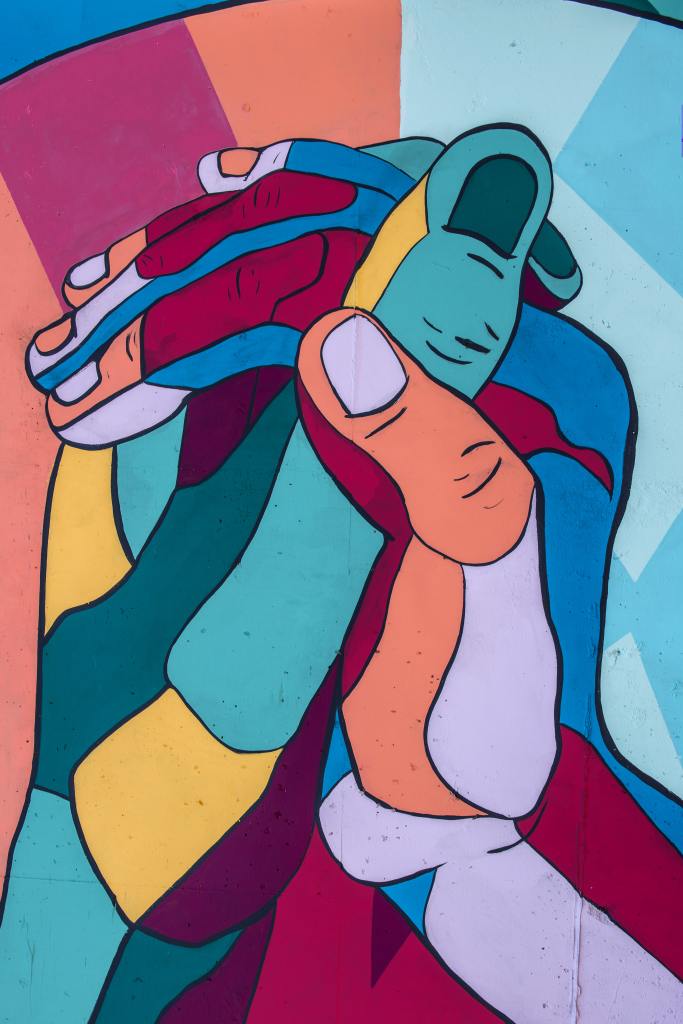
I wasn’t even thinking about writing a part 2 to that initial post, until I came across the picture above. I had also, however, recently been thinking and reflecting upon the state of the COVID-19 virus across the country, and the tremendously scary impact it is having on people, business, well, on everything and everyone.
It also got me thinking about how the country, and greater world, will need everyone, really, everyone to step up by contributing their creative potential to their communities, states, and countries. Really. Why?
Because we’ve not yet nearly seen the end of the virus’s impact, which is going to last well into the future.
And, it will take all of us, each of us contributing what we can. Contributing our passion, expertise, and especially our creativity and love to developing new ways to live and work. New ways to be.
As I’ve written about in other posts, we are all creative. All of us. Creativity is where we find our highest potential, our highest power.
Creating ourselves each day, creating relationships again and again, creating business models, financial models, education models, healthcare models, and governmental models.
The list is endless of what will need to be created and recreated.
We will need to recreate all that we previously knew; and create whole new ways to move us forward. Individually and collectively. Yep, both.
What to do?
If you are already creating and contributing, wonderful. If not, join the fray. Start creating. Today. Right now. Create what is inside of you, your unique contribution.
You are one of a kind. No one else can contribute just like you. No one. Not possible. Your creativity and passion is one of a kind. And, the world needs it. We all need it.
I’m inviting each of you to step outside of your comfort zone, and contribute as you are able. Contribute locally, create something that’s never been seen before. Create it. Recreate something that once worked well in our previous reality, which doesn’t work today. Recreate it.
If you think you can’t, don’t know how, or aren’t talented enough.
Let me be the first person to tell you, that you can, you can learn how, and you are more than talented enough. You are all of those things, and so much more.
Alright, I’ve written about creating a vision for yourself in several posts, yet, to date, have not walked through the process of doing so. What’s interesting is that people usually associate creating a vision with business, which makes sense, yet it makes as much sense, as we will discuss, to create a vision for yourself – for your life. Ready? Let’s go.
What’s first?
First, you want to get out all of your ideas about what your future self will look like, think like, and feel like. Here are some questions to get your thinking started.
What are your goals?
Where do you see yourself in 5 years?
Where do you see yourself in 3 years?
Where do you see yourself in 1 year?
That’s enough to get us started. Let’s take them one at a time, and use practical examples. Here we go.
Identify your 5-year goals
Make a list of all of your goals. Yep, all of them. Why? Because at this stage, you are concentrating on getting out all of the goals that you want to accomplish. Make a list. Here are some of mine.
Publish a book
Travel to Spain
Learn Spanish
Travel to Japan
Knee recovery so I can run again
Expand our remote community education classes
Take a trip out of the country with my best friend
Alright, there are some we can work with. Once you have your goals identified, pick one to start working on. Where you start in the future will depend on the goal. I suggest going out as far as you can. Why?
Because you will find that once you start thinking about 5 years from now, let’s say, more goals will come to mind.
Now that you have your 5-year goals identified, time to start working those goals backward. Meaning that you need to create 3-year goals that connect to the 5-year goals.
Let’s use my 5-year goal to publish a book and work that backward. In order to actually publish a book 5 years from now, I would like to have 75% of it written by year 3? Why? That will give me plenty of time to edit, market, and engage people about the book.
Now, publishing a book is not something I’ve ever done, and that is okay. The realisticness of your goals in year 3 matter less, than that you have an idea or picture of what that future state will look like.
Having that picture in mind is important to the next step, which is creating the next year inside of the 3-year goal.
When you start working on your goal for the next year, you are now in the realm of actually putting your theoretical goal into practice. I’m sure you’ve heard people say theory should feed practice, well, it is as true that practice should feed theory. They are inextricably linked. Always.
Now you can choose how to create your next year inside of the goal you are working on. There are many ways to put yourself to work inside of your goal. First you need to decide what your goal will look like at the end of the next year. Let’s keep using my goal of publishing a book.
What will the book look like at the end of the next year?
I would like to have 150 double-spaced pages written. Alright.
Now, to complete 150 pages by the end of next year, I will have to schedule time to get those pages written. How? First, create quarterly goals. With this particular example, I will break 150 pages into 4 parts.
My quarterly goal then is 38 pages. Now take that to monthly, which is 13 pages. Yep, now to the week. 3 pages a week. Alright, I now have a weekly goal.
And, it is a weekly goal that is connected to a quarterly goal, which is connected to a yearly goal. And, that yearly goal is connected to a 3 year goal, which is connected to the 5 year goal. Phew. Pretty cool.
Here is the system. And, you can put any goal into it, and work it backward the same way.
Identify all of your goals.
Pick one to work on.
Set that goal out into the future and visualize what it will look like.
Work backward to year 3.
Set that 3 year goal.
Work backward to the next year.
Set that yearly goal.
Work backward to each quarter.
Set that quarterly goal.
Work backward to each month.
Set that monthly goal.
Work that backward to weekly.
Set that weekly goal.
You can even take it to daily goal-setting, however, in this example it is not necessary. Now, if my goal was to get that book finished in the next year, taking the goal-setting to daily would actually be very helpful.
As you create these goals and work on them, know that you are actively creating the vision of your future self. Yep. And, as you put them into practice in your life, you are actively working on and creating your future self every day. Pretty cool, and fun.
How to organize them to ensure you move them forward?
Here are some tools you can use.
Calendars
Post-it boards
Whiteboards
Day planners.
How you organize yourself matters less than creating the actions and actually holding yourself accountable to doing them every day. Use whatever organization system that works for you.
And, if what you are using now doesn’t work, change it. There are tons and tons of tools for organization. So many.
Okay, that’s creating a vision of your future self in 5 minutes. Another thing I like to do with my goals is to create a mind map. As I’ve mentioned in many other posts, I am very visual, so I love to see my goals inside of a mind map.
In case you’ve not created a mind map, here is a quick video I created that describes the process.
Alright, you now have a system to create your future self. And, when you get into it, I think you’ll find that it is quite fun. And, guess what?
When you take those daily or weekly actions to create your future self, you will find that your longer term goals are being accomplished bit-by-bit each day. Happy creating.
There was a time when I thought about creativity within a very limited framework. A framework that associated creativity mostly with art. However, what I know to be true today is that creativity is an unlimited framework. There are no limits.
Within this unlimited framework, here is an insight, an inspiration, and a quote.
Insight
You are it. Look for the answers you are seeking within yourself. They do not reside outside of yourself. They are within you. Have been, are, and always will be.
Create the life you want to live into. Create the future from the future. Always look within, then look forward. Make connections between that which you know to be true, and the future state you are creating.
A vision, your vision. You are the creator of that vision. Live it today, tomorrow, and for the rest of your life.
Visionaries don’t wait for someone to hand them a guide to life. They create it everyday. One step, once action at a time. Each day, every day.
And, guess what, you are a visionary. We all are. We just need to get out of our own way. How do you know when you are in your own way?
When you deeply want to do something, try something new – you know, that funny feeling you get in your tummy when you get excited or nervous.
Well, when we feel that, and know also that we are inhibiting our own creativity because we are concerned about what someone might think or say, we are in our own way. In that moment. And, when it passes, and we don’t act, we can also feel upset, yes, and also disempowered.
Disempowerment does not feed creating your vision, and living into it. Empowerment does. Yep. If you are feeling disempowered, don’t fear, you can also move yourself out of disempowerment and into empowerment. You can.
And, here are a couple quotes from that article, though, they are all awesome. Check them all out.
“What everyone in the astronaut corps shares in common is not gender or ethnic background, but motivation, perseverance, and desire — the desire to participate in a voyage of discovery.” — Ellen Ochoa
“Permanent remorse about failing to do your human duty, in my opinion, can be worse than losing your life.” — Miep Gies
“Technique and ability alone do not get you to the top; it is the willpower that is the most important.” — Junko Tabei
“I don’t go by the rule book… I lead from the heart, not the head.” — Diana, Princess of Wales
“The bitterest tears shed over graves are for words left unsaid and deeds left undone.” -Harriet Beecher Stowe
Take action today, create your vision, live into it, and change the world. You are capable of it, and can do it.
There is a difference for me in thinking about something and actually doing that something. I’ve been thinking about writing my whole life, and have only actually written during a very short period of it.
A couple of years ago I read the book by Stephen King, called On Writing. A great book, by the way. In that book King asks you to practice writing by imagining a situation taking place in a house, and you have to write the character, yourself I think, out of that situation. Out of the house.
I did that, and have started several other stories, including the one on this site, yet have, to date, finished none. So far.
Yes, I wrote in college, and even completed a thesis. Yet, that is not the kind of writing I’m talking about. Writing a thesis or a dissertation is about thinking. I’m talking about the kind of writing that comes from the heart.
The kind of writing that moves, touches, and inspires people. Maybe even puts people into action in their life.
Now, I am not insinuating that the book I am now working on will do that. Yet, in the book I am now working on I get to write from both the head and the heart, which is also distinct.
The difference, for me at least, is that I get to let go of the way I normally think, and get in touch with a totally different aspect of myself. Maybe this is a normal experience for those that write often. I would not know. It is, however, an experience that I like quite a bit.
As for writing, I don’t think I like it all that much. Especially the editing process. Difficult. Yet, there is a very real release in writing, which is quite intoxicating. And, it does provide that outlet for the release of ideas, which I do have many.
For me the distinction on writing from the head and the heart is where you create from – are you creating from that thinking part of yourself, where you are analyzing every aspect of the paper or book to ensure it is reliable and valid.
Or, are you writing to write. Writing from the heart, which only really requires that you can stick with it until you have all of the ideas out of you.
Both forms of writing serve a purpose. Both are needed. For me, I have just realized in the last couple of years, that while I do enjoy reading both kinds of books, from the head and the heart,
This week I’ve been reflecting upon just how anxious people are, really. Everywhere. With more COVID-19 cases occurring throughout the country, people are wondering, worrying, and, in some instances, getting frustrated, and yes, even angry. Normal for a very non-normal situation. Whatever those words mean.
Alright, so it then occurred to me that creating a post, weekly, daily, not sure, about insights and inspirations I’ve seen and experienced might be beneficial for people. Especially people that are experiencing floods of emotion. Emotion that can be, at times, very difficult to feel.
Here we go then. An Insight, an Inspiration, and a Quote.
An Insight
Though every person on the planet is experiencing more fear than they normally feel, know that fear is a part of life. We are all fearful about the current pandemic situation. You are not alone.
We are all connected. Yep. When you feel alone, please remember, you are not alone. You are connected to friends, family, peers, colleagues, and people you don’t even know. Example. You are connected to me right now as you read this. Not alone. Remember that.
An Inspiration
Though we are all feeling more fear, people are standing tall all across this country. Yep. Standing for what they believe, standing for change, standing for each other. Helping, assisting, connecting, collaborating, inspiring, and loving each other in whole new ways.
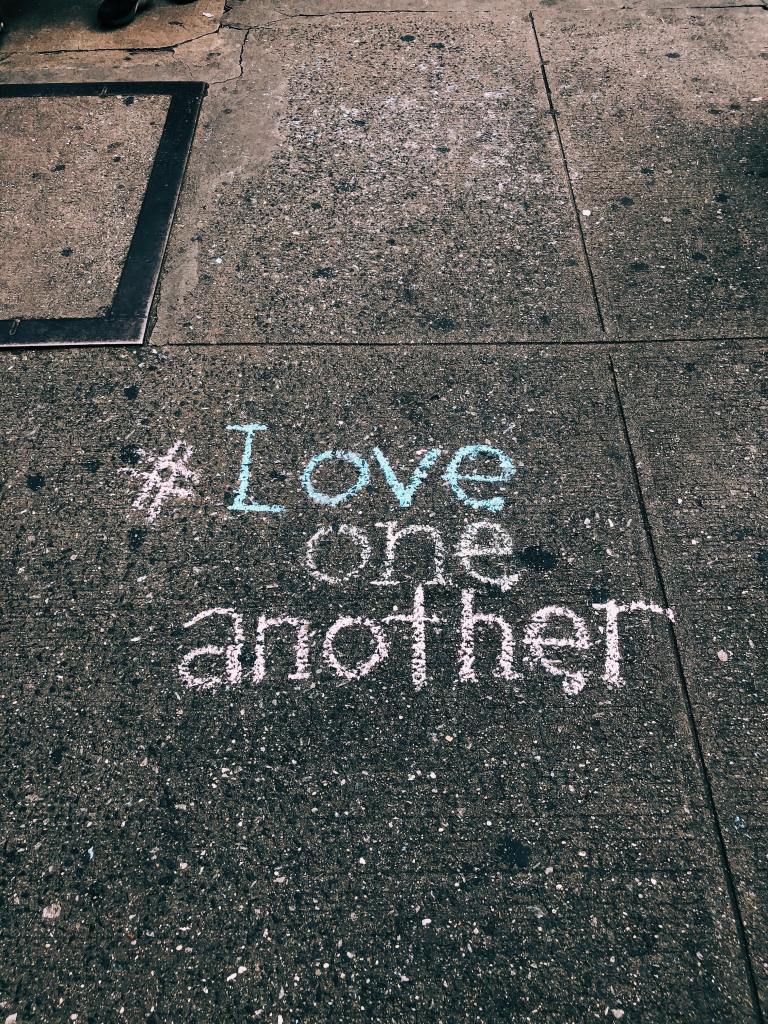
There is so much love on this planet. Really. Everywhere. Love is inspiring. You are inspiring. How do I know that, you ask? Because whatever contribution you are making each day is exactly the contribution needed. Just so. Keep breathing, keep moving, keep standing, and keep loving.
A Quote
“Just don’t give up trying to do what you really want to do. Where there’s love and inspiration, I don’t think you can go wrong.”
“There is no such thing as a faithless person; we either have faith in the power of love, or faith in the power of fear. For faith is an aspect of consciousness. Have faith in love, and fear will lose its power over you. If you have faith in forgiveness, your self-hatred will fall away. Have faith in miracles, and they will come to you.”
This week I’ve been more present to motivation. What I mean is noticing awesome people in my contexts doing amazing things, and the motivation that comes from creating such possibilities.
A good friend of mine once told me that motivation does not come from an outside source, that, in fact, motivation comes from doing things.
Thinking about motivation this way creates the space for an understanding that motivation doesn’t just magically appear.
Yet, as human beings, understanding what is a simple concept about motivation, is not always simple to put into practice. Why? Because humans create patterns (or habits) that are very hard to change.
However, it is possible to change them. And, the first step to creating that change, is to understand that the motivation to do so will develop inside the actions you take to make these changes.
Motivation does not live inside of thinking about the changes, only in the doing.
With so much change happening as a result of the COVID-19 health crisis, then, all of us are living outside of our typical patterns, or habits, and that is difficult for everyone. You are not alone in feeling this way.
It seems to me then that motivation is an inside job. The motivation to take action in life, lives inside the action itself, which we create.
Sometimes humans also want to connect an action to a result. However, connecting actions to results sets us up for failure. When we believe that we are taking action for a result, we concentrate and expect the result to look or be a certain way. And, when the result is not that way, we typically say, I’ve lost my motivation.
Motivation is not lost. It is simply hiding inside the next action, so let go of your expectations on the result, and take that next action.
My invitation – continue to take those daily actions, which create new patterns, new motivations, and new possibilities.
Have you ever considered your blind spots? No? Probably not, seeing as we are blind to them. What in the world are they, and how do they function; and, even more importantly, what can we do about them? Alright, let’s take a look.
What is a blind spot; and, how do they function?
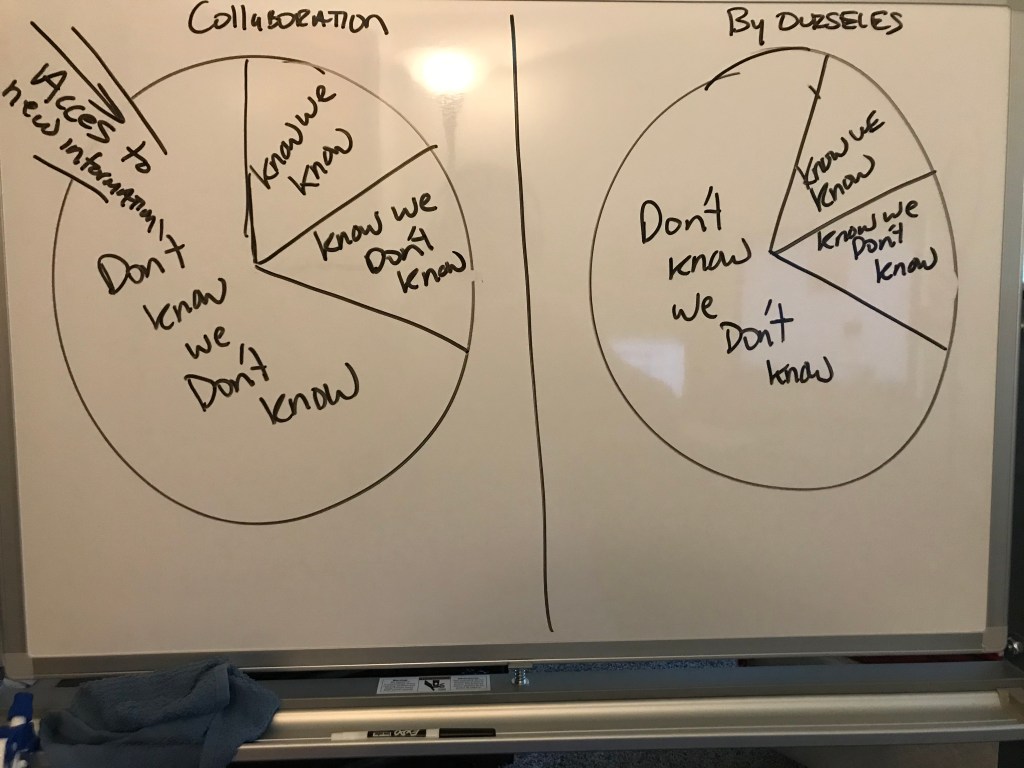
You know what you know, right? Okay. Let me write it this way. You are aware of all those things that you know about, yes? Yes, good. How about those things that you know you don’t know. Yes? Good. Last one. How about those things that you don’t know you don’t know? Hm. A little different, right. Yep. That’s right. That’s your blind spot.
We all have them. And, they are all different. Meaning, that we all have different things that we don’t know we don’t know. Phew. A little semantical, I know. Hm. Let’s do a whiteboard real quick to show you. I also feel another video coming.
July 13, 2020
There we go, better. Let’s say that the circle encompasses all that is knowable. Got it, okay. Now, as you can see, the sections of that which we know we know, and know we don’t know, are much smaller than all that we don’t know we don’t know. A very important distinction. Why?
Because what this simple illustration shows, and what I am pointing to in this post is that there is a vast amount of information (knowing) that is available to all of us, yet is not accessible to most people. Why? Because that which we don’t know we don’t know lives in our blind spot. What can we do?
What can we do?
First, we can become aware. Check. Now what? Well, we can create access to those blind spots. How, you ask? By being open to those that we are surrounded by.
Yep. It is those people that surround us inside of an open communication system where we can learn about our blind spots. Important. Here is another whiteboard to illustrate.
July 13, 2020
What this whiteboard creates is an important distinction that I’ve written about quite extensively on this website, and in many other contexts. Relationships and the interdependent nature of those relationships equals collaboration; and collaboration is where the access is. Yep.
As a matter of fact, the Monday message that went out to the team I work with today, was all about relationships, and just how important they are in all of our lives.
It is through these relationships that we can gain access to our blind spots. Don’t have those kinds of relationships? That’s okay.
You can create them. Really. You can. Why wait. There are so many people on this planet that are interested in the things that you are interested in.
You know things about your interest, and so will they. And, I can guarantee you that you will both learn from each other. Uncovering blind spots for each other along the way. No matter what the topic.
What we are discussing in this post has been written about for thousands of years. Here is an example.
“True wisdom comes to each of us when we realize how little we understand about life, ourselves, and the world around us.” -Socrates (469-399 B.C.)
I love this quote. There are many others like it, written similarly across all cultures. When we recognize that we know way less than there is to learn, and know, we immediately become open to new experiences, and new perspectives.
When we are open, and are in conversation and relationships with people that are interested in our growth, as we are in theirs, our blind spots are regularly pointed out. That is learning. It is the best kind of learning.
Ever heard of the socratic method? Here’s a snippet.
“In the Socratic method, the classroom experience is a shared dialogue between teacher and students in which both are responsible for pushing the dialogue forward through questioning.”
I too love this quote, however, I’m going to offer you a new way to think about it. Consider that the world is your classroom, and that everyone you meet, and are in relationships with can be the person that you share this kind of learning experience with. Truly.
When we are open, interested in learning from someone more than expounding on that which we know, we can learn something from almost anyone we meet.
Really. It is a beautiful experience.
Of course, we must be willing to, in a way, let go of that which we know. Let it go, and start listening, and taking in that which other people know. In the end, guess what? We end up knowing more. Yep.
When, however, we aren’t open, guess what? We get to keep that which we know, yes; yet, we miss out on the opportunity to add to that which we know. A truly missed opportunity.
My invitation to you
Don’t let those learning opportunities pass you by. Grab them while they are here. And, offer them back to those that you meet. For, they, like you, have something to learn from you.
We all have something to learn from each other. And, when we approach our relationships and interactions with that attitude. Phew. We can learn so much. You can learn so much. Start today.
Ask questions, listen, and believe. Believe in your ability to add to that which you know, and to contribute to someone else’s knowledge base. You can.
That is movement. Movement for yourself, for those you are in relationships with, and for all of humanity.
There are countless quotes, books, and movies about “living outside of your comfort zone.” What this actually means, however, is open to great interpretation, and, I think, changes for people over time.
How you view the idea of living outside of your comfort zone is a product of how you were raised, how you think, the context you live and work in, and those that you surround yourselves with.
Further, the idea and actually experience of a comfort zone, and the corresponding uncomfortableness that comes with being outside of it is different for everyone.
As there are over 7.5 billion people on the planet, we can actually say that there are over 7.5 billion different comfort zones.
Growth is the byproduct or result of living outside of your comfort zone. In fact, the only real growth there is is found outside of your comfort zone. There is never any growth inside of a comfort zone.
This may seem like common sense, and it is, however, most people have a hard time realizing this truth. Why? Simple. If feels really good inside of our comfort zones.
Who would want to intentionally create situations or contexts that challenged this comfortability? Really, not many. Most people are perfectly content inside their comfort zones.
Yet, if these people were to examine themselves on the inside, they would find that this contentment is covering up other issues.
Sometimes being outside of your comfort zone happens unintentionally, which can happen when we are faced with a very stressful situation or life event that we didn’t see coming. If we are open to it, there is also growth in these experiences.
Learning how to find comfort in being uncomfortable is manifested by doing things that we find uncomfortable often. When we are open to getting outside of our comfort zones often, there is a comfort that comes as a byproduct of the continual practice of being uncomfortable.
As with most everything else, it takes practice to realize this kind of comfort in the uncomfortable. By practice, I simply mean creating intentional contexts that we find uncomfortable, and engaging in these contexts until they no longer feel as uncomfortable.
Ultimately, until they feel comfortable.
If you are reading this and thinking, nope, not me, I like my comfort zone and have no need to create intentional contexts of uncomfortability. Very well, that is your choice.
If, however, you are thinking, maybe, or yes, sign me up. Then go out and do one thing today that you’ve been avoiding or putting off because it makes you feel uncomfortable, and see what happens.
If it’s anything like the many experiences I’ve had, yes, you can count on being uncomfortable.
Yet, you can also count on that experience providing you a whole lot more, which is only possible by doing things that you find uncomfortable.
Well, it’s been 3 months since I started blogging, and I’ve learned some, and have so much more to learn. Phew, so much.
How did I get started?
As I’ve written in other posts, when COVID-19 sent everyone home, a byproduct of the pandemic was more time. Though I continued to work, the business was/is much slower than normal. In fact, the business is completely different today, and will continue to be so.
As I was looking for another outlet for the additional time, my oldest son and I had a conversation about COVID-19, discussing if future history books would show a large increase in creativity during the pandemic. Not sure, yet it is fun to think about.
What I do know is that it got me thinking about creating a site where I could get out my own creativity, and could also invite others to do the same. Though the latter hasn’t been fully realized, the former has been, and in ways that I never anticipated.
At the time, I had no idea how far it would go, and it pleasantly surprised me for sure. Pretty cool.
I’ve actually integrated the blogging into my normal daily workflow. They are very relevant to each other, and in many ways, they feed on each other. Fun.
What have I learned?
Phew, so many things. Here are a few.
How to create, manage, update, and maintain a website – lots of work, was a steep learning curve for me. Yet, like anything, once you get into it, starting moving work forward, you learn, read other blogs, and adjust as needed.
How to connect social media accounts to websites – actually not difficult. The difficulty is in managing the social media accounts. Making the time to learn how to use them, as they are all very different. Lots of work.
How to manage my time differently – even though there was/has been more time since COVID-19 began, I had to strategically create time each day to move the work forward.
How to differentiate writing from working on the site – both are needed. I write everyday, and, at first, worked on the site everyday. Now, I still write everyday, yet only work on the site once or twice a week. Not sure if that is a proper balance, as I do know updating the site is very important.
How to follow and interact with other bloggers – much fun. I have greatly enjoyed reading other blogs, asking questions, and giving my perspective on other topics. Fun.
How to connect videos to websites – about a month ago I wrote this blog, How We Learn, and Why it’s Important to Understand, and after reflecting upon it, it occurred to me that creating videos would be super fun, and would be another way to engage with people.
How to market your blog – learning more here every day. Lots of ways to market and engage people. I will say, however, that being active and consistent is super important.
How to sign up and write regularly on medium – I had never even heard of medium before beginning to blog. You can follow me here.
I’ve learned so much, and have so much more to learn, which is why I thought this new diary series would be super fun to write.
Let’s take a look at how my blogs have iterated in the past three months.
Lots of development over the past three months. A wonderful journey thus far, and I have every intention of continuing to write in this medium.
Here are some of the topics I’ve covered in the past three months.
Relationships
Mindfulness
Sociology
Psychology
Human Development
Self-Development
Writing
Social Action
Business
Letters
Inspiration and Imagination
Possibilities
The Sound of
That’s actually a pretty inclusive list. The letters category is really new, it was just created last week. There is only one blog in there now, which is the one about my father passing, Letters: For My Dad.
Corvallis, Oregon
That was a tough one to write, and has me in tears now. Phew. I miss him.
What’s next?
Continue to write, and learn. I’ve got a long list of topics to write about, much more than the time to get them all written anytime soon. And, you know, that’s totally okay.
I see blogging as something that will continue to be a part of my life forevermore. I’m not interested in the short game, only in the long one.
I also see my work in higher education and blogging, as something that will continue to converge. Actually, I’ve just recently added coaching services to the website, which I am super excited about. You can check them out here.
How many of you write as a release? Write to get the ideas, thoughts, concerns, dreams, wishes, and hopes out of your head and into a format that you can read and reflect upon. Yes, no? Maybe?
For most of my life, I didn’t. I didn’t regularly write out any of the aforementioned. Not because I wouldn’t have found it beneficial, more because I didn’t really know how. Sounds funny. It is true though.
I would tinker with writing here and there, yet never really developed a system to do so. What I realize now is that having a systematic way you write, or enter into any creative process is, at least for me, very helpful.
It is how I can continue to do so. To write through my pain and heal.
I find that writing of any kind, on a whiteboard, in a journal, in a computer document, anything, is very therapeutic. Why? Because you can then study what you are thinking, instead of simply thinking about it.
There is an important distinction here.
If you only ever think about something, you don’t really do anything with it, with the exception of maybe obsessing over it or worrying about it. Which, in the end, does nothing to move you forward as a human being.
What are some of the writing strategies I use to work through my pain and heal?
I have several different ways that I get ideas out of myself and into the world. And, all of them work well. For, it is really less about the strategy, than that you develop the habit of writing through any situation or context that you find yourself in. From pain toward healing.
Here are some strategies I use daily.
Whiteboards – I have three at home, and many at work, which include a complete whiteboard wall in my office. Very helpful. And, yes, there is also pain and healing that happens at work. It’s not just in our personal life that we need a release for our pain, whether that is frustration or some other emotion we are working through. I actually think that it is in the writing, considering, and working through the pain that healing occurs.
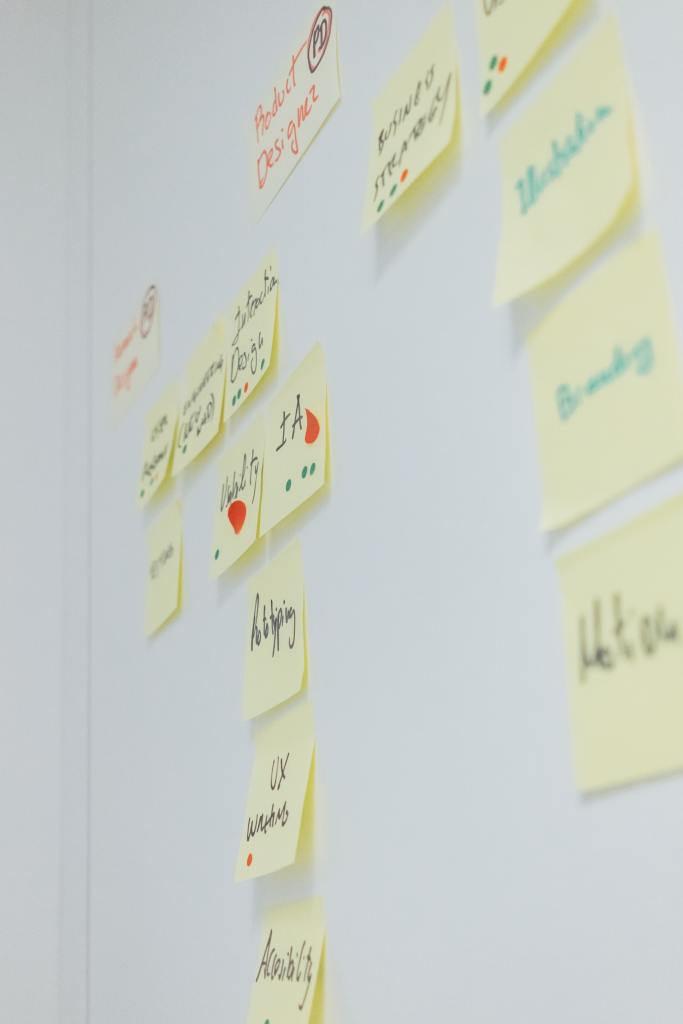
Post-its – on the go, these work very well. I will typically then collect them on a piece of paper, or tape them to a larger 2’x3′ post-it, so that I can play with the ideas. See what’s there, and what possibilities I can see for moving forward.
Journaling – I don’t write in a journal as often today, yet it is still a strategy that I recommend. Especially if you are new to writing about your own pain.
Those are the top three I’ve used, and use daily. And, they all work well, and can be used in combination. Example.
I will also tape post-it’s to pieces of paper, and put them on my magnetic whiteboard. Good visual, and easy to move around, and play with.
Because we all need the release. When we hold all of our pain inside, we cannot heal. It will reside within us, and actually make us ill. Not helpful.
Moving forward from pain, especially deep pain, requires visiting that pain often. Understanding it, working on it, and eventually releasing it. Carrying it around is unnecessary, though many people live this way.
Writing opens us up, and is a safe way to get out that which resides within. There are many different ways to write about pain. You can simply write about the pain, or you can create poems, or other stories about the pain.
What matters more than the writing medium you use, is that you provide yourself the opportunity to heal. Very important.
Know also that it takes time to heal. You may write about something that is causing you pain, and not know healing from that pain for some time. For me, it also takes reflecting upon the pain in my writing.
When I can sit and contemplate that pain, I can see more, and have new insights. It is common for me to go back to something I’ve written several times before I can see a pathway to healing. Very normal.
How can you get started?
Start writing. Write on anything and at any time. Get your pain out of you and into the world so you can actually see it, and work on it. Important.
If you leave your pain inside of you, that is where it will always remain. Literally.
Choose times that work best for you, and create a habit of writing often. For it is in the healthy habit that you create to write about your pain often, that you have the best opportunity to know healing from that pain, and all pain.
Developing a healthy writing habit that is honest and reflective of the pain that lives inside of you creates a connection between your mind and your heart. And, it is inside of the connection between the two that all healing lives.

















 Develop. Inspire. Transform.