The Blog + Video Series #14: Servant Leadership: A Practical Leadership Style for Life and Work

Of all the leadership styles and choices, why choose Servant Leadership? Well, there are many reasons, some of which we will explore in this post, and some in future posts. Let’s get this conversation started by taking a look at Servant Leadership as a principle. In this post, we will also explore Servant Leadership as a practical tool, and as a way of being, or living our life.

The Principles of Servant Leadership

There are many principles of Servant Leadership. Service is the foundation of all the rest, and is the fundamental basis for this leadership style. In order to serve others, one must serve themselves first. This is where it all starts.

Service to the Self

In order to be an effective leader, one must understand their own growth opportunities, and actively work on them. Service to others, starts with this understanding. More, it means being open to critique and feedback from others on areas that you have opportunities to develop.

As a leader, one of your main objectives is to develop those that work for you, and with you. Likewise, you must start by developing yourself in all areas, those that you know about, and those you don’t. The latter are called blind spots, and the team you work with, once a safe and trusting environment is created, will point them out to you.

If you defend yourself and make justifications for these blind spots, you will not grow. And, if you are closed to growth opportunities, your team will also be closed. If your team is closed to growth, you will not gain traction in your business model, or you will only gain traction to a point. You will not go further into that unknown area of growth that most teams never reach.

Accepting our blind spots, and actively creating opportunities to develop skills in those areas will create more trust with your team. Additionally, you will show them that you have the ability to be vulnerable and authentic, which are two more very important principles of being a Servant Leader.

Service to the Team

Many leadership styles depend on the typical organizational hierarchy, where the leaders sit at the top of the pyramid, and look down on the rest of the staff. Effectively, pushing out and down directions, without much dialogue from the team about the effectiveness of such directives.

This image has an empty alt attribute; its file name is top-down-leaders-pyramid.jpg
Distribution Property Solutions, Inc.

Servant Leadership turns that pyramid upside down, which means that front line staff are, in effect at the top of the hierarchy and in a position to effect change within the organization. It means that leaders do provide direction to staff, yet do so in a way that encourages, even demands, reciprocal dialogue and conversation.
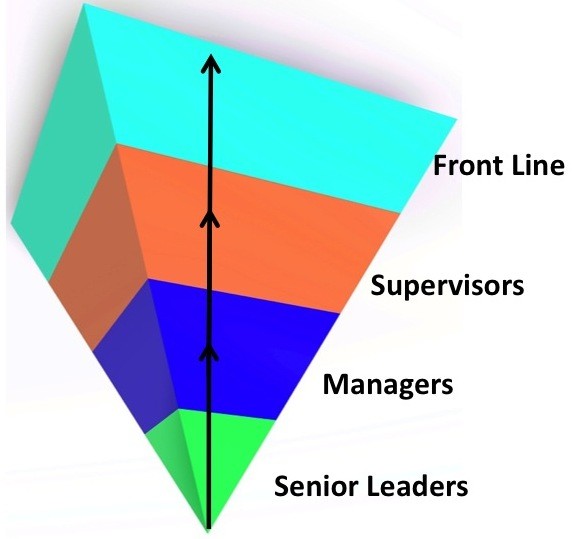
This image has an empty alt attribute; its file name is serving-leaders-pyramid.jpg
Distribution Property Solutions, Inc.

Implementing an approach that encourages reciprocal dialogue and conversation requires a willingness from leaders to realize that they do not, could not, have all the answers. It also requires an understanding that the leaders primary job is serving and developing the team.

As with service to the self, leaders must remain open to serving their teams in the same way, implementing the same types of techniques, which we will explore more in future posts.

The Servant Leadership model also requires leaders to develop the ability to pull people to them, and push people into action when necessary. Though, of the two, the former is the more important aspect of the Servant Leadership model, leaders must also have the fortitude to hold themselves, and the people they work with accountable to rigorous standards and expectations.

Servant Leadership as a Way of Being

Servant Leadership is a leadership style that can be used in all aspects of your life, from relationships with friends and family, to service activities within the community. As a way of being, Servant Leadership requires an understanding that relationships are everything.

Relationships start with the one you have with yourself. Once that relationships is healthy and strong, you are ready to develop high-quality relationships with those around you, and throughout the community. It is impossible to develop healthy, high-quality, relationships with others until you are clear on the relationships you have with yourself.

Servant leadership principles can be utilized in all contexts, because these principles, some of which we have explored here, are simple and pragmatic. These principles are about practice, and the necessity of respecting, honoring, and celebrating yourself and all of those around you.

Leading is something that people do in all walks and aspect of life. And, Servant Leadership is a leadership style, that I believe, is uniquely adaptable to all of these contexts. It is also unique in that it puts the development of the self first, with an understanding that developing yourself is a necessary ingredient to the eventual development of others, whether those others be those in your personal or professional contexts.

References

Greenleaf, Robert K. (2020). The Robert K Greenleaf Center for Servant Leadership. What is Servant Leadership. URL.


This image has an empty alt attribute; its file name is riccardo-annandale-7e2pe9wjl9m-unsplash-2.jpg
Photo by Riccardo Annandale

#businessshange, #leadership, #leadershipdevelopment, #leadershipessentials, #leadershipmindset, #leadershipprinciples, #leadershipvalues, #organizationalchange, #organizationaldevelopment, #servantleadership, #servicetotheself, #servicetotheteam, #teamdevelopment

The Blog + Video Series #13: Moving From Concept to Execution: Implementing Developmental Growth Opportunities at Work

This week I’ve been reflecting upon how we learn. Though there are learning styles, which are important to know, I’ve been reflecting more upon the process of learning. How we take in new information, process it, reflect upon it, adapt it, and formalize it into the other processes and systems we currently use.

Why might this be important to consider, understand, and become familiar with?

Good question. It is important to consider and understand, because this understanding can help leaders create bridges for people. The familiarity of which can create a bridge for your team and move you from concept into execution. Let’s take a look how.

Learning

It’s important for everyone to have access to developmental opportunities. To learn and to grow. Important. Knowing this, how do you suppose you create these opportunities? While larger organizations typically have a model for training staff, it does not always follow that everyone in the organization has the same access to developmental opportunities. Hm.

What to do, then, when your business or organization does not offer training, or those training programs are limited in some way, or designated for only mid-level and executive employees?

Create them from within

As a leader, you can create opportunities for your team to develop and grow. How? Find out what each person’s strengths and weaknesses are, always starting with yourself first, and then find ways to engage them with new concepts and tools to stretch them, and help them grow.

For instance, we created an opportunity in our second year as a team to develop strategic thinking skills, which included several training days. The culmination of which was deploying a system for organizing our daily work and balancing strategy. The need was there, and we moved it forward, and so can you.

Here are some considerations on how to get started.
  • Define the need – here are some questions to assist your thinking.
    • Where is the gap?
    • What training is needed to fill the gap?
    • Who will facilitate the training?
    • When will you implement the training?
    • How will you evaluate the training’s effectiveness?
    • What is the return on investment of the training?
  • Create a training plan with internal or external training professionals – here are some questions to consider.
    • What is the training goal?
    • How will you know when you’ve met your goal?
    • What does post-training traction look like?
    • What metrics will you use to measure traction?
  • Implement – communicate about the training, create buy-in with staff, and implement.
  • Evaluate – make sure you have traction.
  • Repeat – we created a system of training once a quarter. Worked well.
This image has an empty alt attribute; its file name is gaelle-marcel-l8snwgunqbu-unsplash.jpg
Photo by Gaelle Marcel on Unsplash

Adjustment

With any learning process, there is a period of time that people need to adjust to their new workflow reality. How can you assist staff in making these necessary adjustments?

Here are a few ideas.

  • Create a post-training system to ensure that you have traction – the system should at the very least include:
    • Post-training follow up – what did you and the team learn, and how will you move the new concepts and tools forward.
    • Periodic staff check-in’s – I’ve always used one-with-ones to ensure that staff have the support they need, and are adjusting well to their new workflow reality.
    • Measure your movement – create a way to measure your post-training progress. This might be quantitative metrics, such as increases in revenue, or it may be qualitative, such as increased workflow effectiveness.
  • Continue to follow-up – to really gain traction, the new concepts and tools must be incorporated into everyone’s daily work, including yours. There really is no other way. If this does not happen, the new concepts and tools you are implementing will lack traction.
  • Create consistency – once you have movement, start talking with the leadership team about the next training. Be consistent, and offer training opportunities at a regular drumbeat, so staff can count on, and expect them.
  • Monitor progress – continue to check in with staff on their progress. Monitor traction. You may find that after three months, the team needs a refresher on a topic you’ve already covered. That’s okay. What really matters is that you’ve created access for your team to develop and grow; and that you will remain committed to doing so, refreshers and all.
This image has an empty alt attribute; its file name is jj-ying-7jx0-bfiuxq-unsplash.jpg
Photo by Andrew Dunstan on Unsplash

Integrate

Once the team has adjusted to their new reality, which includes new concepts and tools, you will need to devise individual development plans. These plans will ensure that each staff integrates the new concepts and tools into their current workflow in a way that suits their learning style, which will increase retention, mastery, and traction.

Where to start?

As was aforementioned, I’ve used one-with-one’s often in my professional career. I find that they work well to create plans tailored to the individual. These plans can also be used to track progress and as a coaching tool.

The most important thing about integration, is that all staff actively integrate the new concepts and tools into their daily workflow. You are building healthy habits in this regard. Really. People like habits, and once you have created that habituation within yourself, a must, you can deploy that to the team.

Here are a few examples.
  • Whiteboards – some people are very visual, and literally need to see the work drawn or sketched out. I’m like that. If you have staff that are visual, do whiteboard work with them, so they can see the new concepts and tools inside of their current workflow. Important.
  • Post-its – funny. I always say it matters less how you organize yourself, than it does that you develop a system that works for you. And, if post-its work for you, like they do me, use them. Again, what matters is that the staff member can feel a level of comfort with the new concepts and tools, inside of a system they’ve already developed.
  • Calendars – a good way to organize by setting reminders for new tasks. For instance, after we completed a strategic thinking training day last year, I had every staff member add one hour per week of strategic thinking to their calendars.
  • Project Management Systems – we’ve been using a project management system for over a year now. Works for some on the team, and not as much for others. Yet, having a systematized way to move larger projects forward is important. I’ve found this addition helpful, and a contributor to the team’s overall traction.
This image has an empty alt attribute; its file name is jesus-santos-zbbkk2-cgf8-unsplash.jpg
Photo by Andrew Dunstan on Unsplash

Reflect

We all need time to process new information, time to reflect. I advocate for giving your staff the same consideration you give yourself, especially when incorporating new concepts and tools into their daily work. You need it as a leader, and so do they. We all do.

How do you incorporate reflection time into the day?

If you use reflection often as a daily strategy this will be simpler. If you do not, there may be a stretch here for you, however, I believe it is a worthwhile endeavor. We are all inundated with constant stimuli, and the need to take a break from that stimuli to really get clear on our work is necessary and needed.

Here are a few strategies you can try.
  • Build that time in for yourself first – the only way to create traction with anything, is to create it for yourself first. Once you have a system down, you can coach and guide people into it. If you are not familiar with reflection time, add 30-minute reflection times into your daily calendar. Try it a couple times a week, with a goal to have it worked into your calendar daily.
  • Coach the team on taking the same time – once you’ve practiced taking reflection time for yourself, you can advise the team on doing the same thing. Have them build it in similarly. A day or two a week to start, with the goal of having daily reflection time.
  • Create reflection time after meetings and one-with-one’s – another strategy that we employ is taking time to reflect upon decisions. As you practice this strategy, you will come to see, as we have, that many decisions do not need to be made quickly. You have time. Take it, and use it wisely to reflect and engage with yourself and your team on the best course of action.
This image has an empty alt attribute; its file name is ux-indonesia-qc2n6rqu4vw-unsplash.jpg
Photo by Andrew Dunstan on Unsplash

Formalize

Once you have strategies in place to incorporate new learning, integration, adjustment, and reflection time into everyone’s workflow, you can start to make plans to formalize these new processes and systems. Simply meaning that to build these healthy work habits, and to have them stick, they must be practiced daily; and they need to be documented.

As we’ve discussed, people all learn differently, so create a few different ways to engage with the team, which will ensure you maintain traction on the aforementioned learning strategies. The main way we move projects of this size forward is to input them into our project management software, which has worked pretty well.

Again, what you use to formalize and document a new system or process, of which learning and development are two, matters less than you taking the time to create a learning and development plan for yourself, each team member, and the overall team.

I think you will find that the payoff in terms of work efficiency, overall team moral, and team cohesion will increase as you continue to create opportunities for people to learn new things, and to develop themselves at work. And, once that is accomplished, you and your team will be ready to move from concept to execution, and into the traction zone.

Be well, and lead well.

This image has an empty alt attribute; its file name is daria-nepriakhina-zocdwpuirua-unsplash.jpg
Photo by Daria Nepriakhina on Unsplash

#businessdevelopment, #developingteams, #developmentandgroth, #leadershipdevelopment, #leadershipinaction, #leadershipmindset, #leadershippractice, #leadershipprinciples, #leadershipvalues, #learning, #learningandengagement, #organizationaldevelopment, #teambuilding, #teamdevelopment, #teamengagement, #teammoral, #teamtraining

4 Keys to Creating Persistence in the Face of Resistance Through Acceptance for Yourself, and Your Team, Business, or Organization

This image has an empty alt attribute; its file name is lucas-myers-r7fcipagre4-unsplash.jpg
Photo by Lucas Myers on Unsplash

What types of resistance do you face at work, in life? And, how do they affect your daily work, and the people that work around you? In the article, 7 Keys to Balancing Strategic Thinking with the Day-to-Day Operations of Your Team, Business, or Organization, persistence is the first key that I talk about. Right now I do believe it is the most important. Why?

Because, as leaders, there are two ways we are confronted with resistance on a regular basis; and, being persistent is the key to continuing to move our teams, businesses, and organizations forward.

Here are those two ways.

  1. Resistance to the ever-changing realities brought on by the COVID-19 pandemic.
  2. Resistance to the current COVID-19 pandemic reality as compared to our previous realities.
Both of these instances of resistance can cause pain and suffering, for ourselves, our teams, businesses, organizations, and all of those that we serve.

What are some strategies that we can use to notice when we are resisting our current reality, regardless of whether it is due to resisting the amount of daily change we are confronted with, or resisting our new reality in comparison to our previous realities?

Photo by Henri Picot on Unsplash

Here are 4 tips you can use to persist in the face of resistance

1. Notice when you are resisting the current reality

The first step to shifting your attention from resistance to persistence is to know when you are resisting. Sounds simple, yes? It is and isn’t. Noticing when you are resisting the current reality may pose more challenges today, as we are all living and working through so much change.

Combine that amount of change with other environmental stimuli and we have a situation where paying attention to how we are feeling is more challenging.

These are not normal times. Better language. Normal is only relative to what we once knew, and whatever “new normal” we think will show up, it will not be what was. We need to face this reality, get used to it, and learn how to do our work inside of it.

Doing so means learning to notice when we are actively resisting the current reality. How? Practice. Pay attention to how you feel. For me, frustration or agitation are relatively good indicators that I may be resisting the current reality. When I feel frustrated or agitated, I ask myself, why?

What’s the reason for the frustration and agitation?

When the reason is known, and the reason is that you are actively resisting the current reality, you can begin to consider shifting your focus from resistance to persistence through acceptance.

Photo by Eean Chen on Unsplash

2. Shifting your focus from resistance to persistence through acceptance

Acceptance of the current reality is key to shifting from resistance to persistence. It is a must. When we do not accept the current reality, we are also actively resisting the current reality.

Either by living in denial, disagreement, disapproval, opposition, or complete refusal of the current reality. And, what happens when we are living and working this way?

We cannot create new ways to move ourselves, and our teams, businesses, and organizations forward. Maybe better language is that we are limited in our capacity to move ourselves, and our teams, businesses, and organizations forward. Why?

Because when we resist the current reality, we are limited by that focus. And, resistance is a very limited frame of reference. Whereas, persistence is about continuing to move forward in the face of any and all adversity. A much wider frame of reference.

Movement and this wider frame of reference are key. And, when the movement has stalled, as leaders, we can then create that movement. Creation and persistence go very well together. Creation and resistance? Not so much.

When you’ve moved from noticing your resistance to actively shifting your attention to persistence through acceptance, you can create new possibilities for yourself, and your team, business, and organization.

Photo by Joshua Rodriguez on Unsplash

3. Listen tothose around you

Another way we can become more aware of our own resistance is to listen to those around us. When people point to our resistance, it is very helpful. It may not always feel helpful, however, as leaders being open, available, and flexible is important.

When we are open, available, and flexible, we have the ability to take constructive feedback and do something with it. And, doing something with that feedback is important for us, and the teams, businesses, and organizations we lead.

Here is a quick example.

Today I was in conversation with a staff member that was questioning the need for a recurring meeting, as we had recently discussed the need to pause this work for now. Freeing up that staff member to work on the current business needs that are most pressing.

Whereas I was not openly resistant to the idea, upon reflection I noticed that I might have inadvertently been resisting canceling those meetings for various reasons.

However, none of those reasons were more important than the facts. We don’t need that meeting right now. And, that is what the staff member was pointing to. Extremely helpful.

As is the knowledge that sometimes our own resistance of a situation or event may be very subtle; and, not something that we are doing purposefully. An important distinction to be clear on.

You don’t get a demerit for being resistant. You are a human being. We are all resistant at times. Important to remember, as being upset or frustrated with your own resistance will only bring more resistance and frustration. Not helpful.

Listen to the people you have surrounded yourself with.

They are there for a reason. And, that reason may just be to point out your resistance, which is helpful. Knowing this allows you to move from resistance to acceptance and into persistence.

Photo by CoWomen on Unsplash

4. Invite your team, business, or organization to do the same

If you are at times resistance, then so are those that you work with, and serve. Important to understand. As you work on your own resistance, you can assist others in working on their resistance. Sometimes it is simply pointing it out. Other times, it may require a deeper conversation.

Either way, that you know about your own resistance and know how to shift to acceptance, means that you can also coach others on moving into acceptance. It is so important to create more flexibility and adaptability today.

The change we’ve all been through and the change that has yet to come are going to require more flexibility and more adaptability. In turn, they will also require acceptance of what is. Acceptance of the current state of reality today. And, the current state of reality tomorrow. However, they show up.

When we can fully accept what is before us, we can begin to create new pathways for ourselves and our teams, businesses, and organizations. And, when we can create these new pathways, whether they are new business models, new engagement systems, or new staffing models, we can serve our clients, customers, and community in more effective ways. Why?

Because we are not resisting the current reality, pretending that normal will come back. Normal is gone. Let it go, and move from resistance to acceptance and into persistence.

Be well and lead well.

#acceptance, #acceptanceslkills, #businessdevelopment, #businessplanning, #businessstrategy, #covid-19anddevelopment, #covid-19andresilience, #covid-19businessdevelopment, #covid-19leadership, #covid-19organizationaldevelopment, #covid-19teamdevelopment, #leadership, #leadershipdevelopment, #leadershipessentials, #leadershipinaction, #leadershipmindset, #leadershipvalues, #listeningskills, #listentothosearoundyou, #organizationaldevelopment, #persistencewithoutresistance, #teamdevelopment, #teamengagement, #teammoral, #teammorale

Leadership in Practice Series Part 2: Creating 90-Day Priorities Inside of a 10-Year Vision

This image has an empty alt attribute; its file name is matt-noble-bptmnn9jsmq-unsplash.jpg
Photo by Matt Noble on Unsplash

Once your vision is created, then what? Regardless of whether it is a 10-year, 5-year, or 3-year vision, you will need to put plans in place that will connect the daily work to that vision. That is how your 10-year vision will become a reality.

What, then, are the first steps to ensure that your weekly, monthly, and quarterly work connects to the long-term vision?

In this article we will walk through the process we went through to connect the 10-year vision to our 90-day priorities. First, another question.

Where does a leader start when they want to ensure that everyone’s daily work on the team, or in the business or organization they belong to is contributing to the long-term goals?

Let’s take a look.

Start with the 10-year Vision and ask yourself a couple of questions.

  • What are the goals of the 10-year vision?
  • What are the metrics of the 5-year plan?
  • What will the current year look like?

Let’s look at each question, one at a time.

What are the goals of the 10-year vision?

Once the vision is created, it’s time to create the goals that will drive all of the work. However, before you move on to creating those goals, which will drive the objectives and priorities, ask yourself what your vision will look like in reality.

What will the revenue and service look like, what will the staffing model look like, will you add positions between now and then?

Once you’ve asked yourself these questions, or ones that are more important to your particular vision, start to build out what that vision will look like in reality. Here is an example, vision first, then what it will look like in reality.

Here is the vision

This image has an empty alt attribute; its file name is img-2774.png

Here is what it will look like

This image has an empty alt attribute; its file name is img-2775.png
Note that the word profit in this instance is referring to department reinvestment funds.

Once you’ve created the 10-year vision, and also know what it will look like, you are ready to work backward. When I went through this exercise last year, I started this part of the planning session with year 5. I looked at the previously designated metrics and asked myself what they would look like in reality. For instance, what would revenue look like, and how many people would we serve.

What are the metrics of the 5-year plan?

Here is what that looked like

This image has an empty alt attribute; its file name is img-2777.png

It is a wonderful exercise to start with the larger 10-year vision and to work backward to the 5-year plan, creating more clarity as you go. It is how you begin to connect the 10-year vision with the work you need to do today.

Once you’ve worked backward to year 5, you are ready to work backward once again to year 3, or whatever the current year is for your team, business, or organization. It is important to continue to get clearer on what the future reality will look like.

What will the current year look like?

Year 3 Department Objectives

This image has an empty alt attribute; its file name is img-2780.png

As you continue to work backward from the 10-year vision to year 5, to the current year you are planning for, in this example, year 3, the objectives that will lead the team to that 10-year vision do become more clear. Important.

And, as these objectives become more clear, so will the priorities that will drive each person’s work. For instance, in our year 3, we had 1-year objectives, which we executed on in 90-day chunks. Meaning that we focused on moving forward our yearly objectives with 90-day priorities that would shift as needed, yet the objectives would remain the same.

Year 3 Staff Objectives

This image has an empty alt attribute; its file name is img-2776-1.png

Once you get to 90-day priorities, it is time to create a coaching model that will mirror all of the aforementioned. Fully discussing this coaching model is for another article, yet I would like to share with you the simple template we created, so you can see how a 10-year vision can connect to a staff member’s daily work.

Coaching Model Template

This image has an empty alt attribute; its file name is img-2782.png

Though you can only see a portion of the form, you can see the overall process, where the yearly objectives (on the left) are connected to the department objectives (on the left in bold), while the specific priorities and actions to move that work forward are on the right. Fun.

A couple of weeks ago, I wrote the following article, One BHAG, Two BHAG, and Creating a Disruption Vision, in which we discussed the possibility of creating a disruption vision or BHAG inside of a 10-year vision. And now, the planning process we’ve walked through in this article is being recreated. The difference?

Because there is so much change right now, we have a 1-year BHAG, which lives inside of the 10-year vision, and 30-day priorities, instead of 90. I am in the process right now of re-instituting one-with-ones so that we can discuss, plan, and create our next actions one month at a time. Allowing us the pivotability, and flexibility needed.

Very well. There you have an example, with tools, on how you can connect your team, business, or organizations’ 10-year vision to the work that needs to be done daily to ensure that the 10-year vision will live in reality.

Be well, and lead well.

You can reach Jeff Flesch at fleschj@linnbenton.edu

#businesscoaching, #businessmetrics, #creatinga10-yearvision, #creatingstrategy, #creatingvision, #develpingmetrics, #goalsetting, #leadership, #leadershipdevelopment, #leadershipessentials, #leadershipinaction, #leadershipinpractice, #leadershipmindset, #leadershippractice, #leadershipprinciples, #leadershipvalues, #strategicplanning, #strategicthinking, #team, #teambuilding, #teamdevelopment, #teamengagement, #teammoral

Maintaining Motivation Inside of Innovation: An Investigation and Invitation

This image has an empty alt attribute; its file name is peter-fogden-z7oytxgi6vi-unsplash.jpg
Photo by Peter Fogden on Unsplash

A different kind of post today. I am interested in investigating how it is that teams continue to stay motivated, at the individual, and team level, during times of great change and innovation. Have you ever made this consideration? Yes, no? Here is how I began to consider the topic.

COVID-19 has created contexts in teams, businesses, and organizations that have required great strides in innovation. Innovation that is continuous. Every day. Making choices about how to continue to pivot your business model, to keep up the momentum, stay relevant, and remain sustainable. We’ve been inside such a context, much, I’m sure, like you have.

Then about two weeks ago, we had a team assignment connected to the department’s disruption BHAG, which I wrote about in, One BHAG, Two BHAG, and Creating a Disruption Vision . The assignment was to create our top three priorities for July. Why only July? Because, as was aforementioned, the amount, scale, and speed of change right now is so great, creating priorities for more than 30-days seems unreasonable.

During that time, one of our team members asked this question.

How do you maintain motivation inside of innovation? A wonderful question.

It is inside of this question that we will do two things.

  1. Investigate how to continue to create motivation, inside of vast amounts of change and innovation.
  2. Invite you to respond with your thoughts, ideas, and best practices.

We have, then, an investigation, and an invitation. Ready? Let’s go.

First, I have questions. Here are a few that will guide our investigation.

  1. Where does individual motivation come from?
  2. Where does the team’s motivation come from?
  3. What does the larger institution, organization, or business have to do with individual and team motivation, and morale?
  4. What strategies can leaders deploy to ensure that each individual team member and the team as a whole stays motivated during great change?
  5. What is the responsibility of each individual team member when considering motivation inside of innovation?

1. Where does motivation come from?

Though many people look for motivation in things that live outside of themselves, motivation actually comes from within. You become motivated by doing things. For instance, if you want to become more organized or organized differently, you must try new things. Put a new system in place, and practice it. If it works, awesome, if not, try something new.

When we actually practice that which we want to become better at, motivation will arise inside of that practice. In this example, becoming more organized happens as we practice and learn about how to better organize ourselves.

This image has an empty alt attribute; its file name is allie-z7v1izmeqrq-unsplash.jpg
Photo by Allie on Unsplash

2. Where does the team’s motivation come from?

From a psychological perspective, each individual contributes their individual motivation to the collective team. And, from a sociological perspective, the collective team motivation is an output of those individual motivations. The leader of that team must then direct both the individual and team motivation toward the vision, goals, objectives, and priorities.

However, I think it important to remember that when priorities change often inside of creating new business models and learning about new ways to do business, motivation can become precarious. Not necessarily because people are unmotivated, though that is also possible. More, I think it has something to do with just how much work it takes to continue to pivot your business. Again, and again.

3. What does the larger institution, organization, or business have to do with individual and team motivation, and morale?

For me, the answer to this question is rather simple. Whether it happens or not, may not be as simple. All people that work within an organization need to understand, have access to, and be able to connect their individual work to the larger institutional vision. Important.

When these connections can be made, there is more cohesion, and the possibility of motivation remaining higher. We must also remember, however, that there will be varying levels of motivation inside of the institution, organization, or business, dependent on how each team leads their work. There will be differences.

These differences can affect motivation and morale when people cannot see themselves inside of the vision. When creating new visions during times of great change and innovation, these visions should connect to the larger vision. Also important, people need to see themselves inside of these visions.

This image has an empty alt attribute; its file name is rahul-bhosale-ybgc-qvcxmg-unsplash.jpg
Photo by Rahul Bhosale on Unsplash

4. What strategies can leaders deploy to ensure that each individual team member and the team as a whole stays motivated during great change?

Difficult, as leaders may also be struggling with their own motivation during times of great change. Yet, there are things leaders can do for themselves, and their teams to keep motivation present for people. All the while recognizing that there will be times when people are unmotivated. That is also okay. It’s part of the human process.

What things can you do to stay motivated, and to keep the team motivated.
  • Create a new vision – when things are changing on such a vast scale, creating new ways to conceptualize your work is critical. If people continue to do their work just like they did before, which may not work, motivation may remain elusive.
  • Be flexible – flexibility goes hand in hand with adaptability. You must be flexible to adapt to changing situations, no matter how small or large they are. Be open.
  • Listen – understanding how each person is doing on the team is very important. And, you must listen well to really know how they are doing. You need to create individual time with people, and listen.
  • Provide feedback – honest and direct feedback is helpful. We all need to know that we are heading in the right direction, and when we are not, to be guided back. If you lead teams, your team can also do that for you. Important to have that reciprocal relationship.

5. What is the responsibility of each individual team member when considering motivation inside of innovation?

There is really only one thing I want to write about in this area; and that is about Communication. Communicating with each other often by telling each other how things are going, where changes or adjustments are needed, when we are feeling unmotivated, or especially motivated is extremely important. I cannot overstate this fact.

When there are communication breakdowns, people have limited sight on what is happening and understanding of what is known. And, when there are limitations on what people know, people will fill in that gap with what they believe is happening.

Typically, however, the stories that are generated to fill these gaps are incomplete. And, they are only so, because people don’t have all of the information they need.

Communication is one of the most important principles to practice at any time on a team; and now, during COVID-19, it is even more important. Staying connected, and in good communication with your team is essential to maintaining motivation inside of innovation.

This image has an empty alt attribute; its file name is mimi-thian-vdxmsix-n6m-unsplash-1.jpg
Photo by Mimi Thian on Unsplash

Closing

Alright, there is an investigation into motivation inside of innovation. I believe that the investigation has yielded a few possible insights, so let’s capture them again here.

  1. Motivation comes from within ourselves – motivation does not live inside of concepts or objects in the outside world.
  2. The team’s motivation is individual and collective – team motivation comes from each individual’s contribution and the teams combined motivation, which are guided by the leader.
  3. Motivation, vision, and morale – individuals must be able to see themselves inside of the overall vision, and visions need to be connected. Remember also, motivation will go up and down, and that is okay.
  4. Leadership strategies – create a new vision, be flexible, listen well, and provide feedback.
  5. Responsibility and motivation – communicate, communicate, communicate. Important.

Now for the fun part.

My invitation

I am inviting each of you to contribute to this post. I would like to know from your perspective, how do you, or how do you plan to maintain motivation inside of innovation. You can use the questions that were used to guide this post, or you can use the ones that follow.

Here are some questions for you to consider?

  • What strategies do you use to maintain motivation for yourself and your team?
  • What strategies have worked well in maintaining motivation on your team?
  • What other strategies have you not yet tried that you plan to implement soon to increase motivation for yourself and your team?
  • What strategies did not work as well, and why?
  • What other insights do you have to share about motivation and innovation?

Okay, there we have it. An investigation and invitation in how to maintain motivation inside of innovation. Was fun.

#businessdevelopment, #creatingstrategy, #creatingvision, #employeemorale, #innovation, #leadershipdevelopment, #leadershipinaction, #leadershipstrategies, #motivation, #motivationfromwithin, #organizationaldevelopment, #responsibilityandmotivation, #servantleadership, #strategicplanning, #strategicthinking, #teamdevelopment, #teammoral

Moving From Concept to Execution: Implementing Developmental Growth Opportunities at Work

This image has an empty alt attribute; its file name is daria-nepriakhina-zocdwpuirua-unsplash.jpg
Photo by Daria Nepriakhina on Unsplash

This week I’ve been reflecting upon how we learn. Though there are learning styles, which are important to know, I’ve been reflecting more upon the process of learning. How we take in new information, process it, reflect upon it, adapt it, and formalize it into the other processes and systems we currently use.

Why might this be important to consider, understand, and become familiar with?

Good question. It is important to consider and understand, because this understanding can help leaders create bridges for people. The familiarity of which can create a bridge for your team and move you from concept into execution. Let’s take a look how.

Learning

It’s important for everyone to have access to developmental opportunities. To learn and to grow. Important. Knowing this, how do you suppose you create these opportunities? While larger organizations typically have a model for training staff, it does not always follow that everyone in the organization has the same access to developmental opportunities. Hm.

What to do, then, when your business or organization does not offer training, or those training programs are limited in some way, or designated for only mid-level and executive employees?

Create them from within

As a leader, you can create opportunities for your team to develop and grow. How? Find out what each person’s strengths and weaknesses are, always starting with yourself first, and then find ways to engage them with new concepts and tools to stretch them, and help them grow.

For instance, we created an opportunity in our second year as a team to develop strategic thinking skills, which included several training days. The culmination of which was deploying a system for organizing our daily work and balancing strategy. The need was there, and we moved it forward, and so can you.

Here are some considerations on how to get started.
  • Define the need – here are some questions to assist your thinking.
    • Where is the gap?
    • What training is needed to fill the gap?
    • Who will facilitate the training?
    • When will you implement the training?
    • How will you evaluate the training’s effectiveness?
    • What is the return on investment of the training?
  • Create a training plan with internal or external training professionals – here are some questions to consider.
    • What is the training goal?
    • How will you know when you’ve met your goal?
    • What does post-training traction look like?
    • What metrics will you use to measure traction?
  • Implement – communicate about the training, create buy-in with staff, and implement.
  • Evaluate – make sure you have traction.
  • Repeat – we created a system of training once a quarter. Worked well.
Photo by Gaelle Marcel on Unsplash

Adjustment

With any learning process, there is a period of time that people need to adjust to their new workflow reality. How can you assist staff in making these necessary adjustments?

Here are a few ideas.

  • Create a post-training system to ensure that you have traction – the system should at the very least include:
    • Post-training follow up – what did you and the team learn, and how will you move the new concepts and tools forward.
    • Periodic staff check-in’s – I’ve always used one-with-ones to ensure that staff have the support they need, and are adjusting well to their new workflow reality.
    • Measure your movement – create a way to measure your post-training progress. This might be quantitative metrics, such as increases in revenue, or it may be qualitative, such as increased workflow effectiveness.
  • Continue to follow-up – to really gain traction, the new concepts and tools must be incorporated into everyone’s daily work, including yours. There really is no other way. If this does not happen, the new concepts and tools you are implementing will lack traction.
  • Create consistency – once you have movement, start talking with the leadership team about the next training. Be consistent, and offer training opportunities at a regular drumbeat, so staff can count on, and expect them.
  • Monitor progress – continue to check in with staff on their progress. Monitor traction. You may find that after three months, the team needs a refresher on a topic you’ve already covered. That’s okay. What really matters is that you’ve created access for your team to develop and grow; and that you will remain committed to doing so, refreshers and all.
Photo by Andrew Dunstan on Unsplash

Integrate

Once the team has adjusted to their new reality, which includes new concepts and tools, you will need to devise individual development plans. These plans will ensure that each staff integrates the new concepts and tools into their current workflow in a way that suits their learning style, which will increase retention, mastery, and traction.

Where to start?

As was aforementioned, I’ve used one-with-one’s often in my professional career. I find that they work well to create plans tailored to the individual. These plans can also be used to track progress and as a coaching tool.

The most important thing about integration, is that all staff actively integrate the new concepts and tools into their daily workflow. You are building healthy habits in this regard. Really. People like habits, and once you have created that habituation within yourself, a must, you can deploy that to the team.

Here are a few examples.
  • Whiteboards – some people are very visual, and literally need to see the work drawn or sketched out. I’m like that. If you have staff that are visual, do whiteboard work with them, so they can see the new concepts and tools inside of their current workflow. Important.
  • Post-its – funny. I always say it matters less how you organize yourself, than it does that you develop a system that works for you. And, if post-its work for you, like they do me, use them. Again, what matters is that the staff member can feel a level of comfort with the new concepts and tools, inside of a system they’ve already developed.
  • Calendars – a good way to organize by setting reminders for new tasks. For instance, after we completed a strategic thinking training day last year, I had every staff member add one hour per week of strategic thinking to their calendars.
  • Project Management Systems – we’ve been using a project management system for over a year now. Works for some on the team, and not as much for others. Yet, having a systematized way to move larger projects forward is important. I’ve found this addition helpful, and a contributor to the team’s overall traction.
Photo by Andrew Dunstan on Unsplash

Reflect

We all need time to process new information, time to reflect. I advocate for giving your staff the same consideration you give yourself, especially when incorporating new concepts and tools into their daily work. You need it as a leader, and so do they. We all do.

How do you incorporate reflection time into the day?

If you use reflection often as a daily strategy this will be simpler. If you do not, there may be a stretch here for you, however, I believe it is a worthwhile endeavor. We are all inundated with constant stimuli, and the need to take a break from that stimuli to really get clear on our work is necessary and needed.

Here are a few strategies you can try.
  • Build that time in for yourself first – the only way to create traction with anything, is to create it for yourself first. Once you have a system down, you can coach and guide people into it. If you are not familiar with reflection time, add 30-minute reflection times into your daily calendar. Try it a couple times a week, with a goal to have it worked into your calendar daily.
  • Coach the team on taking the same time – once you’ve practiced taking reflection time for yourself, you can advise the team on doing the same thing. Have them build it in similarly. A day or two a week to start, with the goal of having daily reflection time.
  • Create reflection time after meetings and one-with-one’s – another strategy that we employ is taking time to reflect upon decisions. As you practice this strategy, you will come to see, as we have, that many decisions do not need to be made quickly. You have time. Take it, and use it wisely to reflect and engage with yourself and your team on the best course of action.
Photo by Andrew Dunstan on Unsplash

Formalize

Once you have strategies in place to incorporate new learning, integration, adjustment, and reflection time into everyone’s workflow, you can start to make plans to formalize these new processes and systems. Simply meaning that to build these healthy work habits, and to have them stick, they must be practiced daily; and they need to be documented.

As we’ve discussed, people all learn differently, so create a few different ways to engage with the team, which will ensure you maintain traction on the aforementioned learning strategies. The main way we move projects of this size forward is to input them into our project management software, which has worked pretty well.

Again, what you use to formalize and document a new system or process, of which learning and development are two, matters less than you taking the time to create a learning and development plan for yourself, each team member, and the overall team.

I think you will find that the payoff in terms of work efficiency, overall team moral, and team cohesion will increase as you continue to create opportunities for people to learn new things, and to develop themselves at work. And, once that is accomplished, you and your team will be ready to move from concept to execution, and into the traction zone.

Be well, and lead well.

#businesstraining, #creative-process, #creativity, #developinghighqualityrelationships, #developingourselves, #developingprocessesandsystems, #developingresilience, #developingteams, #development, #developmentandgrowth, #experientiallearning, #individual-learning, #individualtraning, #leadership, #leadershipdevelopment, #leadershipessentials, #leadershipinaction, #leadershipmindset, #leadershippractice, #leadershipprinciples, #learning, #learning-and-engagement, #professionaldevelopment, #team, #teambuilding, #teamdevelopment, #teamtraining, #training

Strategy + Action = Traction

This image has an empty alt attribute; its file name is jungwoo-hong-cyumacqmyvi-unsplash.jpg
Photo by Jungwoo Hong on Unsplash

As I was creating a 3-minute video, some time ago now, on creating movement on teams, I uttered the phrase, strategy plus action, equals traction. And, this is so true. Why? Well, before we look at why, here is that video.

Jeff Flesch YouTube

Okay, why. Because in order to move a team, business, or organization forward, you must have both strategy and action. If you only have strategy, you are only talking about doing things; and, if you only have action, you are only doing that which was done yesterday. And, that is not traction.

How can you create strategy, action, and traction? Let’s take a quick look.

Strategy + Action = Traction

The key to creating traction is movement with vision. The first full year in my current position we moved, yet we did not move as a team, and we didn’t have a vision. No traction.

There is a distinction here that is important. You cannot gain traction until you move as a team and are clear on where you are going.

In that first year, we were focused on understanding each other and building relationships. Additionally, we learned the business, and got clear on the strengths and weaknesses in the business model.

In effect, we were focused on each other, and the day-to-day operations of the business, which is totally understandable. You can only move a team forward, once you are in relationship and have created safety, understand the business model, and understand where you are going. That was created in year 2.

Developing a vision, which I’ve written about in other posts, was creating where we were going with intention. Once that vision was created, we had the ingredients to move into traction.

Recap
  1. Build relationships and create safety.
  2. Learn the strengths and weaknesses of the current business model.
  3. Develop a vision to pull you into the future you are creating.

There are other components, which are also important to creating traction, such as developing processes and systems that work together in your business model. In our first year, we did a lot of process upgrades; and in year 2 we started to work on the systems.

In year 3, in the time we had pre-COVID-19, we were continuing to work on those systems; and, even during COVID-19, we have continued this work, though the work has been focused on new processes and systems to support remote and online learning.

Now, in our just-about-to-begin year 4, which we are calling reset to zero, we are going back to creating, building, and maintaining relationships. However, this year it is about creating, building, and maintaining relationships in the community; with our partner organizations, and business clients. Wonderfully exciting work.

For those that learn best audio-visually, here is a very short video on creating strategy, action, and traction. The culmination of which, I have termed the traction zone. Take a look.

Jeff Flesch YouTube

Balancing the day-to-day operations with strategic thinking is also very important to creating strategy, action, and traction, and getting your team, business, and organization into the traction zone.

More to come on how to create this balance, as I am currently working on a new post to discuss 7 keys to creating balance between the day-to-day operations and strategic thinking. Until then, be well and lead well.

#action, #buildingrelationships, #businessplanning, #businessstrategy, #creatingbusinessmodels, #creatingvision, #creatingyourfuture, #developingprocessesandsystems, #developingvision, #leadership, #leadershipdevelopment, #leadershipinaction, #strategiplanning, #strategithinking, #strategy, #strategyplusactionequalstraction, #strengthsandweaknesses, #teamdevelopment, #tracationzone, #traction, #vision

Developmental Growth and Transformation: A Distinction

The Transformation Video Series #1

#creatingchange, #development, #developmentalgrowth, #growing, #growth, #leadership, #leadershipdevelopment, #leadershipinaction, #leadershipmindset, #leadershipprinciples, #personaldevelopment, #professionaldevelopment, #teamdevelopment, #transformation, #transformationalgrowth

One BHAG, Two BHAG, and Creating a Disruption Vision

This image has an empty alt attribute; its file name is rahul-bhosale-ybgc-qvcxmg-unsplash.jpg
Photo by Rahul Bhosale on Unsplash

Two weeks ago, I wrote the post Creating a Big Hairy Audacious Goal: The Creation of the BHAG. In that post, I wrote about the possibility of creating a BHAG that lives inside of another BHAG. Having two BHAGs makes sense, especially right now in the midst of the COVID-19 pandemic.

I termed the BHAG that, at the time was just being created and not yet delivered, a disruption BHAG. And, seeing as the team I work with will get that BHAG Monday morning, I thought writing this piece made good sense. Plus, I made a promise. So, let’s go.

Here are 3 keys to creating a disruption BHAG.

Key #1: Let go of yesterday

To create a disruption BHAG, you must be open to creating from where you stand right now, at this moment. Meaning, you must be willing to let go of what you’ve done up to this point in your team, business, or organization. ALL of it. Especially those things that have worked well. They will not work the same in the future. Let them go.

Letting pieces of a business model, or a process or system go is not easy. Especially when they have worked well. However, you must be willing to let them go. Why? Because if you do not, you will not be able to visualize and put into practice new business models, processes, and systems. And, they are needed.

During the COVID-19 pandemic, many of us were forced to let go of things we were doing, whether they worked well or not. And, now I am inviting you to not only let go of those things, but to also create new ways of working with your team, running your business, or developing your organization. A must.

Photo by Paul Gilmore on Unsplash

Example #1

We create about 300 classes and training opportunities per quarter. They are all in-person. When COVID-19 began to take hold locally, we had to pivot, AND, let go of all the things we had done previously that had worked well for us. Difficult. However, that is the only way to envision a new future. Otherwise, you are always tethered to what was. And, in what was, or the past, there is no future to create. You are simply reproducing yesterday.

Reality check. We went from 300 in-person classes and training opportunties to about 50. Yet, those 50 offerings paved the way for 73 the next quarter, which is now paving the way to our goal of 150 this fall. Movement.

That was the first step in creating the possibility of getting to a disruption vision. Letting go. What was next?

Key #2: Create processes and systems to support the new work

Once you’ve let go of how your team, business, or organization was doing business, you will now begin to create a new business model, and inside of this new business model, you will need new processes and systems to support it.

  • First – get clear on the need, and the new components of the business model.
  • Second – create those new components, move them forward.
  • Third – get clear on the processes and systems needed to support the new business model.
  • Fourth – solidify those processes, systematize them, and document them.

It is important to not get stuck in creating processes or systems until you have developed the business model. Why? Because if you get stuck in thinking about developing a process without understanding the need, and the associated business offering, you will not move forward. The process and systematization will come through creating the new model.

Don’t forget to document the new processes and systems. Very important. Why? Because these are now a part of your business model, and may always be. I know for all of the new business components we’ve added to our business model, they will stay, and will continue to be offered. Let’s look at another example.

Photo by Philipp Mandler on Unsplash

Example #2

Once we created the remote, online, and remote classes, we began to ask the process and system question. And, as was aforementioned, some of these new processes and systems organically developed along the way.

For instance, in developing these new classes, and pivoting our business model 180 degrees, we knew that communicating with the local community was imperative. We filled this need by creating a communication process, and a system, which was also documented to ensure we were regularly communicating with all of our clients, students, and partners. Important.

Key #3: Create the Disruption BHAG

Once you’ve let go of the way you were doing business, and have created new ways to do business, which include new processes and systems that are documented, you are ready to create the new BHAG. How?

3 simple steps

  1. Brainstorm – or, as I’ve termed this in other posts and videos, get your ideas out. It seems very simple when reading, I know, yet, I also know that it is not that easy for everyone. Especially when we are inundated with day-to-day operations. Yet, creating time to think is a needed and necessary strategy for every leader.
  2. Connect them to the larger BHAG – once your ideas are out, see which ones connect naturally to your team, business, or organizations BHAG. Then play with those ideas, and ask yourself a few questions:
    1. Where are we going?
    2. Why are we going there; and,
    3. How are we going to get there?
      1. When you can answer these questions about the larger BHAG, and can see how your new ideas fit into that BHAG, you are almost ready to create the disruption BHAG. Yet before you do, I invite you to reflect.
  3. Reflect and contemplate – let the ideas sit for a little while. And, continue to reflect and contemplate until you are clear on the disruption BHAG. Once you are clear, write it down.

Once you have the disruption BHAG written down, I suggest letting it sit for a little while. I let the one I created recently sit for a couple of weeks. I continued to play with the language and the concepts, and am clearer on the BHAG for doing so. And, the clearer you are, the clearer your team, business, or organization will be.

Photo by Matt Noble on Unsplash

The invitation

Now that you have your new disruption BHAG ready-to-go, it is time to invite the team, business, or organization that you work with to this new vision. You can do this in many different ways. Yet, I do recommend connecting deeply with the people you work with about this new BHAG. They must see themselves inside this new vision, and you are the one to show them this possibility.

Example #3

Alright, we are still in the midst of COVID-19, and the team is still remote. How do I invite them to this new BHAG vision? Hm. Not sure? I wasn’t either. Until I had a conversation with a colleague. They said, “you should do a video.” Wait, what? I’ve never done a video before. Uh, oh.

Well, that is exactly what I did. Cut to many takes later, and hours worth of time spent learning how to upload a video correctly – use YouTube, please, very easy, will save you time – and I have a 6-minute video. Phew. Was awesome.

The email, video, and worksheet will go out Monday morning. I am super excited.

I believe that people are moved by their hearts. You must pull them from there to create anything that will last; and, because I was not able to create the BHAG with them, the video, I do believe, is the next best thing. Looking forward to Monday.

Remember, you can create an additional BHAG inside of the one you currently have. Actually, I think this is the best time to create a new BHAG. A disruption BHAG. Having a new BHAG will create a context that is specific to this next year. As we all know, all teams, businesses, and organizations will be different this next year. Why?

Because, due to the COVID-19 pandemic, we’ve all changed. And, it is inside of this change that you can create new momentum for your team, business, or organization. And, you can do this by connecting with people in a new way through a disruption BHAG, which can live inside of the longer-term BHAG already in existence.

#bhag, #business, #creatingprocess, #creatingsystems, #creatingthefuture, #disruptionvision, #goalsetting, #leadership, #leadershipdevelopment, #lettinggo, #organizationaldevelopment, #strategicplanning, #strategicthinking, #teamdevelopment, #visioning

3 Steps and 9 Keys to Creating Safety on a Team in 5 Minutes

This image has an empty alt attribute; its file name is perry-grone-lblgffladry-unsplash-2.jpg
Photo by Perry Grone on Unsplash

A couple of weeks ago I wrote Three Transformational Leadership Skills; and, creating safety was on of the three. This week, let’s take a deeper look at creating safety among those you work with, and lead. What does it take to create safety? And, how important is creating safety? I believe it is always important, and is even more so now amidst the COVID-19 pandemic, and will continue to be in the next few years, as we all learn about our new realities.

Creating Safety

What does it mean to work in a safe environment, where you feel like you can act and be who you really are, without fear of reprisal? Well, it means exactly that. That those on the team, in the work office, or that are a part of the organization, can be who they are. Meaning, they can act and say what is needed about the direction of the team, without fear of someone lashing out at them, and defending or justifying why their opinion is more important than theirs. The latter, doesn’t work well.

What works well? Creating an environment where people can actively question each other, even be critical of each other, yet know that they are safe. It is a big deal. If you are on a team that can act in this way, you will gain more traction on your goals and objectives.

Why?

Because you are actively talking about the issues that matter most. And, when you are talking about, and creating action plans to resolve those issues, you are creating movement. And, movement is needed and necessary to create traction.

Photo by Jason D on Unsplash

Step 1: Understand the keys to creating safety

I’m sure there are many ways to create safety on a team, or within an organization, yet I can only speak to the ones that have worked in the contexts in which I’ve worked. And, these keys, I think, can be utilized across multiple contexts, across different teams, and across many organizations.

Three keys to creating safety
  • Building relationships – developing high-quality relationships is important to creating safety on any team. Making the time to get to know each person on the team, their hopes and dreams, as well as their strengths and opportunities. Knowing each of them well is necessary to understand their perspective, and to build trust. Trust is akin to safety.
  • Fostering individual perspectives – when people have a say in how things work, and how the team moves forward, more comfort and more safety is created. People want to participate, to collaborate, to draw upon their talent, and to provide their individual perspectives on issues the team faces. Foster these perspectives.
  • Creating support systems – think safety net. People need to understand how they will get the support they need. Support can be delivered many different ways. What is important is that there is a support system in place, and that the team knows how it works.
Photo by Kiana Bosman on Unsplash

Step 2: Understand the keys to your role

As I’ve discussed in other posts, everything you do within your team and organization starts with you. The way that you develop yourself, and lead from within, will determine how you lead without. Same. Taking the time to develop skills that will move yourself forward, hence, the team, is important.

Three keys to your role
  • Being open – one thing that helps foster a safe environment is being open and available. When the team knows you are open, meaning open to new suggestions and ways of doing things, they will feel more appreciated, and more safe.
  • Being available – will also signal the team, that spending time with them is of utmost importance. I’ve always found that open environments foster the most innovation and safety.
  • Being authentic – leading with authenticity creates the possibility that the people on the team will also demonstrate authenticity. And, authentic environments foster contexts where people can give candid and honest feedback about how the team is doing, and what they see as necessary improvements.
Photo by Shane Rounce on Unsplash

Step 3: Understand the keys to the team’s role

Once you are clear on your role, you will have developed the ability to understand the team’s role. And, understanding the team’s role, including each person’s role on the team is important to foster momentum, movement, and traction.

Three keys to the team’s role
  • Individual engagement – creating ways to engage each individual team member at their developmental stage is important to their growth both personally and professionally. And, opportunities for developmental growth is critical to moving teams forward.
  • Team engagement – developing ways to engage the team, and for the team to engage with each other is important to creating safety. People that don’t know each other well, don’t general trust each other, nor will they feel safe with each other.
  • Connecting the individual to the team – fostering individual development while also building the team’s development is a very important component to creating a team that knows how to move, develop, and gain traction in their work every day.

Movement and Traction

Implementing the aforementioned strategies within your team will increase the possibility of creating movement, and gaining traction. And, as the team moves forward, finding new ways to ensure that the safe environment you’ve fostered, and the team has created, is continuously redeveloped is important. Contexts change, organizations grow, they shrink, and they move forward. The ability to develop new strategies to create safety as things change is critical.

The COVID-19 pandemic is, unfortunately, a great example of a change that no one saw coming that has increased anxiety and decreased safety throughout the workforce. Now is the time to create, and recreate safety. Creating safety is an essential leadership skill, and it is also essential to growing, moving, and gaining traction on teams.

Originally posted on servantleadershipcoaching.com

#beingauthentic, #beingopen, #buildingrealtionships, #businesses, #connectingindividualstotheteam, #creatingmovementandtraction, #creatingsafety, #creatingsupportsystems, #fosteringindividualperspectives, #individualengagement, #leadership, #leadershipdevelopment, #leadershipinaction, #leadershipmindset, #leadershipprinciples, #teamdevelopment, #teamengagement, #traction