Poetry and Prose by #1 Amazon Bestselling Author of Nature Speaks of Love and Sorrow, Co-Author of #1 Amazon Bestseller, Wounds I Healed: The Poetry of Strong Women, and Jan/Feb 2022 Spillwords Press Author of the Month
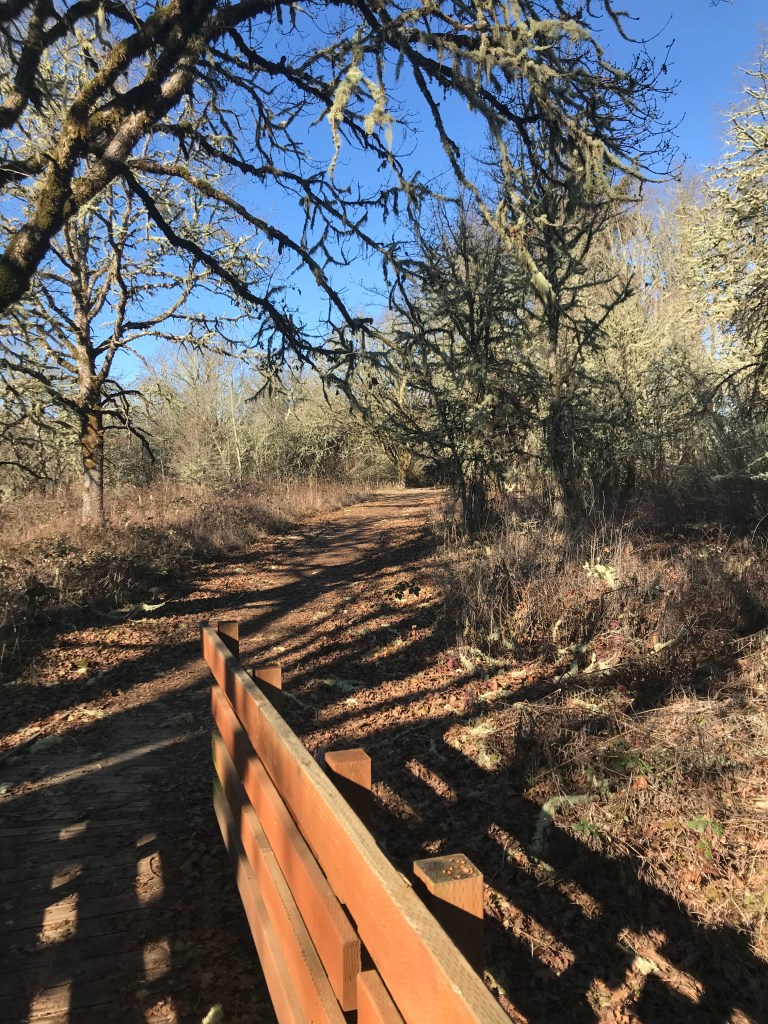
Trail winds to the right, Closed at first, and then open. Beautiful.
A lovely hike today at the William L. Finley National Wildlife Refuge just outside of Corvallis, OR. Such a lovely day. I added a few more of the pictures I took below. And, well, that was my one thing this afternoon.
Of course, both objectives and priorities, must be connected to your goals, and vision, so we’ll also take a look at how to connect them all.
Ready? Good. Here we go.
First, let’s use a goal that is actually part of my work today. A very practical example. Here we go.
Increase connection, collaboration, and unification of noncredit organizations throughout the state of Oregon within the next 2 years.
Alright, we’ve got a goal set. Now, let’s discuss objectives.
Creating Objectives
Where goals can be set for long-term planning, and short-term planning, in the context of this conversation we are using a long-term goal.
Our focus then is to go from our long-term goal to day-to-day activities that will connect back to our long-term goal. Creating objectives can help us do that by breaking our goal up into smaller pieces, which we can achieve in a shorter period of time.
Let’s take a look at an objective for our goal.
Create a noncredit consortium, which includes representatives from each organization that delivers noncredit education throughout the state of Oregon in the next year.
There we go.
Because our goal is to increase connection, collaboration, and unification of noncredit organizations throughout the state of Oregon within the next 2 years, we need an objective that will, well, basically, help us get there.
In this example, creating a consortium within the next year can do just that.
Alright, now we’ve got a 2-year goal, a 1-year objective, now we need some priorities.
Priorities are typically set for a shorter duration of time. They can be set for a day, week, month, and even a quarter. Alright, let’s create some priorities for our objective.
Priority #1 – Create bylaws for the non credit consortium in quarter 3
Priority #2 – Create a leadership structure for the noncredit consortium in quarter 4.
It is possible in this example, that both of these priorities can be achieved within quarter 3, however, to illustrate the example, I’ve chosen to spread them out.
The important point is that we now have a goal, objective, and priorities that are all connected. And, they all have timeframes allocated to them, so we know if we are on or off track. Important.
Once priorities are created, it is time to create next actions.
Creating Next Actions
Creating next actions, or action items, or next steps, is really about identifying the work that needs to be accomplished to meet your priorities, which then means, yep, that you are meeting your objective, and moving closer to attaining your goal.
Let’s create some next actions.
Identify bylaws needed and begin to create them in the January meeting.
Identify 2 or 3 committee members that will continue to work on the bylaws in between the January and February meeting.
Create agreement and alignment on the bylaw next actions, which are due by the February meeting.
There we go.
Now, you’ll notice that I did not create the next actions for priority number 2. The reason this is so, is that that priority is for quarter 4, and, as we complete the next actions to meet the number 1 priority, we will learn more.
Meaning, that the second priority might shift a little by the time we get to the end of quarter 3. Normal.
Recapping, we now have a 2-year goal, 1-year objective, a priority for quarter 3 with next actions, and a priority for quarter 4 with next actions still to be identified.
Before we get to the system part of our conversation, which, of course, is one of my favorite topics, let’s discuss results and metrics a little.
It’s important in all goal-setting activities, personal and professional, to identify a way to measure progress. The measurement can be quantitative or qualitative. Both are needed and necessary.
In our conversational example about the noncredit consortium, we can create a couple of ways to measure our progress. First let’s reset the goal. Here it is.
Goal – Increase connection, collaboration, and unification of noncredit organizations throughout the state of Oregon within the next 2 years.
Now, let’s set a result and a metric.
Result – Increased service to all communities as an outcome of increased collaboration between the noncredit organizations.
Metic – Total service numbers by organization.
We can even take a deeper dive with this result, by creating actually percent increases we expect, such as:
Result – Service numbers increase by 10% in year 2.
Metric – Total service numbers by organization.
Once you have your results and metrics, we need to think about how to gather the data to measure the metric. In this example, we would utilize the systems the various organizations use to gather their student service data.
Alright, we’ve now covered goals, objectives, priorities, next actions, and results and metrics. Let’s now take a look at how these components work together to create a single system.
A Single System
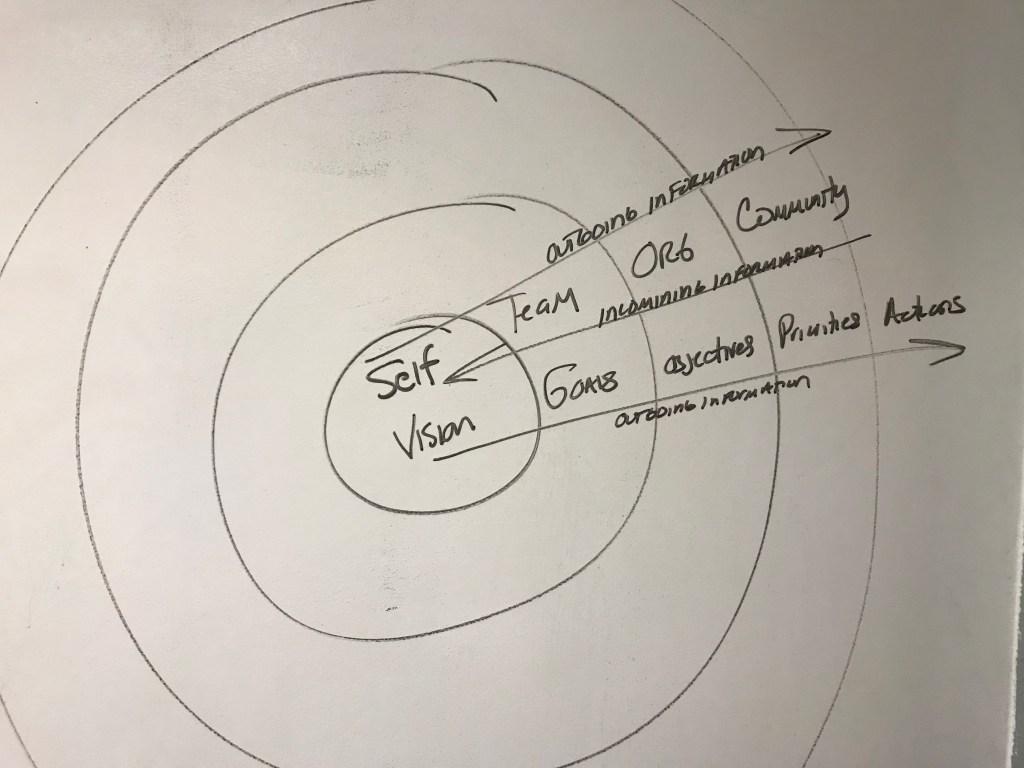
As you all know, I love white boards. And, yes, I’ve created two simple white boards to help us visualize the linear information provided in this post. Here we go.
Corvallis, Oregon 2021
In this first white board we can see I’ve used a relationship ecological system to display the connection between the self, team, organization, and community, and a vision, goals, objectives, priorities, and next actions.
They function the same way.
As we develop as a leader, we take in information from the team, organization, and community, and we give information back out the same way. It’s completely reciprocal and, well, quite lovely.
Similarly, when we create a vision, and set goals, objectives, priorities, and next actions, they inform each other. For instance, the vision informs the goals, objectives, priorities, and next actions. Just as our next actions will inform our upcoming priorities, objectives, goals, and the vision, as needed.
Pretty cool.
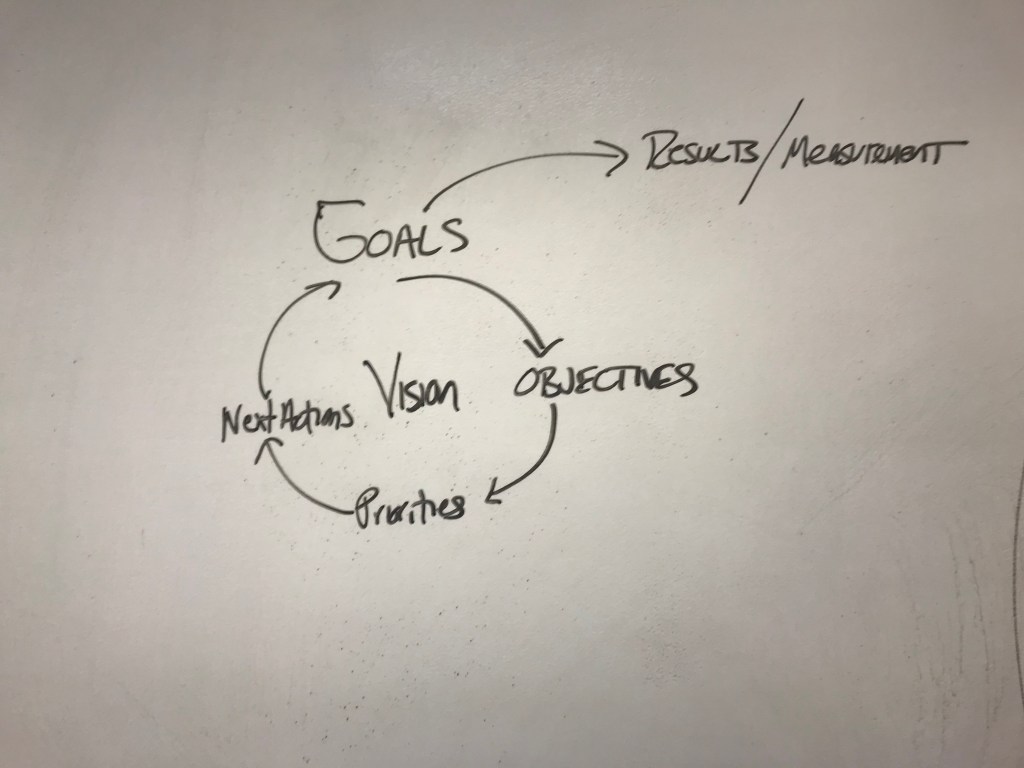
Okay, one more visual. Here we go.
Corvallis, Oregon 2021
In this simple illustration, we can see a similar pattern. The vision is the anchor, as the self is in a relationship system, and informs our goals, objectives, priorities, and next actions, which, in turn, informs our upcoming goals.
Wow, that was fun.
That concludes the second and last installment in My One Thing: Creating Alignment In Our Lives.
You can use these tools in your personal life, just as you can at work. The most important thing is to create a vision for your future self; and; to work towards the realization of that self by taking actions each day that align with the self you see yourself becoming.
Remember, you are the only one that can make that future self a reality.
It was great to put a period on the lengthy second installment of the Leadership Series. In installment 3, we will look at creating and developing teams. Will be fun.
Alright, and next week?
Well, I already have another Haiku scheduled, as well as a Tanka poem. I also have an article on intention and the last installment in My One Thing: Creating Alignment in Our Lives.
I also have some new ideas, which I’ll get to writing about in the next month or two. Here are a few of those ideas.
The Leadership Series Part 3
A new series on leadership, called Leading from Within
An article on the law of attraction
And, of course, I’ll have new entries in both the developmental moments and reflection series in the next few weeks.
Alright, how about birthdays.
Birthdays
Well, my oldest son turned 21 this week, and my youngest will turn 17 in May. Phew. It is hard to believe, and then not, that these boys are so grown.
I am so impressed with who they are becoming as young men, and am so proud of them both. A lucky father, am I.
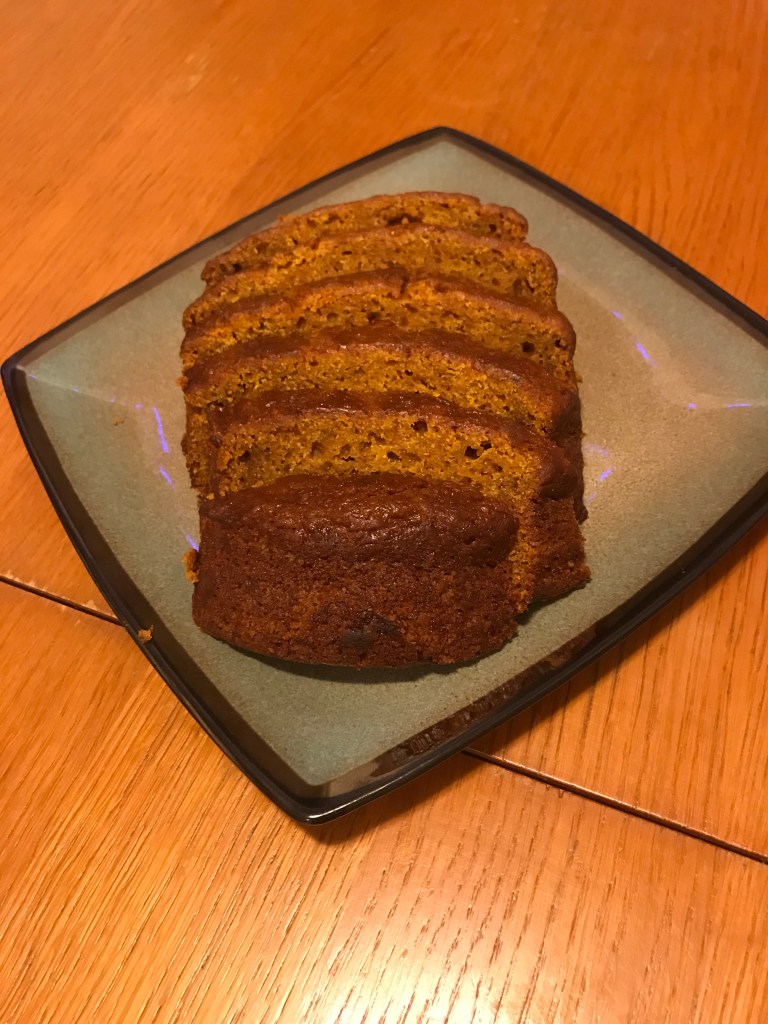
Alright, Justin’s birthday was this past week, so he was over Saturday night, and I made a spinach salad with baked tofu (breaded with panko and slightly fried), and brown sugar butternut squash bread.
Both were super tasty, though I will write that the bread was a little sweet for my tastes. Here is the recipe for the bread, and a couple of pics.
Corvallis, Oregon 2021
Fun!
Overwhelm
As I already mentioned, last week we had our busiest week of registration since the pandemic started. Of course, this also means that the team was super busy, and, each of them, at different times and at different levels, experienced overwhelm. Yes, me included.
On Wednesday it occurred to me, though not for the first time, that we are all inundated with stimulation, and it occurs differently inside of the pandemic. Meaning, many of us are on technology more than ever before; and it is needed and necessary to move our work forward.
However, being aware of creating quiet space is also needed and necessary. I think it is needed more now than ever before, and necessary to keep us centered and in balance.
Thus, I sent the team the following message on Wednesday. Subject line: Please read today: Taking the time needed.
Hi all, Phew, what a busy week! I am so impressed by each of you, by the work and possibilities we continue to create for our community. A record number of registrations continue to come in! And, just as our record number of registrations is a beautiful thing to see and be a part of, we have all felt, in some way this week, overwhelmed by the work we are engaged in. I’ve said what I am about to write, in just about every meeting this week. We all need to create time to put the work down, and just be. Be outside in the sun, if it is sunny as it is today, be in a quiet space in our homes, be, well, wherever you can create time for yourself that is away from technology and stimulation. I am asking each of you to continue to create this time for yourselves when needed. You will see on my calendar today at 1 pm, a walk scheduled. I will be away from my computer and phone for 45 minutes. Please do the same when you can. It can be 10 minutes, 20, or longer, just take that time, and be. Great work this week, team!!!!! Jeff
CORVALLIS, OREGON, 2021
Now, I’ve written before about being overstimulated, and being overwhelmed is similar, and, in fact, can function the same way.
We all need time away from everything and everyone.
As you move throughout your week, I invite you to create this time for yourself. Create time for yourself, to be with yourself. Just for you.
And, take that time to breathe, witness all that surrounds you and is within you, and just be.
When’s the last time you had a difficult conversation? If you are in a relationship with, well, anyone, it is likely you’ve had a difficult conversation recently. They are a part of being in a relationship with someone. Yes, difficult conversations are needed and necessary in the workplace, and they are also needed and necessary in our private lives.
It is through the most difficult conversations where growth for the people inside of the conversation becomes possible. When we avoid these conversations, nothing really happens. Actually, if anything, when we avoid difficult conversations, the relationships we have are built upon a shifting foundation.
Meaning, unstable, and unreliable. Why?
Because, we’re not being true to how we think and feel when we avoid things that are difficult; and, difficult conversations are not removed from this truth.
Many people struggle with having these conversations, just as I once did. Truth. And, yes, they are hard. I’ve had many in the past three years, and, yet, there is also something beautiful in the experience of being in that difficulty with another human being, and creating a way forward.
Alright, let’s first consider two concepts, which occur prior to the difficult conversation, and then a very simple, pun intended, as you will soon see, strategy, you can employ inside of a difficult conversation. Ready? Good. Here we go.
Even in the language, I’ve used thus far to describe a difficult conversation can appear binary. Meaning, either the conversation is in one way difficult, or the opposite, not difficult.
It is important to understand that difficult conversations, like all things in life, live along a continuum. This means that there are many types of difficult conversations, from, let’s say, conversations that are easier, yet still sensitive, to conversations, which are much more difficult.
We can think about them living along a straight line that continues forever, with sensitivity on the far left, and, in a workplace example, a corrective action conversation on the far right. In between?
Many types of conversations. Yet, regardless of the type of difficult conversation, there are several steps we can take to make sure we are ready. The first? Making sure you are clear and that what you understand about the context you are witnessing with the person you need to have a difficult conversation with is true.
What do I mean by clear and true? Let’s take a look.
Clear – that you’ve done the pre-work necessary to understand the context you are witnessing, and that indeed a difficult conversation needs to take place. Again a working example may suffice. Maybe someone on your team is having difficulties at home, or with another coworker, and does not yet have the tools needed to know how to talk about the issue. However, if the employee does not talk with someone about the issue, their work will suffer. In this instance, I would classify this difficult conversation as a sensitive conversation, somewhere toward the left of the continuum. However, it also depends on how long the team has been together, and how long you’ve worked with the employee. If the team is new, and or the employee is new, the conversation will be more difficult. Either way, knowing that the conversation needs to take place and that you are clear on the reasoning is key.
True – true meaning that we’ve taken time to watch the behavior, and reflected upon it. It is super important to avoid emotional reactions to situations as they arise. Taking time to witness behavior gives us a more three-dimensional view. Yes, there are times when we will need to have a difficult conversation at the moment. It happens. However, when we practice applying the clear and true principle, it helps us with planned and unplanned difficult conversations. Both.
Once you are clear and know that what you are seeing is true, you can deploy a very simple strategy to conduct a difficult conversation.
And, yes, I chose this acronym intentionally, as some people find themselves attracted to language. Meaning, they like to use a lot of language when in conversation with someone.
However, using more language than is necessary and needed in a difficult conversation will only make the conversation more difficult and less clear. It is very important to keep things simple.
Strategy – having a strategy for how you are going to have the conversation is important. Here are some questions to ask yourself prior to the conversation.
What are you going to say?
How are you going to say it?
Where will the conversation take place?
What is your goal for the conversation?
What questions might the employee ask, and what are your answers?
How long will the conversation last?
Intentional – you want to, at all costs, make sure this conversation is created intentionally, once you know your strategy. Again, sometimes these conversations happen at the moment, however, I’ve found that most often, you can take the time needed to watch, learn, strategize, and then create the conversational context. And that is doing things intentionally.
Meaningful – the conversation needs to be meaningful. When you create the goal of the meeting, also create the takeaway for the employee. For instance, how is this conversation going to create the possibility of a developmental step forward for the employee? It is important that the conversation includes this developmental step. It is up to the employee to take a hold of that developmental opportunity and do something with it. Just as it is your job as the leader to create the developmental possibility in the first place.
Planned – we’ve covered having a plan for the most part. Here I will simply add that taking the time needed to create your strategy and plan accordingly is important. For instance, making sure to clear your calendar leading up to and after the conversation, so you have time to do the necessary pre-work and decompress after. Difficult conversations are called such because they are difficult for everyone, the leader included.
Learning – once you’ve created the possibility of a developmental step forward for the employee, it’s time to make sure the theoretical development is pulled into practice or reality. It is your job as the leader to ensure this possibility also exists. Now, the developmental work is for the employees to do, however, you can assist them by implementing a timeline and due dates, and a follow up 1W1 to ensure you are supporting them in their development.
Experience – it’s also the leader’s job to ensure that the conversational context is an experience that is safe, and includes both empathy and compassion. Meaning, that everyone is in a different developmental stage as a human being; and people, all people, need safe spaces where they can learn new strategies they can employ in their life to move them forward as human beings. For this to occur, the context needs to be safe, and include both empathy and compassion. Empathizing with someone, simply means understanding where they are free of judgment, and compassion? Means remembering you, as the leader, are a human being just like they are, and have had very similar situations arise in your life.
Wow. That was fun.
Alright, there are several strategies you can employ prior to, during, and after a difficult conversation.
Remember, these conversations are needed and necessary. Really and truly. When we take the time necessary to create safe contexts where difficult conversations can occur, we are paying forward a part of ourselves, and helping someone else move forward in their life. And guess what?
When you create these contexts, you also learn more about who you are as a human being. Always. In every difficult conversation, I’ve ever had, I have always learned more about myself and my own development.
And that, my friend, is movement, and it is beautiful.



























 Develop. Inspire. Transform.