Poetry and Prose by #1 Amazon Bestselling Author of Nature Speaks of Love and Sorrow, Co-Author of #1 Amazon Bestseller, Wounds I Healed: The Poetry of Strong Women, and Jan/Feb 2022 Spillwords Press Author of the Month
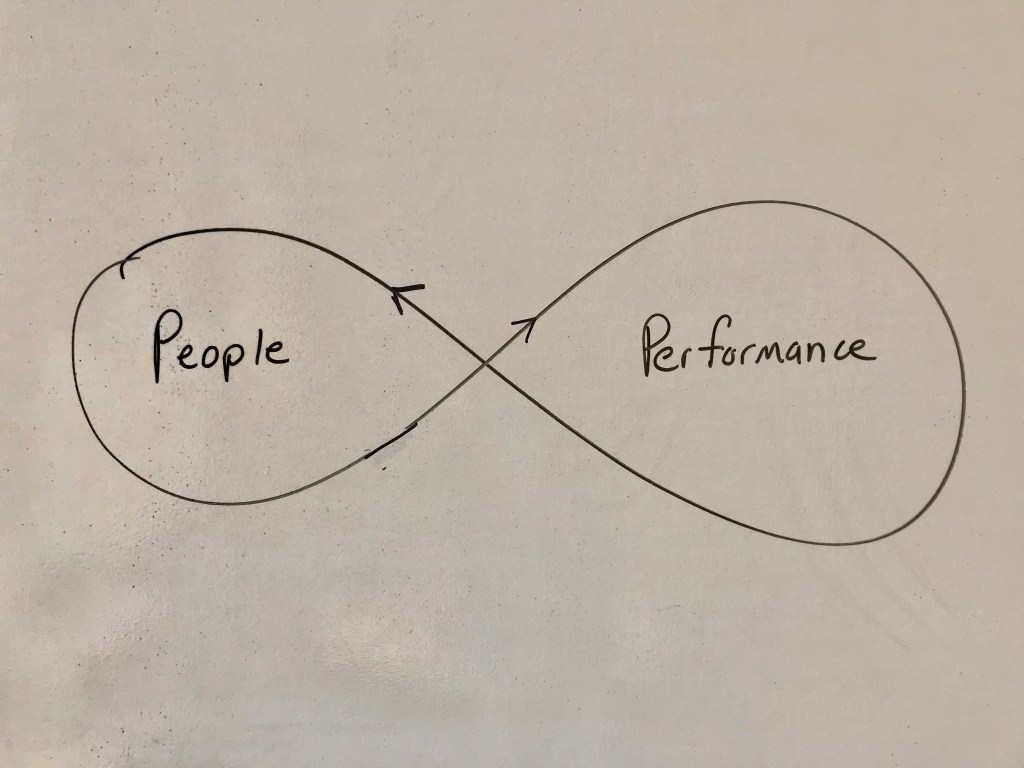
Have you ever heard of the concept, the causal loop? Well, though I am familiar with the concepts that make up the causal loop, in regard to people and performance, I had never really conceptualized them like I am about to present them here.
It is important in any leadership, nay, any team environment to understand a very basic principle. Ready? Good. Here it is.
People and performance both matter. Seems like common sense, yes? Well, often only one side of the causal loop is focused on, which creates an imbalance in a very functional system. How does it work? Good question. Let’s take a look, shall we.
The Causal Loop Albany, Oregon 2021 Photo taken by Author
The Causal Loop
People
In any system, symmetry, or balance, is created when all the system pieces work together. With both symmetry and balance, you can move forward, or produce an output, if you like. And, like any system, when one part is dysfunctional, or is not being paid attention to, the whole system suffers. It may, for instance, still produce an output, yet there will be long-term sacrifices.
It is common for leaders to get caught up in metrics. Meaning, at some point in their tenure, and sometimes this can last the entirety of their tenure, they become obsessed with “the numbers.” It matters less what those numbers, or metrics are, what matters, is that when, as a leader, we become obsessed with results, we forget about the people that make the results happen.
Without people, results are an impossibility. Therefore, if you find yourself stuck on metrics, remember, that focusing solely on outcomes may work for a time. Really, it may. Yet, a performance only approach is not sustainable. Period.
In time, what will occur is that people will burn out, quit, and overall morale will decline. Why? Because their needs are not being prioritized. Simple.
And, like any system, if the parts of the system are not being prioritized and taken care of, the system will, in time, fail. It will always occur this way. Always.
Performance
Now, conversely if as a leader you are always focused on the people, and never focus on the performance, the system will also become dysfunctional, yet will do so in a completely different way.
When the culture of a workplace is the single focus on a team, or in a department, or in an organization or business, then leadership is missing a very important part of the balance of creating and maintaining an effective system. Performance.
Simply, there must be a focus on both people and performance for movement, and eventual traction to occur. A balance, if you like.
It is very normal on a team, any team, for the focus to shift back and forth between the workplace culture and the people, to performance. Shifting of this kind is especially normal on new teams.
I’ve written extensively about the team I work on, and have more forthcoming, and about how the entire first year was spent developing relationships. That was necessary. As it was necessary in year 2 to develop metrics, and in year 2.5 and 3 to focus on performance and people. Both.
There is a balance that can be found, and I imagine it is different on each team, and within each organizational or business culture. Yet, a leader can find it by paying attention. Paying attention to the people and the performance.
Movement and Traction
When you have achieved balance, know that the balance will never really truly be 50% people, 50% performance. Meaning, that sometimes there will be more of a focus on people, and at times on performance. It’s really most important to develop an awareness about how the causal loop functions as a system.
If you sway one way too far, you can move back to center, and vice versa.
Now, when you’ve increased your awareness about the causal loop, and pay attention to both people and performance, guess what?
Things will begin to move, and in some cases, like ours, move so quickly and beautifully, it is quite magical. And, once things start to move, traction will occur.
With traction, you are more than moving as a team. You are moving as a team while being pointed in the exact same direction all focused on the exact same goals and outcomes. Therefore, your performance and results show this truth.
Remember, it takes time to get to a balance between a focus on people and performance; and, that it is the awareness about the importance of both that matters. And, that? Well, that’s progress. Beautiful.
A grand palace, one that goes on, at times Without notice, sitting in the weather, not a care Near, nor a plethora of wear, tear, or despair.
As the sun rises, off in the distance, It casts a glow of such brilliance, making The grand even more persistent, while Simultaneously, reminding us all of our shared resilience.
Such displays need no homage or fanfare, Though, for sure, the latter is not rare, As people from around the world come to Share in the brilliance that is there.
In response to the WDYS #71 prompt from Keep it Alive, by Sadje.
Up and and down, Have you ever trod slowly In the snow on a wintery day?
The feel as your shoe hits the flakes, And disappears inside the icy whiteness, Of the deserted brightness, looking around, To see who’s there, only to notice,
That it’s you, by yourself, taking one Step and then another. Making your way along a path no one Else can see, yet you know, you see
The path as clearly as the snow that’s All around you. It’s awfully astounding, And beautiful, and when we feel that quake Inside, to know that you’re never alone.
Even when there’s no one else in sight, Or who understands your exact plight. A mysterious conjecture of our human nature.
These tranquil days, reaching deep inside, To acknowledge both the pain and pleasure, You’ve been resisting, while persisting always Gives more power to our boundness,
Yet just on the other side is the relief We’ve been seeking. All we have to do Is stay quiet, wait a little while longer And the seeking will turn into a speaking, Releasing us to be found.
Darkness Worn like a cloak On a brocade Of silence
Memories are translucent, and
Fibers of my being Are hard, at times,
To piece together.
They fit in a splash Of overlap, one Scene runs Into the Next,
And, I’m often quite Transfixed,
By the pictures I see, So much so, I wonder If they Are
Even really me.
Lightness And, as the shadow Lifts, light begins To creep in,
Not all at once, no Slowly, one measure At a time.
The light must be Careful, not to Scare too Much
Fright Into the unsuspected.
Those who are not Used to its fullness, Stillness, and yes also Goodness.
Yet, it does invade, And pervade the senses, Bringing with it, a new dawn, With all of its new drawn-
Out histories, yet to be Lived, and then, yes, eventually, Told.
The question, so bold?
Why the darkness and The lightness? What’s the Story of this symbiotic Relationship,
Which manifests in So many different ways When at play, during the Day, and, yes, even when We are hiding in the shadows Of its fullest measure.
Our pleasure unrecognized, not Fully brought to its light.
Symbiosis In the end, dark and light Are a pair of opposites, Just like the rest of The world.
While we get carried Away in a whirl-winded Exploration of why;
Why not try to simply Accept the reality that is.
Lightness exists, As does darkness, and, Paradoxically,
And, oh so commonly,
You can be in the light, While in the dark, just As you can be in the dark, While in the light.
It works that way, all Throughout our days Until we are finally carried away.
Instead of a diary entry this week, I am choosing to share this three-part poem with you. I wrote this a few weeks ago just before traveling to the coast. At that time, it occurred to me to write a poem about three concepts, darkness, lightness, and symbiosis. Yet as I wrote the poem, they felt like three distinct parts of an overall unified whole, so I structured them and am sharing them just as they occurred to me. Fun.
The past few weeks, I’ve been thinking more about patience, and just how important being patient is in all aspects of life. For sure, patience was, and is, something that I continue to be present to, as patience was, and still is in some ways, something that is a developmental opportunity for me.
How do you feel about the concept and practice of patience? Do you think it affects how we interpret the world, and how we, for instance, function at home and work?
I think it does affect all aspects of our lives, whether we are aware or not.
In this post, we’ll explore a couple of ways to expand the concept of patience by unpacking the stimulus response system, and by exploring ways we can increase our patience, or, conversely, decrease our reactivity. Ready? Good. Here we go.
In some ways we are programmed to respond to our environments. As we navigate our environments, our brain takes in data and information, let’s call them inputs, processes them, and then runs through a selection of outputs, or responses. Pretty simple, yes?
Yep, pretty straightforward. The issue? Good question. Well, if we never question our responses, and simply react, we can become reactive, which means that an event occurs and we react without pause. Super helpful in an emergency situation.
In a non-emergency situation, however, it is not always as helpful. There are ways, however, that we can slow down the stimulus response system, which creates a space for more choice.
Emotional Intelligence
Emotional intelligence has been written about for a long time. Very simply, having emotional intelligence means that you understand that there is a space between a stimulus and response, and you can access this space. Accessing the space between a stimulus and response, also means that you are able to make more choices and handle emotions that arise more readily. Important.
Learning about and practicing emotional intelligence is important for all aspects of life, and is particularly effective in our relationships. When we can slow down and increase our choices, we, at the same time, increase the outcomes that are possible in each situation.
As we learn more about our emotional selves we create the opportunity to reduce reactivity, and understand our own humanity. For instance, anger was something that was present for me a lot of my adult life. There are many reasons this is so, knowing today, I was only ever upset with myself for not living the fullest life possible. Knowing this is helpful.
Additionally, understanding that anger can arise, and not mean that I am an angry person is also helpful. We must be careful with the concepts we internalize. If we internalize concepts, such as anger, as part of who we are as a human being, we then become an angry person. It’s just how it works. If, however, we understand that anger is an emotion that, like our thoughts, will arise, yet is not indicative of who we are as a human being, we are immediately freed from the concept. Super helpful and liberating.
Further, it is important to understand that our emotions not only affect us, they affect everyone around us, even if we are unaware. It’s not possible, for example, to carry anger, and to not give it out. We will. And, when we do, then all we see is anger, because, in fact, that’s what we are creating.
However, when we learn about and practice strategies that can increase our emotional intelligence, and at the same time, slow down our reactivity, we have new choices. New ways of being, and of releasing old concepts that we once believed in.
Emotional intelligence has a direct impact on our patience. When we slow down our impulse to react to external stimuli, such as other people and events, and internal stimuli, such as thoughts and emotions, we create a space to choose being patient over being reactive. Important.
And, in the space we create to be more patient, we get to choose from a plethora of ways to respond (not react) to a person or event. Powerful.
There is one practice that has been instrumental in my practice of my own emotional intelligence, and that is meditation. I’ve written about meditation lots of times, and, in fact, it has been scientifically documented that meditation decreases reactivity.
As our reactivity decreases, we see and experience the world more slowly, our patience increases, and we are able to understand our thoughts and emotions on a deeper level. Which also means that we will understand everyone in our lives that much better as well.
And, when we understand ourselves and those we love and care about better, our relationships begin to blossom. Our relationship with ourselves, yes, and with everyone else. A beautiful cycle.












 Develop. Inspire. Transform.