7 Things You Can Do to Develop Courage and Humility

What is the difference between courage and humility? Hm. Well, if you look courage up in a thesaurus, you will find that humility is an antonym for courage. Meaning different, yet is it, really?

I think they are more similar than they are different. And, I think understanding this similarity is important to our lives. Ready to take a look? Good, let’s go.

Let’s define these two, shall we. Here we go.

courage

noun  /ˈkʌrɪdʒ/ /ˈkɜːrɪdʒ/[uncountable]Idioms

the ability to do something dangerous, or to face pain or opposition, without showing fear

Oxford Learner’s Dictionaries

humility

noun /hjuːˈmɪləti/ /hjuːˈmɪləti/[uncountable]

the quality of not thinking that you are better than other people; the quality of being humble

Oxford Learner’s Dictionaries

Hm. At this moment, I’m actually quite surprised about how similar these definitions are. More similar than I would have even predicted.

Do you see it? Either way, it’s okay, let’s take a deeper look at both courage and humility and see what we get.

7 Things You Can do to Develop Courage and Humility

As I’ve written about previously, people often mistakenly believe that there are people that have courage and there are people that don’t. Like it is a developmental trait that some have and others don’t.

However, courage is like any other skill set. Meaning that it can be developed. Yep, it’s true. And, guess what? As you develop courage, you also develop humility. Yep, also true.

Here, then, are 7 ways you can develop courage.

  1. Develop a growth mindset – meaning, be available and open to learning all there is to learn. When you have a growth mindset you realize that there is much more to learn than is known, and you are eager to learn. The opposite of a growth mindset is a fixed mindset. Meaning unavailable and closed to learning. Think flexible versus rigid. When we are flexible, we go with the flow, receive what others have to give us, and then we give what we have back to them. When we are eager to develop a growth mindset, courage follows because contexts where growth mindsets flourish are about development and transformation.
  2. Grow your comfort zone – continuing to practice getting outside of your comfort zone is important. Important to your development, and to the development of courage. When we are outside of our comfort zone, in that moment, we are doing and modeling courage.
  3. Embrace and practice vulnerability – I’ve written several articles recently about vulnerability. Like your comfort zone, when you embrace your own vulnerability and practice being vulnerable, you are immediately being courageous. And, guess what? The more you practice vulnerability, the more courageous you become.
  4. Practice collaboration – collaborative contexts are naturally vulnerable contexts as they are about being open and flexible, learning, and development. When you are collaborating, really collaborating, you are practicing courage; and, the more collaborative contexts you engage in, the more courageous you will become.
  5. Create innovation – innovation and courage go hand in hand. They have to, because innovative contexts are imbued with vulnerability, growth, collaboration, and transformation. Innovative contexts are courageous in nature. The more innovation you create, the more you are being courageous, and the more your courage will grow.
  6. Take risks – though humans like predictability and habit, risk-taking is needed and necessary. Taking risks ensures you develop into the iteration of yourself where you can give the most back to the world. Really. Because humans like predictability and habit, risk-taking feels scary, so when you take risks you will develop courage. The more risk, the more courage will develop.
  7. Face your fears – every human on this planet is afraid. Yes, there is a continuum of fearfulness, yet know that you are not alone in being fearful of things. Fear is a natural part of being a human. However, when you face your fears, you develop courage. And, like risk-taking, or any of the others on this list, the more you face your fears, the more courageous you will become.

Alright, there we have 7 ways you can develop courage. Now, let’s make the connection to humility, shall we.

Photo by Samia Liamani on Unsplash

Here then are

7 Reasons Why Developing Courage Will Also Develop Your humility

  1. Growth mindset – as you develop a growth mindset, you will become more present to just how little humans really know; and, conversely, just how much there is to learn. It is vast, and humbling.
  2. Comfort zones – getting outside of your comfort zone is hard work. Really. At times, very hard. As you get outside of your comfort zone, you will realize how tiring and depleting it can be. Rewarding absolutely, and very, very tiring, and humbling.
  3. Vulnerability – being vulnerable is extremely hard. Of all the items on this list, maybe the hardest. Oftentimes, just being vulnerable once in a different way will cause you to experience great humility.
  4. Collaboration – connecting with other human beings through true collaboration is lovely, and is also an experience where you get to see other humans in action, being vulnerable, developing themselves in new ways, being courageous, taking risks, and transforming. It is a wondrous sight, and very humbling.
  5. Innovation – any and all innovation is humbling. Just the idea of creating something new is a humbling experience. When I created the first iteration of this site, which took a long time, and was totally out of my range of expertise, I was tremendously humbled by the experience.
  6. Risk-taking – like being vulnerable, taking risks is scary. And, if you take risks often, especially while working alongside others, you will experience a whole new level of humbleness.
  7. Fears – facing our fears is extremely difficult; and, when you face them often, you become more humble. You sort of wake up to the reality that facing fears is hard for everyone, so when you witness someone do it, it can actually bring tears to your eyes. Shared humanity.

Photo by Everton Vila on Unsplash

Alright, there are 7 ways you can develop courage, and 7 reasons why developing courage will also result in more humility.

In the event you’ve been wondering, I picked the introduction picture intentionally. Why?

Because developing courage by doing any of the 7 listed above is about being in action, doing things, living your life the best way you know how by giving your all every day.

Sometimes people conflate courage with iconic pictures of the hero saving the day, which is very dramatic. Yet, I want to offer you a different way to think about courage.

Courage is about being human. Recognizing our fears, the current limits of our knowledge, and doing something to face them, and grow ourselves. When we recognize where we have opportunities to develop, we can then take the necessary actions to create opportunities for ourselves to grow.

And, yes, if you like, to even transform. What does it take?

A willingness to set aside the ego, a little at a time, one step at a time, and take a different action. Take an action you’ve never taken before, and see what you get back. I think you’ll be pleasantly surprised.


#collaboration, #comfortzones, #courage, #developingcourage, #developinghumility, #development, #growthmindset, #grwoth, #humility, #innovation, #risktaking, #selfdevelopment, #selfimprovement, #vulnerability

The 4 C’s of Vulnerability: Why Vulnerability is Transformational

Photo by Edurne Chopeitia on Unsplash

I’ve written a lot about vulnerability lately. Why? Well, for many years, I avoided vulnerability at all costs. Really, I did. I was not interested. Actually, I was disinterested to the point of high levels of anxiety. Today? Not the case.

Today I believe that, although being vulnerable is hard work, it is where all the wonders of being a human being live.

Wonders like innovation, resilience, love, compassion, and much more.

In fact, writing an article like this just a short two years ago would have been impossible. Too vulnerable, too much unknown, too much anxiety. We can pretend, or feel as if, anxiety is only our issue. Let me tell you unequivocally, it is not.

Many, many people all across the world suffer from anxiety. An aside, real quick, promise.

Photo by Fernando @cferdo on Unsplash

I was once in a therapist’s office, and they were talking to me about anxiety levels, and I said something like, I believe the entire population of the United States suffers from low-grade anxiety. What did they say? Yep, that’s true.

Now, I could write more about that, however, I’d like to get back to the current topic. Vulnerability.

I believe that vulnerability is important to our individual development. Showing us where we have growth opportunities if we choose, to be vulnerable, and grow into and eventually out of these opportunities. That’s development.

I also believe that vulnerability is a transformational space, which anyone can enter. Of course, of their choosing, when they are ready. What happens, you ask, when you are vulnerable on a regular basis?

Well, many things. However, I think there are 4 things that are distinct to being vulnerable where we get back much more by being vulnerable than we do by making the choice to not be vulnerable.

Photo by Sammie Vasquez on Unsplash

Alright, here, then is

The 4 C’s of Vulnerability: Why Vulnerability is Transformational

1. Connection

There is something about being vulnerable that exposes us to more of our own humanity. And, when we are exposed to more of our humanity, we get to know more about everyone else’s humanity. It works that way.

And knowing both about our own humanity, while also knowing about everyone else’s, gives us more sight about our shared humanity.

Connecting more deeply to the similarity of those around us. When we can connect with others in that way, we get more out of our relationships. Really.

Think about the relationships you have. Are you able to be vulnerable? Hm. If not, well, you may want to rethink those relationships. Why?

Photo by Callum Shaw on Unsplash

Because to be vulnerable you must be in a context that is safe, and with people that you trust. If you are not, vulnerability is way too scary, and rightfully so.

When we are vulnerable, we are exposing parts of ourselves that we don’t normally expose. And, it takes safety and trust to get there. It does.

Therefore if you are in relationships with people where vulnerability is out of the question, I would question the need for those relationships. Hard. Yet, might be needed.

When we are in a safe space, with people we trust, we can be more open, and inside of that openness, being vulnerable becomes more available.

And, as was aforementioned, when we get to share that vulnerable space with someone else, we transform that relationship into something quite different. Beautiful.

2. Compassion

Another quite lovely byproduct of being vulnerable is the opportunity to develop more compassion.

See, when we are vulnerable, we have the opportunity to experience grace for ourselves in doing something that makes us either nervous, fearful, or anxious.

We may not always extend ourselves that grace and the accompanying compassion, yet it is there. As was aforementioned, I was actively disinterested in vulnerability for many years. Over 20 in fact.

However, that does not mean I was never vulnerable. I was. And, inside of those vulnerable moments, some of which were long moments, I did not extend myself grace, nor the accompanying compassion. Nope.

Yet, know that developing more compassion for yourself inside of being more actively vulnerable, is possible. How do I know? Because I am actively vulnerable on a regular basis today. Every day in fact.

Photo by Matt Collamer on Unsplash

Anyone that participates in contexts and experiences that stretch them, that make them feel vulnerable, deserves grace and compassion; and, I can provide both to myself today. Growth.

Another opportunity inside of being vulnerable more often, and developing more compassion for yourself, is that you will also develop more compassion for others. It works that way.

Anytime we can extend ourselves more of something, we can now also extend it to others. And, believe me, everyone can use more grace and compassion today. Seriously.

Inside the space, you create to be more vulnerable, while extending to yourself and everyone else around you more grace and compassion, you have transformed yourself and that relationship.

In those precious moments, our shared humanity is realized, and we can recognize ourselves in each other. It is a beautiful experience. Connecting with another human being on that level is transformation.

Photo by yulia pantiukhina on Unsplash

3. Courage

It takes courage to be vulnerable often; and, when we are more often vulnerable, we get to develop more courage and resilience. Often, I think, people believe that some people have courage and resilience and others do not. Not true.

Like any other skill set, courage and resilience can be developed.

You can grow yourself into a more courageous and resilient self by doing things that are outside of your comfort zone.

And, it just so happens that being vulnerable is outside of most people’s comfort zone. I would actually argue that it is outside of everyone’s comfort zone. That is the nature of vulnerability inside of being human.

When we create the opportunity to grow into a more courageous and resilient self, we also get to model that behavior for people around us.

Family, friends, coworkers, acquaintances, and, yes, even people we don’t know at all. Inspiring.

And, inside of creating more inspiration in this world by being more open and vulnerable, developing ourselves, while also showing others that developmental growth is possible for them too, you get transformation.

Transformation for yourself, yes; and, transformation for those that choose to journey with you into vulnerable situations and contexts, which are created by stepping out of your comfort zone and into spaces that are vulnerable.

Photo by Toa Heftiba on Unsplash

4. Collaboration

When we have deeper connections with ourselves, and likewise, with people close to us, built upon safety and trust, there is an increased likelihood of more collaboration. Fun.

Though I think I’ve always naturally gravitated towards collaborative contexts and people that share a collaborative spirit with me, I was not always available to these types of contexts or people.

Remember, I actively avoided and resisted my own vulnerability for a long time, which also means that I, in many ways, missed out on deeper relationships with people where collaboration was more possible.

Now, I am surrounded by these types of contexts and people.

Even with people that I at one time did not share this type of connection, that connection is more apparent today. And, it can be for you too.

When we are available to a natural human inclination within us to share ourselves with others, to connect with them deeply, and to share all that we have to offer, we are or have become natural collaborators. Really. At that moment, or in those moments, it is true.

A byproduct of entering into collaborative contexts more regularly also means that there is a higher likelihood for innovation to occur. And, inside of innovative contexts transformation is regularly apparent. Why?

Because when we are vulnerably collaborating, we are out on a limb, deeply connected to others in that safe and trusting context, where courage flourishes, as does innovation. And, what often follows innovation is transformation.

Photo by Evie S. on Unsplash

Closing

In closing, I will also offer that where there is the possibility of developing more of a vulnerable self, there is also the possibility of developing less nervousness, fear, and anxiety.

What I’ve learned in the past three years, is that avoiding and resisting things that make us uncomfortable only brings more nervousness, fear, and anxiety. An example? Sure.

When I was working in the private sector, before going back to University at 33, I worked for several large corporations; and, at one of them, I wanted desperately to be promoted into a leadership role.

Well, at that time, I had a great supervisor and mentor, and that goal became a reality.

As many of you know, when you are in leadership roles, the need to speak in front of groups, your team, business, or organization is rather mandatory. It’s part of it. How did I feel about that? Horribly anxious. Really. Sky-high anxiety.

Photo by Product School on Unsplash

I remember the first time being in front of the group, I would eventually lead, at a district meeting. I had a 5-minute speech to give. 5-minutes, that’s all. Might as well have been an hour. Phew.

I was so anxious that the paper I was using for a guide, actually I was reading directly from it, was shaking like a leaf in my hand. Actually, my whole body was shaking like a leaf. Really.

Well, I continued to take on small parts in the meetings, 5 minutes became 10, and 10 developed, over time, into giving entire 1 to 1.5-hour district meetings to the group by myself. The point?

It took time. One step at a time. Bite-sized chunks, as they say, within a context where safety and trust were present.

And, yep, I developed more courage, resilience, much deeper connections with that team, and we did become highly collaborative. Fun.

Since that time, I’ve led several teams, including the team I am on right now and have taught at University. Transformation.

And, you can also be a part of a vulnerable transformation. It’s not complicated, yet it is, as we’ve discussed. Difficult.

Yet, when you take it one step at a time, one action at a time, knowing that it is a process, not a light switch, you can rest in ease knowing that if you persist you will be doing vulnerability more often.

And, guess what? Without even knowing it you will have developed deeper connections, more compassion, and courage, and you will probably find yourself in collaborative contexts more often.

Vulnerability is transformational, and you can partake in it if you choose. Choose well.

#beingvulnerable, #businessdevelopment, #developmentandgrowth, #leadershipdevelopment, #organizationaldevelopment, #selfdevelopment, #selfimprovement, #selftransformation, #vulnerability, #vulnerabilityandcollaboration, #vulnerabilityandcomfortzone, #vulnerabilityandconnection, #vulnerabilityandcourage, #vulnerabilityandhumanity, #vulnerabilityandleadership, #vulnerabilityandreducedanxiety, #vulnerabilityandrelationships, #vulnerabilityandresilience, #vulnerabilityandstrength, #vulnerabilityandtransformation, #vulnerable, #vulnerableascourageandstrength

The Big 5: Developing An Innovative Culture

This image has an empty alt attribute; its file name is javier-trueba-vfjnewjaa2g-unsplash.jpg
Photo by javier trueba on Unsplash

When I worked as a District Sales Leader at Frito-Lay, the company had an operating system for their sales teams, known as the Big 3, which consisted of the following.

  1. 1W1’s
  2. Monthly Team Meetings
  3. Ride-Alongs

I have no idea if the Big 3 is still in place, however, I do know that the system worked well. Why? There are 5 reasons. Ready? Let’s go.

  1. Establish Trust
  2. Create Alignment
  3. Develop Balance
  4. Build Collaboration
  5. Institute Accountability

Little did I know then, that these five outputs would actually show up in a different way 20 years later. Yep. How?

They showed up as important to developing and building an innovative culture. A culture grounded in trust, alignment, balance, collaboration, and, yep, accountability. The outcome? Innovation.

Alright, let’s now call these, just for fun, the Big 5. What, then, do we get when we instill the Big 5 into our teams, businesses, and organizations? A culture where innovation can thrive.

Implementing the Big 5 into your team is about developing culture. As your culture develops, you can then wrap processes and systems around that culture.

You may be wondering about developing systems first, then culture. I would advise against it. Why? Culture matters more. Simple.

Alright, let’s take a look at the Big 5.

Photo by NONRESIDENT on Unsplash

1. Establish Trust

I’ve written about establishing trust a couple of times. In 3 Steps and 9 Keys to Creating Safety on a Team in 5 Minutes, I write about 9 keys to creating safety on teams. And, inside of creating safety is establishing trust. Very important.

Establishing trust must come before people will feel safe. If people do not feel safe, they will hold back. Makes perfect sense. However, when there is trust, people will give all that they have, and they will also be vulnerable, try new things, go out on limbs; and, that is where innovation lives.

When there is trust between you and the team, and between each team member, you have an opportunity to create outputs and outcomes that have never been seen before. Why?

Because trust + safety + vulnerability = innovation.

Once trust and safety are in place, creating alignment is next. Creating alignment can take time. It took the team I currently work on over 2 years to create alignment. Year 1 was creating trust and safety. Year 2, creating alignment.

Photo by JOSHUA COLEMAN on Unsplash

2. Create Alignment

Alignment takes time. Really. It is normal for teams to move in different directions at the beginning. If you are unsure about this truth, that’s okay.

You can implement systems and processes upfront to ensure creating alignment quickly. However, as was aforementioned, creating those systems and processes early will also create a barrier to innovation. Why?

Because innovation thrives in an open environment where all the answers are not figured out. Though this can be stressful, know inside of an innovative environment, where safety, trust and vulnerability thrive, systems and processes will come.

Alignment comes when a vision is cast and strategy is created to tie the day-day operations to that vision. Each person on a team has a role to play in the execution of a vision.

When you get clear on everyone’s role and responsibilities, you are ready to create alignment between the vision and the day-to-day operations.

Here is how it looks linearly.

  1. Create a 10-year vision
  2. Create a 5-year vision
  3. Create a 3-year plan
  4. Create this year’s objectives
  5. Create 90-day priorities
  6. Create work of the month
  7. Create work of the week
  8. Create work of the day

Though that list looks long, it really isn’t that much, though it does take time. There is a very good resource for creating this kind of vision system, it is called Traction: Get a Grip on Your Business, by Gino Wickman. I highly recommend it to all leaders in all organizations.

Alright, now that you’ve established trust and created alignment, the next step is to develop balance. Sounds simple. Yet, developing balance takes practice. Let’s take a look.

Photo by Elena Mozhvilo on Unsplash

3. Develop Balance

As a leader, should you focus more on culture, or more on performance? Hm. Both are important. I like to think about culture and performance, like a see saw. Focus going back and forth. Sometimes, culture takes precedent, and sometimes, performance.

However, you must have both.

If you have a strong culture, and performance issues, you are not moving forward. If you have excellent performance metrics, and no culture, people will burn out and leave.

Developing a balanced approach to culture and performance takes practice, and an open mind. Meaning that when people bring you intelligence that a shift towards culture, or towards performance is needed, be open to shifting focus. Important.

In an open environment where trust and alignment have been created, the team will let you know. Really, they will. However, you still need to pay close attention to the team, and each individual on the team.

Like anything, developing balance takes time, and practice. You will know when you stray too far into one realm or the other. You can feel it when a team is not moving, or is moving too much. Watch, listen, and feel.

Collaboration is another important component to build in the journey towards creating an innovative culture. Some might say it is one of the most important.

Photo by Brooke Cagle on Unsplash

4. Build Collaboration

Why is collaboration so important? Well, to develop an innovative culture, building collaboration is a must. On teams where trust, alignment, and balance have been instituted, vulnerability will also typically be present.

And, being vulnerable with each other in an environment where collaboration is high is a natural breeding ground for innovation. Why?

Because where vulnerability meets collaboration is an open space ready for innovation to occur.

Actually, where vulnerability meets collaboration is where innovation is already happening. Really, it is.

Innovation needs spaces that are open, collaborative, and safe. Further, alignment and balance also help create innovative spaces. Though we’ve already discussed these two, there are two more reasons that showcase just how true the last sentence is.

  1. Because when your team is aligned, you are all on the same page, moving in the same direction. You are one.
  2. Because when there is balance, you also have balance with innovation. For instance, if all you do is innovate, then nothing will move forward. Similarly if all you do is execute, then innovation will founder. You need both. Both innovation and execution. A must.

Alright, now, let’s talk about accountability.

Photo by Bill Oxford on Unsplash

5. Institute Accountability

You may be asking yourself right now, what in the world does accountability have to do with innovation? Well, a lot actually. Let’s go.

Fostering an innovative culture, which also executes is imperative to actually creating newness in the world. You have to develop both sides of the equation. Similar to developing balance. And, how do you instill accountability into your culture? It starts with you.

You must practice accountability. Holding yourself accountable, first. You must also be open to the team holding you accountable. Accountable for what, you ask? For what you say and do. Integrity.

Developing an innovative culture means that each individual, starting with the leader, holds themselves accountable for the actions they take, and sometimes, don’t take.

The same goes with the team. When each individual holds themselves to the culture of innovation that you are developing, the team is also simultaneously held accountable. And, when people don’t perform?

Well, you must understand why. If it is a skill issue, offer them the opportunity to develop, to grow. If they are interested, great. If not, well, that is their choice.

If it is will. Then they also have a choice.

Bottom line. Developing an innovative culture means that accountability is taken seriously. As seriously as having fun, growing together, learning from each other, and innovating new products and services. Same.

Alright, that’s the Big 5 of developing an innovative culture. Fun. And, guess what? You can develop an innovative culture anytime. Really. How? Well, like all things, one step, or action at a time.

What will you develop next?

#buildingbalance, #businessinnovation, #creatingalignment, #creatinginnovation, #creatingsafety, #developingbalance, #establishingtrust, #innovativeleadership, #institutingaccountability, #leadership, #leadershipcahange, #leadershipdevelopment, #leadershipessentials, #leadershipinaction, #leadershipinpractice, #leadershipmindset, #leadershippractice, #leadershipprinciples, #leadershipvalues, #organizationaldevelopment, #organizationalinnovation, #teamdevelopment

3 Things Everyone Needs to Know About Building Relationships

This image has an empty alt attribute; its file name is liz-weddon-wp1netylf58-unsplash.jpg
Photo by Liz Weddon on Unsplash

I originally conceived of this topic and the associated article as one for business. An article about how to create deep connections with the people we work with, and the people we’d like to work with.

However, after reflecting upon it throughout the day, it occurred to me that this topic is applicable to everyone. Why?

Well, relationships are the cornerstone of life. Really. Think about all of the people in your life. You have people that are very close to you, friends and family, work associates and colleagues, and, maybe a little further from you, aquantinaces, clients, and neighbors, to name a few.

And, connecting, really connecting with these people, all of them, requires understanding ourselves.

Understanding why we do the things we do, why we feel the way we do, and think the way we think. Knowing ourselves. Why?

Because in order to connect deeply with another human being we must know ourselves first. Then, we can know them; and, know them as deeply as we know ourselves. If, however, we only know ourselves on the surface, we will only ever know them in the same way. Not a deep connection then.

Alright, let’s take a look at three things you can do to build deeper connections with the people that are currently in your life, and the ones that will show up in the future. Ready? Let’s go.

This image has an empty alt attribute; its file name is mike-clark-ssbhbaxr4c0-unsplash.jpg
Photo by Mike Clark on Unsplash

1. Know Your Why

Remember being little where everything we saw, thought, and felt was done with a sense of wonder and amazement? Yep, me too. Well, does life still feel that way to you? If not, don’t worry, it’s not a demerit; and, you are not alone.

As we grow older, we lose some of that wonder and amazement. Yet, we can intentionally create opportunities to get it back. How?

First, we must get back in touch with the things that drive us. You know, the reasons that get us up in the morning. And, I’m not talking about intellectual reasons. Nope.

I’m talking about those things deep within us that make us the person we are today. Can you feel them? If not, don’t worry. They are there, and you can get back in touch with them.

In the post, 3 Reasons Why Creating Alignment With Your Why Is Important; And, 3 Simple Steps to Create Your Why, I walk through three simple steps you can take to create your why. If you’ve not created one, create one; if you have one, maybe take a look at it again. Why?

It’s important to connect deeply with that why, or to reconnect with it if it’s been a while. When we reconnect with the why of why we do what we do, we are actually reconnecting with the vision we have of ourselves as human beings. And, in that moment, we create new possibilities. Really.

Photo by Danica Tanjutco on Unsplash

When we know who we are, what we are up to in life, we can share that with others. We can touch someone else with the passion we have for life. Just like when we were little.

The reason people connect with children, watch them, smile at them, want to be around them, is that, to them, everything is a wonder.

They are a wonder. Everything is amazing. And, reconnecting with your why can move you in that direction.

Further, when you reconnect with yourself on that level, you can now connect with someone else at that level. Sharing something of yourself that, in some cases, as it was for me for a long time, was buried underneath other intellectual ideas, concepts, and pursuits.

Remember one thing. People are not moved by their intellect, or by their head, they are moved by their emotional-center, or ther heart.

Now, you may be wondering, alright, I’ve got my why, then what? Well, now you can create a statement about your why. Something that you can share with those close to you and those that are further removed from you. Anyone really.

Photo by Clay Banks on Unsplash

2. Create Your Personal Mission Statement

A personal mission statement is something you can create, which declares why you are doing what you are doing; it will also give the people you are connecting with a sense of who you are as a human being. Example? Sure.

Here is my why.

To increase access to higher education for everyone.

Right, yet there is more to it. Yep. Here, then, is also part of my why.

Develop leaders, inspire creativity, and assist with personal transformation.

Okay, so now lets fashion a personal mission statement. Ready? Okay, here we go.

To increase access to higher education for everyone, and to develop leaders, inspire creativity, and assist with personal transformation.

Hm, that’s not quite right. It has the components, yet is not really getting at the crux of the why. Let’s try again. Here we go.

To increase access to higher education for everyone, while also working with students and clients to develop their leadership skills, expand their creative potential, and assist in their personal transformation.

Closer. The point? That there is no one way to create a why, or a personal mission statement. They are yours, and should be created by you for you to share with others when you choose, and how you choose. Simple.

You must simply create from within you. Important. If you don’t, and it is something that you don’t really believe in, well, you will know, and so will everyone else. Believe me. They will know if it is not sincere.

And, really, the point is to deepen your connection with yourself, first, and then with other people. You want it to be real. Real from your heat to the hearts of others.

Alright, you’ve got your why and you’ve created a personal mission statement, now what? A reminder.

Photo by William White on Unsplash

3. Understand that Relationships are Everything

In the post, Creating and Maintaining Relationships: What else is there?, I write about understanding that every relationship in our life is important. All of them. That, in fact, everything we do, everything, is about the relationship we have with ourselves, first, and then with everyone else.

Remember the relationships system? Looks like this.

Pinterest

There we go. Alright, so as you can see from the above system, everything we do starts with us. Everything. And, then as you move from the center circle, out to each corresponding circle, all that we do, goes out to those closest to us, first, and then to those that are further from us.

And, what do they get from you? From me for a time, they got cynicism. Yep. Not a judgement, just the reality as it was, not as it is today. Today?

They get everything I can give them, just as I do for myself, including the why of what I do each and every day.

The coolest thing about sharing your why, your passion, purpose, whatever you want to call it, with others is that they then get to know you on a level that will inspire them. Really.

Think about the people in your life that inspire you. What do they do? I bet they are up to all kinds of cool things, creating change, transforming themselves, working at changing the world. One step at a time.

And, you know the second coolest thing about sharing your why with someone else? You get to learn about their why. Yep. You get to know them on a level that might not have been previously available.

These deep connections are what drive people together. Actually the more appropriate language here, would be that they pull people together. Pulled by inspiring ideas, yes, and by inspiring actions.

Inspiring people to be all they can be is a pretty cool thing; and, guess what? You can be a part of that kind of connection anytime. You can create it. Yep. How? Well, as I’ve mentioned it all starts with you.

Why do you do what you do?

#buildingrelationships, #creatingapersonalmissionstatement, #creatingconnection, #creatingdeeperconnectionswithothers, #creatingdeeperconnectionswithourselves, #creatingrelationships, #creatingyourwhy, #developinghighqualityrelationships, #development, #developmentandgrowth, #emotionalintelligence, #growth, #highly-effective-relationships, #highqualityrelationships, #huamndevelopment, #personalmissionstatement, #relationship-conversations, #relationship-development, #relationships, #relationshipsystems, #selfdevelopment, #transformational-relationships, #understandingrelationships, #workrelationships

Clouds In The Sky

Corvallis, OR September 14, 2020

Alright, so I got home form work today about 5 pm. I was feeling tired before even getting home, so took a nap. Yep. Today, I sleep when needed. Not something I did for most of my life.

Anyway, after my nap, I wanted to go outside. As I walked out of my apartment and looked up and to the left, I squinted. The sun, wait, what?

For those of you wondering what I’m talking about, I live in Oregon, where for the past 7 days the sky has been filled with smoke and ash. No sun in 7 days.

Now, no sun is a normal part of living in the PacNW, yet, not, as it was these past 7 days, due to the largest wildfires in OR history, burning over 1 million acres.

I looked back down, and up and to the right. And, there it was. The sky! The clouds, wow, what a wondrous sight. Beautiful. And, at the same time I was feeling joy and wonder, I was also feeling sadness and worry. Why?

Because the fires are still raging across the state. Many of died, tens of thousands have had to evacuate their homes, many, many, many have lost their homes, and, in several instances, whole towns have been destroyed.

This post is for all of them, and for the amazing firefighters on the front lines battling the wildfires each and every day.

ABC News
Chicago Triibune
Oregon Live

We are thinking about you, sending love, energy, and support to all of you, and appreciate your leadership, dedication, and persistence.

Lead well, and be safe.

#firefighters, #inspiring, #leadership, #leadershipinaction, #oregonfires, #oregonwildfires, #wildfires

10 Reasons Why Asking Questions is Important to Your Development

Photo by Artem Maltsev on Unsplash

To question, or not to question? Hm. How many times do you remember being in a class, with a group of friends, or in a work environment where you wanted to ask a question, yet didn’t? Yep, me too. Really, we all have those memories.

Many people are afraid to ask questions, to speak up generally. Why? Afraid of looking silly, asking the “wrong” questions, not being taken seriously, or being made fun of. Has happened to all of us at some point.

Yet, the ability to ask questions, to discern relevance out of a context that is unclear, to move toward more clarity, while acquiring more knowledge and adding to the knowledge-base within the context is really important. Why?

Well, let’s ask Socrates, shall we. Here we go.

True wisdom comes to each of us when we realize how little we understand about life, ourselves, and the world around us.” – Socrates

Goal Cast

And this one.

The only true wisdom is in knowing you know nothing.” -Socrates

Goal Cast

Powerful. Simply, there is so much unknown about life and the world, that to not ask, to not speak up in a way cheats ourselves and all of humanity out of possible progress.

Photo by NASA on Unsplash

The topic of questioning is so important. Important to life, the world, the production and eventual dissemination of knowledge, and, yes, it is also very important to our development. Why? Well, I’ve got 10 reasons.

Ready? Very well, let’s go.

  1. Learning
    1. Seems simple, yes? The more questions we ask, the more we learn. Though this concept is simple, in practice, many people struggle to ask the questions they have deep inside them. They do. As was aforementioned, though an extrovert, I too once struggled with asking my questions. The issue? When we don’t ask, we actually carry that question around. Literally. We have it within us, unanswered, which can cause us pain, and frustration.
  2. Knowledge
    1. When we ask our questions, we gain knowledge, and we also contribute to knowledge acquisition. Yep. In every question there lives the possibility of more knowledge. We know so little about life and the world. Yet, with every question that we ask, we create the opportunity for us, and everyone else, to learn more.
  3. Clarity
    1. The more questions we ask, the more clarity we have. And, the more clarity everyone else has. As we learn, so does everyone else. And, as we all learn, we transform the nature of the context we’re in, to a context where questions are possible. A context where those that are fearful of asking questions, as you are, or once were, will be empowered to ask their questions. Powerful.
  4. Collaboration
    1. Asking questions is also the breeding ground for collaboration. When we ask questions, we are naturally contributing to a collaborative context, where learning from each other is embraced. We are actually fostering a collaborative context by asking our questions. Seriously, it is true.
  5. Strategy
    1. Asking questions is also super important to developing and executing on strategy. Without questions, you will only ever produce what was produced yesterday. Questions are the birthplace of strategy. And, with strategy, both concepts and execution, we get movement, and with movement, eventual traction in whatever it is we are doing.
  6. Innovation
    1. Like strategy, innovation depends upon asking questions. Creation and innovation are intertwined with curiosity, and those that are curious ask tons of questions. They have to, they are curious. With questions comes the possibility of innovation, and new ways of seeing and experiencing the world.
  7. Vulnerability
    1. When we ask our questions, we are also being vulnerable. We are modeling an attribute that is a necessity for development. Developmental growth is dependent upon being vulnerable, and when we accept our own vulnerability, even enter into vulnerable spaces intentionally, we will ask our questions.
  8. Leadership
    1. Well, if questions are important to strategy and innovation, they are equally important to leadership. Leaders are interested in what others think, know, and feel. They have to be interested, it’s part of being a leader. And, to learn how people think, know, and feel, you must ask questions.
  9. Trust
    1. When we ask questions we also contribute to a context or environment of trust. When we are actively interested in someone else, and what they know, or how they feel and think, we are modeling trust. Especially when we get back questions from those around us, which by leading through asking questions, we will definitely get.
  10. Relationships
    1. Asking questions means that we get to learn more about those around us, which also means that we get to deepen our relationships with those people. It is inevitable. Learning about someone necessitates a relationship. And being in a relationship means knowing about that person, and to know, we must ask questions.
Photo by bantersnaps on Unsplash

Alright, there are 10 reasons why asking questions is important to your development. Let’s take a look at how they are interconnected. Ready? Here we go.

When we learn, we know more, and when we know more we have more clarity about our life, yes, and of the lives of those around us. Learning and knowing are part of development. And clarity is an output of learning and knowing more.

When we collaborate with others we get to know people better, and we also get to know ourselves better.

Knowing others better will always shine a light on the parts of ourselves that we want to develop. It is normal, and is also very healthy.

Within a collaborative context that embraces strategy, we also create the possibility of developing an innovative culture. And, inside of an innovative culture, we create more innovative possibilities, which also contributes to future strategies. All of which contributes positively to our development and growth.

Photo by qinghill on Unsplash

I’ve written in other posts that vulnerability contributes to and fosters innovation. Vulnerability is actually where the seeds of innovation will eventually grow. And, like innovation growing through vulnerability, we also develop and grow when we are vulnerable.

Relationships are created, in part, through trust. When we trust each other, we can be real, be vulnerable, learn more from each other, and grow together. When we are open to each other, we get so much more from each other.

Knowing that we, as Socrates might say, know so very little about life and the world. Knowing this fact is at the center of development and growth.

Leadership is dependent upon all of the aforementioned. And, I am not only writing about leaders in the traditional sense. I am also writing about every human on the planet. We all have the opportunity to lead. Lead from within, and from without.

When we lead by asking questions, we model our interest and support of contexts that are open to development and growth. We create more possibilities for ourselves, and for everyone around us.

Possibilities to learn, to know, to have more clarity, to build collaborations and strategy, which foster vulnerability, trust, and relationships; and, that is leading.

Ask your questions, and develop yourself and everyone else around you.

#clarity, #collaboration, #development, #developmentandgrowth, #growth, #growthanddevelopment, #growthmindset, #innovation, #knowing, #knowledge, #known, #leadership, #leadershipdevelopment, #learning, #questionsandstrategy, #questionsarestrategy, #relationships, #socrates, #socratesandknowledge, #strategy, #trust, #unknown, #vulnerability

4 + 3 = 7 Ways to Become A Transformative Change Agent Today

Photo by Joshua Hibbert on Unsplash

Have you ever considered becoming an agent of change; or, considered, how to move yourself into the realm of transformation? How about considering what leadership, change agency, and transformation have to do with each other?

Well, right now I’m in the middle of the transformation video series, of which the post, Developmental Growth and Transformation: A Distinction is a part.

An important distinction.

Simply, the distinction is that transformation is internally driven, whereas development is externally driven.

And, of the former, becoming a change agent as a leader is transformative. Why? Because when we move on the leadership spectrum away from the status quo and toward becoming an agent of change, we create the possibility of transforming ourselves and everyone around us.

Alright, let’s take a look at becoming a transformative change agent as a leader. There are two parts to this conversation, and they are as follows.

  1. 4 things you can to do to move into the realm of transformation; and,
  2. 3 things you can do to become a change agent.

Ready? Let’s go.

Photo by Evie S. on Unsplash

4 Things You Can Do to Move Into the Realm of Transformation

1. Question All of Your Current Beliefs

When we are living in and for transformation, we always question what we know. Why is this important? Good question.

Because if we know everything there is to know about a particular topic or subject, we can’t learn more. And, when we are closed to learning more, we are also closed to transformation.

The entire realm of transformation occupies the unknown. Why? Because when we live today as we did yesterday, which is essentially what happens when we are closed to learning something new, we simply reproduce today as we lived yesterday. Not transformative.

However, when we are open, and question all of our beliefs, we immediately create a space where learning is possible. Yep.

Now, though learning is possible when we are open and we question our beliefs, we must also be willing to let go of our beliefs. Questioning our beliefs is the first step, and we must also learn how to let go.

Photo by Paul Gilmore on Unsplash

2. Let Go of the Beliefs that No Longer Serve You

When you begin to question your beliefs, the next step is to let go of those that no longer serve you. Can be difficult. Why?

Because we are socialized to think and act in certain ways. And, socialization is powerful. However, when you begin to question your beliefs, you will see there is much to learn. And, it is often necessary to let go of our previous views. It’s okay.

Letting go of beliefs that no longer serve you is not a problem. You don’t get a demerit for letting go. Know also it’s not a sign that those that taught you what you know, were wrong.

It’s not about right and wrong. It’s about knowing that letting go is a natural process of growing, first, and, second, letting go is necessary and needed to find your transformational path.

Once you question your beliefs, and begin to let go of those that no longer serve you, it’s time to begin re-creating your belief system.

Photo by Oluwakemi Solaja on Unsplash

3. Recreate Your Belief System as Often as Needed

People interested in transformation, are actively interested in recreating their belief systems. They are always searching for new ways to learn, to develop, and to be.

Though development and transformation are different, they are related. Development is a wonderful platform to gain the knowledge necessary to enter into the space of transformation.

Recreating your belief system simply means that you are open to doing the internal work necessary to transform.

When we are quiet and do the internal work necessary to question all that we believe, and then let go of the ideas, concepts, and emotions that no longer serve us, we automatically create the space needed to recreate our belief system.

Know that in a space of transformation this process is continuous. It becomes a daily practice. And then? Well, then you are ready to act from a new space, with new beliefs.

Photo by Grant Watkins on Unsplash

4. Taking Action From Your New Belief System

When we question our beliefs, let go of the beliefs that no longer serve us, and then recreate our belief system to fit our current transformative iteration, we automatically take action from that new belief system.

We begin to act from a new space and in a new way. Does it happen all at once? It may, yet often it is iterative, which simply means, as was aforementioned, that it is a continuous process.

Transformation is a continuous process of inquiry, investigation, and in some cases interrogation.

Old beliefs, habits, and patterns can be hard to let go of; yet, with practice, and guidance as needed, new beliefs, habits, and patterns can be created.

Yet, because these beliefs, habits, and patterns are so deeply ingrained within our beings, it takes being intentional.

Much like development, you must want to transform. You must create and set the intention to develop, and you must do the same with transformation.

Alright, once you’ve intentionally embarked into transformation, there are three more things to consider in order to see the connection between leadership, change agency, and transformation.

Photo by Kid Circus on Unsplash

3 Things You Can Do Today to Lead as a Change Agent

1. Create Your Future From Your Future

When we create our future from our future, we recognize that to do other, is to create our future from our past. Happens often. It’s not a demerit.

However, to really create change, we must move into a space where we let go of the past, and stand in a reality that is being imagined as a future concept of a reality we want to live into. Important. How, you ask?

Imagine. Dream. Create. Repeat.

You have within you all of the imagination and dreams that have been present for, well, possibly, your entire life. Time to let them out.

Once you have, you can begin to create the future you want to live into. Create? Meaning, you can begin to take ideas and put them into systems and processes to see them realized. Concept meets execution.

Three simple steps, ready?

  1. Put your imagination to work. Get those dreams out of your head and heart and into the world somewhere, anywhere. Write them down. Don’t limit yourself. Just write them down.
  2. Create a map of those ideas, connecting the ones that are connectable, and then categorize them, or prioritize them. What do you want to create first?
  3. Now, one at a time, create plans and associated actions to see these dreams into reality. Doesn’t matter how “big” or “small” these dreams are. What matters is that you put them into a system to make them a reality. Try it.
Photo by Tim Collins on Unsplash

2. Don’t Worry About Barriers, or People That Don’t Understand

People that actively work to create change in the world are often met with barriers, and people that say it’s not possible. Normal. Why?

Because the status quo is more comfortable, and it’s what people know. People are fearful of what they don’t know, and don’t understand. You will be met with resistance.

However, when you are aware of this, you can meet those barriers and people where they are at. No judgment. And, no problem.

Where there is a barrier, or a person that says what you’re doing is impossible, there is another path toward the realization of your dream. Truth. Often, there will be several other paths, you just need to be patient.

They will show up. How do I know? I’ve experienced it many times. When you are creating change in the world, you are in action, you are pushing on systems that have been in place, in some cases, for years and years.

Yet, they are changeable. All of them. With a little persistence without resistance, you can create the change you want to see in the world.

3. Be Persistent Without Resistance

In the post, Persistence Without Resistance: Getting Outside of Your Comfort Zone, I write about understanding an important distinction. Have you ever worked so hard at something that it almost felt as if you were forcing that something to happen?

Well, sometimes that force can also feel like resistance. Like we are resisting our current reality by trying to create something new to supplant our current reality. It can be subtle.

Or, have you ever just plain resisted your current reality? Maybe, more common?

Either way, when we resist our current reality, we are, in effect, creating more of that reality. Paradox? Yep, yet it is true. There is another way.

Photo by Karim MANJRA on Unsplash

Be persistent without resisting your current reality. Meaning, accept your current reality, just as it is, with all that you enjoy and dislike. Then? Begin to create from that space. A space of no judgement about all that is in your life. Can be difficult.

Yet, in a space of persistence without resistance, we have the best opportunity to actually manifest the reality we are working so hard to create. Yep, just like that.

Alright, so we’ve now discussed 4 things you can do to move yourself into the realm of transformation, and we’ve also covered 3 things you can do today to lead as a change agent.

And, there, then is 4 + 3 = 7 Ways to Become A Transformative Change Agent Today. As I’ve written in many other posts, we need more transformative change agents. In fact, I would argue, we need every one of us to step up, and work to create the change we want to see in the world. Why?

Simple. Because you deserve it, we all deserve it, the whole world does. We all deserve to live in a world where dreams, imagination, innovation, and positive change are regularly created by each of us, you and me.

A Question

What will you create next?

#beliefs, #beliefsystems, #changeagent, #changeandtransformation, #createyourfuturefromyourfuture, #creatingyourfuture, #developingourselves, #development, #developmentandgrowth, #dreams, #imagination, #innovation, #lettinggoofourbeliefs, #newhabits, #newpatterns, #persistence, #persistencewithoutresistance, #questioningourbeliefs, #recreatingourbeliefs, #selfinquiry, #takingaction, #transformation, #transformational, #transformational-life, #transformationalleadership

3 Reasons Why Creating Alignment With Your Why Is Important; And, 3 Simple Steps to Create Your Why

Photo by Dewang Gupta on Unsplash

Have you ever thought about why you do what you do? Maybe you already know, and maybe not. Either way, know that knowing why you do what you do is very important.

You can think about your why as the part of you that drives you to be the person you are today. It is something emotional, not intellectual. It lives deep within us, gives us our sense of purpose, and it also gives people that we know the knowing of who we are as human beings.

Here is a great Ted Talk by Simon Sinek about why your why is so important.

Simon Sinek

Though Simon’s Ted Talk is framed as a leadership principle, it’s applicable to all human beings. To anyone interested in connecting with other human beings on a deeper level.

As I was thinking more about my why this past week, it occured to me that creating alignment with our why, connecting it to those we know, teams we lead or work on, organizations we work within, and communities we belong to is also very important. Why?

There are three main reasons.

Photo by Quino Al on Unsplash

1. Connection

When we connect our why to those closest to us, we create and have a deeper connection with them. We are able to better understand their why through the connection we see in our why.

And, the converse is also true. People can better understand our why through the connection they see in their why. And, this holds true even if they don’t know their why, or we don’t know ours. Really.

Further, we can also deepen our connections with people that know us very little by creating alignment with our why. Why? Because inside our why, they can see aspects of themselves. Really. Think about a time when you were moved emotionally. What happened?

Chances are you felt a deep connection with the person, company, movie, insert here whatever you were engaging with. When we are moved deeply, we can see aspects of ourselves in that which we are engaging with. Powerful.

Photo by Adam Winger on Unsplash

2. Relatability

Creating alignment with our why creates more relatability with those closest to us. And, when we connect our why through all of our relationships, the relatability connects us on a deeper level to everyone in our lives, including our teams, organizations, and community.

We instantly become more relatable as a human being. Again, this is so because people can see aspects of their own humanity in your why, or your story.

These deep connections keep us coming back for more. Really. Think about all the people in your life. Think about their why, even those that are unspoken, or unrealized. What do you see? Still thinking? That’s okay. Here is what I see.

I see that we are pulled closer to those we can relate to and understand. We are also pulled closer to those that move us, inspire us, and touch us in some way. Why’s are powerful.

Photo by Danica Tanjutco on Unsplash

3. Purpose

Simply, when we create alignment with our why through all of our relationships, our connection is deeper, there is more relativity and relatability, and we also create alignment with our purpose, or vision.

When you share your why with others, and intentionally create alignment with your why, you create a very special context. A context that welcomes a shared vision of a future that you are creating together. Whether that is within a relationship, a team, an organization, or a community. It works the same way.

Working within a vision is a much different experience than working without one. Truly. Visions are powerful. Visions are created from why’s.

3 Simple Steps to Create Your Why

If you’ve already created your why, awesome. If not, create one. It’s not difficult. Really. How, you ask? Here are 3 simple steps you can follow to create your why.

  1. Write down why you do what you do.
    1. Now, I’m not talking about pay, benefits, or some other intellectual reason why you do what you do. I’m talking about your emotional-self. The part of you that is inspired to create change in the world. Now, with this frame, answer why do you do what you do, and write down all the ideas that come into your head and heart. All of them
  2. Pick your top 3 reasons from the list
    1. Pick your tops 3 reasons from the list that resonate most with you. You know, the ones that send tingles up your arms and through your body. The ones that make you smile really big, giggle even, as you think about creating that outcome, or result. Yep, that’s it. Those are the ones.
  3. Create your why statement
    1. Now take those three reasons and fashion a statement. Sometimes it will be a single sentence, sometimes it will be a paragraph. Depends. There are no rules here, except that it needs to move you, inspire you, touch you in some way. If it does, it will move, touch, and inspire others. Trust me.

There you go, nice work.

Alright, that’s 3 reasons why creating alignment with your why is important; and, 3 simple steps to creating your why. Pretty simply, yet very powerful.

Next time we will take a look at 5 simple steps you can take to create alignment with your why.

Until then, keep creating. Creating your why, aligning your why with other why’s, and keep inspiring others to do the same.

#businessalignment, #creatingalignmentinyourwhy, #creatingconnection, #creatinginspiration, #creatingpurpose, #creatingrelatability, #creatingvision, #creatingyourstory, #creatingyourwhy, #development, #growth, #humanconnection, #humandevelopment, #inspirational, #leadership, #leadershipdevelopment, #organizationalalignment, #selfdevelopment, #simonsinek, #teamalignment, #vision

The Blog + Video Series #14: Servant Leadership: A Practical Leadership Style for Life and Work

Of all the leadership styles and choices, why choose Servant Leadership? Well, there are many reasons, some of which we will explore in this post, and some in future posts. Let’s get this conversation started by taking a look at Servant Leadership as a principle. In this post, we will also explore Servant Leadership as a practical tool, and as a way of being, or living our life.

The Principles of Servant Leadership

There are many principles of Servant Leadership. Service is the foundation of all the rest, and is the fundamental basis for this leadership style. In order to serve others, one must serve themselves first. This is where it all starts.

Service to the Self

In order to be an effective leader, one must understand their own growth opportunities, and actively work on them. Service to others, starts with this understanding. More, it means being open to critique and feedback from others on areas that you have opportunities to develop.

As a leader, one of your main objectives is to develop those that work for you, and with you. Likewise, you must start by developing yourself in all areas, those that you know about, and those you don’t. The latter are called blind spots, and the team you work with, once a safe and trusting environment is created, will point them out to you.

If you defend yourself and make justifications for these blind spots, you will not grow. And, if you are closed to growth opportunities, your team will also be closed. If your team is closed to growth, you will not gain traction in your business model, or you will only gain traction to a point. You will not go further into that unknown area of growth that most teams never reach.

Accepting our blind spots, and actively creating opportunities to develop skills in those areas will create more trust with your team. Additionally, you will show them that you have the ability to be vulnerable and authentic, which are two more very important principles of being a Servant Leader.

Service to the Team

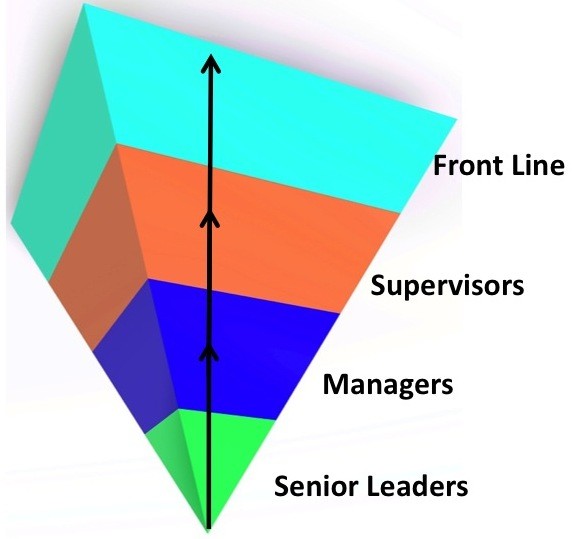
Many leadership styles depend on the typical organizational hierarchy, where the leaders sit at the top of the pyramid, and look down on the rest of the staff. Effectively, pushing out and down directions, without much dialogue from the team about the effectiveness of such directives.

This image has an empty alt attribute; its file name is top-down-leaders-pyramid.jpg
Distribution Property Solutions, Inc.

Servant Leadership turns that pyramid upside down, which means that front line staff are, in effect at the top of the hierarchy and in a position to effect change within the organization. It means that leaders do provide direction to staff, yet do so in a way that encourages, even demands, reciprocal dialogue and conversation.

This image has an empty alt attribute; its file name is serving-leaders-pyramid.jpg
Distribution Property Solutions, Inc.

Implementing an approach that encourages reciprocal dialogue and conversation requires a willingness from leaders to realize that they do not, could not, have all the answers. It also requires an understanding that the leaders primary job is serving and developing the team.

As with service to the self, leaders must remain open to serving their teams in the same way, implementing the same types of techniques, which we will explore more in future posts.

The Servant Leadership model also requires leaders to develop the ability to pull people to them, and push people into action when necessary. Though, of the two, the former is the more important aspect of the Servant Leadership model, leaders must also have the fortitude to hold themselves, and the people they work with accountable to rigorous standards and expectations.

Servant Leadership as a Way of Being

Servant Leadership is a leadership style that can be used in all aspects of your life, from relationships with friends and family, to service activities within the community. As a way of being, Servant Leadership requires an understanding that relationships are everything.

Relationships start with the one you have with yourself. Once that relationships is healthy and strong, you are ready to develop high-quality relationships with those around you, and throughout the community. It is impossible to develop healthy, high-quality, relationships with others until you are clear on the relationships you have with yourself.

Servant leadership principles can be utilized in all contexts, because these principles, some of which we have explored here, are simple and pragmatic. These principles are about practice, and the necessity of respecting, honoring, and celebrating yourself and all of those around you.

Leading is something that people do in all walks and aspect of life. And, Servant Leadership is a leadership style, that I believe, is uniquely adaptable to all of these contexts. It is also unique in that it puts the development of the self first, with an understanding that developing yourself is a necessary ingredient to the eventual development of others, whether those others be those in your personal or professional contexts.

References

Greenleaf, Robert K. (2020). The Robert K Greenleaf Center for Servant Leadership. What is Servant Leadership. URL.

This image has an empty alt attribute; its file name is riccardo-annandale-7e2pe9wjl9m-unsplash-2.jpg
Photo by Riccardo Annandale

#businessshange, #leadership, #leadershipdevelopment, #leadershipessentials, #leadershipmindset, #leadershipprinciples, #leadershipvalues, #organizationalchange, #organizationaldevelopment, #servantleadership, #servicetotheself, #servicetotheteam, #teamdevelopment

An Insight: Creating Alignment in Your Why

September 8, 2020

The ability to share why you do what you do, is much more important than sharing what you do, or how you do it. Simon Sinek talks about this at length in his famous Ted Talk. In this video, we explore an insight I had last week, about the importance of aligning your why with your team, business, organization, and community. They are all related.

#creatingalignmentinyourwhy, #leadership, #leadershipdevelopment, #leadershipinaction, #leadershipmindset, #relationships, #simonsinec, #systemstheory, #youroriginstroy, #youtwhy