Poetry and Prose by #1 Amazon Bestselling Author of Nature Speaks of Love and Sorrow, Co-Author of #1 Amazon Bestseller, Wounds I Healed: The Poetry of Strong Women, and Jan/Feb 2022 Spillwords Press Author of the Month
Well, next week we enter the fourth week of the winter term, and tiredness has become even more present for myself and the team. More on that in a moment.
Let’s first take a look at the writing from this week. Here we go.
Look at that, two My One Thing entries this week. That’s fun.
Alright, and what about next week?
Well, as we discussed in my last entry, I am continuing to write ahead, so have two posts for next weekend almost complete, which are.
The Leadership Series Part 3: Developing Teams
The Law of Attraction
I am also working on several more haiku’s, tanka’s, and poems. Fun.
This past week, I’ve also been reflecting upon growing up in Los Angeles. I don’t know if I’ll actually live permanently in LA again, however, it is a future possibility. Anyway, because of these reflections, I thought I’d share just a few of my favorite places in LA.
Here we go.
Wow, well I could fill several posts with all of the places I love to visit in LA, however, that will do for now. Alright, so quick descriptions, starting from top left, and working our way around clockwise.
Chavez Ravine, Dodger Stadium
Hollywood
Santa Monica
Big Bear
Huntington Beach
King Taco
Now, as some of you know, I also spent a lot of time in Orange County, CA, and will have some pics of OC in one of my future diary entries.
A New (to me) Podcast
I’ve been listening to a new to me podcast lately called, Invisibilia. The show explores the invisible forces, such as thoughts and feelings, that drive our experiences. As you can imagine, I fell in love with it immediately. It is well done, and, well, quite frankly, excellent. I highly recommend taking a listen.
Being Tired
I’ve been feeling more tired lately, and, as such, have been reworking my schedule. Taking off from work a little early each day, coming home and taking a nap, and then proceeding with my day. I don’t do this everyday, yet am doing it more often than ever before.
It occurs to me that we all need to continue to find new ways to get the rest we need. Whether that rest takes the form of a nap, meditation time, a walk, or some other form matters less, than we create the time, and take the time to replenish ourselves.
The important thing is to check our body and mind often for tiredness. And, when we feel depleted, to take the time needed to recover.
When we ignore our own tiredness, we, in a way, run right over our own intuition. And, our intuition is an important part of the human beings we are.
My invitation to you, as it is to myself everyday, is to pay attention to how your thinking and feeling. And, when your thinking feels skewed, or you just feel tired, to rest in a way that will replenish your body and mind.
Now, I want to look at intention five ways. Here they are.
The Head
The Heart
The Head and Heart
The Field of Experience
Creative Beings
Ready? Good. Here we go.
The Head
When I use the term, or concept, head, I am referring to our intellect. The way we think about ourselves and the world. How we think about ourselves and the world has a direct impact on our intention.
For instance, if we believe we are incapable, and the world is a scary place full of bad people, our intention will follow. However, if we believe we are limitless, and that, generally, the world is full of good people, our intention will follow.
Why does this matter?
Because we are the creators of all of our experiences. And, how we think matters in relation to creating the life we want to live. If we are overcome by negative thoughts patterns, we will continue to live in a world full of those negative thoughts.
Meaning, that we will continue to get back very similar looking experiences to how we think about who we are as a human being.
We can actually say that in the head is where it all starts. Yet, it’s not where it all ends.
When I use the term, or concept, heart, I am referring to our intuition. It’s that “gut feeling” we get about ourselves and the world.
Unfortunately, in the United States, intuition is not regarded as important as the intellect, which, in my estimation, is a thinking error. It is a thinking error, because many scientific experiments, breakthroughs in theory, and research, are made through intuition, even if the researcher or scientist is unaware or in denial about this truth.
Factually, human beings feel their way through much of their lives. Feeling through that inner-knowing, which guides us through our experiences, both wonderful, and difficult.
Therefore, our intuition is a big part of how we create and set our intentions. How we feel about our personal and professional lives matter. As does how we feel about the future self we want to create.
The Head and Heart
When we have alignment between our head and our heart, our intellect and intuition will blossom. Many people have a direct conflict between their head and heart. Some are aware about this truth, and some are not.
When we are aware, we can make changes, creating alignment between the two. When we are out of alignment between our head and our heart, we are in a sort of perplexed state.
Have you ever wanted to try something new, and your intellect felt confident, yet your intuition told you a different story? Sure. It happens to us all.
However, if your daily experience, like mine once was, is like this, constantly struggling to make decisions, unsure and worried about the future, it may be because your head and heart are misaligned. It’s not a problem if this is the case, it happens.
What’s important is finding out why there is misalignment, and working towards realignment.
Alright, now that we’ve talked about the head and the heart, and alignment between the two, let’s talk about the field of experience, and setting our intention.
Field of Experience
What does the field of experience mean? Good question. In this discussion, it means all the information we take in and give back out within the contexts we navigate.
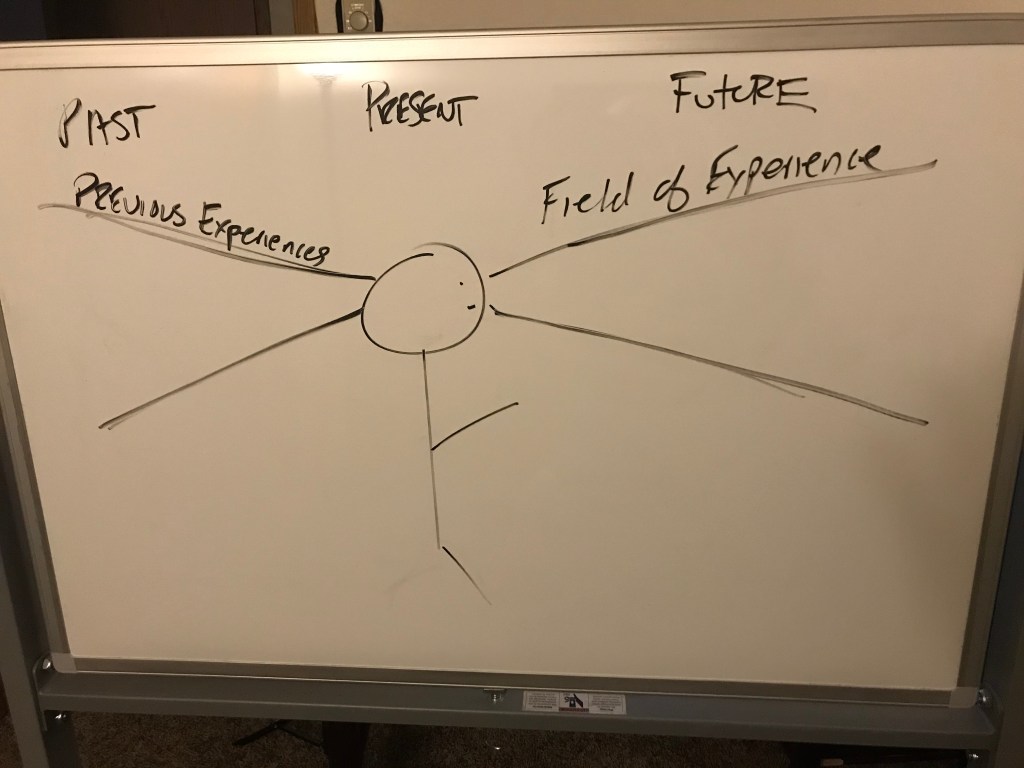
Here is a simple picture of how I view the field of experience. Yes, yes, I know, I’m not an artist. Well, not that kind of artist. You know, writing is an art. Anyway, I digress, here we go.
Corvallis, Oregon 2021
Now, let’s take each of these concepts one at a time and unpack them a little. Here we go.
Incoming Information
As we can see in the above example, we have a field that we experience. That which is in front of us. And, within this field of experience, we are always receiving information. The information we receive comes in many forms, mostly in terms of verbal and nonverbal information.
We take in all of this information, whether we are aware of it or not, and assimilate it into schemas about our lives. The information that fits, makes it into these schemas, or narratives, and what doesn’t, well, we sort of block it out. This blocking is also known as a blind spot.
Now, when we are aware that we function in this way, we can work to ameliorate these blind spots. How? By being open to new experiences and new information, which we don’t quite understand, until, yep, we understand it, and can assimilate it.
And, just as we have new information coming in, we are always creating new information and sending it back out into the world, or, in this example, our field of experience.
As was aforementioned, as we take information in we also give information out. We give information out in the form of verbal and nonverbal communication. And, as we already discussed, when we have a self-view or worldview that is cynical, let’s say, we give that back out to everyone we come into contact with.
However, when we are aware of how our thinking and feeling affects the information we give out, we can create a space of personal and professional transformation. Why?
Because we have now created a space where we have a choice about how we transmit our thinking and feeling. The concept I am alluding to here is emotional intelligence, which is powerful and transformative.
Once we understand how incoming and outgoing information affects our field of experience, we can better understand how the concepts past, present, and future, also affect our field of experience.
Past Present Future
I’ve written about the concepts of past, present, and future many times. They are important to this discussion because when we are facing the past, we are recreating the past in our present moments. And, when we recreate the past in our present moments, we are recreating the past in all of our future moments too. Yep. This is the truth.
However, when we let go of those previous experiences, meaning, that we are present in our current reality, and are creating our lives and our field of experience from the present moment, we are creating a future reality that is not bound by the past.
These concepts are actually quite simple, and yet, can also be confusing sometimes if you’ve never thought about your life experiences this way.
Remember, we create our future from today, from this moment; and, when the present moment is infused with confusion, worry, or shame, for example, about our past, we are then going to recreate those same thoughts and feelings in our present moment.
And, yes, they will then go out to our field of experience, which means they’ll also come back to us just the same.
However, as I’ve mentioned, when we create ourselves anew in each moment, we are creating new realities that are not bound by thoughts and feelings from the past.
And, what happens when what we think and feel is just right? Good question.
When what we think and feel is in alignment, and just feels right, we are ready to set our intention to create ourselves anew in each moment.
It doesn’t mean, however, that we won’t at times have misalignment. It happens.
What it does mean is that more often than not, how we think and feel is aligned. Meaning, that we’ve freed ourselves from our previous worries, anxieties, and frustrations, which may impede our most creative moments.
Because, remember, if we are worried, anxious, and frustrated, we will only create more worried, anxious, and frustrated thoughts and feelings.
Again, at times we will have these thoughts and feelings. Yet, they will not dominate our present moments, because we are aware of how they function, can work through them, and let them go. Important.
Setting Your Intention
For me, creating and setting your intention simply means doing what we’ve already discussed. Now, we’ve covered a lot of information, so let’s recap real quick, so we can see how all of these concepts work together.
The Head (Intellect) – our thoughts contribute to our experience.
The Heart (Intuition) – our feelings contribute to our experience.
Head and Heart Alignment – creating alignment between our thinking and feeling is important.
Incoming Information – we receive verbal and nonverbal information all day, and we assimilate, or block, this information into our current worldview.
Outgoing Information – we are always creating and sending out information, both verbal and nonverbal.
Past Present Future – when we allow our previous experiences to shape our thoughts and feelings, we are creating more of our previous experiences in the present moment. However, when we work through and let go of our previous experiences, we are creating our present reality and future realities based on today, not yesterday.
What Thinks and Feels Right – when we have alignment between our head and our heart, it will just feel right. Meaning, that we’ll be creating our present moments and future moments from today, not our past.
Now we can see how important these concepts are to our intention. For instance, when we are living in the past, allowing our old thoughts and feelings to dictate our current and future realities, our intentions are set exactly so.
Meaning, we will get back all of our old experience. Yes, thoughts, feelings, and actions; and, we will see those things, such as anxiety, worry, doubt, and fear everywhere.
However, when we work through our previous experiences, including our thoughts and feelings, we are creating a reality free from those old patterns, or habits. And?
Our intention follows. We create and set our intention from our present moment, free from our past, facing toward the future we want to create.
Intention, whether we are aware or not, is a powerful force. An example? Sure. Here we go.
Think for a moment about a time when you’ve been upset and really frustrated. Maybe, you’ve been overwhelmed, and it’s lasted at least a few hours, if not an entire day, or a couple of days even. What did you experience in those moments, hours, and days? Yep. More of the same, yes? Of course. That’s how it works.
Similarly, think about a time when you were feeling really good, and that lasted for a couple of hours, or days. What did you experience in those hours and or days? Yes, exactly. More of the same.
Our intention is powerful, and will manifest before us that which we think and feel most passionately about. Even if that is worry, doubt, frustration, and anxiety. Thus, we must take care of our intention, and feed it positivity, hope, love, compassion, empathy, and patience.
Creative Beings
Ultimately, we are creative beings. It’s been said and written many times, creativity is our highest calling. For me, this simply means that we are the active agents in our lives. We create our present reality, which informs our future reality.
And, we do so through the power of intention. Through the ways in which we think and feel about ourselves and the world. We create our present and future realities from this space.
Meaning that we need to take care of the space between our thoughts and feelings, between the information we take in, and the information we give out.
These spaces are dear to us, so use them well, take your time with them, and create and set your intention from this moment, facing towards the future you want to manifest.
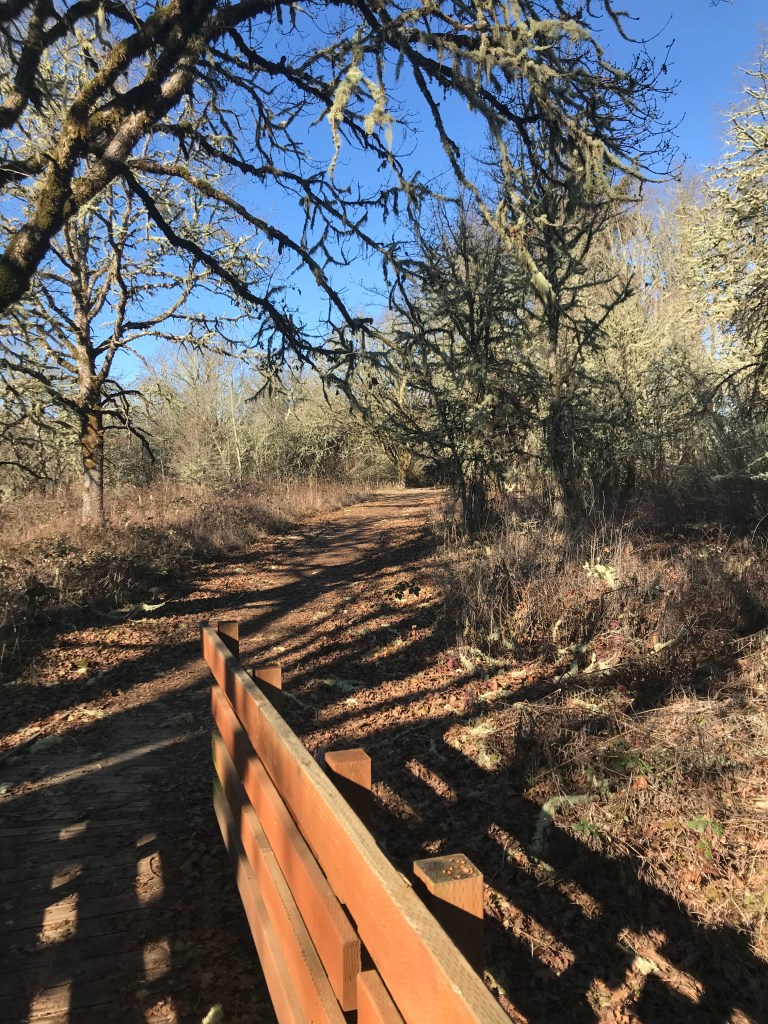
Trail winds to the right, Closed at first, and then open. Beautiful.
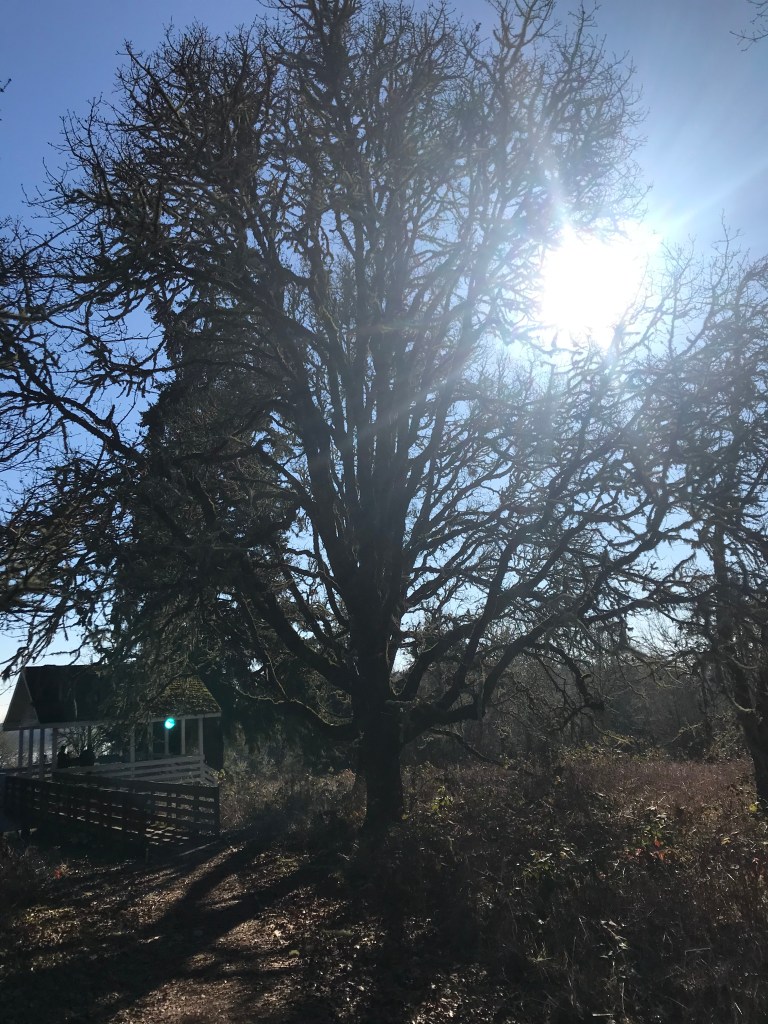
A lovely hike today at the William L. Finley National Wildlife Refuge just outside of Corvallis, OR. Such a lovely day. I added a few more of the pictures I took below. And, well, that was my one thing this afternoon.
Of course, both objectives and priorities, must be connected to your goals, and vision, so we’ll also take a look at how to connect them all.
Ready? Good. Here we go.
First, let’s use a goal that is actually part of my work today. A very practical example. Here we go.
Increase connection, collaboration, and unification of noncredit organizations throughout the state of Oregon within the next 2 years.
Alright, we’ve got a goal set. Now, let’s discuss objectives.
Creating Objectives
Where goals can be set for long-term planning, and short-term planning, in the context of this conversation we are using a long-term goal.
Our focus then is to go from our long-term goal to day-to-day activities that will connect back to our long-term goal. Creating objectives can help us do that by breaking our goal up into smaller pieces, which we can achieve in a shorter period of time.
Let’s take a look at an objective for our goal.
Create a noncredit consortium, which includes representatives from each organization that delivers noncredit education throughout the state of Oregon in the next year.
There we go.
Because our goal is to increase connection, collaboration, and unification of noncredit organizations throughout the state of Oregon within the next 2 years, we need an objective that will, well, basically, help us get there.
In this example, creating a consortium within the next year can do just that.
Alright, now we’ve got a 2-year goal, a 1-year objective, now we need some priorities.
Priorities are typically set for a shorter duration of time. They can be set for a day, week, month, and even a quarter. Alright, let’s create some priorities for our objective.
Priority #1 – Create bylaws for the non credit consortium in quarter 3
Priority #2 – Create a leadership structure for the noncredit consortium in quarter 4.
It is possible in this example, that both of these priorities can be achieved within quarter 3, however, to illustrate the example, I’ve chosen to spread them out.
The important point is that we now have a goal, objective, and priorities that are all connected. And, they all have timeframes allocated to them, so we know if we are on or off track. Important.
Once priorities are created, it is time to create next actions.
Creating Next Actions
Creating next actions, or action items, or next steps, is really about identifying the work that needs to be accomplished to meet your priorities, which then means, yep, that you are meeting your objective, and moving closer to attaining your goal.
Let’s create some next actions.
Identify bylaws needed and begin to create them in the January meeting.
Identify 2 or 3 committee members that will continue to work on the bylaws in between the January and February meeting.
Create agreement and alignment on the bylaw next actions, which are due by the February meeting.
There we go.
Now, you’ll notice that I did not create the next actions for priority number 2. The reason this is so, is that that priority is for quarter 4, and, as we complete the next actions to meet the number 1 priority, we will learn more.
Meaning, that the second priority might shift a little by the time we get to the end of quarter 3. Normal.
Recapping, we now have a 2-year goal, 1-year objective, a priority for quarter 3 with next actions, and a priority for quarter 4 with next actions still to be identified.
Before we get to the system part of our conversation, which, of course, is one of my favorite topics, let’s discuss results and metrics a little.
It’s important in all goal-setting activities, personal and professional, to identify a way to measure progress. The measurement can be quantitative or qualitative. Both are needed and necessary.
In our conversational example about the noncredit consortium, we can create a couple of ways to measure our progress. First let’s reset the goal. Here it is.
Goal – Increase connection, collaboration, and unification of noncredit organizations throughout the state of Oregon within the next 2 years.
Now, let’s set a result and a metric.
Result – Increased service to all communities as an outcome of increased collaboration between the noncredit organizations.
Metic – Total service numbers by organization.
We can even take a deeper dive with this result, by creating actually percent increases we expect, such as:
Result – Service numbers increase by 10% in year 2.
Metric – Total service numbers by organization.
Once you have your results and metrics, we need to think about how to gather the data to measure the metric. In this example, we would utilize the systems the various organizations use to gather their student service data.
Alright, we’ve now covered goals, objectives, priorities, next actions, and results and metrics. Let’s now take a look at how these components work together to create a single system.
A Single System
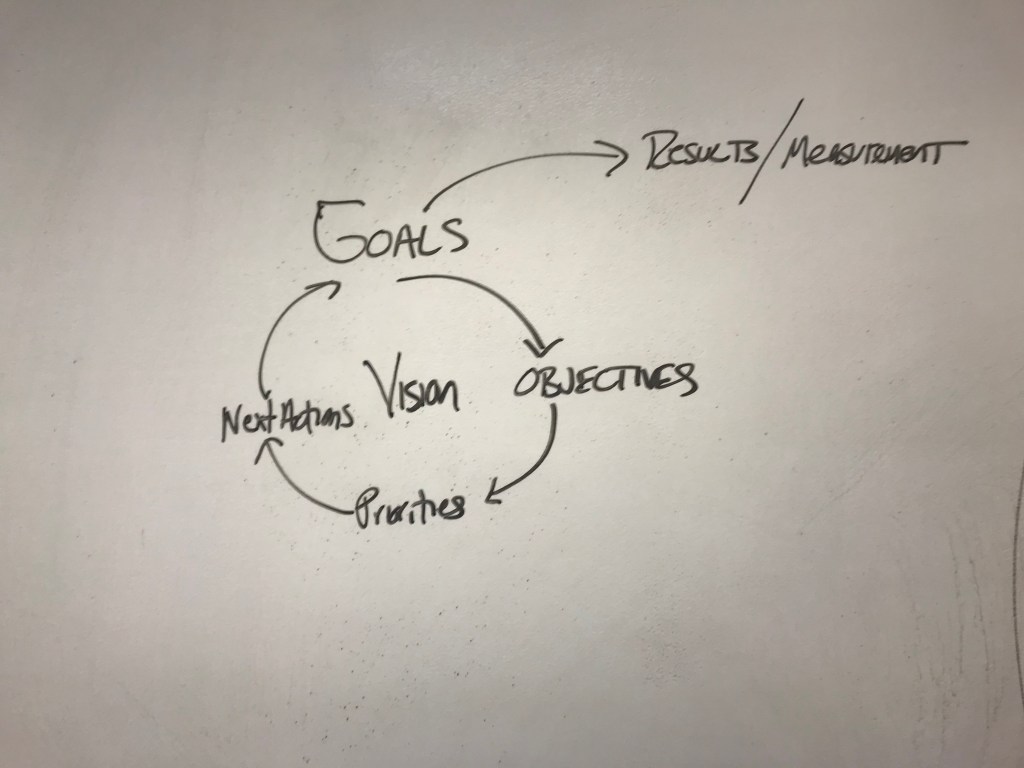
As you all know, I love white boards. And, yes, I’ve created two simple white boards to help us visualize the linear information provided in this post. Here we go.
Corvallis, Oregon 2021
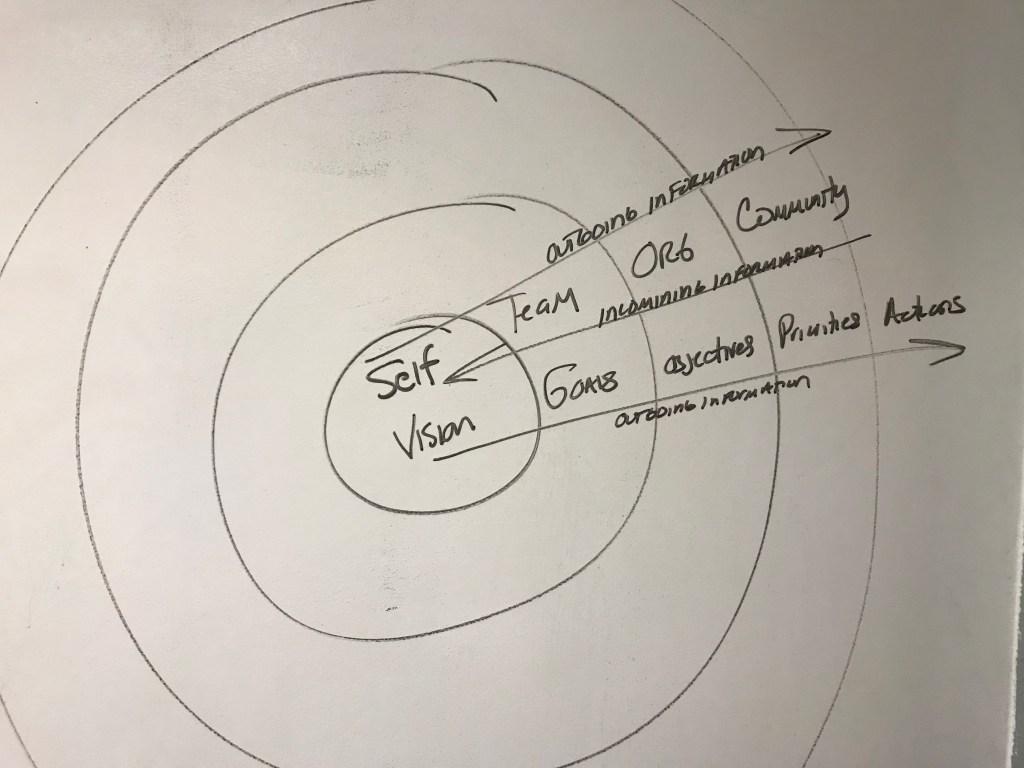
In this first white board we can see I’ve used a relationship ecological system to display the connection between the self, team, organization, and community, and a vision, goals, objectives, priorities, and next actions.
They function the same way.
As we develop as a leader, we take in information from the team, organization, and community, and we give information back out the same way. It’s completely reciprocal and, well, quite lovely.
Similarly, when we create a vision, and set goals, objectives, priorities, and next actions, they inform each other. For instance, the vision informs the goals, objectives, priorities, and next actions. Just as our next actions will inform our upcoming priorities, objectives, goals, and the vision, as needed.
Pretty cool.
Okay, one more visual. Here we go.
Corvallis, Oregon 2021
In this simple illustration, we can see a similar pattern. The vision is the anchor, as the self is in a relationship system, and informs our goals, objectives, priorities, and next actions, which, in turn, informs our upcoming goals.
Wow, that was fun.
That concludes the second and last installment in My One Thing: Creating Alignment In Our Lives.
You can use these tools in your personal life, just as you can at work. The most important thing is to create a vision for your future self; and; to work towards the realization of that self by taking actions each day that align with the self you see yourself becoming.
Remember, you are the only one that can make that future self a reality.




























 Develop. Inspire. Transform.