Poetry and Prose by #1 Amazon Bestselling Author of Nature Speaks of Love and Sorrow, Co-Author of #1 Amazon Bestseller, Wounds I Healed: The Poetry of Strong Women, and Jan/Feb 2022 Spillwords Press Author of the Month
I’ve written several posts about the fact that human beings develop narratives about what they know, what they see, and what they are told. All of us do. We are natural storytellers, and meaning makers. It is how we make sense of the world. However, there is an issue here. Can you see it?
As we create stories about our reality, about what we believe to be true about the world, we can get stuck inside of faulty thinking. And, inside of this faulty thinking, we can begin to create realities, which are not really real. Yep, it’s true.
Example? Okay.
Right now, on the west coast of the United States we have a raging wildfire issue. At this same time, we are living in a pandemic, and have people all across the country in the streets, like they have been in Portland, OR, for months, protesting against systematic and institutional racism. The issue with the latter, of course, is not the protesting, it is the fact that systematic and institutional racism still exists.
Okay, what’s the issue with these issues, you ask? Hm. Let me explain it this way. Here you go.
I’ve talked to several people this past week that are connecting these disparate events, creating stories about the compound effect of this year. However, these issues, while severe and highly problematic, are not connected. They are separate, and are just happening.
Because we are storytellers and meaning-makers we create something more out of what is happening than is really happening. We make these connections. That we do this is not a judgment or a demerit. It is how we are programmed.
However, it doesn’t help our mental health when we connect disparate events. Why? Because when we do, we can go into overwhelm more easily, and start blaming these situations on other people, and, yes, even ourselves. It happens all the time.
Think about a time when you failed a test, or didn’t get a job; and, in that same week or during that same timeframe, a friend or coworker upset you, and then a family member did something you didn’t expect, which also upset you. Well, did you pull these events apart, or did you rather, like most humans, connect them? Important distinction.
If you did connect them, you are not a problem. You are human.
Understanding that our brains work this way instantly creates a new awareness, which can be used to our advantage. How? By understanding that when events happen, they just happen.
We may not like them, or understand them, however, that is part of life. And, these events that just happen are not connected to each other. They are separate.
When we fully grasp this, we have more power over our reality and our life. How? Hm, okay. Here are 5 ways you can create more power over your reality by understanding that disparate events are just that, disparate.
Notice when you are making connections between events that are disconnected – the first step is always to create more awareness about how our mind works. Knowing that all human beings are storytellers and meaning-makers instantly creates a new awareness. Now that this awareness is there, notice when you are making connections between disparate events. Just notice.
Pull those events apart, separate them – when you start to create stories about your reality, which include connecting events or pieces of information that are disconnected, you can pull them apart. Separate them, and leave them that way. More power.
Reorient yourself to the current reality – now that these events, situations, and or information have been separated, you can reorient yourself to the reality as it is, instead of the reality you’ve been creating. Be with that reality, connect with it, really see it as it is.
Notice the difference in how you feel – as you practice noticing your mind and how the mind connects disparate events and information, notice how you feel. How do you feel when you have the power to pull those events apart? Empowered, maybe? Excellent. If you don’t feel empowered right away, don’t worry, keep practicing.
Repeat – building healthy habits, as has been aforementioned, takes practice. Humans also like patterns, or habits, so continue to practice noticing. It takes time. Know though that the only way to become experienced in this practice, like anything, takes doing it again and again. There is no one way, and there is not right and wrong. There is just doing. Again, and again, and again. And, you will get better at it.
There we go. Now what?
Well, if you are so inclined to do so, practice. If not, that’s okay. What I can say is that there was a time when I suffered from terrible anxiety. Much of my anxiety had to do with the stories in my head, which were, of course, not really real.
They were created through habitual thinking. Through connecting disparate events about the world, myself in the world, and about information contained in my head.
You do have a choice. Today, right now. You can choose a different path. One with more power, and empowerment. It takes time. Yet, anything worthwhile always does.
Have you ever thought about why you do what you do? Maybe you already know, and maybe not. Either way, know that knowing why you do what you do is very important.
You can think about your why as the part of you that drives you to be the person you are today. It is something emotional, not intellectual. It lives deep within us, gives us our sense of purpose, and it also gives people that we know the knowing of who we are as human beings.
Here is a great Ted Talk by Simon Sinek about why your why is so important.
Simon Sinek
Though Simon’s Ted Talk is framed as a leadership principle, it’s applicable to all human beings. To anyone interested in connecting with other human beings on a deeper level.
As I was thinking more about my why this past week, it occured to me that creating alignment with our why, connecting it to those we know, teams we lead or work on, organizations we work within, and communities we belong to is also very important. Why?
When we connect our why to those closest to us, we create and have a deeper connection with them. We are able to better understand their why through the connection we see in our why.
And, the converse is also true. People can better understand our why through the connection they see in their why. And, this holds true even if they don’t know their why, or we don’t know ours. Really.
Further, we can also deepen our connections with people that know us very little by creating alignment with our why. Why? Because inside our why, they can see aspects of themselves. Really. Think about a time when you were moved emotionally. What happened?
Chances are you felt a deep connection with the person, company, movie, insert here whatever you were engaging with. When we are moved deeply, we can see aspects of ourselves in that which we are engaging with. Powerful.
Creating alignment with our why creates more relatability with those closest to us. And, when we connect our why through all of our relationships, the relatability connects us on a deeper level to everyone in our lives, including our teams, organizations, and community.
We instantly become more relatable as a human being. Again, this is so because people can see aspects of their own humanity in your why, or your story.
These deep connections keep us coming back for more. Really. Think about all the people in your life. Think about their why, even those that are unspoken, or unrealized. What do you see? Still thinking? That’s okay. Here is what I see.
I see that we are pulled closer to those we can relate to and understand. We are also pulled closer to those that move us, inspire us, and touch us in some way. Why’s are powerful.
Simply, when we create alignment with our why through all of our relationships, our connection is deeper, there is more relativity and relatability, and we also create alignment with our purpose, or vision.
When you share your why with others, and intentionally create alignment with your why, you create a very special context. A context that welcomes a shared vision of a future that you are creating together. Whether that is within a relationship, a team, an organization, or a community. It works the same way.
Working within a vision is a much different experience than working without one. Truly. Visions are powerful. Visions are created from why’s.
3 Simple Steps to Create Your Why
If you’ve already created your why, awesome. If not, create one. It’s not difficult. Really. How, you ask? Here are 3 simple steps you can follow to create your why.
Write down why you do what you do.
Now, I’m not talking about pay, benefits, or some other intellectual reason why you do what you do. I’m talking about your emotional-self. The part of you that is inspired to create change in the world. Now, with this frame, answer why do you do what you do, and write down all the ideas that come into your head and heart. All of them
Pick your top 3 reasons from the list
Pick your tops 3 reasons from the list that resonate most with you. You know, the ones that send tingles up your arms and through your body. The ones that make you smile really big, giggle even, as you think about creating that outcome, or result. Yep, that’s it. Those are the ones.
Create your why statement
Now take those three reasons and fashion a statement. Sometimes it will be a single sentence, sometimes it will be a paragraph. Depends. There are no rules here, except that it needs to move you, inspire you, touch you in some way. If it does, it will move, touch, and inspire others. Trust me.
There you go, nice work.
Alright, that’s 3 reasons why creating alignment with your why is important; and, 3 simple steps to creating your why. Pretty simply, yet very powerful.
Next time we will take a look at 5 simple steps you can take to create alignment with your why.
Until then, keep creating. Creating your why, aligning your why with other why’s, and keep inspiring others to do the same.
I’ve written about vulnerability several times, and am actually right now writing another post about how being vulnerable is actually transformational.
The insight you ask?
Alright, let’s go.
Insight
What you may not know is that in written language, the actual definition of vulnerability is associated with possible harm. Really. Take a look.
vulnerability
NOUN (vulnerabilities)
“The quality or state of being exposed to the possibility of being attacked or harmed, either physically or emotionally.‘conservation authorities have realized the vulnerability of the local population’” Oxford Languages
It was in the writing of the post on vulnerability and transformation that I learned this fact. Interesting. Though I understand why the definition of vulnerability is written as it is, I will offer you another definition of vulnerability to consider in a moment.
Here is the insight.
I believe that vulnerability is also associated with grit, persistence, and resilience. It must be. Why?
Because anyone who is open to being vulnerable regularly, has to also possess grit, persistence, and resilience. Why? Because being vulnerable is hard work. Simple.
I’ve written before that vulnerability is where the jewels of life are found. When we are open and willing to be vulnerable, we immediately get so much more out of life. Right away.
My invitation to you? Be vulnerable. Though it is sometimes hard, you will find more awaiting you in spaces of vulnerability than any other.
I find everything in life inspiring. Really. Take a look around. Wonder is everywhere. And, I find people that venture into the unknown that much more inspiring. Why?
Because, yes, it is hard work; and, it is such a wonderful experience. A paradox. Really. Inspirational.
The department I work in, which includes over 200 people, is one such inspiration. Every one of them.
I’ve written about this team many times. I am so inspired by their vulnerability, courage, grit, persistence, and resilience.
In the face of unprecedented challenges, they continue to create new ways to access community education and training, which is needed now more than ever.
A wonderful group of people. I am very lucky.
Quote
Alright, here is a different way to think about vulnerability.
“Vulnerability is not winning or losing; it’s having the courage to show up and be seen when we have no control over the outcome. Vulnerability is not weakness; it’s our greatest measure of courage.” – BRENÉ BROWN
One of the most important social constructions to understand is how knowledge is socially constructed. Numerous books and articles have been written on this topic, from both a theoretical and practical perspective.
Here, we will explore the social construction of knowledge likewise. Both theoretically and practically. Ready? Let’s go.
Let’s first define knowledge.
knowledge
noun ˈnɒlɪdʒ/ /ˈnɑːlɪdʒ/
[uncountable, singular] the information, understanding, and skills that you gain through education or
experience practical/medical/scientific knowledge
knowledge of/about something He [she] has a wide knowledge of painting and music.
There is a lack of knowledge about the tax system.
There we go.
Now before we go onto our discussion, let’s take a look at what two prominent philosophers had to say about knowledge, Jurgen Habermas, and Michel Foucault.
Habermas’s Perspective
“Habermas argues that domination is an obstacle in the pursuit of true knowledge” (Anttonen, Saila. 1999).
Knowledge is continually produced, internalized, and practiced, or acted upon. Though not always in this order. Sometimes intellectual knowledge precedes practical knowledge, and sometimes practical knowledge precedes intellectual knowledge. Depends.
Think about a time when you learned something through doing. For instance, learning how to drive a car. You can possess the intellectual knowledge about how to drive a car, yet until you actually drive a car, you don’t possess the knowledge necessary to drive a car.
You need both. And, in fact, some would argue, as would I, that practical knowledge outweighs intellectual knowledge. For it is in the doing, or practice, that we learn the most.
We accumulate the real knowledge about something when we do it.
Conversely, however, you can ask me to create a presentation on the social construction of knowledge, yet unless I possess the intellectual knowledge about the social construction of knowledge, I will be unable to create that presentation, try as I might.
Therefore, knowledge is constructed two ways. Through our intellect and through practice. Both.
Who Constructs Knowledge?
Everyone constructs knowledge. From a young child to an older adult, knowledge is continuously produced, internalized, and practiced. Knowledge is all around us. Everywhere.
Think about an interaction you’ve had recently where you learned something new, or taught someone something new. That is knowledge production.
Knowledge is produced, internalized, and practiced continuously, all day, every day.
Yet, there is some knowledge that is considered more illusive, more special, or maybe the more appropriate term is specialized. You typically go to University, College, or Trade School to learn about these types of specialized knowledge.
Simple answer, experts. Yet, what does that really mean? Ah, good question. Someone is considered an expert when they have attained a reasonable amount of intellectual and or practical knowledge about a particular subject or topic. Simple. Why does this matter?
Because the humans that have constructed this knowledge, are just that, human. Meaning that they are like you, like me, and like everyone else. Full of strengths and weaknesses. Both
People often get caught up in the term, expert, thinking that because someone has a degree or certification in one specialized area or another, that they should know what is best for us, or know the best path to take in a certain area of our lives.
Yet, because experts are also human means that they are not infallible. Important. Additionally, because we know that the world and all knowledge within it is socially constructed, we also know that there are many, many ways to understand a subject or topic. Many ways. Not one.
Further, not all knowledge about a particular subject or topic has yet been discovered. Meaning that there is always something more to learn. Always.
Here is what Socrates said about knowledge.
“At the trial, Socrates says, “The only true wisdom consists in knowing that you know nothing.” Socrates put emphasis on knowledge all his life because he believed that “the ability to distinguish between right and wrong lies in people’s reason not in society.”
Ah, wonderful. According to Socrates, then, it is up to the individual, each one of us, to distinguish between right and wrong. And that includes distinguishing between the right and wrong of what someone is telling us is true about our bodies, families, community, and the greater world.
Of course, that does not mean that we don’t need assistance from others, and access to the knowledge we need to make informed decisions and choices. Quite the contrary. More assistance and access is needed.
Knowledge is disseminated in many different ways. We’ve covered some of them already, such as through Universities, Colleges,and Trade Schools. Yet, knowledge is also produced, internalized, and practiced in many other social contexts, which are typically referred to as social institutions.
Before we go further, let’s define the term social institution.
“Typically, contemporary sociologists use the term to refer to complex social forms that reproduce themselves such as governments, the family, human languages, universities, hospitals, business corporations, and legal systems. A typical definition is that proffered by Jonathan Turner (1997: 6): “a complex of positions, roles, norms and values lodged in particular types of social structures and organising relatively stable patterns of human activity with respect to fundamental problems in producing life-sustaining resources, in reproducing individuals, and in sustaining viable societal structures within a given environment.”
Ah, helpful. Thus far, we’ve covered the social construction of knowledge within University, College, and Trade Schools, yet as you can read above, there are many social institutions that socially construct knowledge.
The issue? Same as with the socially constructed knowledge that Universities, College’s, and Trade Schools produce. When we internalize a socially constructed view of the world, and our place in it, we are receiving knowledge that has been produced within a very particular framework.
And, those frameworks include within them people that have biases, just like you and I. Yep. We can deny we have biases, yet we all have them. They are part of socialization.
All socialization, which just means the how, what, why, when, and where of all that you learned as a child, youth, and young adult has within it bias. It has to. It’s one way of viewing the world. Yet, it’s not the only way.
Now, choose any social institution you like, and we can discuss the problems inherent with the production, internalization, and then the eventual reproduction of that knowledge through practice, or action. What problems, you ask? Good question.
One of the largest problems, or issues, we have just discussed. Because we know that knowledge is socially constructed, and we know that all social institutions have within them a particular worldview (or bias) this knowledge then, which is often told as truth, is not truth.
This knowledge is, rather, a subjective interpretation of life and the world through one lens, or viewpoint.
However, when we internalize this socially constructed knowledge as truth, we limit ourselves. We limit that which we can really know about the world and life. If we are conscious of this fact, and continue to choose a limited framework, very well.
However, most people are unaware, so do not actively choose. They subscribe to a particular set of knowledge constructs because they were socialized to do so. Many people live their entire lives this way.
Hm. What to do? Before we get to that question, let’s take a look at obstacles to the acquisition of knowledge. Important.
What are the obstacles to the acquisition of knowledge?
As we’ve discussed, Habermas and Foucault would both argue that power is an obstacle to the acquisition of knowledge. Meaning that with more power comes more knowledge. Or, maybe, it’s that with more knowledge comes more power?
Actually power and knowledge have a reciprocal relationship. Meaning that with more knowledge, you do have more power. Likewise, with more power, you have more access to knowledge. Truth.
And, then?
Well, those with power construct more knowledge, especially of the specialized kind. And, as we’ve discussed, accessing such knowledge is inaccessible for many people.
Therefore understanding how knowledge is socially constructed is important for everyone. Why?
5 Reasons Why Understanding The Social Construction of Knowledge is Important
1. Know matter how much you know intellectually, you must practice it
Practicing our intellectual knowledge is necessary to develop ourselves. When we learn something, and internalize it, the cycle of knowledge production is not complete.
We must practice that knowledge to really know it.
Once practiced, we know it through our entire selves, which is a very different experience than simply having intellectual knowledge about a subject or topic.
2. You can do something with that which you know, or are knowledgeable about
Knowing that knowledge is socially constructed, and that you are an active participant in constructing knowledge creates an opportunity for you to practice distributing your particular knowledge to others.
You are the only one that can educate someone on that which you know, just as you know it.
And, when you give out that which you are knowledgeable about, you will get back that which someone else is knowledgeable about. Meaning, that you will now have acquired more knowledge by giving someone your knowledge. Reciprocal learning.
3. Specialized knowledge is an interpretation, so question it
When we know that all knowledge is socially constructed, we know that questioning all that we learn is necessary and needed. We must question what experts tell us is true about our bodies, families, community, and the greater world.
When we begin to question other people’s truths, we create a space to develop ourselves more. Why?
Because we have created a space to learn more from the expert. Simple. When we don’t take expert knowledge at face value, we create a space to learn more about the subject or topic. Keep questioning.
4. Because bias is inherent in all socially constructed knowledge, be wary of limitation
When we accept knowledge as true, which is given to us by a social institution we limit ourselves. We limit what is knowable.
However, as was aforementioned, when we question that knowledge, we create the opportunity to learn more, and develop more. We don’t accept one worldview or interpretation of the world, which is limiting.
We know knowledge is socially constructed, so we question. We question the knowledge. We become unlimited.
5. Search for knowledge everywhere, both intellectually, and in practice
When we know that knowledge precedes and follows power, we can intentionally create opportunities to learn more. Acquiring more knowledge, both intellectually and practically, moves us forward as human beings.
When we internalize and practice what we learn, we also create an opportunity to produce something out of this knowledge. Of which this article is an example.
And, when we practice that which we know, we have more power as a human being.
In Closing: Question Everything
My final thoughts on the social construction of knowledge is to question everything. Really.
Question the knowledge you now have. Question the knowledge people communicate to you. Question all of it. Powerful.
We choose to accept the knowledge that we have, as well as the knowledge that is communicated to us as true. However, when we know that the world is socially constructed, and that all knowledge is likewise socially constructed, we create an opportunity to question these truths.
Both the ones we’ve considered as truth for most of our lives, and other people’s truths.
We also create a developmental opportunity for ourselves, and as we have discussed, for everyone that we know. We move ourselves from a limited framework to an unlimited one.
Remember, on any subject or topic, there is more to learn. Always. Because we know this to be true, there is always an opportunity to share your knowledge with someone, and for them to share their knowledge with you.
That which you know is powerful. That which you can learn about is powerful.
Knowledge that is produced, internalized, and practiced is socially constructed by you, by me, by experts, by every human being. Thus, question it, question all of it.
Have you ever thought about the difference between developmental growth and transformation? Or, have or do you consider them the same? Hm.
There is an important distinction between developmental growth and transformation, which is important to both personal and professional development. Let’s take a look.
Thorough or dramatic change in form or appearance.‘its landscape has undergone a radical transformation’
A metamorphosis during the life cycle of an animal.‘Both the molting process and the metamorphic transformation from larva to pupa are coordinated and regulated by hormones.’
Ah, do you see the dinsticiton? Either way, let’s work it through.
Development
When you are interested in development, meaning available to it, you occupy a space that welcome’s learning. You stand outside of what you believe to be true about the world, and how you occupy it, and welcome new knowledge, new types of understanding, and new ways of being. Simple. Or is it?
Well, because we have an ego, or, wait, do we? Well, for the purposes of this post, let’s assume we do. Because we have an ego, we don’t like being wrong.
We are constantly seeking validation of what we know. Why?
Because it fits into our worldview. It is what we know. When information comes in, we assemble it into the the narrative of our worldview and who we believe we are. We confirm our ego.
If the information doesn’t fit into our current worldview, we really only have two choices.
Deny the existence of this new information, or become open to it.
Denying this new information is called denial. We are actively denying that another way to look at a situation or event is possible. Egocentric.
However, when we are open to the possibility that there are other ways to think about a situation or event, we have now entered into the developmental arena.
Meaning, that we can now take this new information in, make sense of it, and do something with it.
Even if the information doesn’t fit into our current worldview, if we are open, we can incorporate it into our worldview rather easily. It is all about being open to new information, new ways of understanding, and new ways of being.
The simplest example is to consider development at school and work. When we are confronted with new information, we have a choice. Assimilate and incorporate that new information into our existing worldview, creating new knowledge, or reject it.
I am always in conversation with the team about our goals, objectives, and priorities. Recently, I was asked about hiring someone to run Zoom technology for the upcoming professional development trainings.
I, however, was unsure about the need. Didn’t know. I needed to think about it.
Well, the next week, I ran a Zoom meeting with the team. The meeting was 90-minutes and was about creating our next 30-day priorities. Part of the meeting was creating breakout rooms, which you can do in Zoom. The meeting was a complete disaster. Really, it was. What did I learn?
That you absolutely need someone to run technology while the person running the meeting does just that, runs the meeting. I learned through doing the meeting that hiring someone for a Zoom tech position was absolutely necessary. We are hiring someone right now.
I moved from questioning the need, reflecting upon it, to learning that we definitely needed the new position. I developed.
Alright, that’s development. Opportunities for development are available every day. If you don’t see them, it might be that you are avoiding them or in denial about them. It’s not a demerit. I didn’t develop for a long time. Really. I wasn’t interested. Not a judgement. Just a fact. Let’s now look at transformation.
Now, transformation implies a complete change to the object, thing, or person. Yep, that’s right. How then does transformation differ from development?
While development requires an active openness, as we’ve discussed, transformation requires openness and a complete and total letting go of what was, in favor of what will be. It requires a shift from a focus on the external to the internal.
Transformation is about questioning all you know. Every ounce of what you know, or beleive you know, must be questioned.
Further, you must be willing to let go of how you previously viewed the world. Open to a continual process of creating new information, new ways of understanding, and new ways of being.
The distinction is that with transformation you actively seek out opportunities to question the ways you think, act, and occur. Internally focused.
You are continuously interested in disrupting your old habits and ways of thinking while creating new habits and ways of thinking.
Let me give you an example to help with the distinction.
Let us say you want to develop leadership skills. You can develop leadership skills in lots of ways. You can take classes, read books, even put leadership principles into practice in your life. That is development.
You incorporate new information into the preexisting way you already think about leadership. Simple. How then to create transformation? Mm. Different.
You must be willing to let go of all of your preconceived ideas about what leaders are supposed to do, how they are supposed to act, and how they are supposed to be. All of them. Then what?
You leave your ego at the door.
And, everything you think you know about leadership. Start over. Really. Let it all go. And, create from there.
Transformation can only occur when we let go. Know also that the letting go will need to happen again, and again, and again. Over and over. Why? Because you are disrupting what you held to be true, and creating something new. Key. You are not adding, you are creating.
When the pandemic began here locally, we were approaching the last week of the term at the community college where I work. As I’ve mentioned in other posts, I work in community and continuing education. It is all experiential. All of it. Which means that it is in-person. All of it is, or was.
Within one month of the pandemic beginning here, we let go of all the concepts we held to be true about our business model. All of them. What happened?
We created an entirely new business model. A model that is transformational, as all aspects of it are completely different than the previous model. All of them.
We created all new processes and systems for how we do business. New ways we market and engage with the local community, new ways that instructors teach their classes, even the content that is delivered, while similar, is still completely new. Why?
Because a completely new context has been created. And it was created intentionally by believing something else was possible. Which then replaced our current belief system of how we all viewed our work.
All of us. now our actions follow that new belief system. That is transformation.
When you intentionally create new ways to be, new ways to think, new ways to believe, new ways to be a human, you are creating contexts that are transformational. Never seen or experienced before. Transformation.
How are development and transformation similar?
One key way. When you develop, whether you want to or not, you give out your development to others. If those around you are open, they will learn from you and also develop. And, it is the exact same for you. If those around you are developing, and you are open you will also develop.
It is the same with transformation. If you are creating transformational contexts that change the nature of what’s possible, those around you, if they are open, will also transform. If they are open. If not, then they won’t. Same for development.
Can development lead to transformation?
Oh, yes, absolutely. In some ways, they sort of go together, which is why I wanted to write about the distinction. Whereas they are different, they both are about being open to and participating in creating change.
Here is a distinction on the difference between change and transformation.
“Change is about using external influences to modify actions to achieve desired results. Transformation is about modifying beliefs so that natural actions achieve the desired results.”
See the difference? One is externally driven, and one is internally driven. Very similar to the distinction between development and transformation. Important.
How do you begin to develop or transform?
Really it’s pretty simple, yet not easy. A paradox, yep. My suggestion?
Be open to everything around you. Being open is probably the key to both development and transformation. Both become possible when we are open to new information and new experiences.
When we are open, the world opens up. It really does. There is so much to learn and to experience. Being open creates an immediate possibility. The possibility that you will learn to be more. More of either how you already occur, or more by occurring in a completely new way in a completely new context.
I’ve been reflecting a lot about developing and managing my own resilience this week; and, just how important both are right now. So important. What is resilience you ask? Good question. Here is the definition.
Resilience
(also resiliency) Pronunciation /rəˈzilyəns/ /rəˈzɪljəns/ Translate resilience into Spanish
NOUN 1. The capacity to recover quickly from difficulties; toughness.‘the often remarkable resilience of so many British institutions’
2. The ability of a substance or object to spring back into shape; elasticity.‘nylon is excellent in wearability and resilience’
Essentially resilience is our ability to face adversity, walk through it, learn, and repeat. Again, and again.
I’ve also been thinking about a video I’m going to do soon on resilience for my Developing Servant Leaders site. The idea looks something like this.
First
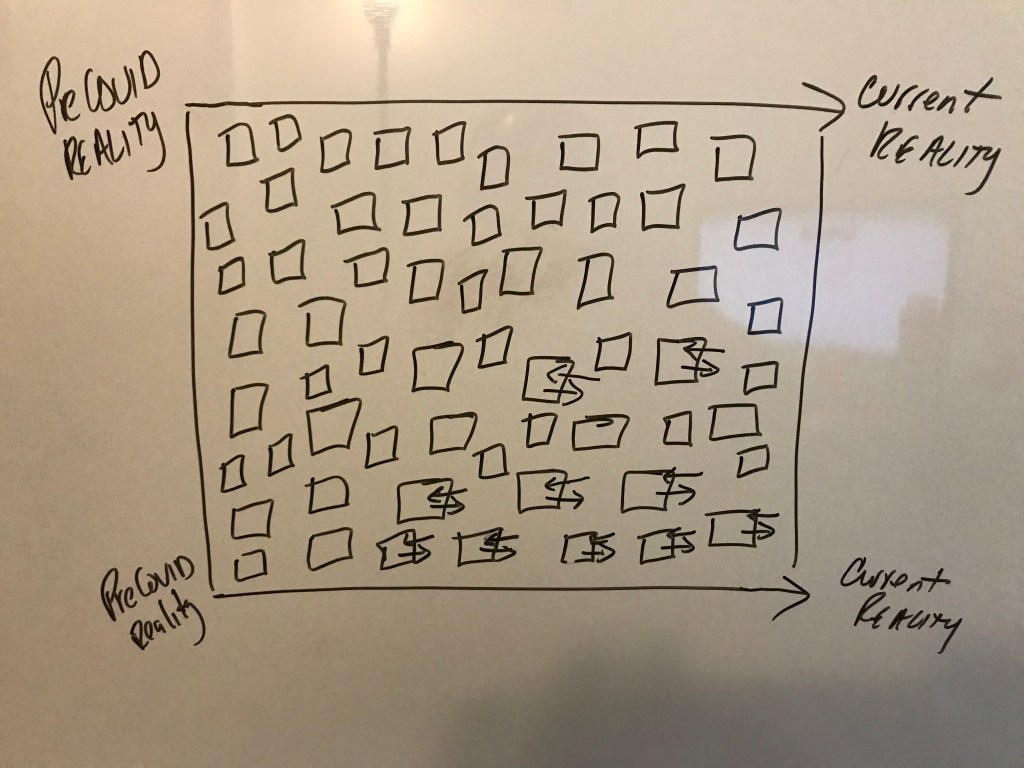
What we are facing right now is a huge gap between that which we once knew to be our reality, and the current COVID-19 reality. A large gap. Inside of this gap, we are all being asked to face ourselves and each other in new ways, with new tools, in entirely new contexts. Hard.
August 1, 2020
For those that are less resilient, even harder. Resiliency, like all developmental traits, lives upon a continuum. It is not that someone has resilience or does not. Everyone has some, some have more. Alright, next.
Second
When you connect the four points of the above whiteboard, you can see the space that we are being asked to navigate and step into. A distinction. Stepping into reality is different from hiding, and running from reality.
It means taking the action you know is there to take, even, maybe especially, when it is hard.
August 1, 2020
Now, you can see the above box, yes? Alright, then within that, let’s call it the COVID-19 developmental box, there are lots of other little boxes, which represent each of us and our comfort zones.
Yep. Meaning that as we interact with, and bump into each other, we are continuously floating in the COVID-19 developmental box. Then how, you may ask, do we develop our resiliency?
Third
We step outside of our box and into the reality that is in front of us. What is stepping outside of your box? It is doing. Again, and again.
Learning, practicing, falling down, failing – AND, getting back up again. Every time.
Know that we don’t have to continuously live outside of our box, or comfort zone. We can, what a friend of mine calls it, blip out, and blip back. Here you go.
August 1, 2020
And, guess what? Everytime we go outside of our box, represented above by arrows, and do something that we consider uncomfortable, we grow. Yep, our box or container gets bigger. Here is one more illustration.
August 1, 2020
As you can see from the above illustration, some people will grow, boxes labeled with a G are now larger, some will not. It’s not a demerit, or a problem if there is no growth. It is, however, a missed opportunity to learn more about yourself and being human. Alright, last section.
Fourth
Also know, especially when you are feeling overwhelmed, that all there is to know and to be experienced in this world, is much larger than this present moment. The COVID-19 moment. Last illustration.
August 1, 2020
Let us say that the entire whiteboard is what is knowable. Got it. Okay. Then consider that the super small box you see is what we’ve been calling the COVID-19 developmental box or gap. Yep. Pretty small in the proper scale.
Remember this distinction when you are confronted with uncomfortableness; and, remember it when you are feeling overwhelmed.
Though today COVID-19 feels like everything there ever was to know, on a universal and historical scale, there is far more to know and experience. Seriously remember that.
There are countless opportunities to develop your resilience today. More opportunities than most people would care to have. Really. And, believe me when I tell you that there are days when I feel the same way. Really. It’s hard.
Yet, like all of life, it is a paradox. Because the opportunity to develop and to learn how to manage our resilience is also a wondrous process. Yep. Hard and wonderful. A paradox.















 Develop. Inspire. Transform.