Poetry and Prose by #1 Amazon Bestselling Author of Nature Speaks of Love and Sorrow, Co-Author of #1 Amazon Bestseller, Wounds I Healed: The Poetry of Strong Women, and Jan/Feb 2022 Spillwords Press Author of the Month
Alright, so I got home form work today about 5 pm. I was feeling tired before even getting home, so took a nap. Yep. Today, I sleep when needed. Not something I did for most of my life.
Anyway, after my nap, I wanted to go outside. As I walked out of my apartment and looked up and to the left, I squinted. The sun, wait, what?
For those of you wondering what I’m talking about, I live in Oregon, where for the past 7 days the sky has been filled with smoke and ash. No sun in 7 days.
Now, no sun is a normal part of living in the PacNW, yet, not, as it was these past 7 days, due to the largest wildfires in OR history, burning over 1 million acres.
I looked back down, and up and to the right. And, there it was. The sky! The clouds, wow, what a wondrous sight. Beautiful. And, at the same time I was feeling joy and wonder, I was also feeling sadness and worry. Why?
Because the fires are still raging across the state. Many of died, tens of thousands have had to evacuate their homes, many, many, many have lost their homes, and, in several instances, whole towns have been destroyed.
This post is for all of them, and for the amazing firefighters on the front lines battling the wildfires each and every day.
ABC NewsChicago TriibuneOregon Live
We are thinking about you, sending love, energy, and support to all of you, and appreciate your leadership, dedication, and persistence.
To question, or not to question? Hm. How many times do you remember being in a class, with a group of friends, or in a work environment where you wanted to ask a question, yet didn’t? Yep, me too. Really, we all have those memories.
Many people are afraid to ask questions, to speak up generally. Why? Afraid of looking silly, asking the “wrong” questions, not being taken seriously, or being made fun of. Has happened to all of us at some point.
Yet, the ability to ask questions, to discern relevance out of a context that is unclear, to move toward more clarity, while acquiring more knowledge and adding to the knowledge-base within the context is really important. Why?
Well, let’s ask Socrates, shall we. Here we go.
“True wisdom comes to each of us when we realize how little we understand about life, ourselves, and the world around us.” – Socrates
Powerful. Simply, there is so much unknown about life and the world, that to not ask, to not speak up in a way cheats ourselves and all of humanity out of possible progress.
The topic of questioning is so important. Important to life, the world, the production and eventual dissemination of knowledge, and, yes, it is also very important to our development. Why? Well, I’ve got 10 reasons.
Ready? Very well, let’s go.
Learning
Seems simple, yes? The more questions we ask, the more we learn. Though this concept is simple, in practice, many people struggle to ask the questions they have deep inside them. They do. As was aforementioned, though an extrovert, I too once struggled with asking my questions. The issue? When we don’t ask, we actually carry that question around. Literally. We have it within us, unanswered, which can cause us pain, and frustration.
Knowledge
When we ask our questions, we gain knowledge, and we also contribute to knowledge acquisition. Yep. In every question there lives the possibility of more knowledge. We know so little about life and the world. Yet, with every question that we ask, we create the opportunity for us, and everyone else, to learn more.
Clarity
The more questions we ask, the more clarity we have. And, the more clarity everyone else has. As we learn, so does everyone else. And, as we all learn, we transform the nature of the context we’re in, to a context where questions are possible. A context where those that are fearful of asking questions, as you are, or once were, will be empowered to ask their questions. Powerful.
Collaboration
Asking questions is also the breeding ground for collaboration. When we ask questions, we are naturally contributing to a collaborative context, where learning from each other is embraced. We are actually fostering a collaborative context by asking our questions. Seriously, it is true.
Strategy
Asking questions is also super important to developing and executing on strategy. Without questions, you will only ever produce what was produced yesterday. Questions are the birthplace of strategy. And, with strategy, both concepts and execution, we get movement, and with movement, eventual traction in whatever it is we are doing.
Innovation
Like strategy, innovation depends upon asking questions. Creation and innovation are intertwined with curiosity, and those that are curious ask tons of questions. They have to, they are curious. With questions comes the possibility of innovation, and new ways of seeing and experiencing the world.
Vulnerability
When we ask our questions, we are also being vulnerable. We are modeling an attribute that is a necessity for development. Developmental growth is dependent upon being vulnerable, and when we accept our own vulnerability, even enter into vulnerable spaces intentionally, we will ask our questions.
Leadership
Well, if questions are important to strategy and innovation, they are equally important to leadership. Leaders are interested in what others think, know, and feel. They have to be interested, it’s part of being a leader. And, to learn how people think, know, and feel, you must ask questions.
Trust
When we ask questions we also contribute to a context or environment of trust. When we are actively interested in someone else, and what they know, or how they feel and think, we are modeling trust. Especially when we get back questions from those around us, which by leading through asking questions, we will definitely get.
Relationships
Asking questions means that we get to learn more about those around us, which also means that we get to deepen our relationships with those people. It is inevitable. Learning about someone necessitates a relationship. And being in a relationship means knowing about that person, and to know, we must ask questions.
Alright, there are 10 reasons why asking questions is important to your development. Let’s take a look at how they are interconnected. Ready? Here we go.
When we learn, we know more, and when we know more we have more clarity about our life, yes, and of the lives of those around us. Learning and knowing are part of development. And clarity is an output of learning and knowing more.
When we collaborate with others we get to know people better, and we also get to know ourselves better.
Knowing others better will always shine a light on the parts of ourselves that we want to develop. It is normal, and is also very healthy.
Within a collaborative context that embraces strategy, we also create the possibility of developing an innovative culture. And, inside of an innovative culture, we create more innovative possibilities, which also contributes to future strategies. All of which contributes positively to our development and growth.
I’ve written in other posts that vulnerability contributes to and fosters innovation. Vulnerability is actually where the seeds of innovation will eventually grow. And, like innovation growing through vulnerability, we also develop and grow when we are vulnerable.
Relationships are created, in part, through trust. When we trust each other, we can be real, be vulnerable, learn more from each other, and grow together. When we are open to each other, we get so much more from each other.
Knowing that we, as Socrates might say, know so very little about life and the world. Knowing this fact is at the center of development and growth.
Leadership is dependent upon all of the aforementioned. And, I am not only writing about leaders in the traditional sense. I am also writing about every human on the planet. We all have the opportunity to lead. Lead from within, and from without.
When we lead by asking questions, we model our interest and support of contexts that are open to development and growth. We create more possibilities for ourselves, and for everyone around us.
Possibilities to learn, to know, to have more clarity, to build collaborations and strategy, which foster vulnerability, trust, and relationships; and, that is leading.
Ask your questions, and develop yourself and everyone else around you.
Have you ever thought about why you do what you do? Maybe you already know, and maybe not. Either way, know that knowing why you do what you do is very important.
You can think about your why as the part of you that drives you to be the person you are today. It is something emotional, not intellectual. It lives deep within us, gives us our sense of purpose, and it also gives people that we know the knowing of who we are as human beings.
Here is a great Ted Talk by Simon Sinek about why your why is so important.
Simon Sinek
Though Simon’s Ted Talk is framed as a leadership principle, it’s applicable to all human beings. To anyone interested in connecting with other human beings on a deeper level.
As I was thinking more about my why this past week, it occured to me that creating alignment with our why, connecting it to those we know, teams we lead or work on, organizations we work within, and communities we belong to is also very important. Why?
When we connect our why to those closest to us, we create and have a deeper connection with them. We are able to better understand their why through the connection we see in our why.
And, the converse is also true. People can better understand our why through the connection they see in their why. And, this holds true even if they don’t know their why, or we don’t know ours. Really.
Further, we can also deepen our connections with people that know us very little by creating alignment with our why. Why? Because inside our why, they can see aspects of themselves. Really. Think about a time when you were moved emotionally. What happened?
Chances are you felt a deep connection with the person, company, movie, insert here whatever you were engaging with. When we are moved deeply, we can see aspects of ourselves in that which we are engaging with. Powerful.
Creating alignment with our why creates more relatability with those closest to us. And, when we connect our why through all of our relationships, the relatability connects us on a deeper level to everyone in our lives, including our teams, organizations, and community.
We instantly become more relatable as a human being. Again, this is so because people can see aspects of their own humanity in your why, or your story.
These deep connections keep us coming back for more. Really. Think about all the people in your life. Think about their why, even those that are unspoken, or unrealized. What do you see? Still thinking? That’s okay. Here is what I see.
I see that we are pulled closer to those we can relate to and understand. We are also pulled closer to those that move us, inspire us, and touch us in some way. Why’s are powerful.
Simply, when we create alignment with our why through all of our relationships, our connection is deeper, there is more relativity and relatability, and we also create alignment with our purpose, or vision.
When you share your why with others, and intentionally create alignment with your why, you create a very special context. A context that welcomes a shared vision of a future that you are creating together. Whether that is within a relationship, a team, an organization, or a community. It works the same way.
Working within a vision is a much different experience than working without one. Truly. Visions are powerful. Visions are created from why’s.
3 Simple Steps to Create Your Why
If you’ve already created your why, awesome. If not, create one. It’s not difficult. Really. How, you ask? Here are 3 simple steps you can follow to create your why.
Write down why you do what you do.
Now, I’m not talking about pay, benefits, or some other intellectual reason why you do what you do. I’m talking about your emotional-self. The part of you that is inspired to create change in the world. Now, with this frame, answer why do you do what you do, and write down all the ideas that come into your head and heart. All of them
Pick your top 3 reasons from the list
Pick your tops 3 reasons from the list that resonate most with you. You know, the ones that send tingles up your arms and through your body. The ones that make you smile really big, giggle even, as you think about creating that outcome, or result. Yep, that’s it. Those are the ones.
Create your why statement
Now take those three reasons and fashion a statement. Sometimes it will be a single sentence, sometimes it will be a paragraph. Depends. There are no rules here, except that it needs to move you, inspire you, touch you in some way. If it does, it will move, touch, and inspire others. Trust me.
There you go, nice work.
Alright, that’s 3 reasons why creating alignment with your why is important; and, 3 simple steps to creating your why. Pretty simply, yet very powerful.
Next time we will take a look at 5 simple steps you can take to create alignment with your why.
Until then, keep creating. Creating your why, aligning your why with other why’s, and keep inspiring others to do the same.
Of all the leadership styles and choices, why choose Servant Leadership? Well, there are many reasons, some of which we will explore in this post, and some in future posts. Let’s get this conversation started by taking a look at Servant Leadership as a principle. In this post, we will also explore Servant Leadership as a practical tool, and as a way of being, or living our life.
The Principles of Servant Leadership
There are many principles of Servant Leadership. Service is the foundation of all the rest, and is the fundamental basis for this leadership style. In order to serve others, one must serve themselves first. This is where it all starts.
Service to the Self
In order to be an effective leader, one must understand their own growth opportunities, and actively work on them. Service to others, starts with this understanding. More, it means being open to critique and feedback from others on areas that you have opportunities to develop.
As a leader, one of your main objectives is to develop those that work for you, and with you. Likewise, you must start by developing yourself in all areas, those that you know about, and those you don’t. The latter are called blind spots, and the team you work with, once a safe and trusting environment is created, will point them out to you.
If you defend yourself and make justifications for these blind spots, you will not grow. And, if you are closed to growth opportunities, your team will also be closed. If your team is closed to growth, you will not gain traction in your business model, or you will only gain traction to a point. You will not go further into that unknown area of growth that most teams never reach.
Accepting our blind spots, and actively creating opportunities to develop skills in those areas will create more trust with your team. Additionally, you will show them that you have the ability to be vulnerable and authentic, which are two more very important principles of being a Servant Leader.
Service to the Team
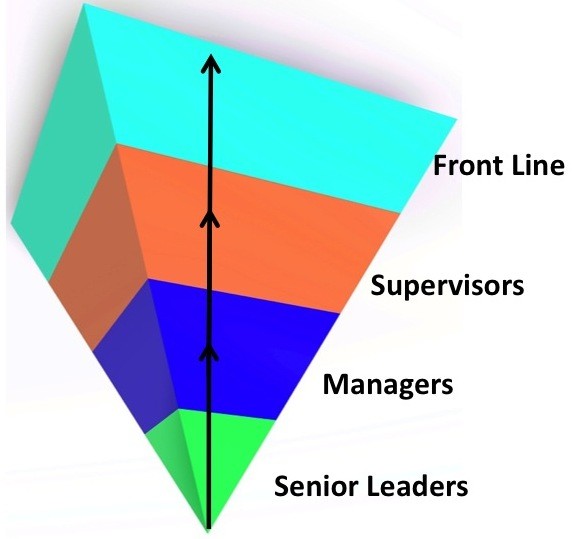
Many leadership styles depend on the typical organizational hierarchy, where the leaders sit at the top of the pyramid, and look down on the rest of the staff. Effectively, pushing out and down directions, without much dialogue from the team about the effectiveness of such directives.
Distribution Property Solutions, Inc.
Servant Leadership turns that pyramid upside down, which means that front line staff are, in effect at the top of the hierarchy and in a position to effect change within the organization. It means that leaders do provide direction to staff, yet do so in a way that encourages, even demands, reciprocal dialogue and conversation.
Distribution Property Solutions, Inc.
Implementing an approach that encourages reciprocal dialogue and conversation requires a willingness from leaders to realize that they do not, could not, have all the answers. It also requires an understanding that the leaders primary job is serving and developing the team.
As with service to the self, leaders must remain open to serving their teams in the same way, implementing the same types of techniques, which we will explore more in future posts.
The Servant Leadership model also requires leaders to develop the ability to pull people to them, and push people into action when necessary. Though, of the two, the former is the more important aspect of the Servant Leadership model, leaders must also have the fortitude to hold themselves, and the people they work with accountable to rigorous standards and expectations.
Servant Leadership as a Way of Being
Servant Leadership is a leadership style that can be used in all aspects of your life, from relationships with friends and family, to service activities within the community. As a way of being, Servant Leadership requires an understanding that relationships are everything.
Relationships start with the one you have with yourself. Once that relationships is healthy and strong, you are ready to develop high-quality relationships with those around you, and throughout the community. It is impossible to develop healthy, high-quality, relationships with others until you are clear on the relationships you have with yourself.
Servant leadership principles can be utilized in all contexts, because these principles, some of which we have explored here, are simple and pragmatic. These principles are about practice, and the necessity of respecting, honoring, and celebrating yourself and all of those around you.
Leading is something that people do in all walks and aspect of life. And, Servant Leadership is a leadership style, that I believe, is uniquely adaptable to all of these contexts. It is also unique in that it puts the development of the self first, with an understanding that developing yourself is a necessary ingredient to the eventual development of others, whether those others be those in your personal or professional contexts.
References
Greenleaf, Robert K. (2020). The Robert K Greenleaf Center for Servant Leadership. What is Servant Leadership. URL.
The ability to share why you do what you do, is much more important than sharing what you do, or how you do it. Simon Sinek talks about this at length in his famous Ted Talk. In this video, we explore an insight I had last week, about the importance of aligning your why with your team, business, organization, and community. They are all related.
Because, as leaders, there are two ways we are confronted with resistance on a regular basis; and, being persistent is the key to continuing to move our teams, businesses, and organizations forward.
Here are those two ways.
Resistance to the ever-changing realities brought on by the COVID-19 pandemic.
Resistance to the current COVID-19 pandemic reality as compared to our previous realities.
Both of these instances of resistance can cause pain and suffering, for ourselves, our teams, businesses, organizations, and all of those that we serve.
What are some strategies that we can use to notice when we are resisting our current reality, regardless of whether it is due to resisting the amount of daily change we are confronted with, or resisting our new reality in comparison to our previous realities?
Here are 4 tips you can use to persist in the face of resistance
1. Notice when you are resisting the current reality
The first step to shifting your attention from resistance to persistence is to know when you are resisting. Sounds simple, yes? It is and isn’t. Noticing when you are resisting the current reality may pose more challenges today, as we are all living and working through so much change.
Combine that amount of change with other environmental stimuli and we have a situation where paying attention to how we are feeling is more challenging.
These are not normal times. Better language. Normal is only relative to what we once knew, and whatever “new normal” we think will show up, it will not be what was. We need to face this reality, get used to it, and learn how to do our work inside of it.
Doing so means learning to notice when we are actively resisting the current reality. How? Practice. Pay attention to how you feel. For me, frustration or agitation are relatively good indicators that I may be resisting the current reality. When I feel frustrated or agitated, I ask myself, why?
What’s the reason for the frustration and agitation?
When the reason is known, and the reason is that you are actively resisting the current reality, you can begin to consider shifting your focus from resistance to persistence through acceptance.
2. Shifting your focus from resistance to persistence through acceptance
Acceptance of the current reality is key to shifting from resistance to persistence. It is a must. When we do not accept the current reality, we are also actively resisting the current reality.
Either by living in denial, disagreement, disapproval, opposition, or complete refusal of the current reality. And, what happens when we are living and working this way?
We cannot create new ways to move ourselves, and our teams, businesses, and organizations forward. Maybe better language is that we are limited in our capacity to move ourselves, and our teams, businesses, and organizations forward. Why?
Because when we resist the current reality, we are limited by that focus. And, resistance is a very limited frame of reference. Whereas, persistence is about continuing to move forward in the face of any and all adversity. A much wider frame of reference.
Movement and this wider frame of reference are key. And, when the movement has stalled, as leaders, we can then create that movement. Creation and persistence go very well together. Creation and resistance? Not so much.
When you’ve moved from noticing your resistance to actively shifting your attention to persistence through acceptance, you can create new possibilities for yourself, and your team, business, and organization.
Another way we can become more aware of our own resistance is to listen to those around us. When people point to our resistance, it is very helpful. It may not always feel helpful, however, as leaders being open, available, and flexible is important.
When we are open, available, and flexible, we have the ability to take constructive feedback and do something with it. And, doing something with that feedback is important for us, and the teams, businesses, and organizations we lead.
Here is a quick example.
Today I was in conversation with a staff member that was questioning the need for a recurring meeting, as we had recently discussed the need to pause this work for now. Freeing up that staff member to work on the current business needs that are most pressing.
Whereas I was not openly resistant to the idea, upon reflection I noticed that I might have inadvertently been resisting canceling those meetings for various reasons.
However, none of those reasons were more important than the facts. We don’t need that meeting right now. And, that is what the staff member was pointing to. Extremely helpful.
As is the knowledge that sometimes our own resistance of a situation or event may be very subtle; and, not something that we are doing purposefully. An important distinction to be clear on.
You don’t get a demerit for being resistant. You are a human being. We are all resistant at times. Important to remember, as being upset or frustrated with your own resistance will only bring more resistance and frustration. Not helpful.
Listen to the people you have surrounded yourself with.
They are there for a reason. And, that reason may just be to point out your resistance, which is helpful. Knowing this allows you to move from resistance to acceptance and into persistence.
4. Invite your team, business, or organization to do the same
If you are at times resistance, then so are those that you work with, and serve. Important to understand. As you work on your own resistance, you can assist others in working on their resistance. Sometimes it is simply pointing it out. Other times, it may require a deeper conversation.
Either way, that you know about your own resistance and know how to shift to acceptance, means that you can also coach others on moving into acceptance. It is so important to create more flexibility and adaptability today.
The change we’ve all been through and the change that has yet to come are going to require more flexibility and more adaptability. In turn, they will also require acceptance of what is. Acceptance of the current state of reality today. And, the current state of reality tomorrow. However, they show up.
When we can fully accept what is before us, we can begin to create new pathways for ourselves and our teams, businesses, and organizations. And, when we can create these new pathways, whether they are new business models, new engagement systems, or new staffing models, we can serve our clients, customers, and community in more effective ways. Why?
Because we are not resisting the current reality, pretending that normal will come back. Normal is gone. Let it go, and move from resistance to acceptance and into persistence.
Once your vision is created, then what? Regardless of whether it is a 10-year, 5-year, or 3-year vision, you will need to put plans in place that will connect the daily work to that vision. That is how your 10-year vision will become a reality.
What, then, are the first steps to ensure that your weekly, monthly, and quarterly work connects to the long-term vision?
In this article we will walk through the process we went through to connect the 10-year vision to our 90-day priorities. First, another question.
Where does a leader start when they want to ensure that everyone’s daily work on the team, or in the business or organization they belong to is contributing to the long-term goals?
Let’s take a look.
Start with the 10-year Vision and ask yourself a couple of questions.
What are the goals of the 10-year vision?
What are the metrics of the 5-year plan?
What will the current year look like?
Let’s look at each question, one at a time.
What are the goals of the 10-year vision?
Once the vision is created, it’s time to create the goals that will drive all of the work. However, before you move on to creating those goals, which will drive the objectives and priorities, ask yourself what your vision will look like in reality.
What will the revenue and service look like, what will the staffing model look like, will you add positions between now and then?
Once you’ve asked yourself these questions, or ones that are more important to your particular vision, start to build out what that vision will look like in reality. Here is an example, vision first, then what it will look like in reality.
Here is the vision
Here is what it will look like
Note that the word profit in this instance is referring to department reinvestment funds.
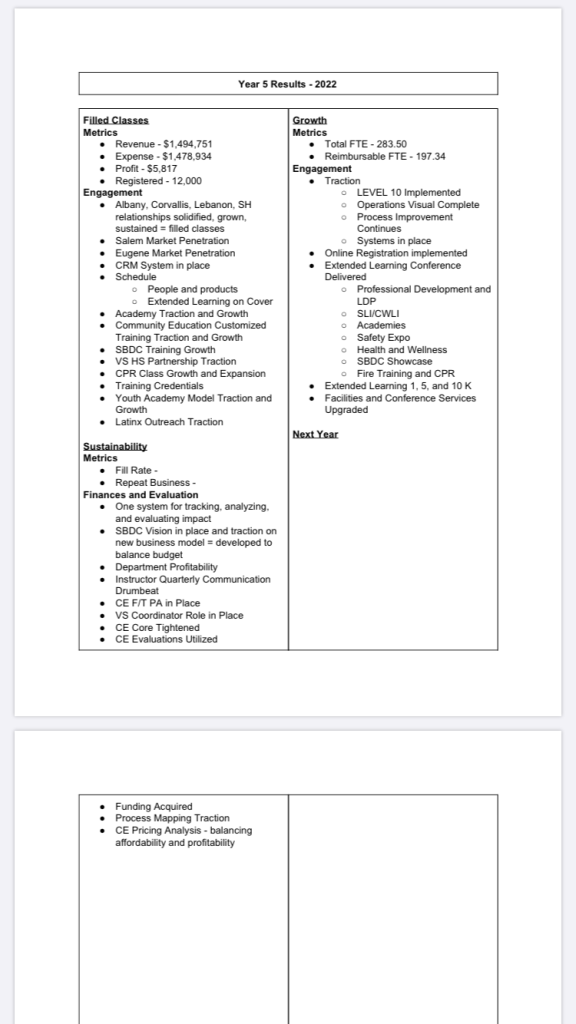
Once you’ve created the 10-year vision, and also know what it will look like, you are ready to work backward. When I went through this exercise last year, I started this part of the planning session with year 5. I looked at the previously designated metrics and asked myself what they would look like in reality. For instance, what would revenue look like, and how many people would we serve.
What are the metrics of the 5-year plan?
Here is what that looked like
It is a wonderful exercise to start with the larger 10-year vision and to work backward to the 5-year plan, creating more clarity as you go. It is how you begin to connect the 10-year vision with the work you need to do today.
Once you’ve worked backward to year 5, you are ready to work backward once again to year 3, or whatever the current year is for your team, business, or organization. It is important to continue to get clearer on what the future reality will look like.
What will the current year look like?
Year 3 Department Objectives
As you continue to work backward from the 10-year vision to year 5, to the current year you are planning for, in this example, year 3, the objectives that will lead the team to that 10-year vision do become more clear. Important.
And, as these objectives become more clear, so will the priorities that will drive each person’s work. For instance, in our year 3, we had 1-year objectives, which we executed on in 90-day chunks. Meaning that we focused on moving forward our yearly objectives with 90-day priorities that would shift as needed, yet the objectives would remain the same.
Year 3 Staff Objectives
Once you get to 90-day priorities, it is time to create a coaching model that will mirror all of the aforementioned. Fully discussing this coaching model is for another article, yet I would like to share with you the simple template we created, so you can see how a 10-year vision can connect to a staff member’s daily work.
Coaching Model Template
Though you can only see a portion of the form, you can see the overall process, where the yearly objectives (on the left) are connected to the department objectives (on the left in bold), while the specific priorities and actions to move that work forward are on the right. Fun.
A couple of weeks ago, I wrote the following article, One BHAG, Two BHAG, and Creating a Disruption Vision, in which we discussed the possibility of creating a disruption vision or BHAG inside of a 10-year vision. And now, the planning process we’ve walked through in this article is being recreated. The difference?
Because there is so much change right now, we have a 1-year BHAG, which lives inside of the 10-year vision, and 30-day priorities, instead of 90. I am in the process right now of re-instituting one-with-ones so that we can discuss, plan, and create our next actions one month at a time. Allowing us the pivotability, and flexibility needed.
Very well. There you have an example, with tools, on how you can connect your team, business, or organizations’ 10-year vision to the work that needs to be done daily to ensure that the 10-year vision will live in reality.
Be well, and lead well.
You can reach Jeff Flesch at fleschj@linnbenton.edu
This week I’ve been reflecting upon how we learn. Though there are learning styles, which are important to know, I’ve been reflecting more upon the process of learning. How we take in new information, process it, reflect upon it, adapt it, and formalize it into the other processes and systems we currently use.
Why might this be important to consider, understand, and become familiar with?
Good question. It is important to consider and understand, because this understanding can help leaders create bridges for people. The familiarity of which can create a bridge for your team and move you from concept into execution. Let’s take a look how.
Learning
It’s important for everyone to have access to developmental opportunities. To learn and to grow. Important. Knowing this, how do you suppose you create these opportunities? While larger organizations typically have a model for training staff, it does not always follow that everyone in the organization has the same access to developmental opportunities. Hm.
What to do, then, when your business or organization does not offer training, or those training programs are limited in some way, or designated for only mid-level and executive employees?
Create them from within
As a leader, you can create opportunities for your team to develop and grow. How? Find out what each person’s strengths and weaknesses are, always starting with yourself first, and then find ways to engage them with new concepts and tools to stretch them, and help them grow.
For instance, we created an opportunity in our second year as a team to develop strategic thinking skills, which included several training days. The culmination of which was deploying a system for organizing our daily work and balancing strategy. The need was there, and we moved it forward, and so can you.
Here are some considerations on how to get started.
Define the need – here are some questions to assist your thinking.
Where is the gap?
What training is needed to fill the gap?
Who will facilitate the training?
When will you implement the training?
How will you evaluate the training’s effectiveness?
What is the return on investment of the training?
Create a training plan with internal or external training professionals – here are some questions to consider.
What is the training goal?
How will you know when you’ve met your goal?
What does post-training traction look like?
What metrics will you use to measure traction?
Implement – communicate about the training, create buy-in with staff, and implement.
Evaluate – make sure you have traction.
Repeat – we created a system of training once a quarter. Worked well.
With any learning process, there is a period of time that people need to adjust to their new workflow reality. How can you assist staff in making these necessary adjustments?
Here are a few ideas.
Create a post-training system to ensure that you have traction – the system should at the very least include:
Post-training follow up – what did you and the team learn, and how will you move the new concepts and tools forward.
Periodic staff check-in’s – I’ve always used one-with-ones to ensure that staff have the support they need, and are adjusting well to their new workflow reality.
Measure your movement – create a way to measure your post-training progress. This might be quantitative metrics, such as increases in revenue, or it may be qualitative, such as increased workflow effectiveness.
Continue to follow-up – to really gain traction, the new concepts and tools must be incorporated into everyone’s daily work, including yours. There really is no other way. If this does not happen, the new concepts and tools you are implementing will lack traction.
Create consistency – once you have movement, start talking with the leadership team about the next training. Be consistent, and offer training opportunities at a regular drumbeat, so staff can count on, and expect them.
Monitor progress – continue to check in with staff on their progress. Monitor traction. You may find that after three months, the team needs a refresher on a topic you’ve already covered. That’s okay. What really matters is that you’ve created access for your team to develop and grow; and that you will remain committed to doing so, refreshers and all.
Once the team has adjusted to their new reality, which includes new concepts and tools, you will need to devise individual development plans. These plans will ensure that each staff integrates the new concepts and tools into their current workflow in a way that suits their learning style, which will increase retention, mastery, and traction.
Where to start?
As was aforementioned, I’ve used one-with-one’s often in my professional career. I find that they work well to create plans tailored to the individual. These plans can also be used to track progress and as a coaching tool.
The most important thing about integration, is that all staff actively integrate the new concepts and tools into their daily workflow. You are building healthy habits in this regard. Really. People like habits, and once you have created that habituation within yourself, a must, you can deploy that to the team.
Here are a few examples.
Whiteboards – some people are very visual, and literally need to see the work drawn or sketched out. I’m like that. If you have staff that are visual, do whiteboard work with them, so they can see the new concepts and tools inside of their current workflow. Important.
Post-its – funny. I always say it matters less how you organize yourself, than it does that you develop a system that works for you. And, if post-its work for you, like they do me, use them. Again, what matters is that the staff member can feel a level of comfort with the new concepts and tools, inside of a system they’ve already developed.
Calendars – a good way to organize by setting reminders for new tasks. For instance, after we completed a strategic thinking training day last year, I had every staff member add one hour per week of strategic thinking to their calendars.
Project Management Systems – we’ve been using a project management system for over a year now. Works for some on the team, and not as much for others. Yet, having a systematized way to move larger projects forward is important. I’ve found this addition helpful, and a contributor to the team’s overall traction.
We all need time to process new information, time to reflect. I advocate for giving your staff the same consideration you give yourself, especially when incorporating new concepts and tools into their daily work. You need it as a leader, and so do they. We all do.
How do you incorporate reflection time into the day?
If you use reflection often as a daily strategy this will be simpler. If you do not, there may be a stretch here for you, however, I believe it is a worthwhile endeavor. We are all inundated with constant stimuli, and the need to take a break from that stimuli to really get clear on our work is necessary and needed.
Here are a few strategies you can try.
Build that time in for yourself first – the only way to create traction with anything, is to create it for yourself first. Once you have a system down, you can coach and guide people into it. If you are not familiar with reflection time, add 30-minute reflection times into your daily calendar. Try it a couple times a week, with a goal to have it worked into your calendar daily.
Coach the team on taking the same time – once you’ve practiced taking reflection time for yourself, you can advise the team on doing the same thing. Have them build it in similarly. A day or two a week to start, with the goal of having daily reflection time.
Create reflection time after meetings and one-with-one’s – another strategy that we employ is taking time to reflect upon decisions. As you practice this strategy, you will come to see, as we have, that many decisions do not need to be made quickly. You have time. Take it, and use it wisely to reflect and engage with yourself and your team on the best course of action.
Once you have strategies in place to incorporate new learning, integration, adjustment, and reflection time into everyone’s workflow, you can start to make plans to formalize these new processes and systems. Simply meaning that to build these healthy work habits, and to have them stick, they must be practiced daily; and they need to be documented.
As we’ve discussed, people all learn differently, so create a few different ways to engage with the team, which will ensure you maintain traction on the aforementioned learning strategies. The main way we move projects of this size forward is to input them into our project management software, which has worked pretty well.
Again, what you use to formalize and document a new system or process, of which learning and development are two, matters less than you taking the time to create a learning and development plan for yourself, each team member, and the overall team.
I think you will find that the payoff in terms of work efficiency, overall team moral, and team cohesion will increase as you continue to create opportunities for people to learn new things, and to develop themselves at work. And, once that is accomplished, you and your team will be ready to move from concept to execution, and into the traction zone.
Have you ever thought about the difference between developmental growth and transformation? Or, have or do you consider them the same? Hm.
There is an important distinction between developmental growth and transformation, which is important to both personal and professional development. Let’s take a look.
Thorough or dramatic change in form or appearance.‘its landscape has undergone a radical transformation’
A metamorphosis during the life cycle of an animal.‘Both the molting process and the metamorphic transformation from larva to pupa are coordinated and regulated by hormones.’
Ah, do you see the dinsticiton? Either way, let’s work it through.
Development
When you are interested in development, meaning available to it, you occupy a space that welcome’s learning. You stand outside of what you believe to be true about the world, and how you occupy it, and welcome new knowledge, new types of understanding, and new ways of being. Simple. Or is it?
Well, because we have an ego, or, wait, do we? Well, for the purposes of this post, let’s assume we do. Because we have an ego, we don’t like being wrong.
We are constantly seeking validation of what we know. Why?
Because it fits into our worldview. It is what we know. When information comes in, we assemble it into the the narrative of our worldview and who we believe we are. We confirm our ego.
If the information doesn’t fit into our current worldview, we really only have two choices.
Deny the existence of this new information, or become open to it.
Denying this new information is called denial. We are actively denying that another way to look at a situation or event is possible. Egocentric.
However, when we are open to the possibility that there are other ways to think about a situation or event, we have now entered into the developmental arena.
Meaning, that we can now take this new information in, make sense of it, and do something with it.
Even if the information doesn’t fit into our current worldview, if we are open, we can incorporate it into our worldview rather easily. It is all about being open to new information, new ways of understanding, and new ways of being.
The simplest example is to consider development at school and work. When we are confronted with new information, we have a choice. Assimilate and incorporate that new information into our existing worldview, creating new knowledge, or reject it.
I am always in conversation with the team about our goals, objectives, and priorities. Recently, I was asked about hiring someone to run Zoom technology for the upcoming professional development trainings.
I, however, was unsure about the need. Didn’t know. I needed to think about it.
Well, the next week, I ran a Zoom meeting with the team. The meeting was 90-minutes and was about creating our next 30-day priorities. Part of the meeting was creating breakout rooms, which you can do in Zoom. The meeting was a complete disaster. Really, it was. What did I learn?
That you absolutely need someone to run technology while the person running the meeting does just that, runs the meeting. I learned through doing the meeting that hiring someone for a Zoom tech position was absolutely necessary. We are hiring someone right now.
I moved from questioning the need, reflecting upon it, to learning that we definitely needed the new position. I developed.
Alright, that’s development. Opportunities for development are available every day. If you don’t see them, it might be that you are avoiding them or in denial about them. It’s not a demerit. I didn’t develop for a long time. Really. I wasn’t interested. Not a judgement. Just a fact. Let’s now look at transformation.
Now, transformation implies a complete change to the object, thing, or person. Yep, that’s right. How then does transformation differ from development?
While development requires an active openness, as we’ve discussed, transformation requires openness and a complete and total letting go of what was, in favor of what will be. It requires a shift from a focus on the external to the internal.
Transformation is about questioning all you know. Every ounce of what you know, or beleive you know, must be questioned.
Further, you must be willing to let go of how you previously viewed the world. Open to a continual process of creating new information, new ways of understanding, and new ways of being.
The distinction is that with transformation you actively seek out opportunities to question the ways you think, act, and occur. Internally focused.
You are continuously interested in disrupting your old habits and ways of thinking while creating new habits and ways of thinking.
Let me give you an example to help with the distinction.
Let us say you want to develop leadership skills. You can develop leadership skills in lots of ways. You can take classes, read books, even put leadership principles into practice in your life. That is development.
You incorporate new information into the preexisting way you already think about leadership. Simple. How then to create transformation? Mm. Different.
You must be willing to let go of all of your preconceived ideas about what leaders are supposed to do, how they are supposed to act, and how they are supposed to be. All of them. Then what?
You leave your ego at the door.
And, everything you think you know about leadership. Start over. Really. Let it all go. And, create from there.
Transformation can only occur when we let go. Know also that the letting go will need to happen again, and again, and again. Over and over. Why? Because you are disrupting what you held to be true, and creating something new. Key. You are not adding, you are creating.
When the pandemic began here locally, we were approaching the last week of the term at the community college where I work. As I’ve mentioned in other posts, I work in community and continuing education. It is all experiential. All of it. Which means that it is in-person. All of it is, or was.
Within one month of the pandemic beginning here, we let go of all the concepts we held to be true about our business model. All of them. What happened?
We created an entirely new business model. A model that is transformational, as all aspects of it are completely different than the previous model. All of them.
We created all new processes and systems for how we do business. New ways we market and engage with the local community, new ways that instructors teach their classes, even the content that is delivered, while similar, is still completely new. Why?
Because a completely new context has been created. And it was created intentionally by believing something else was possible. Which then replaced our current belief system of how we all viewed our work.
All of us. now our actions follow that new belief system. That is transformation.
When you intentionally create new ways to be, new ways to think, new ways to believe, new ways to be a human, you are creating contexts that are transformational. Never seen or experienced before. Transformation.
How are development and transformation similar?
One key way. When you develop, whether you want to or not, you give out your development to others. If those around you are open, they will learn from you and also develop. And, it is the exact same for you. If those around you are developing, and you are open you will also develop.
It is the same with transformation. If you are creating transformational contexts that change the nature of what’s possible, those around you, if they are open, will also transform. If they are open. If not, then they won’t. Same for development.
Can development lead to transformation?
Oh, yes, absolutely. In some ways, they sort of go together, which is why I wanted to write about the distinction. Whereas they are different, they both are about being open to and participating in creating change.
Here is a distinction on the difference between change and transformation.
“Change is about using external influences to modify actions to achieve desired results. Transformation is about modifying beliefs so that natural actions achieve the desired results.”
See the difference? One is externally driven, and one is internally driven. Very similar to the distinction between development and transformation. Important.
How do you begin to develop or transform?
Really it’s pretty simple, yet not easy. A paradox, yep. My suggestion?
Be open to everything around you. Being open is probably the key to both development and transformation. Both become possible when we are open to new information and new experiences.
When we are open, the world opens up. It really does. There is so much to learn and to experience. Being open creates an immediate possibility. The possibility that you will learn to be more. More of either how you already occur, or more by occurring in a completely new way in a completely new context.
It occurred to me that I’ve used multiple strategies the past three years to accomplish this balance, some have worked well, some not as much. What’s most important, however, is not that some didn’t work, rather, it is important that some did.
Trying new strategies is part of leadership development. Actually, it is development itself. Try something new. If it works, keep it, if not get rid of it.
Well, then, let’s take a look at 7 keys you can use to balance strategy with day-to-day operations. And, if you choose to incorporate one, great. If you already do these things, wonderful. And, if they are new to you, give one or two a try and see what happens.
7 Keys to Balancing Strategy with Day-to-Day Operations
Persistence – being persistent is an important leadership trait; as is knowing that not everything that you implement will work. It just won’t. There is nothing wrong with that, and you do not get a demerit if something doesn’t work. All that means is that you need to be persistent in your actions to find that process, or system that will work. Stick to it, and you will find it.
Prioritization – we are all inundated with multiple competing priorities. It is very important, however, to get clear on how those competing priorities should be prioritized. Very important. Otherwise, all of your priorities will have the same level of importance, and chances are many of them will not move forward.
Patience – very important to have patience with yourself. When you develop patience with yourself, you will also have more patience with the people on your team, or in your business, or organization. Trust me when I write that patience will win over force any day. Patience is sustainable, force, not so much. Be patient, and give yourself the time you need to breathe.
Determination – when one is determined, they are moving forward, and do not let obstacles stand in their way. Important for every leader everywhere. Why? Because the nature of leadership ensures that obstacles will often present themselves before us. Often. Being resolute and steadfast, while also being flexible in your approach is key. You will be challenged regularly. You will also be drawn to the day-to-day operations. Normal. Yet be steadfast, and determined to incorporate strategy into your daily workflow. It is possible.
Organization – understanding an organizational system that works for you is essential. It does not have to make sense to anyone else. Just you. Important, as people often think that their organization system must be understandable to others. Not so. You need to understand it, period. Also know that how you organize yourself will change as the business changes. It is supposed to.
Time Management – a difficult skill set to develop for me, yet one that I have made progress on in the past few years. What I’ve learned, similar to learning to organize myself, is that there is no one way to manage time effectively. Important to understand. When you understand this, you will actively seek out new ways to manage your time, until you find the system that works for you. And, time management should also change as the business changes. It must.
Vision Clarity – you must be very clear on your vision. If you are not clear, you will continue to do day-to-day tasks that are not moving you closer to achieving the goals associated with your vision. Being clear on your vision, ensures that you are moving your vision forward when you are working on the day-to-day operations. You are then always working on your strategy, even when you are working in the “weeds.”
There we go. 7 keys to creating balance between strategy and the day-to-day operations of your team, business, or organization. Are there other keys, you ask? Of course. These are simply the ones that I am most present to now.
There are many meaningful ways to balance strategy and day-to-day operations. How many there are matters less, than, as leaders, we try new things, and incorporate new strategies into our workflow often. Be open and flexible to new ideas, new ways of doing things, and new ways of being.
Teams, businesses, and organizations change often. And, with change comes the need to be open to changing as the need changes. A must.
If you’ve tried the keys outlined in this post, awesome. If you’ve not tried them all, try a new one, try two. If you already do them all, wonderful, you’re ahead.
If you’re not sure how to incorporate these keys into your workflow, here are a couple of quick suggestions before I close.
Persistence – continue to try new things. Get your best ideas out, and invite others to collaborate. Your ideas + their ideas =.even better ideas. Continue to persist, you will find the process, system, or vision you are looking for.
Prioritization – how do you prioritize your work? Know that however you prioritize your work today, there are a million other ways to prioritize. If what you are doing is not working, try something new. Remember, as the team, business or organization iterates, the way you prioritize yourself will also have to iterate.
Patience – a big one. Though being persistent and determined are very important. Being patient is equally important. Give yourself the time to breath and think. A must. Schedule the time into your calendar. Make time, and let your team know this is your time to just be. Go for a walk, or just sit. Doesn’t matter. What matters is doing it daily. For a time, I had a recurring appointment on my calendar for myself. It read, breathing. And, I did just that.
Determination – yep, important. Things will happen and “go wrong.” It is the nature of leadership, especially when leading innovative teams, businesses, or organizations. Stay the course. Remember, that “failure” is part and parcel of the creative process. You cannot have breakthroughs without breakdowns. They go together.
Organization – similar to prioritization, trying new organizational strategies is important, and needed. Example – when I started my current job, I organized myself in an “old school” way. File folders, and lots of paper. Then I went completely digital, then back to files, and folders. Now, a combination. Again, what matters is continuing to try new things. When something’s not working, do it differently. You may be surprised how that will open up more thinking space for you.
Time Management – phew, time management is so important today. I am much better at it today; yet I would say the first two years on the job, I really struggled in this area. How did I begin to improve? Continually trying new things; and, asking for help. The department administrative assistant, to this day, goes through my calendar with me, and asks this question – why do you have this meeting? Hm. And, if the meeting on my calendar is not connected to the vision, I cancel it.
Vision Clarity – yep. Once you’ve become skilled in the aforementioned areas, you will have more time to work on strategy. And, once you are clear on your vision, the aforementioned keys will also become easier. Why? Because the clearer you are on the vision, the more you understand the work you really need to be doing. You begin to see other work you’ve been doing in a new light. And, you will begin to let that other work go. If the daily work is not connecting to the vision, let it go.
Alright, we’ve discussed 7 keys to balancing strategy and day-to-day operations; and, we’ve also looked at a few ways you can incorporate these keys into your workflow.
Remember, the most important thing about creating balance in your work, is to always be present to the reality that trying, and doing things in new ways is necessary and needed.
When you are unsure of what to try next, try something new, stand back and see what happens. If it works well, keep it. If not, let it go; and, then, try something else. Whatever you do, keep moving. Be and lead well.
































 Develop. Inspire. Transform.