The Social Construction Series Part 2: 5 Reasons Why Understanding The Social Construction of Knowledge is Important

Photo by Jaredd Craig on Unsplash

In The Social Construction Series Part 1: 7 Reasons Why Understanding Social Constructions Is Important, I write about the need to understand how the world is actually socially constructed. All of it. Important.

One of the most important social constructions to understand is how knowledge is socially constructed. Numerous books and articles have been written on this topic, from both a theoretical and practical perspective.

Here, we will explore the social construction of knowledge likewise. Both theoretically and practically. Ready? Let’s go.

Let’s first define knowledge.

knowledge

noun ˈnɒlɪdʒ/ /ˈnɑːlɪdʒ/

  1. [uncountable, singular] the information, understanding, and skills that you gain through education or
    1. experience practical/medical/scientific knowledge
    2. knowledge of/about something He [she] has a wide knowledge of painting and music.
    3. There is a lack of knowledge about the tax system.

There we go.

Now before we go onto our discussion, let’s take a look at what two prominent philosophers had to say about knowledge, Jurgen Habermas, and Michel Foucault.

Habermas’s Perspective

“Habermas argues that domination is an obstacle in the pursuit of true knowledge” (Anttonen, Saila. 1999).

University of Leeds

Foucault’s Perspective

“Foucault, however, argues that all knowledge is constituted and socially constructed under conditions of power” (Anttonen, Saila. 1999).

University of Leeds

And, what prey tell, do both of these philosophers consider an obstacle to knowledge for some, and a boon for others? Power.

Let’s now consider the social construction of knowledge.

Photo by Timo Volz on Unsplash

How is Knowledge Constructed?

Knowledge is continually produced, internalized, and practiced, or acted upon. Though not always in this order. Sometimes intellectual knowledge precedes practical knowledge, and sometimes practical knowledge precedes intellectual knowledge. Depends.

Think about a time when you learned something through doing. For instance, learning how to drive a car. You can possess the intellectual knowledge about how to drive a car, yet until you actually drive a car, you don’t possess the knowledge necessary to drive a car.

You need both. And, in fact, some would argue, as would I, that practical knowledge outweighs intellectual knowledge. For it is in the doing, or practice, that we learn the most.

We accumulate the real knowledge about something when we do it.

Conversely, however, you can ask me to create a presentation on the social construction of knowledge, yet unless I possess the intellectual knowledge about the social construction of knowledge, I will be unable to create that presentation, try as I might.

Therefore, knowledge is constructed two ways. Through our intellect and through practice. Both.

Who Constructs Knowledge?

Everyone constructs knowledge. From a young child to an older adult, knowledge is continuously produced, internalized, and practiced. Knowledge is all around us. Everywhere.

Think about an interaction you’ve had recently where you learned something new, or taught someone something new. That is knowledge production.

Knowledge is produced, internalized, and practiced continuously, all day, every day.

Yet, there is some knowledge that is considered more illusive, more special, or maybe the more appropriate term is specialized. You typically go to University, College, or Trade School to learn about these types of specialized knowledge.

Photo by Roman Mager on Unsplash

Who Constructs Specialized Knowledge

Simple answer, experts. Yet, what does that really mean? Ah, good question. Someone is considered an expert when they have attained a reasonable amount of intellectual and or practical knowledge about a particular subject or topic. Simple. Why does this matter?

Because the humans that have constructed this knowledge, are just that, human. Meaning that they are like you, like me, and like everyone else. Full of strengths and weaknesses. Both

People often get caught up in the term, expert, thinking that because someone has a degree or certification in one specialized area or another, that they should know what is best for us, or know the best path to take in a certain area of our lives.

Yet, because experts are also human means that they are not infallible. Important. Additionally, because we know that the world and all knowledge within it is socially constructed, we also know that there are many, many ways to understand a subject or topic. Many ways. Not one.

Further, not all knowledge about a particular subject or topic has yet been discovered. Meaning that there is always something more to learn. Always.

Here is what Socrates said about knowledge.

“At the trial, Socrates says, “The only true wisdom consists in knowing that you know nothing.” Socrates put emphasis on knowledge all his life because he believed that “the ability to distinguish between right and wrong lies in people’s reason not in society.”

The Independent

Ah, wonderful. According to Socrates, then, it is up to the individual, each one of us, to distinguish between right and wrong. And that includes distinguishing between the right and wrong of what someone is telling us is true about our bodies, families, community, and the greater world.

Of course, that does not mean that we don’t need assistance from others, and access to the knowledge we need to make informed decisions and choices. Quite the contrary. More assistance and access is needed.

Photo by Annie Spratt on Unsplash

How is Knowledge Disseminated?

Knowledge is disseminated in many different ways. We’ve covered some of them already, such as through Universities, Colleges,and Trade Schools. Yet, knowledge is also produced, internalized, and practiced in many other social contexts, which are typically referred to as social institutions.

Before we go further, let’s define the term social institution.

“Typically, contemporary sociologists use the term to refer to complex social forms that reproduce themselves such as governments, the family, human languages, universities, hospitals, business corporations, and legal systems. A typical definition is that proffered by Jonathan Turner (1997: 6): “a complex of positions, roles, norms and values lodged in particular types of social structures and organising relatively stable patterns of human activity with respect to fundamental problems in producing life-sustaining resources, in reproducing individuals, and in sustaining viable societal structures within a given environment.”

Stanford Encyclopedia of Philosophy

Ah, helpful. Thus far, we’ve covered the social construction of knowledge within University, College, and Trade Schools, yet as you can read above, there are many social institutions that socially construct knowledge.

The issue? Same as with the socially constructed knowledge that Universities, College’s, and Trade Schools produce. When we internalize a socially constructed view of the world, and our place in it, we are receiving knowledge that has been produced within a very particular framework.

And, those frameworks include within them people that have biases, just like you and I. Yep. We can deny we have biases, yet we all have them. They are part of socialization.

All socialization, which just means the how, what, why, when, and where of all that you learned as a child, youth, and young adult has within it bias. It has to. It’s one way of viewing the world. Yet, it’s not the only way.

Now, choose any social institution you like, and we can discuss the problems inherent with the production, internalization, and then the eventual reproduction of that knowledge through practice, or action. What problems, you ask? Good question.

One of the largest problems, or issues, we have just discussed. Because we know that knowledge is socially constructed, and we know that all social institutions have within them a particular worldview (or bias) this knowledge then, which is often told as truth, is not truth.

This knowledge is, rather, a subjective interpretation of life and the world through one lens, or viewpoint.

However, when we internalize this socially constructed knowledge as truth, we limit ourselves. We limit that which we can really know about the world and life. If we are conscious of this fact, and continue to choose a limited framework, very well.

However, most people are unaware, so do not actively choose. They subscribe to a particular set of knowledge constructs because they were socialized to do so. Many people live their entire lives this way.

Hm. What to do? Before we get to that question, let’s take a look at obstacles to the acquisition of knowledge. Important.

Photo by Jaco Pretorius on Unsplash

What are the obstacles to the acquisition of knowledge?

As we’ve discussed, Habermas and Foucault would both argue that power is an obstacle to the acquisition of knowledge. Meaning that with more power comes more knowledge. Or, maybe, it’s that with more knowledge comes more power?

Actually power and knowledge have a reciprocal relationship. Meaning that with more knowledge, you do have more power. Likewise, with more power, you have more access to knowledge. Truth.

And, then?

Well, those with power construct more knowledge, especially of the specialized kind. And, as we’ve discussed, accessing such knowledge is inaccessible for many people.

Therefore understanding how knowledge is socially constructed is important for everyone. Why?

5 Reasons Why Understanding The Social Construction of Knowledge is Important

1. Know matter how much you know intellectually, you must practice it

Practicing our intellectual knowledge is necessary to develop ourselves. When we learn something, and internalize it, the cycle of knowledge production is not complete.

We must practice that knowledge to really know it.

Once practiced, we know it through our entire selves, which is a very different experience than simply having intellectual knowledge about a subject or topic.

2. You can do something with that which you know, or are knowledgeable about

Knowing that knowledge is socially constructed, and that you are an active participant in constructing knowledge creates an opportunity for you to practice distributing your particular knowledge to others.

You are the only one that can educate someone on that which you know, just as you know it.

And, when you give out that which you are knowledgeable about, you will get back that which someone else is knowledgeable about. Meaning, that you will now have acquired more knowledge by giving someone your knowledge. Reciprocal learning.

3. Specialized knowledge is an interpretation, so question it

When we know that all knowledge is socially constructed, we know that questioning all that we learn is necessary and needed. We must question what experts tell us is true about our bodies, families, community, and the greater world.

When we begin to question other people’s truths, we create a space to develop ourselves more. Why?

Because we have created a space to learn more from the expert. Simple. When we don’t take expert knowledge at face value, we create a space to learn more about the subject or topic. Keep questioning.

4. Because bias is inherent in all socially constructed knowledge, be wary of limitation

When we accept knowledge as true, which is given to us by a social institution we limit ourselves. We limit what is knowable.

However, as was aforementioned, when we question that knowledge, we create the opportunity to learn more, and develop more. We don’t accept one worldview or interpretation of the world, which is limiting.

We know knowledge is socially constructed, so we question. We question the knowledge. We become unlimited.

5. Search for knowledge everywhere, both intellectually, and in practice

When we know that knowledge precedes and follows power, we can intentionally create opportunities to learn more. Acquiring more knowledge, both intellectually and practically, moves us forward as human beings.

When we internalize and practice what we learn, we also create an opportunity to produce something out of this knowledge. Of which this article is an example.

And, when we practice that which we know, we have more power as a human being.

In Closing: Question Everything

My final thoughts on the social construction of knowledge is to question everything. Really.

Question the knowledge you now have. Question the knowledge people communicate to you. Question all of it. Powerful.

We choose to accept the knowledge that we have, as well as the knowledge that is communicated to us as true. However, when we know that the world is socially constructed, and that all knowledge is likewise socially constructed, we create an opportunity to question these truths.

Both the ones we’ve considered as truth for most of our lives, and other people’s truths.

We also create a developmental opportunity for ourselves, and as we have discussed, for everyone that we know. We move ourselves from a limited framework to an unlimited one.

Remember, on any subject or topic, there is more to learn. Always. Because we know this to be true, there is always an opportunity to share your knowledge with someone, and for them to share their knowledge with you.

That which you know is powerful. That which you can learn about is powerful.

Knowledge that is produced, internalized, and practiced is socially constructed by you, by me, by experts, by every human being. Thus, question it, question all of it.

Definition of knowledge taken from Oxford Learner’s Dictionaries.

#bias, #creatingknowledge, #development, #developmentandgrowth, #education, #foucaultandknowledgeandpower, #habermasandknowledgeandpower, #humandevelopment, #internalizedknowledge, #jurgenhabermas, #knoweldgeproduction, #knowledgedissemintation, #knowledgeproduction, #michelfoucault, #power, #practicalknolwedge, #psychology, #selfdevelopment, #socialconstruct, #socialconstruction, #socialconstructionism, #socialinstitutions, #sociology, #socratesandknowledge, #specializedknowledge, #thefamily, #theroreticalknowledge, #worldview

The Blog + Video Series #12 – Developmental Growth and Transformation: A Distinction

The Transformation Video Series #1

Have you ever thought about the difference between developmental growth and transformation? Or, have or do you consider them the same? Hm.

There is an important distinction between developmental growth and transformation, which is important to both personal and professional development. Let’s take a look.

First, let’s define the terms.

development

Translate development into Spanish

NOUN

  • The process of developing or being developed.‘she traces the development of the novel’
    1. A specified state of growth or advancement.‘the wings attain their full development several hours after birth

transformation

Translate transformation into Spanish

NOUN

  • Thorough or dramatic change in form or appearance.‘its landscape has undergone a radical transformation’
    1. A metamorphosis during the life cycle of an animal.‘Both the molting process and the metamorphic transformation from larva to pupa are coordinated and regulated by hormones.’

Ah, do you see the dinsticiton? Either way, let’s work it through.

Development

When you are interested in development, meaning available to it, you occupy a space that welcome’s learning. You stand outside of what you believe to be true about the world, and how you occupy it, and welcome new knowledge, new types of understanding, and new ways of being. Simple. Or is it?

Well, because we have an ego, or, wait, do we? Well, for the purposes of this post, let’s assume we do. Because we have an ego, we don’t like being wrong.

We are constantly seeking validation of what we know. Why?

Because it fits into our worldview. It is what we know. When information comes in, we assemble it into the the narrative of our worldview and who we believe we are. We confirm our ego.

This image has an empty alt attribute; its file name is iulia-mihailov-91racj7xmxe-unsplash.jpg
Photo by Iulia Mihailov on Unsplash

If the information doesn’t fit into our current worldview, we really only have two choices.

Deny the existence of this new information, or become open to it.

Denying this new information is called denial. We are actively denying that another way to look at a situation or event is possible. Egocentric.

However, when we are open to the possibility that there are other ways to think about a situation or event, we have now entered into the developmental arena.

Meaning, that we can now take this new information in, make sense of it, and do something with it.

Even if the information doesn’t fit into our current worldview, if we are open, we can incorporate it into our worldview rather easily. It is all about being open to new information, new ways of understanding, and new ways of being.

The simplest example is to consider development at school and work. When we are confronted with new information, we have a choice. Assimilate and incorporate that new information into our existing worldview, creating new knowledge, or reject it.

This image has an empty alt attribute; its file name is saketh-garuda-shy-ckpyjre-unsplash-1.jpg
Photo by Saketh Garuda on Unsplash

Example.

I am always in conversation with the team about our goals, objectives, and priorities. Recently, I was asked about hiring someone to run Zoom technology for the upcoming professional development trainings.

I, however, was unsure about the need. Didn’t know. I needed to think about it.

Well, the next week, I ran a Zoom meeting with the team. The meeting was 90-minutes and was about creating our next 30-day priorities. Part of the meeting was creating breakout rooms, which you can do in Zoom. The meeting was a complete disaster. Really, it was. What did I learn?

That you absolutely need someone to run technology while the person running the meeting does just that, runs the meeting. I learned through doing the meeting that hiring someone for a Zoom tech position was absolutely necessary. We are hiring someone right now.

I moved from questioning the need, reflecting upon it, to learning that we definitely needed the new position. I developed.

Alright, that’s development. Opportunities for development are available every day. If you don’t see them, it might be that you are avoiding them or in denial about them. It’s not a demerit. I didn’t develop for a long time. Really. I wasn’t interested. Not a judgement. Just a fact. Let’s now look at transformation.

This image has an empty alt attribute; its file name is suzanne-d-williams-vmkbfr6r_jg-unsplash.jpg
Photo by Suzanne D. Williams on Unsplash

Transformation

Now, transformation implies a complete change to the object, thing, or person. Yep, that’s right. How then does transformation differ from development?

While development requires an active openness, as we’ve discussed, transformation requires openness and a complete and total letting go of what was, in favor of what will be. It requires a shift from a focus on the external to the internal.

Transformation is about questioning all you know. Every ounce of what you know, or beleive you know, must be questioned.

Further, you must be willing to let go of how you previously viewed the world. Open to a continual process of creating new information, new ways of understanding, and new ways of being.

The distinction is that with transformation you actively seek out opportunities to question the ways you think, act, and occur. Internally focused.

You are continuously interested in disrupting your old habits and ways of thinking while creating new habits and ways of thinking.

Let me give you an example to help with the distinction.

This image has an empty alt attribute; its file name is disruptivo-i0ypwvhnzni-unsplash.jpg
Photo by DISRUPTIVO on Unsplash

Let us say you want to develop leadership skills. You can develop leadership skills in lots of ways. You can take classes, read books, even put leadership principles into practice in your life. That is development.

You incorporate new information into the preexisting way you already think about leadership. Simple. How then to create transformation? Mm. Different.

You must be willing to let go of all of your preconceived ideas about what leaders are supposed to do, how they are supposed to act, and how they are supposed to be. All of them. Then what?

You leave your ego at the door.

And, everything you think you know about leadership. Start over. Really. Let it all go. And, create from there.

Transformation can only occur when we let go. Know also that the letting go will need to happen again, and again, and again. Over and over. Why? Because you are disrupting what you held to be true, and creating something new. Key. You are not adding, you are creating.

This image has an empty alt attribute; its file name is arnaud-weyts-4hbszgi3z0c-unsplash.jpg
Photo by Arnaud Weyts on Unsplash

Example

Let’s see. Okay. Here we go.

When the pandemic began here locally, we were approaching the last week of the term at the community college where I work. As I’ve mentioned in other posts, I work in community and continuing education. It is all experiential. All of it. Which means that it is in-person. All of it is, or was.

Within one month of the pandemic beginning here, we let go of all the concepts we held to be true about our business model. All of them. What happened?

We created an entirely new business model. A model that is transformational, as all aspects of it are completely different than the previous model. All of them.

We created all new processes and systems for how we do business. New ways we market and engage with the local community, new ways that instructors teach their classes, even the content that is delivered, while similar, is still completely new. Why?

Because a completely new context has been created. And it was created intentionally by believing something else was possible. Which then replaced our current belief system of how we all viewed our work.

All of us. now our actions follow that new belief system. That is transformation.

This image has an empty alt attribute; its file name is jen-theodore-hbkwmj41y0i-unsplash.jpg
Photo by Jen Theodore on Unsplash

When you intentionally create new ways to be, new ways to think, new ways to believe, new ways to be a human, you are creating contexts that are transformational. Never seen or experienced before. Transformation.

How are development and transformation similar?

One key way. When you develop, whether you want to or not, you give out your development to others. If those around you are open, they will learn from you and also develop. And, it is the exact same for you. If those around you are developing, and you are open you will also develop.

It is the same with transformation. If you are creating transformational contexts that change the nature of what’s possible, those around you, if they are open, will also transform. If they are open. If not, then they won’t. Same for development.

Can development lead to transformation?

Oh, yes, absolutely. In some ways, they sort of go together, which is why I wanted to write about the distinction. Whereas they are different, they both are about being open to and participating in creating change.

Here is a distinction on the difference between change and transformation.

“Change is about using external influences to modify actions to achieve desired results. Transformation is about modifying beliefs so that natural actions achieve the desired results.”

cioinsight.com

See the difference? One is externally driven, and one is internally driven. Very similar to the distinction between development and transformation. Important.

How do you begin to develop or transform?

Really it’s pretty simple, yet not easy. A paradox, yep. My suggestion?

  • Be open to everything around you. Being open is probably the key to both development and transformation. Both become possible when we are open to new information and new experiences.

When we are open, the world opens up. It really does. There is so much to learn and to experience. Being open creates an immediate possibility. The possibility that you will learn to be more. More of either how you already occur, or more by occurring in a completely new way in a completely new context.

Photo by Franck V. on Unsplash

#changemanagement, #creatingchange, #creatingtransformation, #developmentalgrowth, #distinctionbetweentransformationanddevelopment, #handlingchange, #leadership, #leadershipcahange, #leadershipdevelopment, #leadershipessentials, #leadershipinaction, #leadershipmindset, #leadershippractice, #leadershipprinciples, #leadershiptransformation, #leadershipvalues, #personaldevelopment, #selfdevelopment, #transformationalleadership

Coping With Our Emotions: Why Hope And Despair Are Two Sides of The Same Coin

Photo by Ron Smith on Unsplash

Have you ever considered hope and despair at the same time? Hm. I’m not sure that I have. I would like to. Thoughts? Well, let’s do a cursory look, and see what we get.

In 4 Reasons Why Language Is Power, I wrote about the power of language. We don’t typically consider the power that lives inside the language we use. It is very important. It shapes experiences, expectations, and trajectories that we set our lives on.

Similarly, in The Social Construction Series Part 1: 7 Reasons Why Understanding Social Constructions Is Important, I wrote about the importance of understanding that all things are socially constructed. All of them. Hence, this post is also a social construction.

Yet, knowing this frees us from the fetter of worrying about attaching ourselves to social constructions, or concepts that we agree with or disagree with.

Alright, let’s define our key terms.

hope

Pronunciation /hōp/ /hoʊp/ 

Translate hope into Spanish

NOUN

  • A feeling of expectation and desire for a certain thing to happen.‘he looked through her belongings in the hope of coming across some information’

despair

Pronunciation /dəˈsper/ /dəˈspɛr/ 

Translate despair into Spanish

NOUN

  • The complete loss or absence of hope.

Well, look at that. Hope is defined as a feeling of expectation and desire about a result. Hm. Interesting. And, despair is defined as the lack of hope, or lack of such a feeling of expectation and desire about a result. Mm, this will be fun.

Photo by Stephen Leonardi on Unsplash

Expectations and desires for a certain [result] thing to happen

If hope is, at least as it is defined here, associated with an expectation and desire for a certain thing to happen, when we hope we are essentially concentrating on a result.

And, if that result doesn’t occur? Then we may fall into despair, which is the lack of the expectation and desire for a certain thing to happen. The issue?

We cannot have hope without despair. They go together. If you can feel hope, then it is equally possible to feel despair. Not a problem. Important, however, to understand. Why?

Often, people get upset or frustrated when in despair. Yet, as we can see from the language itself, it is only natural. If you subscribe to the feeling of hope, then you will sometimes feel despair. And, vice versa.

Photo by Jon Tyson on Unsplash

Another way to look at hope and despair

Another way to think about hope and despair is as two sides of the same coin. The world is full of these opposites. Sad and happy, life and death, and so on. For the world to occur as it does, they are needed.

Yet, we can create more power over these concepts by understanding that they always occur together. Meaning that if you are sometimes hopeful, you will sometimes feel despair. It is a must.

When we understand this as true, we can shift our thinking, and mindset to incorporate this apparent paradox with a new understanding.

The new understanding is that these concepts are one. Think about the coin analogy I’ve used in this post. A coin is one thing, yes? Yet, it has two distinct sides; head and tales. Hope and despair are the same. As are all pairs of opposites.

Photo by Simon on Unsplash

When do we run into trouble with these concepts?

When we expect hope, for instance, to show up more than despair. Why? Because then when despair shows up, we get down, frustrated, maybe even angry. Not helpful.

By accepting that despair is a part of hope, as sadness is a part of happiness, we increase our awareness about the fact that despair will come; and, guess what?

When it does, it’s okay. It’s normal to feel despair sometimes. Just as it’s normal to feel sad sometimes. If you never feel sad, or despair, then happiness and hope will elude you. True.

It is also important to welcome despair as much as you welcome hope. Why? Because when we resist feeling despair, we avoid it. And, when we avoid things, we actually attract more of those concepts into our life.

Photo by Priscilla Du Preez on Unsplash

I avoided sadness for such a long time, that I was often sad. Really. Did I look sad all the time? No. It was internal. Yet, believe me, it was there. As was despair.

Yet, when you openly accept that all feelings happen, you create a space to be with them when they come. No judgment. Being in despair or sad doesn’t mean anything.

You are not having “issues” because you sometimes feel despair. Funny how we create language around “negative” emotions and associate them with problems. Not helpful. In fact, detrimental, and untrue.

What can you do?

When you are hopeful, notice. And, be hopeful. Be just as you are in those wonderful moments of hope. Or, happiness, joy, or elation.

And, when you are in despair, notice. And, be in despair. Be just as you are in those wonderful moments of having despair. Or, sadness, melancholy, or misery.

Our emotions come and go. It is important to expect them all to show up. All of them. And, to welcome them all. When we welcome them all, they stop having power over us.

In that moment of acceptance, we create a space to be with our emotions in a completely new way. Free of judgement and created meaning that one emotion is better, or should be more expected than another.

Remember that our emotions just are, and that hope and despair are two sides of the same coin. Just like the heads and tales of a coin, hope and despair are one.

#copingwithemotions, #despair, #development, #developmentandgrowth, #dualism, #emotional-development, #emotional-intelligence, #emotional-self, #emotions, #emotionsareone, #growth, #hopanddespair, #hope, #leadership, #leadershipconcepts, #leadershipdevelopment, #personaldevelopment, #personaltransformation, #selfdevelopment

From Confusion to Clarity Part 0: Change As A System of Related Parts

August 16, 2020

It occured to me after writing, From Confusion to Clarity Part 1: From Confusion to Clarity in 5 Simple Steps, that there was a need to create a post about the context of change. How and why change occurs, prior to thinking about the distinction between developmental growth and transformation.

I created the above video for this purpose. Let’s also discuss it here for a few moments.

A system of change?

Change is actually a rather ordered system. Meaning that it always occurs, and in a similar manner, no matter how small or large. Important to remember that even when we don’t notice, change is always happening. Always. Alright, let’s take a look at this system.

Here are the four parts.

This image has an empty alt attribute; its file name is yan-ots-ff14fkgecym-unsplash.jpg
Photo by Yan Ots on Unsplash

1. Order

We live, work, and love, and we do so in an ordered system. Yes? Meaning that we order our world. It’s different for everyone, yet everyone has some sort of way they order their lives. Even if we don’t write out our goals, objectives, and priorities, we have them, and know them. At home and at work.

We believe that how we order our lives is unchanging. Solid. Stable. Then what?

Something Changes

Most recently, COVID-19. Massive amounts of change. Changing all that we thought we previously knew about our ordered lives. At home and at work.

Creating a necessity to pivot businesses, and create new goals, objectives, and priorities. Yes, in business, and yes, at home. Both. Personally and professional, we’ve all been affected.

When this happens we all go into disorder. With the scale of change that COVID-19 created, the whole world went into disorder.

This image has an empty alt attribute; its file name is sharon-mccutcheon-tn57ji3cewi-unsplash.jpg
Photo by Sharon McCutcheon on Unsplash

2. Disorder

In disorder, we are trying to understand what is happening. Confused, worried, fearful, yes. And, at the same time, we are in survival mode. What can we do? How can we do it?

Moving anything and everything forward that we can. Personally creating new ways to shop, to exercise, to socialize. Professional, creating new business models in our new reality. Everything delivered remotely. New engagement methods, new financial models, new everything. Right? Phew.

And then?

This image has an empty alt attribute; its file name is edgar-chaparro-r6mbxuhnxbk-unsplash.jpg
Photo by Edgar Chaparro on Unsplash

3. Reorder

Professionally, we begin to once again create longer term goals, objectives, and priorities. Sometimes going out a year, and working backwards to priorities for the next quarter, then the month, and then the day. Beginning to create a sense of order once again.

Personally, we also begin to think about longer term goals. Creating new ways to think about living inside of our new reality. What’s possible? How can we create it?

Then?

4. Order

We have a new order. Phew. Lot’s of work. And inside of this new order, we continue to move forward. Creating, moving, creating, moving, creating, moving. Again, and again. Life.

Something Changes

Of course inside of this new ordered system, we must keep in mind that it is inevitable that another change will occur. It has to. It’s part of the system we call life.

And, what happens when that change occurs. The cycle starts all over again. Really, it does. Here.

  1. Order
    1. Change
  2. Disorder
  3. Reorder
  4. Order
    1. Change
  5. Order

And so on.

Another thing to note is that even the most subtle changes cause this system to move. It is always moving. We may not notice it, yet it is there. In the background it is always functioning.

Usually, it takes larger changes for us to notice.

Alright, that’s thinking about change as a system, which I think will be helpful in engaging with the aforementioned post on developmental growth and transformation.

Be well. Love well. Live well.

#change, #confusiontoclarity, #covid-19, #creatingnewpossibilities, #decreasingconfusion, #development, #disorder, #fromconfusiontoclarity, #growth, #increasingclarity, #livingunlimitedlives, #mindulness, #order, #orderedsystems, #reorder, #selfdevelopment, #systemofchange, #systemsofchange

Developmental Growth and Transformation: A Distinction

This image has an empty alt attribute; its file name is franck-v-miwgz02clki-unsplash.jpg
Photo by Franck V. on Unsplash

Have you ever thought about the difference between developmental growth and transformation? Or, have or do you consider them the same? Hm.

There is an important distinction between developmental growth and transformation, which is important to both personal and professional development. Let’s take a look.

First, let’s define the terms.

development

Translate development into Spanish

NOUN

  • The process of developing or being developed.‘she traces the development of the novel’
    1. A specified state of growth or advancement.‘the wings attain their full development several hours after birth

transformation

Translate transformation into Spanish

NOUN

  • Thorough or dramatic change in form or appearance.‘its landscape has undergone a radical transformation’
    1. A metamorphosis during the life cycle of an animal.‘Both the molting process and the metamorphic transformation from larva to pupa are coordinated and regulated by hormones.’

Ah, do you see the dinsticiton? Either way, let’s work it through.

Development

When you are interested in development, meaning available to it, you occupy a space that welcome’s learning. You stand outside of what you believe to be true about the world, and how you occupy it, and welcome new knowledge, new types of understanding, and new ways of being. Simple. Or is it?

Well, because we have an ego, or, wait, do we? Well, for the purposes of this post, let’s assume we do. Because we have an ego, we don’t like being wrong.

We are constantly seeking validation of what we know. Why?

Because it fits into our worldview. It is what we know. When information comes in, we assemble it into the the narrative of our worldview and who we believe we are. We confirm our ego.

This image has an empty alt attribute; its file name is iulia-mihailov-91racj7xmxe-unsplash.jpg
Photo by Iulia Mihailov on Unsplash

If the information doesn’t fit into our current worldview, we really only have two choices.

Deny the existence of this new information, or become open to it.

Denying this new information is called denial. We are actively denying that another way to look at a situation or event is possible. Egocentric.

However, when we are open to the possibility that there are other ways to think about a situation or event, we have now entered into the developmental arena.

Meaning, that we can now take this new information in, make sense of it, and do something with it.

Even if the information doesn’t fit into our current worldview, if we are open, we can incorporate it into our worldview rather easily. It is all about being open to new information, new ways of understanding, and new ways of being.

The simplest example is to consider development at school and work. When we are confronted with new information, we have a choice. Assimilate and incorporate that new information into our existing worldview, creating new knowledge, or reject it.

This image has an empty alt attribute; its file name is saketh-garuda-shy-ckpyjre-unsplash-1.jpg
Photo by Saketh Garuda on Unsplash

Example.

I am always in conversation with the team about our goals, objectives, and priorities. Recently, I was asked about hiring someone to run Zoom technology for the upcoming professional development trainings.

I, however, was unsure about the need. Didn’t know. I needed to think about it.

Well, the next week, I ran a Zoom meeting with the team. The meeting was 90-minutes and was about creating our next 30-day priorities. Part of the meeting was creating breakout rooms, which you can do in Zoom. The meeting was a complete disaster. Really, it was. What did I learn?

That you absolutely need someone to run technology while the person running the meeting does just that, runs the meeting. I learned through doing the meeting that hiring someone for a Zoom tech position was absolutely necessary. We are hiring someone right now.

I moved from questioning the need, reflecting upon it, to learning that we definitely needed the new position. I developed.

Alright, that’s development. Opportunities for development are available every day. If you don’t see them, it might be that you are avoiding them or in denial about them. It’s not a demerit. I didn’t develop for a long time. Really. I wasn’t interested. Not a judgement. Just a fact. Let’s now look at transformation.

This image has an empty alt attribute; its file name is suzanne-d-williams-vmkbfr6r_jg-unsplash.jpg
Photo by Suzanne D. Williams on Unsplash

Transformation

Now, transformation implies a complete change to the object, thing, or person. Yep, that’s right. How then does transformation differ from development?

While development requires an active openness, as we’ve discussed, transformation requires openness and a complete and total letting go of what was, in favor of what will be. It requires a shift from a focus on the external to the internal.

Transformation is about questioning all you know. Every ounce of what you know, or beleive you know, must be questioned.

Further, you must be willing to let go of how you previously viewed the world. Open to a continual process of creating new information, new ways of understanding, and new ways of being.

The distinction is that with transformation you actively seek out opportunities to question the ways you think, act, and occur. Internally focused.

You are continuously interested in disrupting your old habits and ways of thinking while creating new habits and ways of thinking.

Let me give you an example to help with the distinction.

This image has an empty alt attribute; its file name is disruptivo-i0ypwvhnzni-unsplash.jpg
Photo by DISRUPTIVO on Unsplash

Let us say you want to develop leadership skills. You can develop leadership skills in lots of ways. You can take classes, read books, even put leadership principles into practice in your life. That is development.

You incorporate new information into the preexisting way you already think about leadership. Simple. How then to create transformation? Mm. Different.

You must be willing to let go of all of your preconceived ideas about what leaders are supposed to do, how they are supposed to act, and how they are supposed to be. All of them. Then what?

You leave your ego at the door.

And, everything you think you know about leadership. Start over. Really. Let it all go. And, create from there.

Transformation can only occur when we let go. Know also that the letting go will need to happen again, and again, and again. Over and over. Why? Because you are disrupting what you held to be true, and creating something new. Key. You are not adding, you are creating.

This image has an empty alt attribute; its file name is arnaud-weyts-4hbszgi3z0c-unsplash.jpg
Photo by Arnaud Weyts on Unsplash

Example

Let’s see. Okay. Here we go.

When the pandemic began here locally, we were approaching the last week of the term at the community college where I work. As I’ve mentioned in other posts, I work in community and continuing education. It is all experiential. All of it. Which means that it is in-person. All of it is, or was.

Within one month of the pandemic beginning here, we let go of all the concepts we held to be true about our business model. All of them. What happened?

We created an entirely new business model. A model that is transformational, as all aspects of it are completely different than the previous model. All of them.

We created all new processes and systems for how we do business. New ways we market and engage with the local community, new ways that instructors teach their classes, even the content that is delivered, while similar, is still completely new. Why?

Because a completely new context has been created. And it was created intentionally by believing something else was possible. Which then replaced our current belief system of how we all viewed our work.

All of us. now our actions follow that new belief system. That is transformation.

This image has an empty alt attribute; its file name is jen-theodore-hbkwmj41y0i-unsplash.jpg
Photo by Jen Theodore on Unsplash

When you intentionally create new ways to be, new ways to think, new ways to believe, new ways to be a human, you are creating contexts that are transformational. Never seen or experienced before. Transformation.

How are development and transformation similar?

One key way. When you develop, whether you want to or not, you give out your development to others. If those around you are open, they will learn from you and also develop. And, it is the exact same for you. If those around you are developing, and you are open you will also develop.

It is the same with transformation. If you are creating transformational contexts that change the nature of what’s possible, those around you, if they are open, will also transform. If they are open. If not, then they won’t. Same for development.

Can development lead to transformation?

Oh, yes, absolutely. In some ways, they sort of go together, which is why I wanted to write about the distinction. Whereas they are different, they both are about being open to and participating in creating change.

Here is a distinction on the difference between change and transformation.

“Change is about using external influences to modify actions to achieve desired results. Transformation is about modifying beliefs so that natural actions achieve the desired results.”

cioinsight.com

See the difference? One is externally driven, and one is internally driven. Very similar to the distinction between development and transformation. Important.

How do you begin to develop or transform?

Really it’s pretty simple, yet not easy. A paradox, yep. My suggestion?

  • Be open to everything around you. Being open is probably the key to both development and transformation. Both become possible when we are open to new information and new experiences.

When we are open, the world opens up. It really does. There is so much to learn and to experience. Being open creates an immediate possibility. The possibility that you will learn to be more. More of either how you already occur, or more by occurring in a completely new way in a completely new context.

#beliefsystems, #changeandtransformation, #covid-19, #creatingchange, #creatingnewcontexts, #creatingnewknoweldge, #creatingnewwaysofbeing, #creativity, #development, #developmentalgrowth, #distinction, #distinctionbetweentransformationanddevelopment, #ego, #growth, #humandevelopment, #leadership, #letting-go, #personaldevelopment, #selfdevelopment, #transformation

The Blog + Video Series #9: Developing and Managing Your Resilience During COVID-19

August 1, 2020

I’ve been reflecting a lot about developing and managing my own resilience this week; and, just how important both are right now. So important. What is resilience you ask? Good question. Here is the definition.

Resilience

(also resiliency)
Pronunciation /rəˈzilyəns/ /rəˈzɪljəns/
Translate resilience into Spanish

NOUN
1. The capacity to recover quickly from difficulties; toughness.‘the often remarkable resilience of so many British institutions’

2. The ability of a substance or object to spring back into shape; elasticity.‘nylon is excellent in wearability and resilience’

Oxford Languages

Essentially resilience is our ability to face adversity, walk through it, learn, and repeat. Again, and again.

I’ve also been thinking about a video I’m going to do soon on resilience for my Developing Servant Leaders site. The idea looks something like this.

First

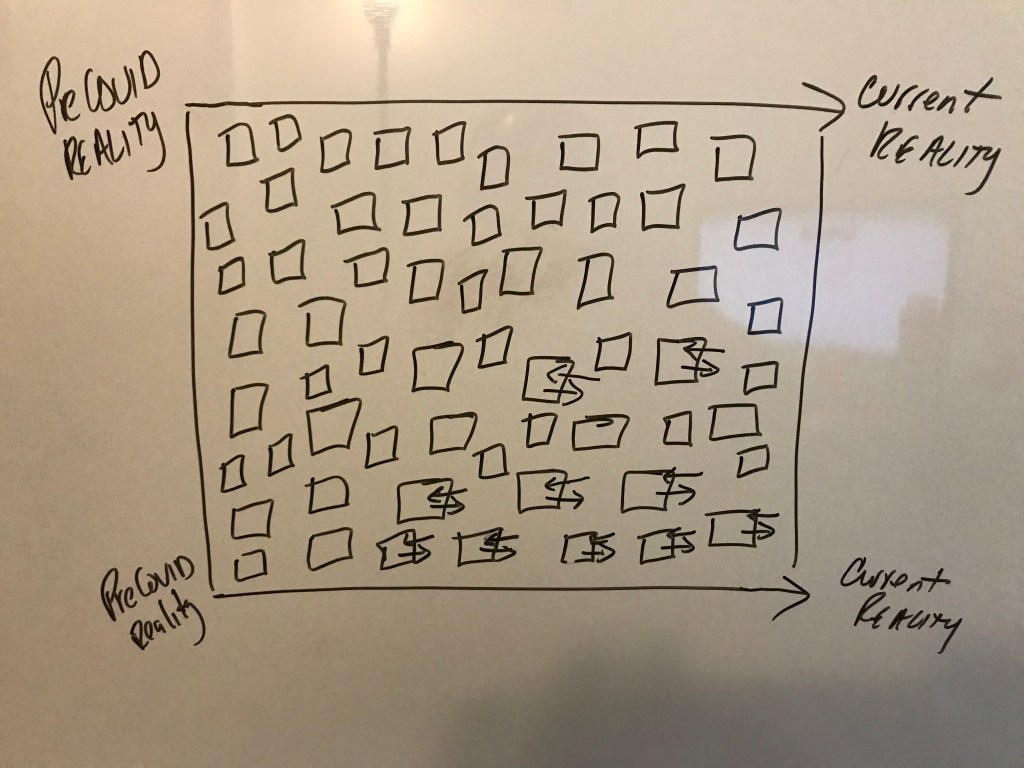
What we are facing right now is a huge gap between that which we once knew to be our reality, and the current COVID-19 reality. A large gap. Inside of this gap, we are all being asked to face ourselves and each other in new ways, with new tools, in entirely new contexts. Hard.

This image has an empty alt attribute; its file name is img-2993.jpg
August 1, 2020

For those that are less resilient, even harder. Resiliency, like all developmental traits, lives upon a continuum. It is not that someone has resilience or does not. Everyone has some, some have more. Alright, next.

Second

When you connect the four points of the above whiteboard, you can see the space that we are being asked to navigate and step into. A distinction. Stepping into reality is different from hiding, and running from reality.

It means taking the action you know is there to take, even, maybe especially, when it is hard.

This image has an empty alt attribute; its file name is img-2994.jpg
August 1, 2020

Now, you can see the above box, yes? Alright, then within that, let’s call it the COVID-19 developmental box, there are lots of other little boxes, which represent each of us and our comfort zones.

Yep. Meaning that as we interact with, and bump into each other, we are continuously floating in the COVID-19 developmental box. Then how, you may ask, do we develop our resiliency?

Third

We step outside of our box and into the reality that is in front of us. What is stepping outside of your box? It is doing. Again, and again.

Learning, practicing, falling down, failing – AND, getting back up again. Every time.

Know that we don’t have to continuously live outside of our box, or comfort zone. We can, what a friend of mine calls it, blip out, and blip back. Here you go.

This image has an empty alt attribute; its file name is img-2995.jpg
August 1, 2020

And, guess what? Everytime we go outside of our box, represented above by arrows, and do something that we consider uncomfortable, we grow. Yep, our box or container gets bigger. Here is one more illustration.

This image has an empty alt attribute; its file name is img-2996.jpg
August 1, 2020

As you can see from the above illustration, some people will grow, boxes labeled with a G are now larger, some will not. It’s not a demerit, or a problem if there is no growth. It is, however, a missed opportunity to learn more about yourself and being human. Alright, last section.

Fourth

Also know, especially when you are feeling overwhelmed, that all there is to know and to be experienced in this world, is much larger than this present moment. The COVID-19 moment. Last illustration.

This image has an empty alt attribute; its file name is img-2998.jpg
August 1, 2020

Let us say that the entire whiteboard is what is knowable. Got it. Okay. Then consider that the super small box you see is what we’ve been calling the COVID-19 developmental box or gap. Yep. Pretty small in the proper scale.

Remember this distinction when you are confronted with uncomfortableness; and, remember it when you are feeling overwhelmed.

Though today COVID-19 feels like everything there ever was to know, on a universal and historical scale, there is far more to know and experience. Seriously remember that.

There are countless opportunities to develop your resilience today. More opportunities than most people would care to have. Really. And, believe me when I tell you that there are days when I feel the same way. Really. It’s hard.

Yet, like all of life, it is a paradox. Because the opportunity to develop and to learn how to manage our resilience is also a wondrous process. Yep. Hard and wonderful. A paradox.

Develop well.

Photo by Gia Oris on Unsplash

#beinguncomfortable, #covid-19anddevelopment, #covid-19andresilience, #covid-19growth, #developingresilience, #developmentandgrowth, #humandevelopment-2, #learningcomfortinuncomfotableness, #managingresilience, #resilience, #selfdevelopment

Developing and Managing Your Resilience During COVID-19

This image has an empty alt attribute; its file name is gia-oris-5dt-joxsl78-unsplash.jpg
Photo by Gia Oris on Unsplash

I’ve been reflecting a lot about developing and managing my own resilience this week; and, just how important both are right now. So important. What is resilience you ask? Good question. Here is the definition.

Resilience

(also resiliency)
Pronunciation /rəˈzilyəns/ /rəˈzɪljəns/
Translate resilience into Spanish

NOUN
1. The capacity to recover quickly from difficulties; toughness.‘the often remarkable resilience of so many British institutions’

2. The ability of a substance or object to spring back into shape; elasticity.‘nylon is excellent in wearability and resilience’

Oxford Languages

Essentially resilience is our ability to face adversity, walk through it, learn, and repeat. Again, and again.

I’ve also been thinking about a video I’m going to do soon on resilience for my Developing Servant Leaders site. The idea looks something like this.

First

What we are facing right now is a huge gap between that which we once knew to be our reality, and the current COVID-19 reality. A large gap. Inside of this gap, we are all being asked to face ourselves and each other in new ways, with new tools, in entirely new contexts. Hard.

This image has an empty alt attribute; its file name is img-2993.jpg
August 1, 2020

For those that are less resilient, even harder. Resiliency, like all developmental traits, lives upon a continuum. It is not that someone has resilience or does not. Everyone has some, some have more. Alright, next.

Second

When you connect the four points of the above whiteboard, you can see the space that we are being asked to navigate and step into. A distinction. Stepping into reality is different from hiding, and running from reality.

It means taking the action you know is there to take, even, maybe especially, when it is hard.

This image has an empty alt attribute; its file name is img-2994.jpg
August 1, 2020

Now, you can see the above box, yes? Alright, then within that, let’s call it the COVID-19 developmental box, there are lots of other little boxes, which represent each of us and our comfort zones.

Yep. Meaning that as we interact with, and bump into each other, we are continuously floating in the COVID-19 developmental box. Then how, you may ask, do we develop our resiliency?

Third

We step outside of our box and into the reality that is in front of us. What is stepping outside of your box? It is doing. Again, and again.

Learning, practicing, falling down, failing – AND, getting back up again. Every time.

Know that we don’t have to continuously live outside of our box, or comfort zone. We can, what a friend of mine calls it, blip out, and blip back. Here you go.

This image has an empty alt attribute; its file name is img-2995.jpg
August 1, 2020

And, guess what? Everytime we go outside of our box, represented above by arrows, and do something that we consider uncomfortable, we grow. Yep, our box or container gets bigger. Here is one more illustration.

This image has an empty alt attribute; its file name is img-2996.jpg
August 1, 2020

As you can see from the above illustration, some people will grow, boxes labeled with a G are now larger, some will not. It’s not a demerit, or a problem if there is no growth. It is, however, a missed opportunity to learn more about yourself and being human. Alright, last section.

Fourth

Also know, especially when you are feeling overwhelmed, that all there is to know and to be experienced in this world, is much larger than this present moment. The COVID-19 moment. Last illustration.

This image has an empty alt attribute; its file name is img-2998.jpg
August 1, 2020

Let us say that the entire whiteboard is what is knowable. Got it. Okay. Then consider that the super small box you see is what we’ve been calling the COVID-19 developmental box or gap. Yep. Pretty small in the proper scale.

Remember this distinction when you are confronted with uncomfortableness; and, remember it when you are feeling overwhelmed.

Though today COVID-19 feels like everything there ever was to know, on a universal and historical scale, there is far more to know and experience. Seriously remember that.

There are countless opportunities to develop your resilience today. More opportunities than most people would care to have. Really. And, believe me when I tell you that there are days when I feel the same way. Really. It’s hard.

Yet, like all of life, it is a paradox. Because the opportunity to develop and to learn how to manage our resilience is also a wondrous process. Yep. Hard and wonderful. A paradox.

Develop well.

#comfortzone, #comfortzones, #covid-19, #covid-19growht, #covid-19growth, #development, #developmentandgrowth, #develping-resilience, #growing, #growth, #humandevelopment, #learning, #managingresilience, #perspective, #resielnce, #selfdevelopment, #uncomfortable

Create A Vision For Your Future Self in 5 Minutes

Photo by tanialee gonzalez on Unsplash

Alright, I’ve written about creating a vision for yourself in several posts, yet, to date, have not walked through the process of doing so. What’s interesting is that people usually associate creating a vision with business, which makes sense, yet it makes as much sense, as we will discuss, to create a vision for yourself – for your life. Ready? Let’s go.

What’s first?

First, you want to get out all of your ideas about what your future self will look like, think like, and feel like. Here are some questions to get your thinking started.

  • What are your goals?
  • Where do you see yourself in 5 years?
  • Where do you see yourself in 3 years?
  • Where do you see yourself in 1 year?

That’s enough to get us started. Let’s take them one at a time, and use practical examples. Here we go.

Identify your 5-year goals

Make a list of all of your goals. Yep, all of them. Why? Because at this stage, you are concentrating on getting out all of the goals that you want to accomplish. Make a list. Here are some of mine.

  • Publish a book
  • Travel to Spain
  • Learn Spanish
  • Travel to Japan
  • Knee recovery so I can run again
  • Expand our remote community education classes
  • Take a trip out of the country with my best friend

Alright, there are some we can work with. Once you have your goals identified, pick one to start working on. Where you start in the future will depend on the goal. I suggest going out as far as you can. Why?

Because you will find that once you start thinking about 5 years from now, let’s say, more goals will come to mind.

Now that you have your 5-year goals identified, time to start working those goals backward. Meaning that you need to create 3-year goals that connect to the 5-year goals.

Photo by Alex Nemo Hanse on Unsplash

Year 3

Let’s use my 5-year goal to publish a book and work that backward. In order to actually publish a book 5 years from now, I would like to have 75% of it written by year 3? Why? That will give me plenty of time to edit, market, and engage people about the book.

Now, publishing a book is not something I’ve ever done, and that is okay. The realisticness of your goals in year 3 matter less, than that you have an idea or picture of what that future state will look like.

Having that picture in mind is important to the next step, which is creating the next year inside of the 3-year goal.

Photo by Isaac Smith on Unsplash

The next year

When you start working on your goal for the next year, you are now in the realm of actually putting your theoretical goal into practice. I’m sure you’ve heard people say theory should feed practice, well, it is as true that practice should feed theory. They are inextricably linked. Always.

Now you can choose how to create your next year inside of the goal you are working on. There are many ways to put yourself to work inside of your goal. First you need to decide what your goal will look like at the end of the next year. Let’s keep using my goal of publishing a book.

What will the book look like at the end of the next year?

I would like to have 150 double-spaced pages written. Alright.

Now, to complete 150 pages by the end of next year, I will have to schedule time to get those pages written. How? First, create quarterly goals. With this particular example, I will break 150 pages into 4 parts.

My quarterly goal then is 38 pages. Now take that to monthly, which is 13 pages. Yep, now to the week. 3 pages a week. Alright, I now have a weekly goal.

And, it is a weekly goal that is connected to a quarterly goal, which is connected to a yearly goal. And, that yearly goal is connected to a 3 year goal, which is connected to the 5 year goal. Phew. Pretty cool.

Here is the system. And, you can put any goal into it, and work it backward the same way.

  1. Identify all of your goals.
  2. Pick one to work on.
  3. Set that goal out into the future and visualize what it will look like.
  4. Work backward to year 3.
  5. Set that 3 year goal.
  6. Work backward to the next year.
  7. Set that yearly goal.
  8. Work backward to each quarter.
  9. Set that quarterly goal.
  10. Work backward to each month.
  11. Set that monthly goal.
  12. Work that backward to weekly.
  13. Set that weekly goal.

You can even take it to daily goal-setting, however, in this example it is not necessary. Now, if my goal was to get that book finished in the next year, taking the goal-setting to daily would actually be very helpful.

As you create these goals and work on them, know that you are actively creating the vision of your future self. Yep. And, as you put them into practice in your life, you are actively working on and creating your future self every day. Pretty cool, and fun.

How to organize them to ensure you move them forward?

Here are some tools you can use.

  • Calendars
  • Post-it boards
  • Whiteboards
  • Day planners.

How you organize yourself matters less than creating the actions and actually holding yourself accountable to doing them every day. Use whatever organization system that works for you.

And, if what you are using now doesn’t work, change it. There are tons and tons of tools for organization. So many.

Okay, that’s creating a vision of your future self in 5 minutes. Another thing I like to do with my goals is to create a mind map. As I’ve mentioned in many other posts, I am very visual, so I love to see my goals inside of a mind map.

In case you’ve not created a mind map, here is a quick video I created that describes the process.

Alright, you now have a system to create your future self. And, when you get into it, I think you’ll find that it is quite fun. And, guess what?

When you take those daily or weekly actions to create your future self, you will find that your longer term goals are being accomplished bit-by-bit each day. Happy creating.

#creatinglongtermgoals, #creatingshorttermgoals, #creatingyourfuture, #dailyactions, #goal-setting, #goals, #growth, #mindmaps, #practice, #selfdevelopment, #theory, #theoryandpractice, #vision

The Blog + Video Series #3: Finding Comfort in Being Uncomfortable: Part 1

July 12, 2020

There are countless quotes, books, and movies about “living outside of your comfort zone.” What this actually means, however, is open to great interpretation, and, I think, changes for people over time.

How you view the idea of living outside of your comfort zone is a product of how you were raised, how you think, the context you live and work in, and those that you surround yourselves with.

Further, the idea and actually experience of a comfort zone, and the corresponding uncomfortableness that comes with being outside of it is different for everyone.

As there are over 7.5 billion people on the planet, we can actually say that there are over 7.5 billion different comfort zones.

Growth is the byproduct or result of living outside of your comfort zone. In fact, the only real growth there is is found outside of your comfort zone. There is never any growth inside of a comfort zone.

Photo by Kyle Glenn on Unsplash

This may seem like common sense, and it is, however, most people have a hard time realizing this truth. Why? Simple. If feels really good inside of our comfort zones.

Who would want to intentionally create situations or contexts that challenged this comfortability? Really, not many. Most people are perfectly content inside their comfort zones.

Yet, if these people were to examine themselves on the inside, they would find that this contentment is covering up other issues.

Sometimes being outside of your comfort zone happens unintentionally, which can happen when we are faced with a very stressful situation or life event that we didn’t see coming. If we are open to it, there is also growth in these experiences.

Photo by Hello I’m Nik 🎞 on Unsplash

Learning how to find comfort in being uncomfortable is manifested by doing things that we find uncomfortable often. When we are open to getting outside of our comfort zones often, there is a comfort that comes as a byproduct of the continual practice of being uncomfortable.

As with most everything else, it takes practice to realize this kind of comfort in the uncomfortable. By practice, I simply mean creating intentional contexts that we find uncomfortable, and engaging in these contexts until they no longer feel as uncomfortable.

Ultimately, until they feel comfortable.

If you are reading this and thinking, nope, not me, I like my comfort zone and have no need to create intentional contexts of uncomfortability. Very well, that is your choice.

If, however, you are thinking, maybe, or yes, sign me up. Then go out and do one thing today that you’ve been avoiding or putting off because it makes you feel uncomfortable, and see what happens.

If it’s anything like the many experiences I’ve had, yes, you can count on being uncomfortable.

Yet, you can also count on that experience providing you a whole lot more, which is only possible by doing things that you find uncomfortable.

Until next time….

#comfortzones, #creatinggrowth, #development, #growth, #growthanddevelopment, #individualdevelopment, #personaldevelopment, #selfdevelopment