Poetry and Prose by #1 Amazon Bestselling Author of Nature Speaks of Love and Sorrow, Co-Author of #1 Amazon Bestseller, Wounds I Healed: The Poetry of Strong Women, and Jan/Feb 2022 Spillwords Press Author of the Month
In the first installment of the Social Construction Series, we discussed why understanding social constructionism is important to our daily lives. How we interpret our world, think and feel about it; choices we make, and practices we keep, or let go of. Important.
In the second installment, we discussed the importance of understanding that all knowledge is socially constructed. All of it. And, how the production, distribution, and access, or lack thereof, to knowledge affects our lives. Also important.
In the third installment, we discussed the importance of understanding that our identities, every part of them, are also socially constructed. Giving us power and the freedom to create our identity as we want it to be, not as someone has said it should be.
In this fourth installment, we will discuss the social construction of reality; and, why considering a different way to think about reality as important to our lives, to your life. Important to the human being you are today, and the human being you want to be tomorrow. Ready? Let’s go.
Well, what exactly is reality? How does it function, and why do we understand our world as the reality it is? Hm. Let’s define reality, shall we. Here we go.
Reality is a true, or factual account of a situation inherent with problems that exist in contrast to what you’d like your reality to be. Hm. Not sure about these definitions. How about you? Let’s look at a different way to think about reality.
Here you go.
“Human existence is, ab initio, an ongoing externalization. As man externalizes himself, he constructs the world into which he externalizes himself. In the process of externalization, he projects his own meanings into reality. Symbolic universes, which proclaim that all reality is humanly meaningful and call upon the entire cosmos to signify the validity of human existence, constitute the farthest reaches of this projection.80 b.” ― Peter L. Berger,
Alright, so what do you read here? Okay. Well, let me tell you what I read.
That reality, all reality, is a projection of what it is that we think it is. That’s about it.
Reality is about a created truth, our factual account, of a situation inherent with problems, and possibilities, that is seen to exist.
And, who prey, creates it and sees it? Well, you do, I do.
Our realities, however, are different. Your reality is not the same as mine, which is why having general statements, as in the aforementioned definitions from Oxford, are problematic. They’re not inclusive enough, and leave people wanting, and, in some cases, confused.
Right, well, what then?
Let’s take a look at 5 reasons why understanding the social construction of reality as a fluid representation of a world, nay many worlds (over 7 billion in fact), is important to your life. Ready? Here we go.
If we begin to consider reality as fluid, always shifting and moving, we release ourselves from the false notion that reality is in some way a static, or solid, representation of that which we see. Make sense?
Reality is influenced by several key factors. Here are a few.
Our current state of mind
Our emotional state
Our past
Our present situation
Our future
Complex, yet simple. Another fun paradox.
Let’s look at each of these in more detail.
1. Our current state of mind
What we believe, we see. Yep. True. If we believe the world is full of bad people with hidden agendas, guess what we’ll see? Yep. A world full of bad people with hidden agendas.
Conversely, if we believe the world is full of good people with noble intentions, yes, that is what we will see.
Now, the world is not binary.
The world is full of both, that which we will find good and that which we will find bad. The point is that, what we expect to see, is what we will see; and, that then becomes our reality.
2. Our emotional state
Our emotions, like our mind, are powerful. How we feel, especially if we are sensitive to our emotions, like I am, influences how we see the world.
If we feel hopeful, we will see hope. If we feel despair, yep, we will see despair. It works that way. Again, complex, and yet quite simple.
Of course, we know that we have many emotions within us, and they come and go like waves in the ocean. Here, then gone, here again, then gone again.
The point is when we are unaware of our emotional state, we are not aware of how our emotions are influencing our perception of reality.
When we focus on our past, especially when that past is full of things we label as a problem, we can literally bring those problems into our present reality. Really.
If we are focusing more on what happened yesterday, than the present context, we are creating a disruption in the reality right in front of us, and, in effect, replacing that reality with an alternative version from a past time.
However, when we are aware that our minds work this way, we can catch ourselves living in the past, and shift our attention back to the present moment, and let go of the past.
4. Our present situation
If we are not at peace with our present reality, we will continue to see issues and problems. In effect, creating even more issues and problems as possible.
When we fight against the reality we see, we make our current reality into a larger problem, and, at the same time, increase our own pain and suffering.
However, if we recognize this pattern, or habit, we can disrupt the habit and replace it with understanding and grace. We can change our reality into something that is more congruent with what we want to see. Finding more peace and harmony in the process.
5. Our future
When we are scared of the future, or feel like the future will only ever be a reproduction of the past, limited and painful, that is what our future will be. Simple. That which we put our attention on expands, and becomes our reality.
Yet, when we let go of our past, and remain open to our future being all that we want it to be, we can begin to shift our attention and create a reality that is quite different.
We can begin to create the future reality that we want to manifest. One that is full of possibility.
Reality is fluid and dynamic, not stable and static. And, we have the power within us to create the reality we want to live into. We do.
There are over 7 billion worlds (realities) on this planet. One reality for each of us. Yep. The paradox?
Sure, here you go.
Though there are over 7 billion worlds on this one planet, there are certain things we agree on. Yep. Example? Sure, we all mostly agree that a tree is a tree, right? The sun is the sun, the stars are stars.
Yet, know that a tree, the sun, and the stars were not always called such. They weren’t. There was a time when they were called something else, and a time when they were called nothing at all. They just existed. That’s it.
Know that the reality you want to live into is available to you. Has been, is, and will always be available.
Reality is socially constructed by each of us every minute of every day. Next time you find yourself frustrated about your current reality, ask yourself why that’s so.
Here are a couple questions you can ask yourself.
In my current state of mind, am I expecting to see frustration?
Is my emotional state having an impact on how I am seeing my reality?
Am I thinking about my past experiences, and bringing them into my present reality?
Am I not at peace with my present situation?
Am I thinking that the future will only ever be a reproduction of my past?
When you ask yourself these questions, see what you get back. And, shift your attention away from these thoughts and emotions, and to the present reality. And?
Begin to create the future you’ve been waiting for. Make that future your reality now, today. You are the only one that can do so.
Now I’m working on a third; the social construction of reality. Yep. And, why is understanding the social construction of reality important? Hm. Power.
As we discussed in 4 Reasons Why Language Is Power, how we describe our reality in language, whether we are describing something internal or external to ourselves, is powerful. It is in essence the reality that we know.
Writing the piece on the social construction of reality is really fun; and, I hope you will all enjoy it.
Right, so integrity. What’s the deal with integrity? Important, yes? I’ve actually read a couple of posts in the past couple of weeks that have mentioned integrity, and I am excited to add my lens to the mix this week.
I think about integrity a little differently, which simply means I conceptualize, internalize, and practice integrity in a way that pushes on the traditional notions of integrity.
It is important to investigate definitions, to push on them when needed, and to conceptualize them differently when they don’t work as intended.
The definition of reality and truth, as we will discuss in the social construction of reality is a good example of this notion, as is the post I am writing on integrity. Will be fun.
Maintaining a growth mindset, which I will also write more about in the next couple of weeks, by remaining curious means that we get to take in all of the wonder that surrounds us.
That’s important right now. Maybe more important than ever before.
Remaining curious means taking time for yourself. Taking time to be quiet, to walk by yourself, for yourself, to reflect, to question, to contemplate, and to discover.
When we take time for ourselves, we get back so much more. It is a paradox. Often people think that being continuously busy is the way to get back more, or to progress more, or to move themselves forward more.
And, being active, actively creating the life you want to manifest for yourself is important, yet, not at the expense of your own internal contemplation, reflection, and discovery time.
Example? Sure.
Yesterday, I came home from a very busy day, and immediately took a nap. Yep, been doing that more often. Feels good. Refreshing.
I then got up, had a little something to eat, and started working again. And, guess what? I became frustrated? Why?
Because I had essentially gone from work, to sleep, and back to work. What did I do?
I stopped, turned out the light, and meditated for 30-minutes. And?
Inside of that meditation I had a couple of really nice insights, which then fueled the rest of my evening. Meaning that I switched from work, to writing, and developed this week’s ideas for my blog.
My invitation to you on this wonderful Tuesday evening is to remember to take time for yourself. Unplug, go for a walk, meditate, just sit. Do whatever it is that you do to refresh your inner-self.
It is in this space where curiosity and everything else in life for that matter lives; and, where you will find the answers to the questions you are asking yourself right now.
Have you ever heard of the Highly Sensitive Person (HSP)? Hm. Either way, know that although I’ve been a highly sensitive person my whole life, I had never heard this phrase until about 2 years ago. Here’s what happened.
About 2 years ago I was at a team building event, and we had one of our instructors come and talk about the highly sensitive person.
It only took about 10 minutes for me to get it. Yep. Then?
As I reflected upon the information I received at the teambuilding, and the new information from the book, so many things occured to me about my childhood, youthood, and adulthood.
I could clearly see my high sensitivity, what was then labeled as shyness or actually derogatorily called being sensitive.
I internalized my shyness and sensitivity as a problem for many, many years.
What I could have never known as a child, youth, or even as an adult previous to a couple of years ago, is that being a highly sensitive person is also a paradox, and a gift. Yep. How, you ask?
Sure. One, question first.
What do you think of when you imagine someone that is highly sensitive; or what association do you make? It’s okay. It’s not a judgement.
Did you see someone in a position of weakness, or in need of help? It’s okay if you did, today it’s normal.
What I am showing you is that in language being sensitive is associated with weakness; and, that that same language is what is used to experientially socialize children to think of high sensitivity as a weakness.
Now, though I am pleasantly surprised that the definition leads with receptivity and capability, it soon enough gets to easily hurt or damaged. Unfortunate, and just plainly not ture.
What is true is that being a person with high sensitivity, like most things in life, is a paradox. How, you ask? Right, well, let’s take a look shall we.
First, let’s explore high sensitivity. Now, know that my experience with the topic of high sensitivity is in being a person with high sensitivity. Meaning, that I’ve not read much about the topic.
Having high senstiivty pretty much means as it sounds. That, in some aspects, people with high sensitivity are more sensitive to external and internal stimulation.
Here are a couple of examples.
People might be highly sensitive to light, sound, touch, taste, smell, and emotions, both their own, and other peoples. There are many ways these sensitivities manifest, which you can check out on the Highly Sensitive Person website.
More often than not, people that have high sensitivity do not know it. Some don’t ever end up knowing it, and some, like myself, do. Approximately 15 to 20% of the population has high sensitivity.
The issue with not knowing, is that people with high sensitivity may end up internalizing their sensitivity as a problem, which is unhealthy and can be destructive.
Many people with high sensitivity end up using unhealthy coping mechanisms, like substance abuse, to bury their sensitivity and inability to understand and cope in more healthy ways.
I label high sensitivity as a paradox to push the limits of language and experience, of what is known. Important. Example? Of course.
I know several people with high sensitivity; and, all of them are clear and strong.
Yep, they are sensitive, and sensitive in different ways, yet that sensitivity makes them clearer and stronger.
A paradox.
In language, as we discussed, sensitivity is associated with a weakness, or deficit, which is simply not the case.
When people that are highly sensitive know about their sensitivity, they can learn to cope with their higher sensitivity, and, in many cases, higher emotional input and output in more healthy ways.
Further, because emotions are felt more, both internal and external, it provides the highly sensitive person with a gift.
The gift of feeling more, knowing more, and loving more.
Another gift is being able to sense where people are at emotionally. Super helpful always, and even more so in leadership roles.
It gives you the opportunity to meet people exactly where they are, free of any judgement. You understand your emotions more, and so you understand other people’s emotions more too. It works like that.
Being a person with high sensitivity has been a journey from thinking for many, many years that I was broken to the realization that I am clear about my emotions and stronger for my sensitivities. Much Stronger.
If you think you might be a person living with high sensitivity, I recommend you take the sensitivity quiz on the Highly Sensitive Person website.
Regardless of whether you are a person living with high sensitivity or not, it is important to remember that our senses and emotions are part of being human. We all have them.
Yes, some people are more sensitive than others to their senses and emotions. However, we all need to take the time to understand our sensations and emotions; time to be with them, and greet them with compassion and grace.
Along the way, please also don’t forget to continue to extend yourself that same compassion and grace. You deserve it.
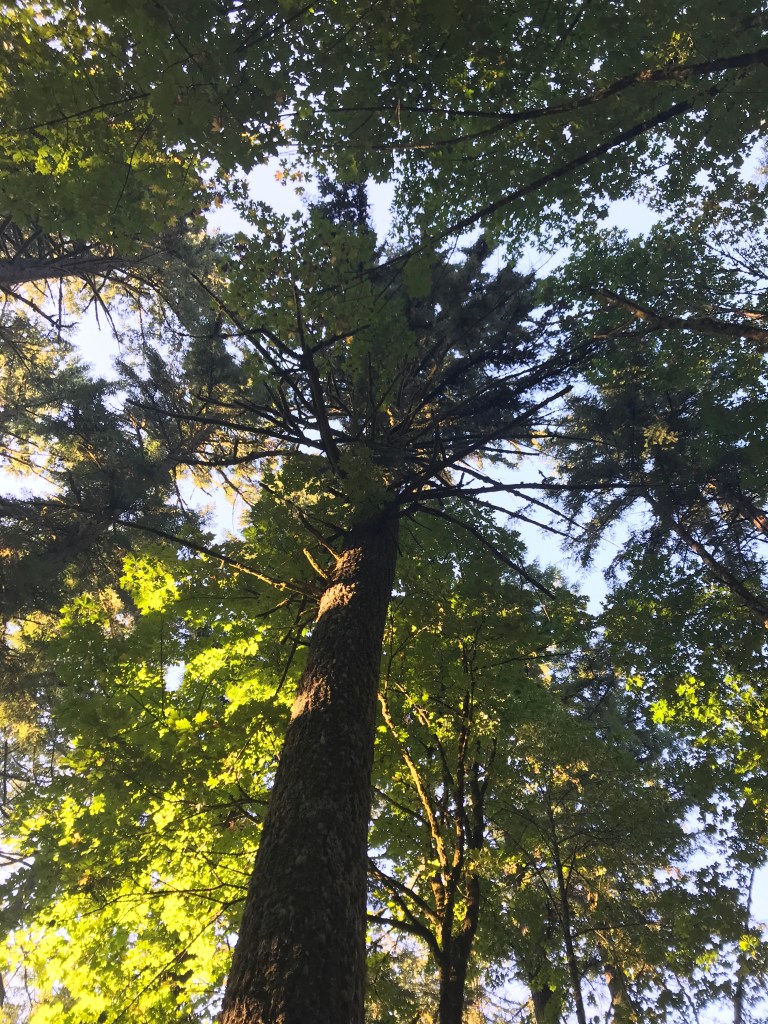
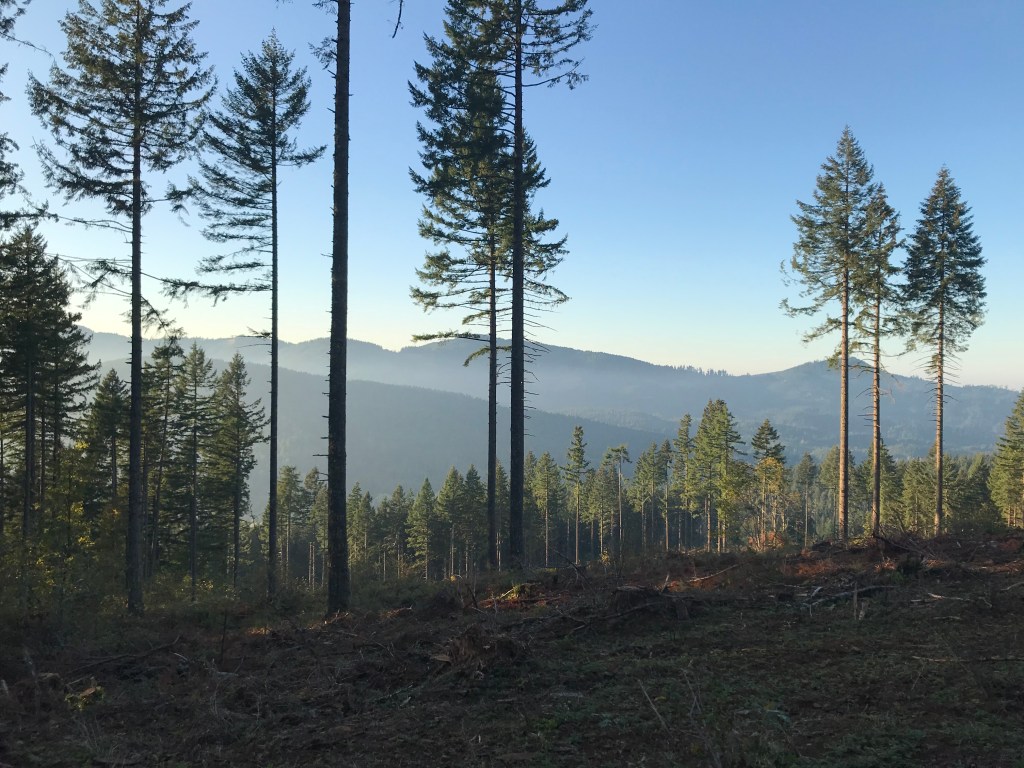
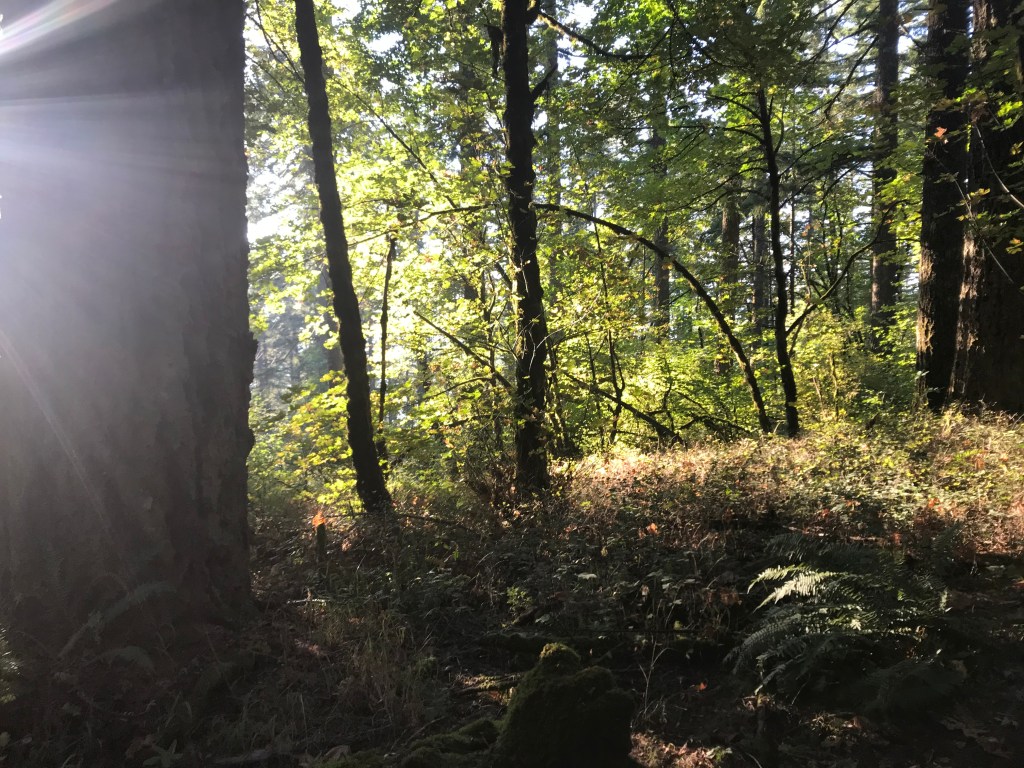
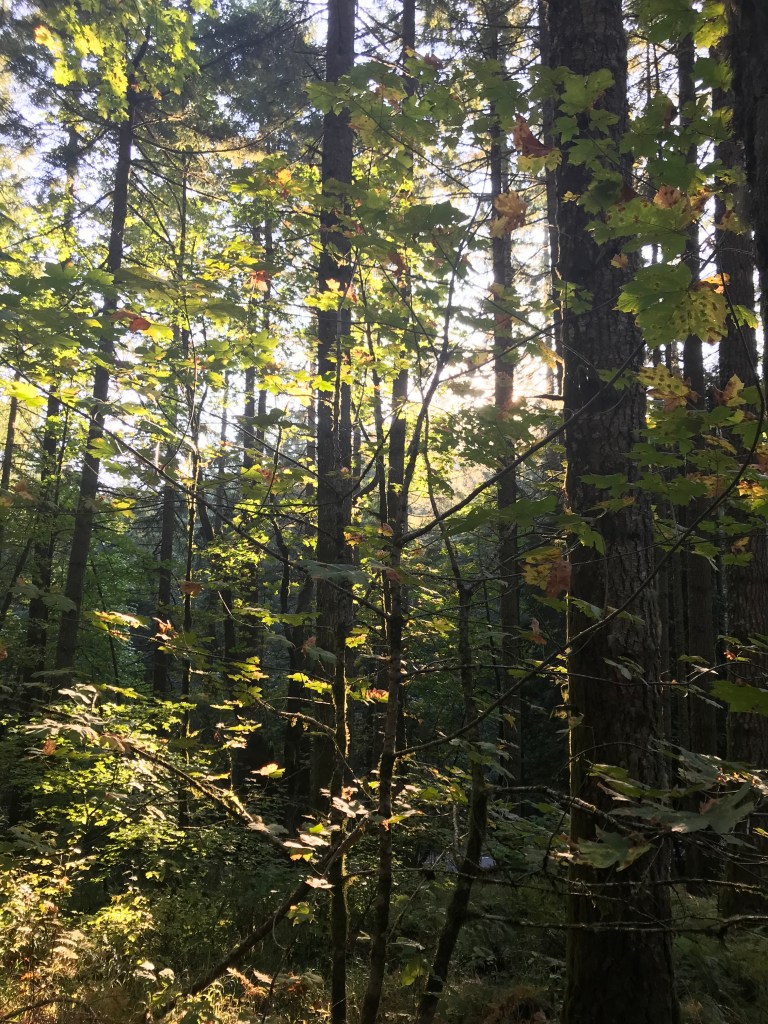
It’s almost the rainy season in the Pac Northwest, so getting out in the sunshine today was a must. Was gorgeous out today, as you will see in the pics below.
While I was hiking this poem occured to me. 🙂
Nature’s bounty Human failings
Separate though They seem
Inextricably connected They are one
A mirror
Of both bounty And failing
One in breath One in mind
Two inseparable Joined in A hindered hearted delight
As I was walking back to my office this past week, and I entered into the breezeway just around the corner from my office, I looked up just as I came under the overhanging second floor. Why?
To see if the second floor was aligned with the top of the building. Wait, what? Yes, I did. Why, you ask?
“Don’t let anyone rob you of your imagination, your creativity, or your curiosity. It’s your place in the world; it’s your life. Go on and do all you can with it, and make it the life you want to live.” Mae Jemison
There are so many good quotes about staying curious. Why? Well, let’s take a look at why; yet, as always, I’d like to first define curiosity. Here we go.
There. When we remain curious, we are actively acknowledging there is much more in the world to know about than is known. Yes, by us, and by everyone else for that matter.
I’ve written many times about the known and unknown, and, essentially, that it is the space between the two where people choose to grow or not.
We can choose to go back towards what is comfortable, known, and remain as we are today; or, we can choose to go towards what may be uncomfortable, unknown, and grow.
Those that are naturally curious, are intrigued by the smallest things in life. Things that other people might pass right by without even noticing.
In fact, I think people that are curious have a keen awareness of themselves, which means they also have a keen awareness of the world around them.
7 Reasons Why Remaining Curious Can Move You From a Fixed Mindset to a Growth Mindset
1. Recognition of the unknown
When we know that there is much more to learn about the world, and everyone in it, than we actually know, we are instantly curious.
Being curious is about being real with ourselves about all that we know, and all that we don’t.
Just writing that last paragraph makes me smile. Smile because I know everytime I leave my house, there is an opportunity to learn something from someone. Always curious. Fun.
2. Replacing what is known with new knowns
And, as we learn more about the world from other people, we get to replace some of our knowns with new knowns. How?
Well, humans often get stuck inside of limited thinking. Thinking that because they are an expert in a certain field, that their learning is complete. No so.
Every topic and subject is incomplete from a perspective of all there is to learn. Really. Every topic and subject.
When you are in a conversation with someone that proposes that their perspective is the final perspective on a topic, you can smile internally knowing that is not so, and remain curious about the topic.
I guarantee you there is more to learn and to know.
3. Remaining hopeful about the future
When we are curious, we are naturally hopeful about the future. We have to be. Why? Because being curious means believing in a future where growth and new possibilities flourish.
More, it means actively creating that future every day. One idea, goal, or dream and corresponding action at a time. Beautiful.
4. Recreating ourselves each day
Curiosity, like all things, starts within. When we do our internal work, inquiring into why we think and feel the way we do, we are actively interested in recreating ourselves often. Every day, in fact. Really.
In each moment lives the possibility of something new, a new possibility for that moment, and then, yes, the corresponding context, and the greater world. It starts with us, and goes out from there.
And, as we recreate ourselves, we also create a new sense of self. We let go of the person we were, and welcome the developmental iterations that will come as a byproduct of our own curiosity and interest in ourselves.
And, guess what?
When we treat ourselves with this kind of respect, that respect, along with the curiosity and interest, go out to others. It will infect them with a renewed sense of who they are as a human being.
Wonderful to watch and be a part of.
6. Reinventing the contexts we engage with
As we recreate ourselves each day, we also reinvent the contexts that we’re engaged with. Why?
Because, as we recreate ourselves, we are leading a transformational process that will affect everyone around us. It has to.
And, as we reinvent our contexts, we get to invite other people to participate in our curiosity. Our curiosity, yes, about ourselves, first, and then our curiosity with other people, the work they do, the possibilities we see as a product of the work we are doing in ourselves. Much fun.
7. Remembering our truth
When we remember our truth about the human being we are, and the future human being we are actively creating each day, we stay curious. Curiosity is a transformational practice.
When we remain curious, we get stuck less often. We feel more connected to ourselves and to everyone else around us.
We are, in effect, living our lives as a child would, full of wonder and hope. Knowing that dreams do come true, because we actively see them come true all the time.
When we live our truth, we see the world through a whole new lens; and, part of that lens is a lens of the curious being that we are all meant to be.
When we are actively curious, question all things, we are living in a growth mindset, which really just means that we are open to learning about all things from all people.
We are open, flexible, and eager to learn.
A growth mindset is about learning as much as we can, and then using that knowledge to create the life we want to live. Each and every day.
Curiously pondering everything around us, wondering, dreaming, and then taking all that we learn and applying it to our lives.
The post got me thinking more about curiosity, and how important being actively curious is to life in general, and then even more so, some would say, to innovation and leadership.
You may be asking, how did you get there from the post about writing and the distinction between theory and practice? Good question.
Because when you are actively curious, you are always looking. Looking for things to wonder about, to ask questions about, to, really, know more about.
Right now, I am working on a new post about curiosity, which starts with something like,
do you remember being a child and looking around and seeing everything, really, everything, in your context as a wonder?
Children have that sense of wonder about the world. Why? Well, in part, because they’ve not been socialized into thinking and/or acting in a particular way.
At that stage of development, everything is possible. All of it. And, you know what? It’s possible to live that way as an adult, every day. Really, it is. How do you ask? Well, we will discuss that more in the forthcoming post.
For now, I’d like to send you a few quotes about curiosity, as we head into this lovely weekend.
“I have no particular talent. I am merely inquisitive.” Albert Einstein
I’ve written before and said many times that it is in the spaces where vulnerability occurs that innovation will also occur. Well, when we are vulnerable, we are also naturally curious. I think we can safely say that
vulnerability + curiosity = innovation
That’s fun.
As you walk through your weekend, take a look around, wonder about the things you see, ask questions you normally wouldn’t, and see what you end up knowing more about.
As some of you know, I started practicing meditation about three years ago; taught to me by someone that spent 15 years in India. And it has been one of the most important developmental inquiries in my life. So, of course, when I read that title, I was like, wait, what?!
Of course I read it. And?
The writer completely missed the point of meditation. Further, the “expert” the writer draws examples from throughout the article is questionable, at best, as an authority on meditation.
Well, what followed then was an important distinction for writers that came as an insight of reading the article. The distinction? Yep, here we go.
I’ve written a couple times about the importance of making the distinction and understanding the difference between theory and practice. The distinction between the two is paramount in organizational development and education.
Yet, what I’ve been reflecting upon more this past week is just how important the distinction between theory and practice is for writers. Yep.
As I’ve been writing for years, I think I’ve always understood this distinction, yet it’s really only been the past three years that I’ve really known about it. Did you catch the distinction? Ah, if you did, excellent, if not, never fear.
Before we get into the discussion of theory and practice, let’s define our terms.
Very good. Now, what do you see? Yep, it’s pretty straight forward.
Theory is about idea generation. About trying to explain something to the best of one’s ability by rationalizing the knowledge one has about a subject through their intellect. Yep, that’s about it. Practice?
Different. Practice is about doing something. It is about understanding a subject through the practice of actually doing that subject; and, then explaining that subject through the practical knowledge now possessed.
Now, both are needed. Yep. We need both intellectual knowledge and practical knowledge. However, theoretical knowledge can never supersede practical knowledge. Why?
Because no matter how much we know about a subject, we can never really know about that subject until we engage in it. Example? Sure.
Let us say I want to create a new budget. One that will connect all of my daily spending to my bank accounts, which will then funnel back to a spreadsheet that I can track daily.
I can theorize about how a new budget system like this might work by reading about it, however, I will never really know if it will work for me until I try it. Simple, right? Yep.
Why, then, is this important to writers? Because when we write, and we are writing about something that we are theorizing about, we should own it.
We should let the reader know that the piece they are reading is a theoretical exploration, not a practical one. Why?
Alright, here are
3 Reasons Why Writers Should Know About the Distinction Between Theory and Practice
1. Transparent
Being transparent about the subject matter we write about is important. It’s important to our own development, as writers, yes, and as human beings; and, it’s also important to the reader.
When we write about a topic that we know intellectually, that’s fine, write about it that way. Letting the reader know that you are conducting a theoretical exploration is just fine, and needed.
Have you ever heard the phrase theory informs practice, and practice informs theory? It’s true.
When we theorize about how something might work, we will only ever really know if that theory will hold true by conducting an experiment, yes, or by simply doing it. Yep.
And, when we do something, like create the budget from the aforementioned example, we will learn things we did not, could not, theorize about; and, we can then recreate the theory in light of this new information. Finished? Nope, not quite. Why?
Because someone else might conduct the same experiment with the budget system, let’s say, and get a completely different outcome, or experience. Yep.
I once had an instructor that would say, show me any theory, and I can show you a mitigating variable for that theory. Meaning another idea that would change the outcome of the experiment, or experience.
Therefore, it is very important when writing to elaborate on the knowledge that we currently have, both intellectually and practically. It helps readers know where the limits of our knowledge is, and where they can pick up from, if they choose, and move that knowledge forward.
In owning the limitations of our own knowledge, whether it is intellectual or practical, we are being thoughtful. I love reading an article or a book about a topic where the author has been intentional in communicating the limits of their knowledge.
As a reader, this kind of commitment from a writer garners a whole different level of trust from me. And, I am more likely to read more of their work.
Being thoughtful about our own limitations is an important thing to do; though, it will probably feel awkward and scary. Human beings don’t usually like to own their own limitations.
Yet, I would argue that owning our limitations is not, in and of itself a limitation. Rather, owning our limitations is a starting point, a strength.
A place from where we can grow and develop. Learn more, both intellectually and practically.
And, in that growth, guess what? We learn more, which means we can do more, and be more. We can write more. More about what we know about. Both intellectually and practically. Fun.
Of course. When we stand in our truth, we get back way more. Though owning a limitation feels scary, it is the only way we can ever grow and develop. If you have no limitations, or rather, areas to grow yourself, then there is nothing to ever read, or really do.
Life inside of that world, where we know all there is to know, is finite. That world is the limited one.
However, when we are truthful about our own developmental opportunities, we immediately become unlimited. Why?
Because we have now taken a stand to learn more, to develop more, and to possibly transform the person we are today into a whole new iteration. A new self that stands in the reality, or truth, about themselves. That is powerful. A paradox?
Yes, and no. The whole world is full of paradoxes like this one.
We are fearful of the exact thing that, when embraced, is the key to relinquishing that exact fear. That is life as a human being on this planet.
Alright, so there are 3 Reasons Why Writers Should Know About the Distinction Between Theory and Practice. And, to be clear, this distinction is important for every human being. Really.
It is important in all aspects of our lives. When we are clear on the areas we want to develop and grow, we can engage with people in meaningful conversations and create contexts to move those aspects of ourselves forward.
We can learn more, become more, and then, yep, do more.
It has occured to me in writing this post that I can do a better job of letting readers know about the limits of my intellectual and practical knowledge.
Though the focus of my writing is, and will continue to be, on both my intellectual and practical knowledge, writing this post has brought a new awareness of this topic to the fore of my consciousness; and, for that I am grateful.
Every time I write an entry in this series, I usually write something like, phew, what a busy week. See, I did it again. Well, it is busy and also quite wonderful. 🙂
Alright, here’s what I’ve been up to the past two weeks.
Writing
This past week, I wrote a couple of articles. In case you missed them they were as follows:
Well, I am currently working on a couple of new pieces, which include an article on the mind, one on being a Highly Sensitive Person (HSP), and one on writing. Fun.
I am also considering writing something for a periodical publication. It’s been a while since I’ve submitted anything like this, and am wondering about the periodicals to send to. If you’ve got an insight for me here, I would greatly appreciate it.
Strategy
This week is my strategy week at work. Meaning that I don’t take meetings unless absolutely necessary, and I work on creating the next couple of years of work for the team I work on.
Of course, these are drafts we are talking about here, as the team I work on is highly collaborative, and will have tons of input for me on anything created this week.
It is a nice time to reflect upon where we’ve come as a team, remember where we are going, and begin to fill in all of the work needed to be completed for us to get there. It’s fun.
About two years ago I learned about High Sensitivity. At that time, I had never heard about it before, and was sort of stunned. Meaning that I could see myself in all that was being talked about, and yet, was in some ways resistant to the idea that I might be a Highly Sensitive Person (HSP).
Upon reflection, and a little reading, I came to the, not hard to make, determination that I was an HSP, and had always been.
Certain feelings I always had, and things I felt more in my environment than other people, made more sense to me than ever before. Was truly a transformative moment for me.
I am reflecting upon my HSP’ness now in preparation for the article I will be writing later this week.
If you’d like to learn more about being a Highly Sensitive Person, here are a couple of books I highly recommend.
If you are still interested, here is a cool questionnaire you can take to see how you rate on the sensitivity scale. I just took it again for fun, and rated a 19. Definitely highly sensitive. 🙂
Both of the books are wonderful, and I highly recommend them if you are interested in Leadership and or Eastern Spirituality. Funny, they are both very alike in that regard. Interesting how that works.
Not sure what the next book will be, yet, this past week I did create a new possibility. What, you ask? Of creating a local remote book club. Yep. There are two other people interested at this time. I’m hopeful to get 2 or 3 more people.
As I was pursuing the book club idea, sending out invitations, it got me thinking about a blogger book club. That might be kind of fun. What do you think?
What is your purpose? Do you know, or have you ever considered it; I mean, really considered it? Like, written it down, reflected upon it, and used it to interact with people you know, or meet?
Well, I’ve been thinking a lot the past few weeks about purpose. And, just today it dawned on me that authenticity is a very important concept to the development of your purpose. Really. How, you ask. Well, let’s define our terms, and then we’ll discuss it.
Alright, there we go. Now, we can see from these definitions that purpose is about setting an intention to achieve something; and, that authenticity is about being true to who we are.
Important. Why?
Because in order to set an intention to create your purpose, you must be true to who you really are; not the person you were, or the person people tell you you are. A very important distinction.
If you create a purpose that is imbued with ideas about your past-self or with ideas about the person you believe people want you to be, your purpose will not inspire you, nor will it inspire anyone else.
Okay. Let’s take a look at
10 Reasons Why Developing Your Purpose is Dependent on Being Authentic
1. Inspired
In order to be inspired, and to inspire others, you must believe in your purpose with both your head and heart. A must. When we develop a purpose that is connected to our authentic-self, the human being we know ourselves to be, we are instantly inspired.
2. Dedicated
Living a purpose-driven life is hard work. Really, it is. It takes dedication. And, when we create our purpose directly from our authentic-self, we have a deep well of dedication. A well, that, at times, seems like it will never empty. A beautiful feeling.
3. Passionate
When we are true to who we are, we are inspired, yes, and we also have deep passion for all that we do. Why? Because when we are authentic, the purpose we create will naturally connect to all aspects of our lives. Work, family, friends, everyone, and everything.
4. Persistent
When you are living your purpose, you will meet many challenges. It’s part of it. However, when our purpose is connected to our authentic-self, you will get up every time you fall down. Every time. You will persist under any and all circumstances. You must have created your purpose from your authentic-self to be present to this level of persistence.
5. Resilient
A natural byproduct of living a purpose-driven life is developing more resilience. You have to when you are constantly challenged in pursuit of your purpose. When your purpose is created from your authentic self, you will develop more resilience than you ever thought possible. Amazing.
When we are connected to our authentic-self and purpose, we are also interested in developing and growing. We are open with people about who we really are. And, when we are open and true to who we are, opportunities for growth sprout everywhere.
7. Vulnerable
When we are authentic and living a purpose-driven life, opportunities to be vulnerable arsie often. These opportunities are driven by you, and those you surround yourself with. When we are vulnerable, people we are close to feel safe and also venture into vulnerable spaces. Beautiful.
8. Loved
When you are true to who you are, love arises more often. Love for yourself and the human being you are, and love for those around you. When you are authentic and living your purpose, you feel more love, are more love, and give out more love. It just happens.
9. Complete
When you are authentic, and are creating and moving your purpose into the world, you feel more complete. You are more complete. Notions of hiding parts of yourself begin to disappear, and you give yourself and everyone around you that completeness. They can feel it, and know it, as you practice being the human being you are.
10. Driven
Authenticity and purpose align to create more drive. More drive to continue to create your purpose from the space of your authentic-self. And, when you are driven, the people you choose to surround yourself with are also driven. Driven to change the world one action at a time. A wonder.
It is amazing how being the authentic human being we know ourselves to be can transform so many aspects of our lives. It can, and does.
When we remove the barriers that have been handed to us and created by ourselves, we can begin to live the life we’ve been thinking of, hoping for, and dreaming about. How?
Dedicate time to yourself, for yourself. Reflect upon the work you are doing right now. Is it the work you’ve been thinking of, hoping for, and dreaming about? Yes, wonderful. And, if not?
Begin to let go of the person that you were socialized to believe you are. Really. Begin to let go of those concepts, restrictions, and limitations, and get in touch with your authentic-self.
Once you are in touch with your authentic-self, begin to create the life you’ve been thinking of, hoping for, and dreaming about. Create your new life by taking one step at a time toward getting in touch with your authentic-self.
As you take these steps toward your authentic-self, your purpose will show up. Why? Because, your purpose already lives inside of you. Inside of the authentic-self you know yourself to be.
























 Develop. Inspire. Transform.