Poetry and Prose by #1 Amazon Bestselling Author of Nature Speaks of Love and Sorrow, Co-Author of #1 Amazon Bestseller, Wounds I Healed: The Poetry of Strong Women, and Jan/Feb 2022 Spillwords Press Author of the Month
Alright, another week closer to this year’s end, and entering deeper into winter, which, for where I currently live, means more, well, a ton more rain to be accurate. Whereas, I didn’t grow up in a very rainy area, Los Angeles is, of course, known for sun most of the time, I am more comfortable with the rainy weather these days.
And, yes, writing did occur this week, and here is what that looked like.
One of my goals this week was to get, The Leadership Series Part 2.5: Why Developing the Self is Always the First Step in Leadership completed, and that did not happen. Next week. Yes, so what about next week? Let’s take a look.
In the poetry realm, I have a few ideas. I am thinking about two poems right now, one on flow, and one on force, which will be fun. And, then the aforementioned leadership article will be a focus next week, as will another entry in the social construction series. I’m not sure about the latter just yet. Meaning, the topic. Not sure.
I’ve also got a couple of ideas about creating vision, and managing the gap between your current reality and your future projected reality, or the real and ideal in leadership terms. Alright, how about reading. Sure, let’s go.
Well, I am still working on, or, rather, finishing, the book about and by Sri Ramana Maharshi, and I am now reading Killing Commendatore, which I started last week. And?
It is a very Haruki Murakami type book, which means? That, so far, it is awesome. Of course, it starts with a prologue, and the main character is painting a portrait of a client that has no face, or rather has a face of mist. And then?
Then Murakami begins to create the world you’ll be entering into, all of the typical trials and tribulations and the emotional breakdowns and breakthroughs that follow for the main character. I’ve only read about 60 pages, and Murakami has already covered a lot of ground.
I am looking forward to discussing what I’ve read thus far with the remote book club tonight. How about listening? A new entry topic this week. Ready? Good. Here we go.
Though podcasts have been around for well over 25 years, I didn’t start listening to podcasts until about 5 years ago. I know, I know, I am now playing catch up. Fun!
Here are a couple of podcasts, which you may not have heard of, and are very good.
Alright, so I have a soft spot for the television show the office. Fun. And, an Oral History of the Office does a great job recounting just how hard it was to get that show on the air in the United States. A very interesting and entertaining podcast.
Louder Than A Riot was one that I stumbled onto, as I listen to most of my music on Spotify, and I caught an ad about the new podcast. Wow. The podcast traces systematic and structural racism in this county in regard to hip-hop. A caution. The episodes are raw and explicit. The topics they cover are so important, and the two hosts, Rodney Carmichael and Sidney Madden, are stellar.
Resistance is one I just found this past week, and it traces systematic and structural racism in the United States through the lens of protesters all across the country. I’ve listened to most of the episodes already, and they are well done. Again, the host, Saidu Tejan Thomas Jr., does a fantastic job. This podcast is also raw and explicit.
Alright, that was fun. I recommend all three. How about stimulation? Yep, here we go.
It has occurred to me off and on over the past several weeks, and I’m sure I’ve written about it, that stimulation is something that I monitor. Important. Why?
Because when we are constantly stimulated with work, computer screens, phones, television, even conversation, we are depleting our vital energies. And? That’s oaky, we just need to be aware that replenishment is needed and necessary.
What can we do? Well, there are many things. All of which we have discussed in previous posts. My favorites? Yep, there are two that I consider paramount.
Meditation
Walking
So important. Both meditation and walking get me away from all stimulation, and, in a way, create a reset of sorts. Simply meaning, they restore my energy levels. Oh, and there is one more. Naps. I take several naps now each week. Super refreshing.
What we do to get our quiet and reenergizing time matters less than we get it. That I get it, and that you get it. So?
If you’re not getting enough replenishment time for yourself, make sure to create that time. It can start with simply leaving the computer station, or setting the phone down, and walking out the door for a walk. Really important.
Alright, that’s all for this week.
I hope you all have a wonderful holiday and a lovely remainder of 2020.
I’ve been thinking a lot about power this past week, and how power, like everything else we’ve covered in this series, is also a social construction. Important to understand. Why?
Because when we fully understand that power, and how it is distributed, is a social construction we create a space to discuss the possibility of changing how that power is distributed. It is inside of this possibility that we will discuss power as a social construction. Ready? Good let’s go.
Power is the ability or capacity to do something or act in a particular way, especially as a faculty or quality, such as influencing the behaviors of others or the course of events.
We could discuss power in a myriad of ways. In this article, however, we will cover five ways power is experienced. For it is in the experience of power that lies, pun intended, the power to change how power is socially constructed and distributed.
Using a Foucauldian lens for this analysis, we can say that power is granted through knowledge. The more knowledge you have, the more power you have. Why? Because the more you know, the more you understand, and the more you understand, especially about how systems and institutions work, the more you can deploy your power, or knowledge, to change the system.
Now, there are other concepts, which we will also discuss a little later that make the distribution and deployment of power unequal.
For now, let’s take a look at how Michel Foucault describes the connection between knowledge and power.
“On Foucault’s account, the relation of power and knowledge is far closer than in the familiar Baconian engineering model, for which “knowledge is power” means that knowledge is an instrument of power, although the two exist quite independently. Foucault’s point is rather that, at least for the study of human beings, the goals of power and the goals of knowledge cannot be separated: in knowing we control and in controlling we know.”
That’s a pretty powerful concept. Meaning, that the more we know, the more control we have over our experiential field, life. Why? Same reason as above. Because the more we understand how the system works, the more we can work the system to our advantage.
Now, the latter part of that quote, in controlling we know, is, for me, about internalization. Meaning that once we are aware of our knowledge base, and we seek out new knowledge, we understand that in order to create change, we must control and effect our actions to create such change.
We can also term this concept personal agency, which basically means understanding how much personal agency someone has, you have. As was alluded to earlier, the field of experience, available life choices, if you will, is not equally distributed.
Thus, power and knowledge are also not equally distributed, nor then are they internalized across racial, cultural, sexual, gendered, geographical, and socioeconomic statuses the same. They are not.
Kimberle Crenshaw, who developed Intersectionality Theory, might argue that, in fact, in order to understand people’s available life choices, you must do so within a framework that analyzes all dimensions of a person’s identity, especially as that identity is located and embedded in social structures and systems.
Here is a short quote about Intersectionality Theory.
“Intersectionality is a lens through which you can see where power comes and collides, where it interlocks and intersects. It’s not simply that there’s a race problem here, a gender problem here, and a class or LBGTQ problem there. Many times that framework erases what happens to people who are subject to all of these things.” -Kimberle Crenshaw
Now, we can connect the internalization of granted knowledge and power, and available life choices, to the need to analyze these system dynamics through an intersectional lens. Very important.
An intersectional lens would ensure that we look at how people are situated and located, or in a Founcalidian term, observed, within the social system, before making any claims about access to knowledge and power to begin with.
Here is another excerpt from Foucault’s work on observation.
“The examination also situates individuals in a “field of documentation”. The results of exams are recorded in documents that provide detailed information about the individuals examined and allow power systems to control them (e.g., absentee records for schools, patients’ charts in hospitals). On the basis of these records, those in control can formulate categories, averages, and norms that are in turn a basis for knowledge. The examination turns the individual into a “case”—in both senses of the term: a scientific example and an object of care. Caring is always also an opportunity for control.”
Now here we can see that being observed also matters in relation to the access to knowledge and power. Observation, or what I’ll term surveillance, ensures that knowledge and power, and ultimately control, stay in certain hands, and out of “others.”
The effect of distributing knowledge and power in this way creates even more inequality. Meaning that power is distributed in ways that embed power within social institutions, and those that work in those institutions convey their power in very prescriptive ways.
Foucault writes about the Panopticon to describe the distribution of power.
“Bentham’s Panopticon is, for Foucault, a paradigmatic architectural model of modern disciplinary power. It is a design for a prison, built so that each inmate is separated from and invisible to all the others (in separate “cells”) and each inmate is always visible to a monitor situated in a central tower. Monitors do not in fact always see each inmate; the point is that they could at any time. Since inmates never know whether they are being observed, they must behave as if they are always seen and observed. As a result, control is achieved more by the possibility of internal monitoring of those controlled than by actual supervision or heavy physical constraints.”
Now, whereas Foucault is focusing on prisons in this last excerpt, or what many contemporary activists call the prison industrial complex, the way that power is distributed in the prison has corollaries to all social institutions.
“The principle of the Panopticon can be applied not only to prisons but also to any system of disciplinary power (a factory, a hospital, a school). And, in fact, although Bentham himself was never able to build it, its principle has come to pervade aspects of modern society. It is the instrument through which modern discipline has been able to replace pre-modern sovereignty (kings, judges) as the fundamental power relation.”
And as this last excerpt alludes to, once power is codified into social institutions, it is the actors within those insitutision that take on the role and responsibility of the deployment of institutional power. And with that deployment discipline follows.
The deployment of power by actors working within social institutions, ranges from school teachers to priests, to police offers, and government officials.
The reason we have brought identity characteristics into this discussion, such as race, culture, sexuality, gender, geography, and socioeconomic status, is that the deployment of power, and the discipline that follows, is centered on the body.
“Foucault’s genealogy follows Nietzsche as well as existential phenomenology in that it aims to bring the body into the focus of history. Rather than histories of mentalities or ideas, genealogies are “histories of the body”. They examine the historical practices through which the body becomes an object of techniques and deployments of power. In Discipline and Punish, Foucault shows how disciplinary techniques produce “docile bodies”: bodies of prisoners, soldiers, workers and schoolchildren were subjected to disciplinary power in order to make them more useful and at the same time easier to control. The human body became a machine the functioning of which could be optimized, calculated, and improved. Its functions, movements and capabilities were broken down into narrow segments, analyzed in detail and recomposed in a maximally effective way.”
And, though in this excerpt these identity characteristics are not presented. We can now take a look at Simone Brown’s work to make this connection concrete.
“Importantly, Browne also accounts for methods of evading or repositioning surveillance, which she gathers under the phrase “dark sousveillance.” Dark surveillance refers to “the tactics employed to render one’s self out of sight, and strategies used in the flight to freedom from slavery as necessarily ones of undersight.… Dark sousveillance is a site of critique, as it speaks to black epistemologies of contending with antiblack surveillance” (p. 21). In addition to writing about the sociotechnical processes that catalog, control, and delimit black bodies, the cataloging of “dark sousveillance” offers an agenda for coping with and subverting structures of control.”
Here we can see clear connections to a Foucauldian analysis, yet the analysis is taken further by Brown by centering race as the means by which the deployment of institutional power is a central focus. Black bodies are surveilled and then disciplined (controlled), by the continuous objectification of their bodies as a commodity of power.
Now, from this analysis, we can see various ways that power is granted, internalized, distributed, deployed, and then used as a disciplinary tool.
Yet, power is socially constructed. Meaning, there is no natural law that requires power to be distributed and deployed as it is today. And, in fact, we can see people all across the United States today, protesting institutional and structural racism.
Both institutional and structural racism keep the distribution and deployment of power as is, status quo.
Yet, we as individuals, have the ability to create and effect change, and you can see that movement in the streets all across this country, as people call for, and demand, an end to police brutality against people of color.
Here is a statement from the Black Lives Matter website.
“Enough is enough. Our pain, our cries, and our need to be seen and heard resonate throughout this entire country. We demand acknowledgment and accountability for the devaluation and dehumanization of Black life at the hands of the police. We call for radical, sustainable solutions that affirm the prosperity of Black lives. George Floyd’s violent death was a breaking point — an all too familiar reminder that, for Black people, law enforcement doesn’t protect or save our lives. They often threaten and take them. Right now, Minneapolis and cities across our country are on fire, and our people are hurting — the violence against Black bodies felt in the ongoing mass disobedience, all while we grapple with a pandemic that is disproportionately affecting, infecting, and killing us. We call for an end to the systemic racism that allows this culture of corruption to go unchecked and our lives to be taken.We call for a national defunding of police. We demand investment in our communities and the resources to ensure Black people not only survive, but thrive. If you’re with us, add your name to the petition right now and help us spread the word.“
We must remember that though the entire world is socially constructed, moment by moment, these social constructions are very real in their consequences.
When we stand by and tacitly give our agreement to the ways in which power is distributed and deployed in this country, we are condoning the continued surveillance and brutalization of communities of color. Unacceptable.
As I’ve written about in many articles, it starts with each of us. How we think, feel, speak, and act. We each have available to us our own unique gifts, talents, knowledge, and thus power.
And, when we can use these tools to take action and increase awareness about the world, how it operates, both its strengths and weaknesses, we are at once working together to create a more equitable and just world.
And, for today, this is my action. What will yours be?
Jeff Flesch
9:00 am on December 18, 2020 Tags: correlativedata, data and information, displaying, intersectionswithinandbetweendata, learningstyles, linear, movement ( 4 ), nonlinear, visualizing, whiteboards
Several months ago, I wrote the article How We Learn, and Why it’s Important to Understand. Though I’ve always been interested in and engaged with learning styles, the pandemic has brought the need to consider new ways to continue to learn in a way that fits our particular learning styles even more present for me. And?
Well, I had an insight this week about visual learners, of which, I am one. And, thought about how important it is to ensure that no matter where we are called to work, or what data we are called to work on, that we can all access ideas and tools that can assist our efforts to continue to move ourselves forward.
Alright, so in this 3-minute reflection, I am including three ways that I create opportunities to feed the hyper-visual learner that I am. Ready? Good. Here we go.
Much of the data our team uses is linear. Simply meaning that there is an order to whatever data we are handling, or using, such as step 1, 2, and then, 3. Simple.
Yet, when we are only looking at a set of steps, such as steps 1 through 3, for instance, we may not see how step 3 may be correlated, or, rather, affect step 17. And, it is important that we consider these other possible correlations.
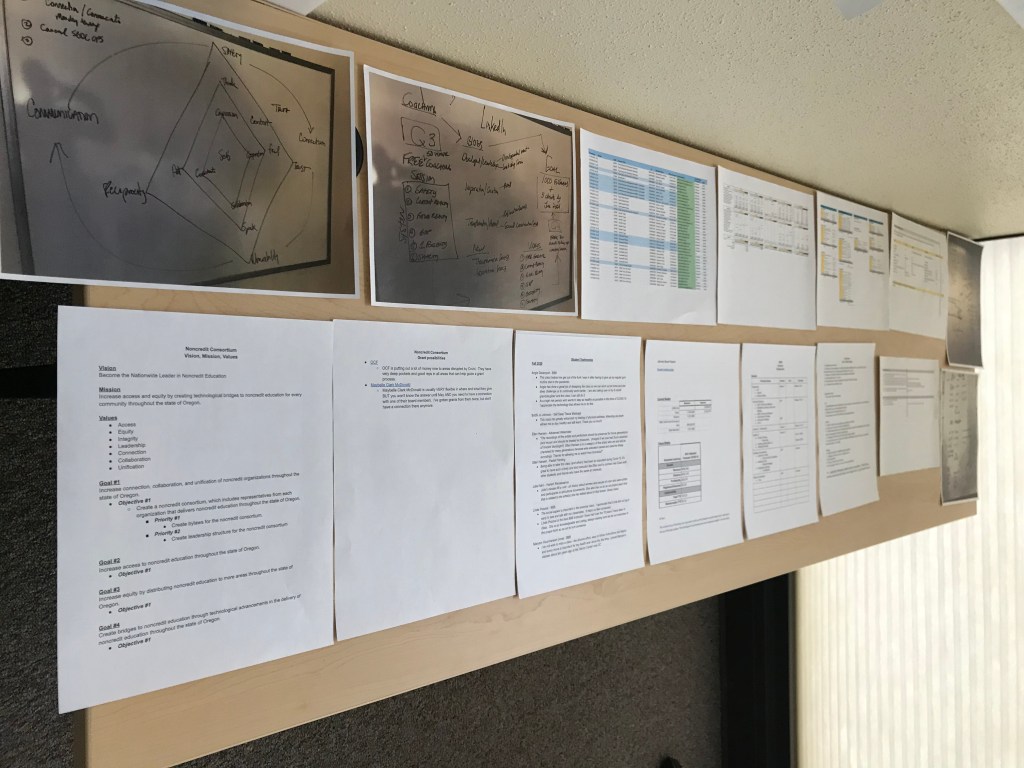
I find great utility in printing and displaying data on an open surface. It allows me to see the data from a different perspective, and gets me away from the computer, which though very helpful, can become limiting. Limiting how? Good question. Here is an example.
The team I work on has many projects going on at the same time, with different leads from different programs. And, just like other team members, I lead my share. Now, with my projects, I will print out an aspect of that project, it may be the latest iteration of some language or numbers I want to consider, and display each one with all of the other projects I’m working on. It looks like this.
December 17, 2012
The reason that the printing and displaying technique is so effective is that it also allows me to see across programs, to possible correlations between them. The intersections of which create more synergy and foster new outputs and outcomes for our team. Super fun.
2. Display the Data Differently
Another technique we like to use is to simply display data differently. An example? Sure.
I’ve written previously about the vision we’ve created on this team, and have also written about department-level and individual-level priorities; and, how important it is that individual priorities connect to the department priorities and the larger departmental vision. These connections ensure that everyone is moving in the same direction, and that we are pointed towards our vision.
However, if you simply look at a list of priorities with a vision say as a header to a linear document, there is utility, yet it is rather lackluster. Meaning, we can do better to ensure that people see all of the priorities; and, fully understand how their priorities and the actions that live inside of those priorities are connected to the department.
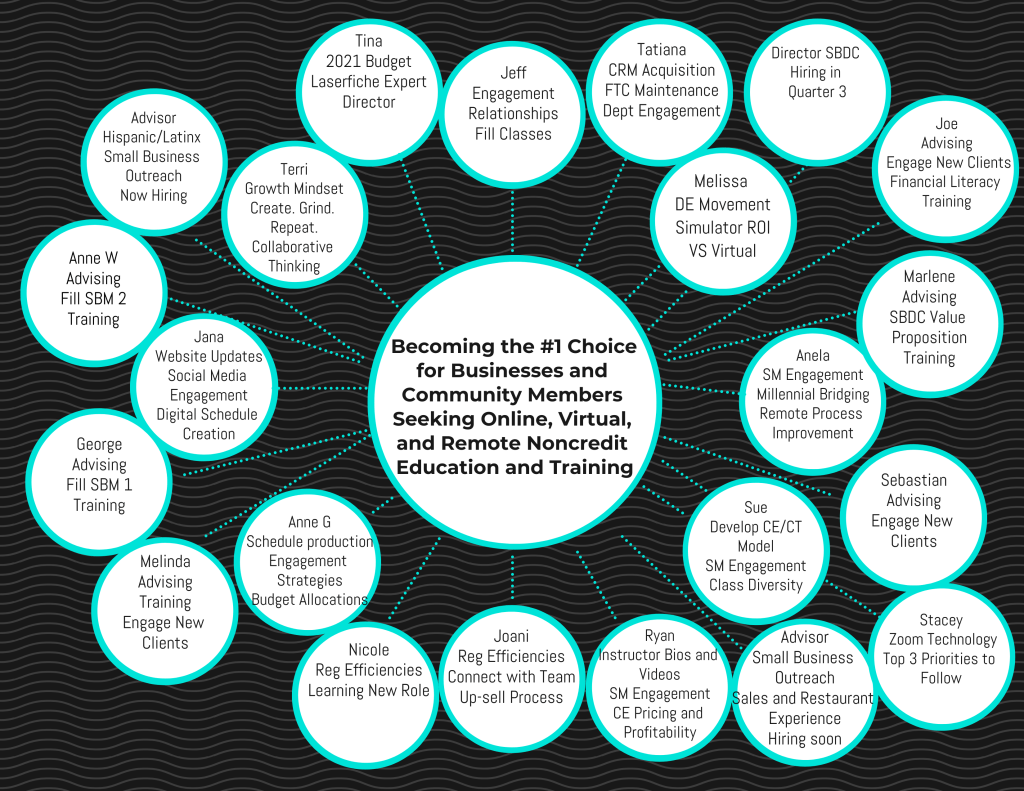
Here is a very simple visual example of what that looks like.
December 17, 2020
This mind map was created using Venngage, which is a fun tool for taking linear data and making that data visual. Helpful.
These types of visualizations also let people see how their work is connected to their teammates. Especially teammates in other programs they might not see as much. Also helpful.
3. Whiteboards
Of course we’re going to discuss whiteboards, one of my favorite ways to display linear and nonlinear data and information. And, yep, it can go both ways.
Meaning, that you can start with linear data and then create nonlinear ideas and connections, just as you can start with nonlinear data and create a linear system that works for the project you are working on.
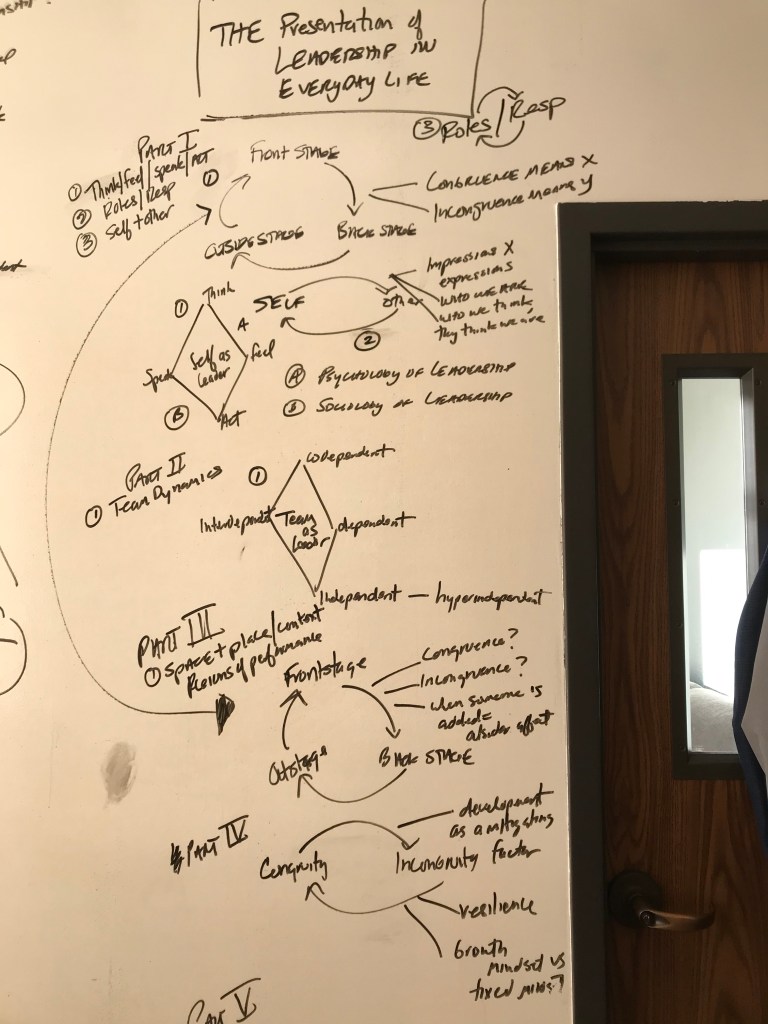
Here is an example of a linear and nonlinear whiteboard I did about some future writing I have in mind.
December 17, 2020
Here you can see the linear thinking in the sectioning off of information by parts, and then the nonlinear, which there is more of, in the variously, and in some ways haphazardly, written constructs and concepts. What am I doing? Good question.
I am getting ideas out of my mind and onto a medium that will allow me to continue to iterate these constructs and concepts for future use. As the work unfolds, there is always something I see differently and learn about, which would have been unavailable to me without working the whiteboard process as I do. Much fun.
How you manage to continue to feed your visual nature matters much less than you create the opportunity to visualize data and information in ways that continue to take your thinking, and that of your teams, further.
When we are mindful about how we learn, we can create all kinds of new possibilities that allow us to step outside of the limitations that are found in very helpful systems, like computer technology.
And, when we do so, we open up new ways to view, think, internalize, and reflect upon these data and information in ways that were previously unavailable to us, which can create more movement for ourselves and our teams.














 Develop. Inspire. Transform.