A Journey from Breakdown to Breakthrough

Photo by Rafael Pol on Unsplash

For most of my life I associated breakdowns with something to be avoided. An issue? Not necessarily. However, consider that breakdowns always lead to breakthroughs. And, without breakthroughs there is no movement. Movement, you ask?

I mean you cannot move your life into new realms of understanding and experience when you avoid breakdowns. Not possible. However, when you are open to an understanding that includes breakdowns and the associated breakthroughs as part of the human experience, you can move your life into new realms. Really.

Before we go further, let’s take a look at the definition of breakdown.

breakdown

Translate breakdown into Spanish

NOUN

  1. A mechanical failure.‘breakdowns could totally disrupt production’
  2. A failure of a relationship or system.‘a breakdown in military discipline’
    1. 2. A sudden collapse in someone’s mental health.‘Heather had a breakdown following the death of her sister’
  3. The chemical or physical decomposition of something.‘the breakdown of ammonia to nitrites’
    1. 3. An explanatory analysis, especially of statistics.‘a detailed cost breakdown’
  4. A lively, energetic American country dance.

Alright, let’s use 1.2 for the purposes of this conversation.

You may then ask, well, how do I become open to breakdowns as part of my regular daily experience? Ah, good. Let’s take a look at three things you can do every day that will ensure that you fully experience your breakdowns and the associated breakthroughs.
Photo by James Sutton on Unsplash

1. Welcome the Breakdowns

Often human beings avoid doing something new because we believe we need to look good and be right. Seriously. Take a moment right now, and really sit inside of this concept for a minute. And? Yep.

If you are really open to this conversation, you will agree that you too often avoid new experiences, because to be vulnerable and admit we don’t know is hard. Really hard.

Let me write that again. Being vulnerable and admitting we don’t know about something is hard. Really hard.

It is okay to acknowledge that; to admit this truth. It is. Admitting this truth simply means you are now aware that new experiences frighten people. With this new awareness you can now work from a space that allows for more openness. A paradox. Yep.

Actually becoming aware of this truth immediately opens you up. Right away. How? Because when we are no longer avoiding something about ourselves that we don’t like, and we embrace reality as it is, we create a new space within ourselves to know ourselves better, and to learn.

What to do?

The next time you are invited to take on something new that you don’t know much about, or have tried in the past and failed, try it again. Why?

Because inside of your new awareness about breakdowns, you have a new understanding; that breakdowns are normal. We need them to move ourselves forward. We need them to get to breakthroughs. Welcome the breakdowns. It simply means you are on the right track.
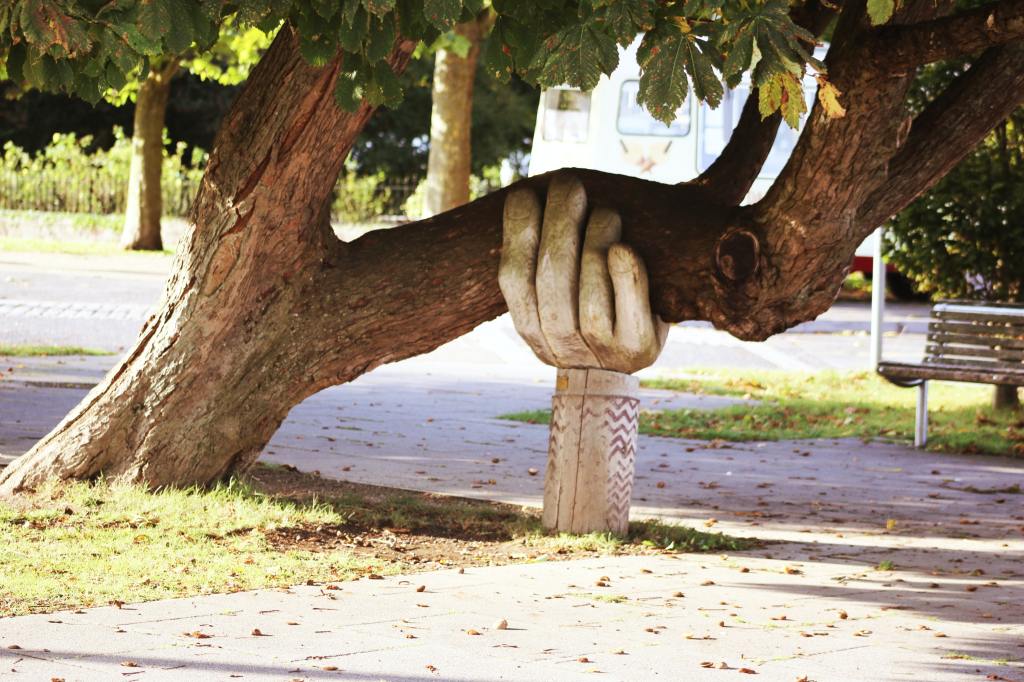
Photo by Neil Thomas on Unsplash

2. Ask for Help

Another thing hard for many humans to do is ask for help. Why? Because like trying new things, admitting that we need help, makes us fearful. When we act with a need to look good and be right, there is no space to ask for help. We see it as a weakness. Again a paradox. Why?

Because as I’ve written about in other posts, the idea that we know everything there is to know about any topic is silly. No matter how many degrees you have, or how much practical experience you have, there is always something to learn. Always.

Within this context, asking for help is normal. And, it is. Very normal. Does that mean asking for help is easy? No. Admitting we don’t know, need help, no matter what it is we are doing is hard. Very hard.

However, like understanding that breakdowns are normal, having this new understanding about asking for help, immediately opens you up. Opens you up to understanding the true nature of your humanity. And, in this space, you have the opportunity to learn more, be more, and know more. Awesome.

What to do?

When you are in breakdown, stay there. Yep, that’s right. Stay inside of that breakdown, and really feel it. Then, if you get a breakthrough, great. If not, ask for help. There is everything right about asking for help. Think about it like this. If you don’t ever ask for help, you are not expanding that which you know.

And, when we stop expanding what we know, we are limiting ourselves, and our human potential. Your potential is vast. It already is. If you experience that vastness, wonderful. If you’ve yet to experience it, don’t worry. Follow the steps in this post, and you will begin to experience it. Really.

Photo by Lucas Gallone on Unsplash

3. Capture the Breakthroughs

You will never know when a breakthrough will come. Sometimes you will get a breakthrough right on the other side of a breakdown. Sometimes it will be later. It’s okay. Normal.

What’s important is to capture your breakthroughs. In the moment you have a breakthrough, you may not even be sure what it is related to; and, that’s okay. Write it down anyway. Hold onto it. You will see where it belongs eventually.

Once you know where your breakthrough insight belongs, you can make plans to implement it into that area of your life. Sometimes you will choose to do this right away; and, sometimes you will wait. Both are fine. It matters less when you implement your breakthrough, than it is that you stay open to adopting it in some way. Why?

Because that breakthrough is a direct result of a breakdown you had. Whether you can trace the breakthrough back to a breakdown, it is related. Important. And, why it is so important to track and capture your breakthrough in some way.

Let’s now take a look at the definition of breakthrough.

breakthrough

Translate breakthrough into Spanish

NOUN

  1. A sudden, dramatic, and important discovery or development.‘a major breakthrough in DNA research’
    1. 1. An instance of achieving success in a particular sphere or activity.as modifier ‘the band’s breakthrough album’

Alright, we’ve now discussed a journey from breakdown to breakthrough. Though there is much more to discuss about breakdowns and breakthroughs, we covered enough to keep you moving.

When I started seeing my lifecoach 3 years ago, she once asked me this question:

Can you limp along a little while longer?

At that time in my life, a concept like a journey from breakdown to breakthrough was not available to me. Well, it was, however, I was not paying attention, nor was I in touch with myself. When we are out of touch with our own humanity the conversation we just had is harder to put into action.

However, what I’ve come to realize in the past three years, is that with guidance and persistence, the journey from breakdown to breakthrough can become a reality for everyone.

A reality that includes welcoming our breakdowns, a willingness to ask for help, and a system we can use to capture our breakthroughs so we can learn, and move ourselves forward.

Definitions retrieved from Oxford Languages

#askforhelp, #breakdowntobreakthrough, #breakthrough, #creatingyourlife, #emotional-intelligence, #fear, #humanpotential, #keepmoving, #learning, #movingfromstucktounstuck, #natureofhumanity, #openness, #vulnerability

A Favorite Quote and Reminder

Smithsonian Magazine

“Every great dream begins with a dreamer. Always remember, you have within you the strength, the patience, and the passion to reach for the stars to change the world.” -Harriet Tubman

Goalcast

Dream. Create. Lead.

#changingtheworld, #creatingchange, #dreamer, #dreams, #harriet-tubman, #leadership, #leadershipvalues, #passion, #quote, #strength

4 Things to Notice and 4 Ways to Move Yourself From Stuck to Unstuck

Photo by Alex Iby on Unsplash

Do you ever feel stuck? Like you are doing the same thing every day, getting the same result, and wondering why this is so? Yep. Happens to all of us at some point in our lives. In fact, it is possible that it happens often.

On any given week, I would say that I get stuck multiple times. True. Really. I have no issue owning my stuckness, as it is inside of being stuck that you learn to become unstuck. How?

Well, let’s take a look at 4 things to notice and 4 ways you can, right now, today, if you choose, move from stuck to unstuck.

1. Notice Frustration and Worry

When we are stuck, emotions like frustration and worry arise more often. Why? Because internally we know that the actions we are taking are not working. They are, rather, a product of being in a rut. Or, being stuck.

As I wrote about in The Stories We Are Told and The Stories We Tell Ourselves: Becoming Limitless, we are the ones that get ourselves stuck. And, it happens inside of limited thinking. We believe we are limited in some way when we are stuck. Or, we believe we already know all there is to know about a particular subject or topic. Issue?

Yes. Why? Because it is an impossibility for anyone to know everything there is to know on any subject or topic. Really. Impossible.

1. What can you do if you are thinking, feeling, and acting this way?

  • Once you notice your frustration and worry, stop what you are doing. Really. Stop. Take a break, and think about the thoughts you are having. Are you considering all options? Or, are you merely reacting to the situation at hand? Important distinction.
  • Then, ask someone their opinion. Seriously. Often, when I am stuck, it is someone else that shows me another way forward. The coolest part about this? That you get unstuck and learn something new at the same time. Pretty cool.
Photo by NESA by Makers on Unsplash

2. Notice your own fear, especially of the unknown

Ah, I’ve written a lot about fear. In Fear of the Unknown: Take A Stand and Take Action Anyway, I write about getting out of our own way. Seriously. Read any self-development book, and in it you will read about getting out of your own way. Is it easy? No. Not at first.

Yet, like anything we do, it gets easier the more we practice getting out of our own way. When you experience fear about an action you are thinking about taking, more than likely it is a product of an innate need to look good or be right. Yep.

We are so concerned that we might look silly or foolish, we don’t take action, or we take action within a limited framework. Which, when you really think about it, is kinda silly and foolish.

In order to become unstuck from our fear, we must be vulnerable; and, take the action there is to take, especially when we feel nervous. When you are nervous, you are growing. Yep. At that moment, you are growing your own developmental spectrum.

2. What can you do if you are allowing fear to keep you stuck?

  • Take the actions anyway. Move forward. Let go of the need to look good, and be right. When we are stuck in looking good or being right, we cannot grow. There is absolutely no growth with that mindset.
  • A growth mindset is about being open, vulnerable, and the practical knowledge that we know way less than there is to know.
  • Learn to become comfortable in not knowing, and looking silly. You will find that when you take action from a standpoint of not knowing, and being okay with “looking silly” that people will actually respond to you. Why? Because they have the exact same fears. The exact same. When you get outside of your fear, you will inspire them.
Photo by Anna Auza on Unsplash

3. Notice when you are avoiding situations, tasks, or contexts

In the post, 3 Reasons Why Avoidance is an Ineffective Strategy, I write about why avoidance is ineffective. Essentially when we are avoidant, we are contributing to our own stuckness. We are. Why?

Because we are actively resisting a situation, task, or context, which means in that area of our life, we are stuck. Yep. When we avoid, we don’t move forward. We standstill. Stuck.

Further, when we avoid, we can also feel off, and not so well. Frustration, worry, and anxiety can be higher because internally we know we are avoiding something that needs our attention. See, we can’t get out of ourselves. Even when we think we can get out of it, we can’t.

However, when we are open to our own avoidance, we can actively choose to notice it, and begin to consider how to move forward. It doesn’t mean that that area of our life will move forward all at once, or simply. Noticing our avoidance, however, does mean we are now open to creating movement.

3. What can you do when you are being avoidant?

  • Pay attention to those situations, tasks, and contexts that you are avoiding. When you notice them, stop yourself and ask, why. Why are you being avoidant? Get to that reason if you can.
  • Whether the reason is at the surface or not, begin to consider things you can do to move forward. Once you choose an action, take it. No matter how small. Take that action. It will be uncomfortable. Especially at first.
  • Remember though, it is inside of the continual actions we take every day that comfort will come. And, comfort in what is uncomfortable today will come. It will.
Photo by Annie Spratt on Unsplash

4. Notice when you are holding tight to your current reality, and begin to let go

In the post, Creating Your Life Anew by Letting Go of The Life You Are Currently Living, I write about the necessity of letting go of the life, or reality, you are currently living in order to live a new one.

It is the same as being stuck. When we hold tight to our current reality, we cannot let go. Impossible. We are then stuck. Essentially, holding onto our current reality is being stuck. They are synonymous. Why?

Because you cannot become unstuck from that which you are stuck to. We must learn to let go. If we do not, we end up living in a false reality where things are static and do not change. Yet, that is not the real world. The world changes with or without our consent. Just look at the current reality right now.

4. What can you do when you are holding tight to your current reality?

  • Practice letting go. Choose an aspect of your life that you believe you are stuck in, and begin to consider what about that current reality you can live without. And, let go.
  • Once you’ve let go of that aspect of your current reality, create something new to fill that reality, to move forward.
  • As with the other suggestions, you can focus on smaller aspects of your life where you are stuck first. Practice, practice.
  • When you’ve practiced letting go in smaller aspects of your life, you may be ready to try something larger. Take it one step at a time. Slowly. There is no hurry here.

Alright, there are 4 things to notice, and 4 ways to move from stuck to unstuck. Remember, being stuck is a normal part of life; and becoming unstuck is a wonderful learning experience.

Moving from stuck to unstuck is a developmental growth process. You simply need to be open to notice when you are stuck, and then to take a different action in that area of your life.

My invitation to you

Notice when you are stuck. Be at peace with it. It is okay, normal. Once noticed, create a new action in that area of your life. When you’ve created that new action, create the next one, and then the next one. And, so on. I think you will be surprised at what you get back.

#avoidance, #beatpeace, #becominglimitless, #beingsilly, #beingvulnerable, #creatingmovement, #creatingmovementinourlife, #development, #developmentandgrowth, #embracingoursilliness, #gettingunstuck, #growth, #growthmindset, #inspiration, #learingtoletgo, #learningcomfortinuncomfotableness, #lettinggo, #movingfromstucktounstuck, #takingaction

The Blog + Video Series #9: Developing and Managing Your Resilience During COVID-19

August 1, 2020

I’ve been reflecting a lot about developing and managing my own resilience this week; and, just how important both are right now. So important. What is resilience you ask? Good question. Here is the definition.

Resilience

(also resiliency)
Pronunciation /rəˈzilyəns/ /rəˈzɪljəns/
Translate resilience into Spanish

NOUN
1. The capacity to recover quickly from difficulties; toughness.‘the often remarkable resilience of so many British institutions’

2. The ability of a substance or object to spring back into shape; elasticity.‘nylon is excellent in wearability and resilience’

Oxford Languages

Essentially resilience is our ability to face adversity, walk through it, learn, and repeat. Again, and again.

I’ve also been thinking about a video I’m going to do soon on resilience for my Developing Servant Leaders site. The idea looks something like this.

First

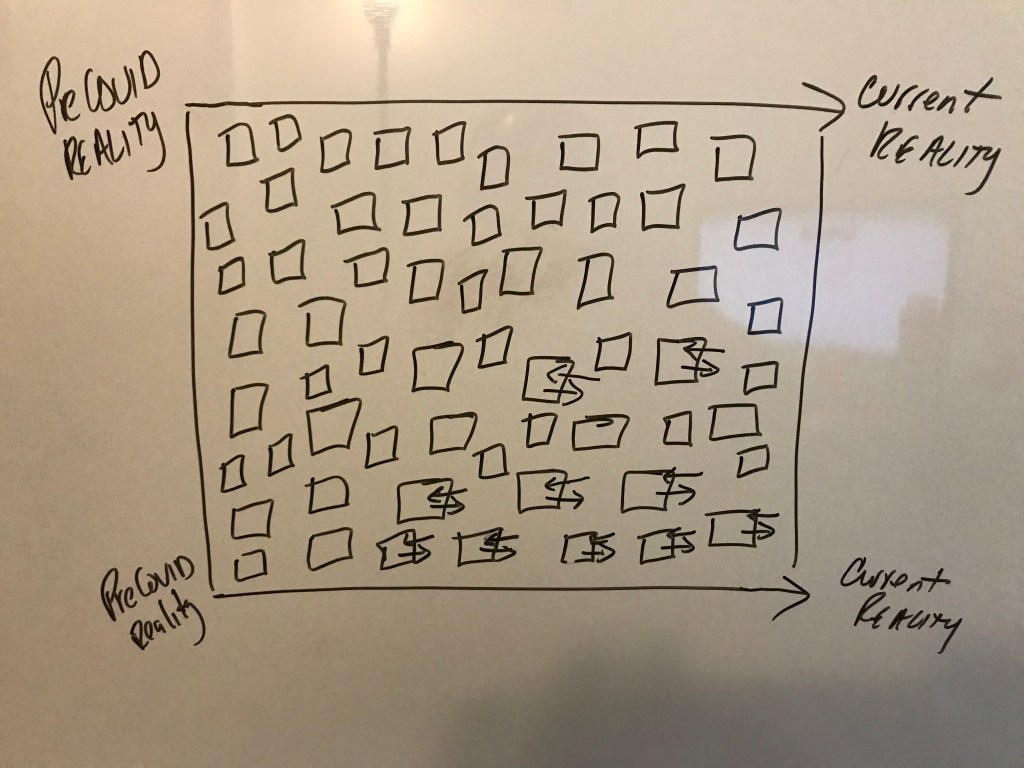
What we are facing right now is a huge gap between that which we once knew to be our reality, and the current COVID-19 reality. A large gap. Inside of this gap, we are all being asked to face ourselves and each other in new ways, with new tools, in entirely new contexts. Hard.

This image has an empty alt attribute; its file name is img-2993.jpg
August 1, 2020

For those that are less resilient, even harder. Resiliency, like all developmental traits, lives upon a continuum. It is not that someone has resilience or does not. Everyone has some, some have more. Alright, next.

Second

When you connect the four points of the above whiteboard, you can see the space that we are being asked to navigate and step into. A distinction. Stepping into reality is different from hiding, and running from reality.

It means taking the action you know is there to take, even, maybe especially, when it is hard.

This image has an empty alt attribute; its file name is img-2994.jpg
August 1, 2020

Now, you can see the above box, yes? Alright, then within that, let’s call it the COVID-19 developmental box, there are lots of other little boxes, which represent each of us and our comfort zones.

Yep. Meaning that as we interact with, and bump into each other, we are continuously floating in the COVID-19 developmental box. Then how, you may ask, do we develop our resiliency?

Third

We step outside of our box and into the reality that is in front of us. What is stepping outside of your box? It is doing. Again, and again.

Learning, practicing, falling down, failing – AND, getting back up again. Every time.

Know that we don’t have to continuously live outside of our box, or comfort zone. We can, what a friend of mine calls it, blip out, and blip back. Here you go.

This image has an empty alt attribute; its file name is img-2995.jpg
August 1, 2020

And, guess what? Everytime we go outside of our box, represented above by arrows, and do something that we consider uncomfortable, we grow. Yep, our box or container gets bigger. Here is one more illustration.

This image has an empty alt attribute; its file name is img-2996.jpg
August 1, 2020

As you can see from the above illustration, some people will grow, boxes labeled with a G are now larger, some will not. It’s not a demerit, or a problem if there is no growth. It is, however, a missed opportunity to learn more about yourself and being human. Alright, last section.

Fourth

Also know, especially when you are feeling overwhelmed, that all there is to know and to be experienced in this world, is much larger than this present moment. The COVID-19 moment. Last illustration.

This image has an empty alt attribute; its file name is img-2998.jpg
August 1, 2020

Let us say that the entire whiteboard is what is knowable. Got it. Okay. Then consider that the super small box you see is what we’ve been calling the COVID-19 developmental box or gap. Yep. Pretty small in the proper scale.

Remember this distinction when you are confronted with uncomfortableness; and, remember it when you are feeling overwhelmed.

Though today COVID-19 feels like everything there ever was to know, on a universal and historical scale, there is far more to know and experience. Seriously remember that.

There are countless opportunities to develop your resilience today. More opportunities than most people would care to have. Really. And, believe me when I tell you that there are days when I feel the same way. Really. It’s hard.

Yet, like all of life, it is a paradox. Because the opportunity to develop and to learn how to manage our resilience is also a wondrous process. Yep. Hard and wonderful. A paradox.

Develop well.

Photo by Gia Oris on Unsplash

#beinguncomfortable, #covid-19anddevelopment, #covid-19andresilience, #covid-19growth, #developingresilience, #developmentandgrowth, #humandevelopment-2, #learningcomfortinuncomfotableness, #managingresilience, #resilience, #selfdevelopment

Developing and Managing Your Resilience During COVID-19

This image has an empty alt attribute; its file name is gia-oris-5dt-joxsl78-unsplash.jpg
Photo by Gia Oris on Unsplash

I’ve been reflecting a lot about developing and managing my own resilience this week; and, just how important both are right now. So important. What is resilience you ask? Good question. Here is the definition.

Resilience

(also resiliency)
Pronunciation /rəˈzilyəns/ /rəˈzɪljəns/
Translate resilience into Spanish

NOUN
1. The capacity to recover quickly from difficulties; toughness.‘the often remarkable resilience of so many British institutions’

2. The ability of a substance or object to spring back into shape; elasticity.‘nylon is excellent in wearability and resilience’

Oxford Languages

Essentially resilience is our ability to face adversity, walk through it, learn, and repeat. Again, and again.

I’ve also been thinking about a video I’m going to do soon on resilience for my Developing Servant Leaders site. The idea looks something like this.

First

What we are facing right now is a huge gap between that which we once knew to be our reality, and the current COVID-19 reality. A large gap. Inside of this gap, we are all being asked to face ourselves and each other in new ways, with new tools, in entirely new contexts. Hard.

This image has an empty alt attribute; its file name is img-2993.jpg
August 1, 2020

For those that are less resilient, even harder. Resiliency, like all developmental traits, lives upon a continuum. It is not that someone has resilience or does not. Everyone has some, some have more. Alright, next.

Second

When you connect the four points of the above whiteboard, you can see the space that we are being asked to navigate and step into. A distinction. Stepping into reality is different from hiding, and running from reality.

It means taking the action you know is there to take, even, maybe especially, when it is hard.

This image has an empty alt attribute; its file name is img-2994.jpg
August 1, 2020

Now, you can see the above box, yes? Alright, then within that, let’s call it the COVID-19 developmental box, there are lots of other little boxes, which represent each of us and our comfort zones.

Yep. Meaning that as we interact with, and bump into each other, we are continuously floating in the COVID-19 developmental box. Then how, you may ask, do we develop our resiliency?

Third

We step outside of our box and into the reality that is in front of us. What is stepping outside of your box? It is doing. Again, and again.

Learning, practicing, falling down, failing – AND, getting back up again. Every time.

Know that we don’t have to continuously live outside of our box, or comfort zone. We can, what a friend of mine calls it, blip out, and blip back. Here you go.

This image has an empty alt attribute; its file name is img-2995.jpg
August 1, 2020

And, guess what? Everytime we go outside of our box, represented above by arrows, and do something that we consider uncomfortable, we grow. Yep, our box or container gets bigger. Here is one more illustration.

This image has an empty alt attribute; its file name is img-2996.jpg
August 1, 2020

As you can see from the above illustration, some people will grow, boxes labeled with a G are now larger, some will not. It’s not a demerit, or a problem if there is no growth. It is, however, a missed opportunity to learn more about yourself and being human. Alright, last section.

Fourth

Also know, especially when you are feeling overwhelmed, that all there is to know and to be experienced in this world, is much larger than this present moment. The COVID-19 moment. Last illustration.

This image has an empty alt attribute; its file name is img-2998.jpg
August 1, 2020

Let us say that the entire whiteboard is what is knowable. Got it. Okay. Then consider that the super small box you see is what we’ve been calling the COVID-19 developmental box or gap. Yep. Pretty small in the proper scale.

Remember this distinction when you are confronted with uncomfortableness; and, remember it when you are feeling overwhelmed.

Though today COVID-19 feels like everything there ever was to know, on a universal and historical scale, there is far more to know and experience. Seriously remember that.

There are countless opportunities to develop your resilience today. More opportunities than most people would care to have. Really. And, believe me when I tell you that there are days when I feel the same way. Really. It’s hard.

Yet, like all of life, it is a paradox. Because the opportunity to develop and to learn how to manage our resilience is also a wondrous process. Yep. Hard and wonderful. A paradox.

Develop well.

#comfortzone, #comfortzones, #covid-19, #covid-19growht, #covid-19growth, #development, #developmentandgrowth, #develping-resilience, #growing, #growth, #humandevelopment, #learning, #managingresilience, #perspective, #resielnce, #selfdevelopment, #uncomfortable

A Blogger’s Diary 7/31/20: On Eleanor Roosevelt

NPR

I am reading Eleanor Roosevelt: The Early Years right now. It’s awesome. I’ve always drawn upon Eleanor Roosevelt (ER) quotes, and have seen biographies about ER, yet reading the book has given me much more to consider, and to reflect upon. Powerful.

If you’ve not read much about ER, here are some of my favorite quotes, and a cool American Experience interview I highly recommend with Vernon Jarrett.

“You gain strength, courage, and confidence by every experience in which you really stop to look fear in the face. You are able to say to yourself, ‘I lived through this horror. I can take the next thing that comes along.’ You must do the thing you think you cannot do.” – Eleanor Roosevelt

Goalcast
National Park Service

“The purpose of life is to live it, to taste experience to the utmost, to reach out eagerly and without fear for newer and richer experience.” – Eleanor Roosevelt

Goalcast
Franklin D Roosevelt Presidential Library and Museum

“Tomorrow is a mystery. Today is a gift. That is why it is called the present.” – Eleanor Roosevelt

Goalcast

Here is the American Experience interview.

American Experience

With all that we face today, it is important to remember that what is now, is now, yes, yet will not always be our present now. Make sense? Said another way, this too shall pass.

Stay healthy and well.

#confidence, #conqueringfear, #courage, #dothatwhichyouthinkyoucantdo, #eleanor-roosevelt, #eleanorrooseveltandrace, #newexperiences, #purpose, #purposeoflife, #stregth, #thepresent

The 4 Catalysts: Book 1, Part 2, Chapter 1

Photo by Jen Theodore on Unsplash

Brave – ready to face and endure danger or pain; showing courage.

Strength – the quality or state of being physically strong.

Intellect – the faculty of reasoning and understanding objectively, especially with regard to abstract or academic matters

Part 2

1

“You are braver than you believe, stronger than you seem and smarter than you think.” -Christopher Robin, Winnie the Pooh

GoodReads

Though the four had lived in a world full of change, they did not feel it, nor did they think much about it. Their lives had been, up to this point, rather monotonous.

Not like the days when their ancestors lived in the four corners. Those days were full of change even the catalysts felt. For a catalyst to actually feel change, it must be on a global scale.

What the four didn’t know, couldn’t know, was that the seeds of change, they, were about to embark on a journey for the ages. One that would have even concerned their ancestors.

The West

Unlike the East, the West was hot. Very hot, and dry, not wet and humid like the East. No, the West was a dry, arid, desert landscape, with rolling sand dunes, and distant mountains, which surrounded the Valley of the Sun.

Photo by Tanya Nevidoma on Unsplash

It was in this Valley that Lorel, and the People of the Sun lived; and, where the Castle of Sand was located. Like Sheldon, Lorel was the Mage of the East, and as such, fulfilled their obligation to the People of the Sun.

Unlike Sheldon, Lorel preferred to live alone. No Quara running after, nor house servants picking up after them. Just Lorel. Well, Lorel, and Hok, Lorel’s falcon, who, like Lorel, had lived in the Castle of Sand for generations. In fact, Hok’s ancestors had served Lorel’s ancestors for as long as anyone could remember.

Lorel was in their study at the top of the Castle, when Hok flew in and perched themselves just over Lorel’s shoulder.

“What’s the matter, Hok?”

It was just then that Lorel sensed it, them. Lorel quickly made their way to the window overlooking the vast dunes to the East. Sure enough, five riders were making their way to the Castle.

Surrounding the Castle were hamlets, many of them. The hamlets were where the People of the Sun lived. Lived, and thrived. Even though the People of the Sun didn’t take care of Lorel and the Castle proper, they took care of all of the surrounding landscape and hamlets.

Photo by fereydoun kia fereydoun kia on Un

And, though no one took care of Lorel and the Castle, there was one in particular, one tribesperson that looked in on Lorel regularly. Talom was their name, and their dedication to Lorel was complete.

Talom was a senior advisor among the People of the Sun, and was known for their great intellectual prowess. Even Lorel considered Talom one of the smartest people they had ever met.

As the riders approached the hamlets, Talom readied themselves for conversation.

The first rider was young. Younger than Talom expected. The rider gave off waves of arrogance, not surprising Talom in the least. The other four riders stayed back, while the youngster dismounted, and approached Talom on foot.

The hamlet’s inhabitants spilled out into the narrow streets that connected the small homes constructed of sand, sticks, and brush. Children and teenagers raced up to stand behind Talom, while their parents yelled at them to stay back.

The young man approached, and said “Who are you, old man? We’re seeking Lorel, Mage of the East. We’re not interested in talking to the likes of you. Simply point the way, and we’ll pass in peace.”

Talom snickered inwardly. The arrogance of such a boy to suppose he could simply ride up to the Castle of Sand, and speak with Lorel. Funny. Absurd. Talom gathered himself, breathing slowly, patiently, and just as the boy was about to speak…

“Who am I? Why, who are you, young master? We are the People of the Sun. This is our hamlet, which lies in the shade of the Castle of Sand.”

The young horse rider paused, grinned, then stepped back, looked over his shoulder, and said, “Seems like we have an issue here. This old one will not let us pass. What should we do boys?”

While the young horse rider was speaking to his fellow riders, Talom could sense something. Yes, it was Lorel communicating with them through the fire pit just to Talom’s right. Fire was the Mage’s Art, and they could do just about anything with it, including using it to communicate.

“Talom, what’s going on? Why is this boy here with four other men, and those infernal horses? What do they want?”

Talom still breathing slowly and patiently, answered back, “Master, I don’t like these horse riders, there’s something wrong with them. Not sure what it is, but something is amiss.”

Just then the boy advanced toward Talom at an amazing speed, drawing a throwing knife as he did so, and as he was about to throw, a curtain of fire erupted between the rider and Talom. The horse rider almost ran right into it, yet stopped just in time.

Photo by Mohamed Nohassi on Unsplash

The boy stumbled back, tripped, and tumbled to the desert floor. Now scrambling back towards his horse and the other rides. And, doing so quickly.

As the boy was retreating, Lorel came walking down the narrow hamlet streets towards the wall of fire. As Lorel passed the gathered children, they brushed their heads and shook hands of parents and caretakers, young and old alike.

Lorel then made their way toward Talom, standing right beside them. In that same instance, Lorel withdrew the wall of fire. Hok was sitting just over Lorel’s left shoulder, on the top of one of the hamlets, taking in their Master’s poise under pressure.

“What do you want? You don’t belong here, and are not sanctioned to be away from the Center. The Center is where you live, and where you are to stay. The far reaches of the West is no place for you. Now go.”

The boy stood up, brushed himself off, and called to one of the other men to bring him the pack.

Pack, what pack, Talom thought. Talom didn’t like this at all.

One of the older men brought the pack over, handed it to the boy, then made his way back to his horse.

The boy said, “We were tasked with delivering this to you. It was not an easy journey. Several died. We are what remains of the dispatch. This is for you.”

Lorel took the pack, opened it, and upon seeing the contents, stumbled backwards, almost falling over.

What in the world was the East Mage’s Book of Change doing with these men, and that infernal boy? What was it doing in the West, about as far away as you could get from the distant East? And, oh no, what about Sheldon?

“Oh, Talom, we have an issue.”

#book, #change, #creatingchange, #fantasy, #fiction, #fictionbook, #fictionfantasy, #fictionscifi, #fictionscififantasy, #fictionwriting, #mage, #scifi, #scififantasy, #the4catalysts, #the4mages, #writing

4 Reasons Why Language Is Power

Photo by Hannah Wright on Unsplash

Ever thought about the power of language? Yes, no? I hadn’t until about three years ago. Why? Well, as I’ve mentioned in many of my posts, about three years ago I began to develop myself, really develop.

And, when you work on yourself, from the inside out, which is the only real way, you begin to understand the power that we, you, hold within you. It is a vast power, and language is a part of that power.

Before we begin to look at the power of language, let’s start with a definition.

language

NOUN
1. The method of human communication, either spoken or written, consisting of the use of words in a structured and conventional way.

Oxford Languages

Alright, pretty straightforward, right? Do you read anything in there about the power of language? No, me either. However, it’s there, believe me. Let’s take a look then at 4 reasons why language is so powerful.

1. Language is what we use to create meaning

As I’ve written about in other posts, human beings are meaning-makers. We continuously construct narratives, or stories, about life. We take in information, a stimulus, and we convert that information into a patterned story about how we perceive ourselves. Then we respond.

We respond from the space of the story. From the beliefs we hold about who we are. Can you see the power in that. Pretty powerful.

For instance, if we believe we are limited, because someone told us that when we were little, we will respond from a space of limit. Without thinking about it. Important.

In this example, it’s not as if we are consciously thinking about these limitations. These limitations live in the stories we tell ourselves, and others about who we are. They operate independently. Aware of them or not, they are there. Powerful.

Imagine deciding to not do something because someone told us not to do that thing when we were little. If we really sit inside of this concept, it may fill us with sadness.

Know, however, that at the end of this article we will discuss how to get in touch with the stories we have. Why? Because when we are aware of them, even though we don’t know all of them, we can choose a different response. We can create new stories.

Photo by S O C I A L . C U T on Unsplash

2. Language is what we use to communicate

Though verbal and written communication are not the only ways we communicate with each other, they are two of the primary ways we do so. We take that which we know to be “true,” drawn from the stories we have about ourselves, and use it to construct language to communicate with people.

Further, when we communicate with people, and they do or say something to confirm the story we have about ourselves, that story becomes more codified.

These stories, then, have been “confirmed” over years and years of inner-dialogue, and are also “proven” by those we interact with. Complex. And simple.

For instance, if I believe that I am limited, and act that way, then those around me, after time, will stop asking me to do things that stretch me, or make me uncomfortable.

Not because they don’t want me to stretch and grow, rather because I always say no. I confirm for them my own self-perceived limitation. And, in return, they confirm that limitation in my mind by not asking me to stretch and grow.

Thomas Cooley wrote about this concept over 100 years ago.

“The looking-glass self describes the process wherein individuals base their sense of self on how they believe others view them. Using social interaction as a type of “mirror,” people use the judgments they receive from others to measure their own worth, values, and behavior”

Lesley University

And, then sociologist Erving Goffman took Cooley’s work further.

“The term ‘symbolic interactionism’ refers, of course, to the peculiar and distinctive character of interaction as it takes place between human beings. The peculiarity consists in the fact that human beings interpret or ‘define’ each other’s actions instead of merely reacting to each other’s actions. Their ‘response’ is not made directly to the actions of one another but instead based on the meaning which they attach to such actions. Thus, human interaction is mediated by the use of symbols, by interpretation, or by ascertaining the meaning of one another’s actions.” (Blumer, p. 180, in Paul Gingrich)

Hawaii.edu

Therefore, how we think is how we act, believe, and perceive. And, those around us do the same. Have you ever had an interaction with someone that didn’t know you, and they interacted with you in a way that didn’t fit the story you have of yourself? Yes? What did you do?

Did you align with your own story about the person you believe yourself to be? Or, did you act in a different way? Most of the time, people will continue to behave as they have, which is consistent with the actions, beliefs, and perceptions they have of who they are.

Reason? Because to act, believe, and perceive otherwise is incongruent with their perceived identity. And, all of it, the actions we take, and the beliefs and perceptions we have first of all live in language. That is powerful.

Photo by Noah Buscher on Unsplash

3. Language is what we use to make sense of the world

When you look out your window, what do you see? A tree? A bush? The sun or moon? Whatever you see, and the words you use to describe the world all live in language. All of it.

Think about the word sun. Where did that come from? Well, let’s take a quick look.

Origin

“Old English sunne, of Germanic origin; related to Dutch zon and German Sonne, from an Indo-European root shared by Greek hēlios and Latin sol .”

Oxford Languages
And, even cursory searches of the internet will show that the roots of the word sun cross cultures.

“This is ultimately related to the word for “sun” in other branches of the Indo-European language family, though in most cases a nominative stem with an l is found, rather than the genitive stem in n, as for example in Latin sōl, Greek ἥλιος hēlios, Welsh haul and Russian солнце solntse (pronounced sontse), as well as (with *l > r) Sanskrit स्वर svár and Persian خور‎ xvar. Indeed, the l-stem survived in Proto-Germanic as well, as *sōwelan, which gave rise to Gothic sauil (alongside sunnō) and Old Norse prosaic sól (alongside poetic sunna), and through it the words for “sun” in the modern Scandinavian languages: Swedish and Danish solen, Icelandic sólin, etc.”

Handbook of Germain Etymology

Yet, is the sun, the sun? Or is it a star? Same with a tree. Is a tree, a tree? Or, is it something else. The point? That the language we use to describe the world becomes just that. The world we see. The world we know.

When we see a tree, we don’t question the fact that at some point a tree was not called a tree. Nor was the sun called the sun. They were called something else, or nothing at all.

The relationship we have with the language we use to describe the world we see and perceive as our reality, is therefore extremely important, and powerful. It must be.

Photo by Slava on Unsplash

4. Language is what we use to create our reality

Yep. Truth. Language is what we use to create meaning, to communicate, to understand the world, and to create our reality. In another post, I wrote something like, there are 7 billion different realities on this planet. Truth. How’s that?

Because we all understand our reality as we understand it. Yes, based on the stories we are told about who we are, the stories we then create to fit these stories, and the conformations we get from those around us that codify our notions of the stories we know to be true about who we are.

And, that is creating our reality. One thought, belief, and perception at a time.

However, because language, and our interpretation of it, is so powerful, we can also use language to create a different reality, with different stories, beliefs, and perceptions. Yep, we can.

Photo by Benigno Hoyuela on Unsplash

As with most things, first you need to be aware of the power of language. Check. Then, it is about learning to notice when you are creating a reality that consistently fits the story of who you think you are. If that is what you want for your reality. Awesome. Done. If not?

Once you are aware, and notice how you consistently continue to create a response to a stimulus that is in alignment with, let us say, limitation, you can begin to choose a different response.

A response that aligns with the reality you now want to create. A reality without limits. Powerful.

Phew, that was a lot. More than I expected in this one post. Yet, because language is so powerful, there is a lot more to write about. A lot more.

Yet we will leave that to a future post.

Language is powerful. We can use language to confirm all the things we think about ourselves, given to us by someone else, and continuously confirmed by ourselves and everyone around us. OR.

We can use language to disrupt that which we believe we know about ourselves, and use the power of language to create a whole new reality for ourselves. And, guess what?

Everytime someone chooses disruption over the status quo, everyone benefits. All of humanity does.

#beliefs, #communication, #concepts, #creatingmeaning, #creatingnarratives, #creatingstories, #language, #perceptions, #philosohpy, #practical, #practice, #psychology, #reality, #socialpsychology, #sociology, #stimulusresponse

An Insight, An Inspiration, and A Quote: On Being Vulnerable

Photo by Genessa Panainte on Unsplash

Insight

Vulnerability is a wonderful gift. When we choose vulnerability over fear, we open ourselves up to learn more about ourselves and all of humanity.

For a long time I chose fear. Not so today. In the spirit of vulnerability, here is a video I created last week on the importance of being vulnerable.

Inspiration

I am inspired by everyone in my life, and everyone I meet. All of them. This past week, I was particularly inspired by a colleague of mine. Terri Houde is a Corporate Trainer, works on our team, and created the following video about an upcoming video series. Check out vulnerability in action. Inspiring.

A Quote

“Security is mostly a superstition. It does not exist in nature, nor do the children of men as a whole experience it. Avoiding danger is no safer in the long run than outright exposure. Life is either a daring adventure, or nothing.” -Helen Keller

Habitsofwellbeing.com

“Vulnerability is not winning or losing; it’s having the courage to show up and be seen when we have no control over the outcome. Vulnerability is not weakness; it’s our greatest measure of courage.” “People who wade into discomfort and vulnerability and tell the truth about their stories are the real badasses.” – BRENÉ BROWN

Bookriot.com

Be well. Be vulnerable.

#awe, #brene-brown, #courage, #helen-keller, #insight, #inspiration, #inspirational, #life, #love, #streght, #vulnerability, #vulnerable, #wonder

Creating and Maintaining Relationships 5: An Important Distinction About Attachment and Healthy Relationships

Photo by Markus Spiske on Unsplash

What’s the difference between an attachment and a healthy relationship? And, why does it matter? Well, it’s only been in the past year, really, that I can really make this distinction. What does that mean?

Well, I hold a degree, actually two of them, that stipulate that I know about this distinction. Yep. And, while those pieces of paper are in frames, and the person writing this article does have intellectual information about the theoretical differences between attachment and healthy relationships, that is not knowing.

Alright, you are doing very well, stay with me. One more distinction.

Holding intellectual information means that you have a grasp, even expertise, in understanding a particular topic or subject. This is a true statement. Does it then follow that because you have intellectual information about a subject or topic that you also know about that topic or subject? No. Why?

Because to know something, really know it, in your head and your heart, you must have lived through it. It is the only way. It must be experienced.

While many people can theorize about the difference between attachment and healthy relationships, they only really know the difference if they have lived through something that has shown them that difference. Which is why I have only recently learned, and now know, about this distinction. And, it is an important one.

Here is a good example.

intellectual
The adjective intellectual describes something related to or using the mind or intellect. Your creative pursuit of singing in a rock band is different from your intellectual interest in 16th-century drama.

Vocabulary.com

In the above example, singing in the rock bank is known because it is being done, lived, it is real. While the intellectual interest in 16-century drama is purely theoretical, made up of ideas. The person that has intellectual information of 16-century drama can never know what being in a 16-century drama is like. Phew. Okay, I think that covers it.

Now let’s create the distinction between attachment and healthy relationships. The distinction between the two is important because many people believe they are in a healthy relationship with someone, when they are actually only attached. They are not really in a healthy relationship.

Photo by Anne Nygård on Unsplash

Attachment and Healthy Relationships

It is important to understand that we are all attached to people, things, and objects. Attachment is a deep feeling we have for someone or something. These attachments will correspondingly drive our behavior, whether we are aware of it or not.

Because our attachments will drive our behavior and reciprocally our emotional state, they can often be destructive, especially in adulthood.

And, especially in relationships that don’t work so well. Why?

Because when we have a deep emotional attachment to someone, we will continue to stay close to that person even when it is unhealthy for us to do so. Think about the relationships you’ve had, or may have right now.

Do you have any that don’t work so well, yet you continue to stay in relationship with that person? We’ve all been there. That is attachment at work.

Of course, you can love someone, also be attached, and still not be in a healthy relationship. Also important to understand. Often people also confound love, and the attachment that comes with that love, with a healthy relationship.

It is particularly difficult the longer you are with the person; and, can be extremely painful when you finally make the choice to leave the relationship.

In effect, attachment can cloud our decision and choice-making process on leaving relationships that we are better off leaving. Difficult.

Photo by Ivan Aleksic on Unsplash

What Can We Do?

You can notice how you feel, how you think. Do you have an inner knowing that your relationship is not working, yet you stay?

Remember, if your inner-knowing acknowledges the relationship as not working, it is not a demerit. It happens to everyone at some point in their life.

When you know, you have a choice. You can stay, and continue to feel and think one way, yet act in a different way. However, know that when we feel and think one way, and act out of accordance with this knowing, we will be out of balance. Leading us to have more anxiety and frustration.

And, of course, when we have more anxiety and frustration, we are not being healthy to ourselves, or our partner. Really.

Know also that you can love someone completely, and still know that leaving is needed.

#anxious, #attachment, #frustrated, #headandheart, #healthyrelationships, #inner-knowing, #inuition, #relationships, #toughchoices, #toughdecisions, #unhealthyrelationships