The Leadership Series Part 3.5: Developing High-Performing Teams

Getting into Action and the Resulting Traction

Photo by Shridhar Gupta on Unsplash

Well, it’s been a little while since I’ve written an installment in this series. Busy, just like you. I am also continuing to work on a new leadership series, Leading from Within, the first post of which will be out in the next month.

Alright, where we left off in the last installment of the leadership series, was discussing relationships, process, and systems. All necessary and needed to prepare yourself and the team for being in action and gaining traction.

In this post we will look at roles and responsibilities, getting into action, and the resulting traction. Ready? Good. Here we go.

Photo by Andrew Neel on Unsplash

Roles and Responsibilities

In a team environment, defining each team member’s work and areas of expertise is important. If you don’t know, you won’t know who to hand the “ball” to, who to go to when you need help, and you will not understand what your team members do at work.

Being on a team means defining roles and responsibilities. The first time the team and I completed this task, it was hard. Hard because I came from outside of the department, and most of the people in the burgeoning department knew of each other, yet didn’t really know each other. Meaning, there were acquaintances, yet for what this team would eventually begin to create and build, acquaintances wouldn’t be enough.

We needed to really know each other, to really get each other; and, to do that, you need to dig into the individual work.

I’m sure there are many ways to define roles and responsibilities, yet I only really know how we did it, so here we go.

  • Defining roles and responsibilities – it is important on a new team to use the same language. In fact, I’ve not written a post about this concept, and it is an important one. When you are building a team and a culture around a team, you are creating an overarching system for how people communicate; and, using the same language consistently is key, which is why defining roles and responsibilities is an important first step.
  • Individual staff time – once you’ve defined roles and responsibilities, and have talked with each staff member about their individual roles and responsibilities, each staff member will need time to actually write their roles and responsibilities out. Know that they may have never been asked to do something like this, so will need some time. I think we took about 2 or 3 weeks to write ours out.
  • All staff meetings – once all of the roles and responsibilities are submitted, create an all staff meeting to go through them together; and, have each staff member talk through their roles and responsibilities. Important. This will give their teammates the opportunity to ask questions.
  • Document and file – after all staff members have sight on each other’s work, and have had the opportunity to ask questions and discuss their work, make sure to document and file the roles and responsibilities. Documentation can be done many ways. If you use a project management system, that would work, as would a Google shared drive folder.
  • Keep them handy – how you document the roles and responsibilities matter less than that they are accessible to all staff, and are referenced often. After we completed our roles and responsibilities, I used these data to formulate portions of our very first 1W1 conversations. Helpful.

Photo by Edho Pratama on Unsplash

Results

As we created our roles and responsibilities, we also worked through the results we intended to achieve in our respective positions.

Here is an example of what that looked like.

Albany, Oregon 2021

Yep, that picture is a little askew, yet you get the idea.

Setting your intention early on in a team’s formation can really assist everyone, especially if you are in a leadership position. It tells you what people are passionate about, and how they plan to achieve their goals, and results.

Once everyone’s roles and responsibilities are declared and results are clearly articulated, it’s time to create a system for getting into action.

Photo by Jakob Owens on Unsplash

Getting into Action

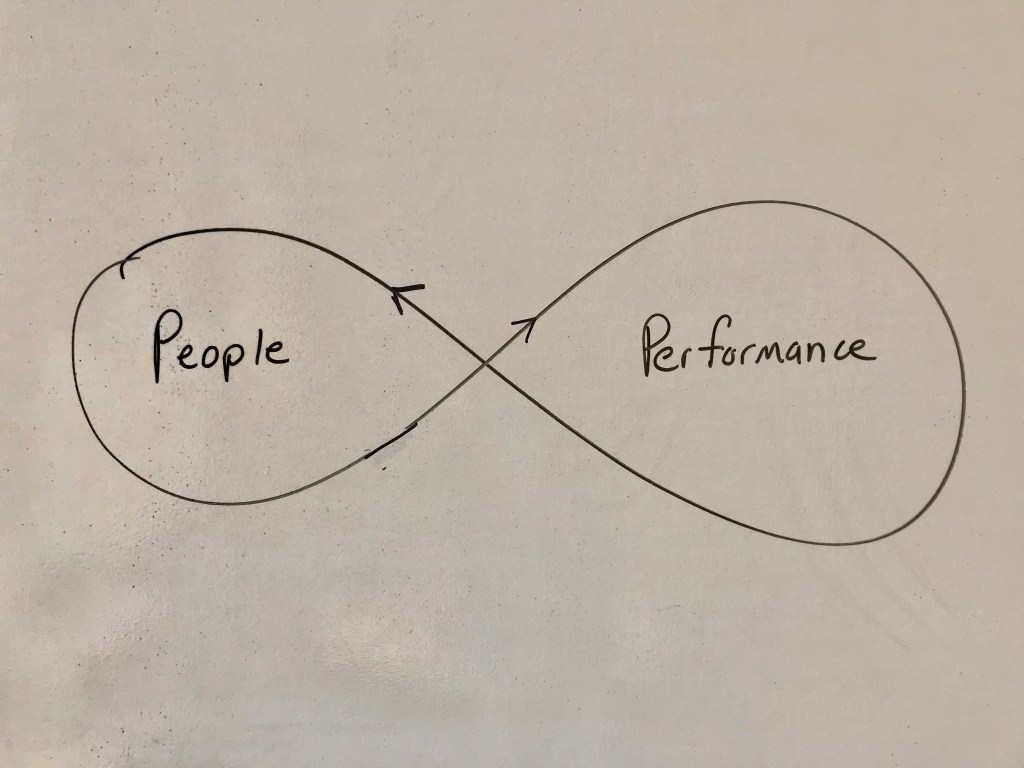
The past two weeks I’ve been reflecting more upon the system we’ve created over the past three years, which I’m going to walk you through momentarily. One thing you will notice is that within the system, there is a focus on both people and performance.

As I wrote about in the post, Causal Loop 101, a focus on people only results in a lack of action and traction, whereas a focus on performance only will result in declining morale and burnout.

Here is a very simple system anyone in a leadership position can use to move from inaction to action to traction. Ready? Good. Here we go.

  1. Door’s always open – as I’ve written about in other posts, creating safety on your team is paramount. And, one way to do that is to ensure you are available. Being open and available for people let’s everyone know that they are the priority.
  2. 1W1’s – I’ve been conducting 1W1’s with the team for almost 4 years now. These 1W1 conversations have iterated over time. For almost 2 years they were weekly, and now? Only as needed. 1W1’s are instrumental when creating a new team. Creating relationships takes time, intention, and thoughtfulness. There really isn’t anything more important than these relationships.
  3. Program Meetings – these smaller interdepartmental meetings have also iterated over time. Today, there is really only one program that still meets weekly. It is the most complex program, with the most staff, so that’s what feels right today.
  4. Area-specific meetings – the registration staff also meets weekly right now. Super helpful during a time when we are not all together in our office, and can easily have ad hoc conversations. At some point these meetings will probably go by the wayside, yet not right now.
  5. Quarterly team building – an important aspect of building teams is making sure that each person on the team has access to high quality developmental opportunities. We began quarterly team building in year 2, and though we are on a hiatus from team building right now, they will be back once we are back on campus.
  6. Weekly messaging – as many of you know, I send the team a message each Monday morning. It is a way for me to stay connected, and give them a reflection from the week before. Something for them to ponder and reflect upon as they work through their week.
  7. Monthly Updates – I usually send out a small monthly progress report, which lets the team know how we are performing across each program in the department. They are to keep the connection going, to give them data, and to celebrate our many victories.
  8. Quarterly reports – these more detailed reports relay important data on how we performed against our metrics, and testimonials from students and clients. They serve two distinct purposes – give the team my sight and thinking on the current reality and landscape, and to celebrate our accomplishments.
Photo by Slidebean on Unsplash

Resulting Traction

When people on a team feel safe, know what each other do, understand their goals and priorities, and fully support the vision, you will get traction. One way to ensure that happens is to install systems into the team to ensure that there is predictability and stability.

Though our systems are mostly home-grown, they work; and, though the type of education we work in changes rapidly, just like businesses in the private sector, there is always a sense of predictability and stability amidst the chaos. Important.

You might be thinking, what does traction look like?

Well, it can look lots of different ways. One thing it is not? Just hitting a metric. That’s not it.

Meeting your goals, objectives, priorities, and metrics is only one part of the equation. Just one. The other? Developing high-quality relationships with each other that can withstand changes and chaos that will come your way. It is inevitable.

If you have the former without the latter, the team will eventually falter. If you have the latter without the former, you will achieve the former in time, and the resulting traction. Guaranteed.

Alright, that’s the last entry in The Leadership Series. It was fun. As I mentioned at the beginning of this post, I am currently working on a new Leadership Series, the first post of which should be out sometime in April. That will also be fun. Until then, lead well.

#action, #beinginaction, #creatingtractiononteams, #leadership-development, #peopledevelopment, #personaldevelopment, #professionaldevelopment, #results, #rolesandresponsibilities, #teambuilding, #teamdevelopment, #traction

A Blogger’s Diary 3/21/21: On Writing, Reflecting, Next Week, and Silence

This past week, I’ve been reflecting upon, well, the last year. Phew. As businesses begin to open up more here across the country, and the vaccine becomes more and more available, it is interesting to ponder where we’ve come from, where we are, and where we are going.

It’s also interesting to ponder and be present to the need to create time for ourselves away from the chaos, so we can just be; and, be in silence.

Before I get to my reflection on silence, however, let’s have a couple reflections on this past week’s posts, and a look at what next week holds.

Writing

I spent some more time completing the Leadership Series this week, with the final entry on building high-performance teams, which will publish next Saturday. Now that that series is complete, I will turn some of my attention to a new leadership series, Leading from Within.

I also spent some time this week, writing poetry for future posts. It’s fascinating to me to watch people develop, myself, of course, included. When I look at the first poem I wrote several months ago, to the most recent one, there are similarities, yet they are quite different. Iterative development. Fun.

Alright, here are two reflections from this week’s posts.

This image has an empty alt attribute; its file name is image-1-1.jpg
Image credit; Sonny Mauricio

Dream

The poem Dream was inspired by the WDYS prompt from Keep it Alive, by Sadje.

As I pondered the scenic picture, I reflected upon how we gaze upon nature, and how nature gazes back. It’s all quite lovely. I began with that thought in mind, and then just let the words come. Well, better language would be that the words just came. I don’t have anything to do with the “letting” in this process.

I also reflected upon and played with the concepts of perception, diversity, and the vast ocean of both we have in this lovely world. It is so beautiful to contemplate all that we see within and without, isn’t it? Lovely.

I obviously also played with the concepts of dreaming and reality. For now, I will only say that that is up to the individual. Each of us. What’s a dream to you, and what’s real is for you alone; and, I think it is quite lovely that way.

Streams

Ah, the poem Streams was inspired by my childhood in Los Angeles; and, yes, there really was a “river bed” out back. It was the only real river I saw on a regular basis. Know though, that, as kids, we did get to see real streams, yet they were few and far between in the big city in which we lived.

Funnily enough, you don’t actually have to travel far in LA to get to a stream, yet most of the time I spent in water was, as many of you know, at the beach. Love the ocean, always have, always will.

I also played with the concept of existence in this poem. Pointing to a reality only found within. And, lastly I reflected upon dreams and how important it is to have them, tend them well, and to, yes, water them with love and affection. Nurture them, I say, and they will surely manifest for you one day.

Next Week

As was aforementioned, this week, I finished the Leadership Series with a final installment on building high-performance teams. I am amazed, and then not, at how long this series took to complete. Factually, I wanted to write an installment on organizations, yet am going to wait to complete that installment in the Leading from Within series, which I’ve started.

I am also working on new posts on silence, strategic thinking, sleep, and, yep, another post on gardening. Fun.

I’ve also written several more poems this past week, they just came, and am looking forward to sharing those with you in the coming weeks.

I have a lot more ideas, and will let those percolate for a while.

Silence

I wrote a poem once on Silence. Actually it was one of the first poems I wrote when first swept away, quite literally, with ideas, images, and language for the poems that have come since that time.

I had a couple of challenging days this past week, and I’ve never in my life been more grateful for the silence that I get to take part in today. Sitting in silence is such a wonder. It is all at once, empty and full of healing beyond a description that any language can conjure.

Suffice to say, or write, rather, as I have before, that if you find yourself overwhelmed with life, emotions, people, places, or events, try to create some silent time for yourself. Away from everything. For it is in the spaces that we create to be silent where the mysteries of this universe become more clear; and, when there is more clarity, there is more space for you to live and to love.

A wonder.

Have a fantastic week.

#poetry, #abloggersdiary, #blog, #blogger, #blogging, #contemplation, #diary, #dream, #existence, #humandevelopment, #introspection, #leadershipseries, #leadingfromwithin, #losangeles, #mindfulness, #poem, #reality, #silence, #streams, #writing

A Developmental Moment #6: Why Learning to Ask for Help is Necessary and Needed

Why Asking for Help is a Strength not a Weakness

The past two weeks I’ve been reflecting more upon patience and asking for help. The more people I meet, the more I realize just how important developing patience is, as is the ability to recognize when we need help.

Often people mistakenly believe that asking for help is, in some way, a demerit, or means they are in some way deficient. I would like to dispel this notion now.

When we ask for help, we are recognizing a limit, for the moment, to either what we know, or are capable of doing. It does not mean that we are deficient. In fact, it means the opposite.

Meaning that when we recognize a limit within ourselves, we immediately get to grow that limit to a new level. And, in that moment we are courageous. Many of the greatest leaders of all time recognize and celebrate this fact.

Here is a great quote from Barack Obama about asking for help.

Asking for Help 101

As I reflect upon times when asking for help was more difficult for me, I considered a few strategies that may be helpful for those that, like me, continue to see the action of asking for help as a developmental opportunity.

  • Start small – when asking for help, you can start small. Start by thinking about the areas in your work or life that you would either like to learn more about, or could use assistance with. For instance, when I first started to open up to the idea of asking for help, I would ask people to assist me with pieces of projects that fit their skill set. When you can ask someone for help, and give them a piece of work that excites or inspires them, it makes the process of asking for help a little easier.
  • Begin with people you already trust – one of the reasons I shied away from asking for help was because I was concerned about looking incompetent, which is a simple thinking error. When we don’t ask for help, and we try to do everything on our own is, in fact, when incompetence will be seen and felt. However, one way to allay the fear of looking incompetent by asking for help, is to ask someone you already know and trust.
  • Make it a healthy habit – the only way to really make asking for help stick in your life, is to do it regularly. Simply meaning, that creating a healthy habit of asking for help when needed, will continue to push you outside of your comfort zone. However, the more you ask for help, the less uncomfortable it will feel.

There are three simple strategies you can use to begin to ask people for help. Remember, we are always getting help from people around us, always. Whether we are aware of it or not, we are all connected and interdependent. Yep, true.

As we have discussed, asking for help is a courageous act. Yet, people continue to see asking for help as something that is a weakness. Let’s continue to bust this myth, shall we? Good. Here we go.

Photo by Ben White on Unsplash

A Strength Not A Weakness

Here are a few more reasons why asking for help is needed and necessary, and should be considered a strength not a weakness.

  • Relationships – when we ask someone for help, we are acknowledging that relationships matter to us. That, in fact, we are vulnerable enough to say, “you know, I don’t know.” Important. When we are vulnerable in our relationships, and that vulnerability is reciprocated, our relationships become deeper and more meaningful.
  • Connection – when we learn to ask for help, we become more open. More open to asking people we don’t know for help. As we pursue asking people we don’t know for help, we create the opportunity to meet new people; and, to deepen our connection with our own humanity, and the humanity of others.
  • Collaboration – as we practice asking for help, we learn that this practice becomes a strength. We learn that asking for help is essential in order to really collaborate with other people. No true collaboration exists without asking for help. Simple.
  • Synergy – as we begin to collaborate more, we realize that inside of true collaboration exists a very powerful concept, called synergy. Synergy occurs when people are aligned, work together, and help each other. When you work on a team that has synergy, you are able to innovate and execute inside of any situation. Why? Because you’ve learned to ask for help. You’ve learned that asking questions, and asking for help is an essential part of being a human being.

Alright, there are a few more reasons why asking for help is needed and necessary, and why asking for help is a real strength.

If you’re not used to asking for help. Don’t worry. Try some of the strategies listed above in asking for help 101; and remember, when we ask for help, we are admitting, yes, we don’t know something, or need assistance in completing something. And, guess what?

We all don’t know many things; and, we all need assistance getting things done. We do. It’s not a demerit. It’s the opposite.

Asking for help is a sign of courage and a sign of your inner strength.

#asking-for-help, #collaboration, #connection, #courageous, #humandevelopment, #leadershipdevelopment, #organizationalculture, #relationships, #self-development, #strategy, #strength, #synergy, #teamdevelopment

The Reflection Series #8: Causal Loop 101

People, Performance, and Progress

Have you ever heard of the concept, the causal loop? Well, though I am familiar with the concepts that make up the causal loop, in regard to people and performance, I had never really conceptualized them like I am about to present them here.

It is important in any leadership, nay, any team environment to understand a very basic principle. Ready? Good. Here it is.

People and performance both matter. Seems like common sense, yes? Well, often only one side of the causal loop is focused on, which creates an imbalance in a very functional system. How does it work? Good question. Let’s take a look, shall we.

The Causal Loop Albany, Oregon 2021 Photo taken by Author

The Causal Loop

People

In any system, symmetry, or balance, is created when all the system pieces work together. With both symmetry and balance, you can move forward, or produce an output, if you like. And, like any system, when one part is dysfunctional, or is not being paid attention to, the whole system suffers. It may, for instance, still produce an output, yet there will be long-term sacrifices.

It is common for leaders to get caught up in metrics. Meaning, at some point in their tenure, and sometimes this can last the entirety of their tenure, they become obsessed with “the numbers.” It matters less what those numbers, or metrics are, what matters, is that when, as a leader, we become obsessed with results, we forget about the people that make the results happen.

Without people, results are an impossibility. Therefore, if you find yourself stuck on metrics, remember, that focusing solely on outcomes may work for a time. Really, it may. Yet, a performance only approach is not sustainable. Period.

In time, what will occur is that people will burn out, quit, and overall morale will decline. Why? Because their needs are not being prioritized. Simple.

And, like any system, if the parts of the system are not being prioritized and taken care of, the system will, in time, fail. It will always occur this way. Always.

Performance

Now, conversely if as a leader you are always focused on the people, and never focus on the performance, the system will also become dysfunctional, yet will do so in a completely different way.

When the culture of a workplace is the single focus on a team, or in a department, or in an organization or business, then leadership is missing a very important part of the balance of creating and maintaining an effective system. Performance.

Simply, there must be a focus on both people and performance for movement, and eventual traction to occur. A balance, if you like.

Maintaining Balance

It is very normal on a team, any team, for the focus to shift back and forth between the workplace culture and the people, to performance. Shifting of this kind is especially normal on new teams.

I’ve written extensively about the team I work on, and have more forthcoming, and about how the entire first year was spent developing relationships. That was necessary. As it was necessary in year 2 to develop metrics, and in year 2.5 and 3 to focus on performance and people. Both.

There is a balance that can be found, and I imagine it is different on each team, and within each organizational or business culture. Yet, a leader can find it by paying attention. Paying attention to the people and the performance.

Movement and Traction

When you have achieved balance, know that the balance will never really truly be 50% people, 50% performance. Meaning, that sometimes there will be more of a focus on people, and at times on performance. It’s really most important to develop an awareness about how the causal loop functions as a system.

If you sway one way too far, you can move back to center, and vice versa.

Now, when you’ve increased your awareness about the causal loop, and pay attention to both people and performance, guess what?

Things will begin to move, and in some cases, like ours, move so quickly and beautifully, it is quite magical. And, once things start to move, traction will occur.

With traction, you are more than moving as a team. You are moving as a team while being pointed in the exact same direction all focused on the exact same goals and outcomes. Therefore, your performance and results show this truth.

Remember, it takes time to get to a balance between a focus on people and performance; and, that it is the awareness about the importance of both that matters. And, that? Well, that’s progress. Beautiful.

#people, #balance, #causal-loop, #leadershipdevelopment, #movement, #performance, #progress, #relationships, #selfdevelopment, #teamdevelopment, #traction

A Developmental Moment #5: Patience as a Concept and Practice

Expanding our Patience While Limiting our Reactivity By Understanding and Practicing Our Emotional Intelligence

The past few weeks, I’ve been thinking more about patience, and just how important being patient is in all aspects of life. For sure, patience was, and is, something that I continue to be present to, as patience was, and still is in some ways, something that is a developmental opportunity for me.

How do you feel about the concept and practice of patience? Do you think it affects how we interpret the world, and how we, for instance, function at home and work?

I think it does affect all aspects of our lives, whether we are aware or not.

In this post, we’ll explore a couple of ways to expand the concept of patience by unpacking the stimulus response system, and by exploring ways we can increase our patience, or, conversely, decrease our reactivity. Ready? Good. Here we go.

Photo by CDC on Unsplash

The Stimulus Response System

In some ways we are programmed to respond to our environments. As we navigate our environments, our brain takes in data and information, let’s call them inputs, processes them, and then runs through a selection of outputs, or responses. Pretty simple, yes?

Yep, pretty straightforward. The issue? Good question. Well, if we never question our responses, and simply react, we can become reactive, which means that an event occurs and we react without pause. Super helpful in an emergency situation.

In a non-emergency situation, however, it is not always as helpful. There are ways, however, that we can slow down the stimulus response system, which creates a space for more choice.

Emotional Intelligence

Emotional intelligence has been written about for a long time. Very simply, having emotional intelligence means that you understand that there is a space between a stimulus and response, and you can access this space. Accessing the space between a stimulus and response, also means that you are able to make more choices and handle emotions that arise more readily. Important.

Learning about and practicing emotional intelligence is important for all aspects of life, and is particularly effective in our relationships. When we can slow down and increase our choices, we, at the same time, increase the outcomes that are possible in each situation.

Home and Work

As we learn more about our emotional selves we create the opportunity to reduce reactivity, and understand our own humanity. For instance, anger was something that was present for me a lot of my adult life. There are many reasons this is so, knowing today, I was only ever upset with myself for not living the fullest life possible. Knowing this is helpful.

Additionally, understanding that anger can arise, and not mean that I am an angry person is also helpful. We must be careful with the concepts we internalize. If we internalize concepts, such as anger, as part of who we are as a human being, we then become an angry person. It’s just how it works. If, however, we understand that anger is an emotion that, like our thoughts, will arise, yet is not indicative of who we are as a human being, we are immediately freed from the concept. Super helpful and liberating.

Further, it is important to understand that our emotions not only affect us, they affect everyone around us, even if we are unaware. It’s not possible, for example, to carry anger, and to not give it out. We will. And, when we do, then all we see is anger, because, in fact, that’s what we are creating.

However, when we learn about and practice strategies that can increase our emotional intelligence, and at the same time, slow down our reactivity, we have new choices. New ways of being, and of releasing old concepts that we once believed in.

Photo by Katie Moum on Unsplash

Closing Thoughts

Emotional intelligence has a direct impact on our patience. When we slow down our impulse to react to external stimuli, such as other people and events, and internal stimuli, such as thoughts and emotions, we create a space to choose being patient over being reactive. Important.

And, in the space we create to be more patient, we get to choose from a plethora of ways to respond (not react) to a person or event. Powerful.

There is one practice that has been instrumental in my practice of my own emotional intelligence, and that is meditation. I’ve written about meditation lots of times, and, in fact, it has been scientifically documented that meditation decreases reactivity.

As our reactivity decreases, we see and experience the world more slowly, our patience increases, and we are able to understand our thoughts and emotions on a deeper level. Which also means that we will understand everyone in our lives that much better as well.

And, when we understand ourselves and those we love and care about better, our relationships begin to blossom. Our relationship with ourselves, yes, and with everyone else. A beautiful cycle.

#conceptandpractice, #developmental-moment, #emotionalintelligence, #home-and-work, #leadershipdevelopment, #meditation, #patience, #reactivity, #selfawareness, #selfdevelopment, #slowing-down, #stimulusresponse, #understandingyourself

My One Thing This Week: Creating a Vision Traction Organizer

Current Reality, Future Reality, and Gaining Traction

Photo by Toa Heftiba on Unsplash

Alright, it’s been a while since I’ve created a My One Thing post. As I considered this this past week, it occurred to me to write a post about creating a Vision Traction Organizer (VTO). The VTO is taken from the book Traction: Get A Grip On Your Business, by Gino Wickman.

I’ve written about the book Traction before, and highly recommend it for anyone working in the business world, both private and public, no matter the size of your business. It is a very practical and implemtable book.

Alright, so here is what the VTO for the Extended Learning Department at Linn-Benton Community College looked like in year 2.

Extended Learning, Vision Traction Organizer

As you can see, it begins on the left side with the department values and vision and then works all the way to the right displaying the department goals, and issues the department is facing. Hence, traction. Why?

Well, as I’ve written about before, the only way to make a vision a reality, personal or professional, is to actually tie that vision to day-to-day life in the form of smaller goals. When you have your day-to-day activities tied to the vision of who you want to be, or where you want your organization or business to be in, say, 3 years, you will develop traction.

Meaning, you will move toward and likely manifest that reality for yourself, or your team.

Now, since the department’s second year together, well, we’ve had some, let’s say, unexpected things occur, such as the pandemic. Yep, so now that we’ve been living inside of this pandemic for a full year, it was time to start to sketch out the next 3 years.

Here is what it looks like on my white board wall.

Albany, Oregon 2021

If you compare the two, you will see that the revenue goals are much lower than they were expected to be when the original VTO was created in our second year together. That, however, is the reality. And, as I’ve written about before, being clear on the current reality is necessary and needed in leadership.

We may not want to look at the current reality, we may want to instead run and hide from it, yet, it will only follow us if we do. And, in refusing to acknowledge the current reality, just as it is, the people that work in your organization or business, will be confused. Confused because they are not getting honest communication from leadership. Not helpful.

Further, when we don’t stand in and accept our current reality, we cannot create new realities. The only way to create a vision for the future, is to accept reality as it is. Just as it is now. Then work from there. Simple. Yet, this can be hard for people in new leadership roles. Trust me, I know how that feels.

However, you will find that your team, organization, or business, will be grateful when leadership stands in and actively communicates the current reality. For it gives everyone a real starting point.

Alright, that’s My One Thing for this week. The next step will be to take the “whiteboard wall VTO” and put it into a graphics design software package. Once I’ve done that, I will create another post and walk you through some of my thinking about Extended Learning’s next three years. That will be fun.

#business, #current-reality, #gettingagriponyourbusiness, #ginowickman, #leadership, #leadershipdevelopment, #myonething, #selfdevelopment, #strategicthinking, #traction, #vision, #visiontractionorganizer

A Blogger’s Diary 2/14/21: 2 Writing Reflections and A Weekend in Yachats

Yachats, Oregon 2021

As some of you may know, over the December holidays, I had a trip scheduled to the Oregon coast, and, at that time, the trip just didn’t feel right, so I cancelled. Well, as I was writing one night after work, I think it was Wednesday, it occurred to me that a trip to the coast this weekend felt right, so I booked a small cottage about 100 yards from the Ocean, and set out late Friday afternoon.

Before I write more about my time in Yachats, let’s take a look at two of the posts from this past week.

2 Writing Reflections

The Reflection Series: Thinking About Time Differently

I always love what I write, even when the writing is difficult, or it doesn’t turn out exactly like I anticipated; and, the latter happens, well, not quite often, yet as a burgeoning writer it happens. It’s part of the process.

The reflection on time and energy was such a fun post to write, as considering how my (our) energy is spent daily is an important consideration. One that I think more about today, than in times past.

As I wrote about in the post, the idea came from a conversation with a colleague of mine, and since that time, I’ve written this post, made a very short video for LinkedIn, and mapped most of my work (and some of the departments). Here is the latter.

Albany, Oregon 2021

As you can see, what is helpful is knowing how much energy each project takes, and the timeframe the work will take place. On the vertical axis, you can see time labeled as work of the year, work of the quarter, work of the month, and work of the week; and, energy is on the horizontal axis.

I am currently reflecting on this graph, and will use the information contained within to construct my next year of work. Super helpful.

Guide

The poem guide was created as I sat and reflected upon my childhood and how I was taught well, very well, in fact, how to use, and develop, my intelligence, perseverance, and determination to “get things done.” The issue?

Well, I wasn’t taught, and it is totally okay that this was so, how to develop my intuition. Yet, it was always there, waiting, and, in fact, guiding me, even though I was unaware for a very long time.

I really enjoyed writing this poem as I believe it is a reflection of many young people’s lives, especially in the United States.

Yachats

Oh, how I love, love, love the coast. Or, maybe it is called the beach, shore, ocean, or sea, where you live. Either way, I adore being at the coast, and the trip this past weekend was no exception.

I spent my almost two days there, walking along the coast trail, taking photos, meditating, and writing. Oh, yes, I did get some nice sleep too.

Here are some pictures from my time in Yachats.

Lovely, yes?

Yes, it was great fun. I’ll be sharing some of the new poetry I created this weekend in the coming weeks. One is already scheduled for tomorrow night. I hope you enjoy it, as much as I enjoyed getting to take in all of the scenery and beauty that inspired it.

Alright, that’s all for this week.

Have a splendid week.

#poetry, #blog, #blogger, #bloggersdiary, #blogging, #coast, #guide, #mindmap, #ocean, #oregon, #poem, #timeandenergy, #wom, #woq, #wow, #woy

The Reflection Series #7: Thinking about Time Differently

Using Our Energy Level As A Measure Of Time

Photo by Jon Tyson on Unsplash

This past week I’ve been reflecting upon time management. Well, to be more specific, time management in relation to projects, tasks, and, then, after a conversation with a colleague of mine, energy.

Have you ever thought about scheduling your day by the energy you exert in relation to the projects or tasks you work on? Well, I had never really thought about my time this way either.

Or rather, I think a lot about how much energy a project or task takes, yet I have never created a system for analyzing my energy output.

Well, it’s about time, I think. Pun intended.

Before we go on further in the discussion, however, let’s first take a look at my projects and tasks in a linear format, which is the picture below.

Albany, OR 2021

I find it helpful to write out the projects and tasks I am responsible for.

Yet, in the linear version to the left, I am missing several pieces needed to get a grasp on the whole picture.

Meaning, how do the projects and tasks relate to the department priorities? Good question.

Let’s take a look.

Below is a mind map to assist in answering this question.

Albany, OR 2021

Completing the whiteboard mind map helped me see a couple of things that are not apparent when data or information is presented linearly.

Here are some of the things I learned from mapping the projects and tasks nonlinearly.

  • Most of my time is currently spent in meeting the department’s sustainability priority.
  • There are at least three commitments that aren’t connected to a department priority. They are the bubbles, or circles, that are off to the side, disconnected from the rest of the mind map.
  • We are working on systems in each program, yet they are different systems.

And here is a question that arose after reflecting upon this mind map overnight.

How does my time on these various projects and tasks vary as a function of energy output?

It is very common to measure out time in, well, units of time. For instance, project A takes X amount of time, whereas project B takes Y amount of time. Helpful.

Yet, what we also know about time is that, for instance, you can work on a project or task for an hour, let’s say, without exerting that much energy. While, conversely, you can spend 30-minutes on a project or task that requires much more mental, or physical, output. How do you then manage your time?

If you simply gauge or measure all projects the same way, you may, for instance, have a work day that is full of high energy outputs, and a day that has very little, which may cause a balance issue.

My suggestion? Good question.

Well, I plan to remap my projects and tasks by energy output. It might look something like this.

Corvallis, OR 2021

A rough sketch this is, however, even in this rough sketch, you can get the idea.

What this sketch does not take into account, or, rather, does not, at this time, have space for, are those projects that fall outside the department priorities.

More reflection for me.

Alright, that wraps up this entry in the reflection series on thinking about time differently.

Remember, if we simply use time as the only way we measure our output, without considering energy, for instance, we may be missing a big piece of the overall framework of how we schedule ourselves and our work.

#energy, #humandevelopment, #introspection, #leadership, #mindmap, #reflection, #selfdevelopment, #selfimprovement, #strategicthinking, #timemangagement

Leading From Within

An Exploration of 4 Years Inside A Non Credit Department at the Local Community College

Linn-Benton Community College - Home | Facebook
Linn-Benton Community College, Albany, Oregon

As I continue to reflect upon the last 4 years in the position I hold at the College, I learn more about myself, and about being a human being on this planet.

It is funny to think that leading a team at a small community college in Albany, Oregon, would provide insights of this kind, and yet, they do. Why?

Because no matter where you lead, it’s you doing the leading, for one, and two, all contexts to some extent are the same. Yes, the challenges, people, systems, and structures, are different, yet you are there, and you are always getting to know, and developing yourself and other people. Same.

After spending time in leadership in the private sector, and now having done so in the public sector, there are several things that we will discuss in this new series that are similar; and, in some ways, mirror each other.

In this first installment in this new series, I will lay out a brief outline, if you will, of the posts to come. It will be a way to set the stage for the concepts we will discuss, unpack, and walk through together.

I’m going to frame this first entry, and the following entries, by year, which will provide us a base from which to work through the narrative to follow. Ready? Alright, here we go.

Photo by Jon Tyson on Unsplash

2016-17

I remember well when the job description for the position I currently hold, Director of Extended Learning at Linn-Benton Community College, landed on my desk. I was working in a program at the college, which was struggling, and in threat of being eliminated. In fact, the program has been eliminated.

I looked over the position description, talked to my wife, friends, and family, and took a walk with a colleague, who asked me this question. Are you an operations man, Jeff? Whoa. Was I?

I was very unsure, and needed to think about it. Here are some of the considerations I made previous to applying to the position, which, I think, are quite generalizable.

  • Reflecting upon my work and academic career.
  • Reflecting upon what I would bring to the position.
  • Doing research about the position.
  • Having conversations with the hiring supervisor.
  • Having conversations with staff in the department.

There were more, bet you get the idea. It is important when making a life change to make all of the considerations and reflections we feel necessary. What happened? Well, I ended up saying this to my then wife.

If it was meant to be, we will know by getting the offer; and, if not, then not.

Of course, you know that I got the offer, and have been in the position for almost 4 years. And, what was the first year like? Hell and heaven all rolled into one. Kinda like life.

2017-18

The first year, especially the first six months, was extremely painful. One of the most painful experiences of my life. Why? Because all day every day, I was outside of my comfort zone. I was also, at this time, not treating my mind and body very kindly.

Here is what the first year looked like.

  • Breakdown central.
  • Remembering who I am.
  • Development outside of the college.
  • Life coach.
  • Breakdown to breakthrough becomes a reality.
  • Relationship development, with myself, and the team.

I say often when talking about that first year, that that was the year of relationships. Yes, we did other things, which I’ve written about in other posts, yet the basis for almost every action that year was developing deeper relationships with ourselves and each other. Painful in many ways, yes, and beautiful in many more.

Photo by Mimi Thian on Unsplash

2018-19

In the second year, things started to move. Meaning, we began to move, well, almost like a team. We were getting closer, and yet, had a lot more work to do.

Here is what the second year looked like.

  • Process and system improvement.
  • People in the right positions.
  • Vision, mission, goals.
  • Developing priorities.
  • Metrics and measurement.
  • Internal advocacy.
  • External relationships.

As we then moved into year 3, the team became more aligned, and we began to get traction in all areas of our business. As a matter of fact, in the fall of 2019 we were on pace to grow our service to the local communities by another 10%. Amazingly fun.

2019-20

Then, as we moved from fall to winter, we continued our alignment trajectory, and, of course, you all know what happened in early 2020. Yep. A pandemic.

Here is what that looked like.

  • Team alignment.
  • Gaining traction.
  • Filled classes, growth, sustainability.
  • Pandemic?
  • Reprioritizing.
  • Creating 5 new business models.
  • Community response.

Initially, we were wrestling with questions, such as could we deliver completely remote classes. At that time, we did not have remote offerings, so there were no processes or systems to draw upon. Yet, we ended up taking all 5 business models completely remote, and the community response was stellar.

Photo by Ian Schneider on Unsplash

2020-21

As we entered year 4, all 5 programs were either creating and delivering remote classes and training, or would be by the fall of 2020. And, there was a lot of work to do to continue the momentum we created earlier that year.

Here is what that looked, and well, is like.

  • Creating all new processes and systems.
  • From disruption to sustainability.
  • Filled classes, growth, sustainability.
  • Engagement, relationships, conversion, process and priorities.
  • Planning for the future.
  • 10 business models?

And for next year? Well, I’ve actually been reflecting upon this question quite a bit. Someone asked me recently, what do you see for our work as we, at some point, begin to offer in-person classes again. First, I think offering in-person classes again is still in the distant future, yet I do have some thoughts.

What’s Next?

As we move into the second-half of the 2020-21 school year, we are offering new classes and training, and filling them up with local community members.

I see a 2 to 3 year slow progression from completely remote classes and training, to what I think will be a hybrid-model of both remote and in-person classes and training in the future.

What will the percent mix be of remote and in-person classes in the future? I don’t know. I do think, however, that, unlike when the pandemic started here locally, it will not be sudden. It will take time.

And, that’s okay. There is no rush. We will meet the community needs as they change. That’s part of what we do, and what we do well.
Alright, that completes the overview of the Leading From Within series. I look forward to future posts, where I can share, in more detail, how each of these years has impacted me as a leader, and, even more importantly, as a human being.

#alignment, #business, #coaching, #development, #engagement, #grwoth, #humandevelopment, #leadership, #leadingfromwithin, #ledaershipdevelopment, #metrics, #pandemic, #relationships, #strategicthinking, #systems, #teamdevelopment

Growing Your Awareness and Attention

A New Way to Think About Growing Your Comfort Zone

Photo by qinghill on Unsplash

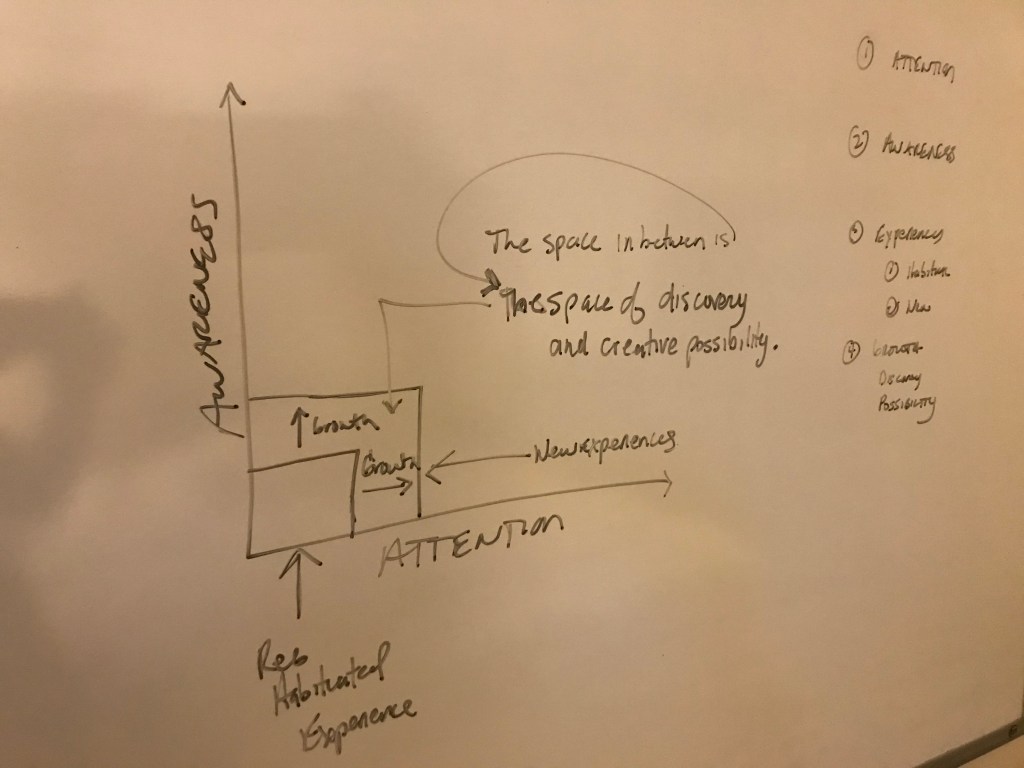
The other day I was reflecting upon a conversation I had with a colleague of mine. We were talking about an upcoming leadership training, and ideas for iterating portions of the training. And, what, prey, do you think happened? Yes, I, rather we, went straight to the whiteboard.

I ended up drawing an x and y axis, and though it was, in that moment, unclear exactly what I was trying to convey, upon reflection, it became much more clear. Hence, this post about growing your awareness and attention by getting outside of your comfort zone.

Here’s what we’ll cover.

  1. Attention
  2. Awareness
  3. Experiences
    1. Habituated Experiences
    2. New Experiences
  4. Growth
    1. Discovery
    2. Possibility

Ready? Good. Here we go.

Photo by Francesco Gallarotti on Unsplash

Attention and Awareness

We all have differing levels of attention and awareness. These levels also shift, dependent on our experience, which we will discuss more in a minute.

There are three basic levels of attention and the awareness; what we know we know, what we know we don’t know, and what we don’t know we don’t know. The last of which is also called a blind spot. We all have them. Phew. Still with me. Good.

Basically, it is those blind spots that we are addressing in this article. What we don’t know we don’t know. Because, in fact, the only way to understand what we don’t know we don’t know, is to have someone or something point to it.

Of course, we must be open to new experiences, learning, and paying attention. If we are, our awareness about ourselves as human beings will increase, and our blind spot, in this area at least, will decrease.

Experiences

When we choose to have the same experiences every day, sticking to our normal routine, or habits, we miss out on the opportunity to grow our attention and awareness. Why?

Because, when we stay in our normal routine, we don’t pay as close attention to our environments, as we do when we are in a new experience. Think about the last time you did something new. Did you pay closer attention to the experience? The sights, sounds, smells, or information you were receiving? Yep.

We pay more attention in a context that is new to us, because we don’t know what to expect, and, most likely, are a little unsure and hesitant. That is getting outside of our comfort zone. That feeling of unease.

Yet, when we get outside of our comfort zone, our capacity to pay attention increases, as does our awareness. And, when our attention and awareness increase by way of the new context we’ve exposed ourselves to, our attention and awareness increase in others as well.

Growth

As we grow our attention and awareness in new contexts, we discover new things about ourselves, and about the world. Of course, discovery is hard. We must be vulnerable, willing to take risks.

Humans have a tendency to stay inside of their comfort zones; inside of their habits, where they feel safe. However, inside of our comfort zone, discovery is not possible. Why? Because we know about these experiences. We’ve been doing them for, well, in some instances, all of our lives.

However, when we are open to new experiences, we get to discover, and we get to create new possibilities. As we learn and grow, we also get to create. It’s inside of this creative space, where new possibilities exist for our lives. It is quite beautiful.

Here is what growing your comfort zone, as we’ve discussed it here, looks like to me visually.

Corvallis, Oregon, 2021

As you can see in this simple diagram, the space in between our normal experiences, and new experiences, is where we can grow our attention and awareness.

Our attention to the new experience, which will spill over into all of our experiences, and our awareness of who we are as human beings. The latter also translates into understanding all human beings. It’s how it works.

Alright, that is a new way to think about growing our attention and awareness by getting outside of our comfort zone.

And, as my colleague would say and I’ve written before, the size of the step we take outside of our comfort zone is entirely up to us. And, once outside, we always get to return to our comfort zone.

The important thing to remember is that when we choose new experiences that challenge us, we are growing. And, well, growth is a beautiful thing to be a part of, and to watch.

#attention, #awareness, #comfort-zone, #discovery, #experience, #growingourcomfortzone, #growth, #habituation, #new, #possibility