Poetry and Prose by #1 Amazon Bestselling Author of Nature Speaks of Love and Sorrow, Co-Author of #1 Amazon Bestseller, Wounds I Healed: The Poetry of Strong Women, and Jan/Feb 2022 Spillwords Press Author of the Month
This past week I’ve been reflecting upon time management. Well, to be more specific, time management in relation to projects, tasks, and, then, after a conversation with a colleague of mine, energy.
Have you ever thought about scheduling your day by the energy you exert in relation to the projects or tasks you work on? Well, I had never really thought about my time this way either.
Or rather, I think a lot about how much energy a project or task takes, yet I have never created a system for analyzing my energy output.
Well, it’s about time, I think. Pun intended.
Before we go on further in the discussion, however, let’s first take a look at my projects and tasks in a linear format, which is the picture below.
Albany, OR 2021
I find it helpful to write out the projects and tasks I am responsible for.
Yet, in the linear version to the left, I am missing several pieces needed to get a grasp on the whole picture.
Meaning, how do the projects and tasks relate to the department priorities? Good question.
Let’s take a look.
Below is a mind map to assist in answering this question.
Albany, OR 2021
Completing the whiteboard mind map helped me see a couple of things that are not apparent when data or information is presented linearly.
Here are some of the things I learned from mapping the projects and tasks nonlinearly.
Most of my time is currently spent in meeting the department’s sustainability priority.
There are at least three commitments that aren’t connected to a department priority. They are the bubbles, or circles, that are off to the side, disconnected from the rest of the mind map.
We are working on systems in each program, yet they are different systems.
And here is a question that arose after reflecting upon this mind map overnight.
How does my time on these various projects and tasks vary as a function of energy output?
It is very common to measure out time in, well, units of time. For instance, project A takes X amount of time, whereas project B takes Y amount of time. Helpful.
Yet, what we also know about time is that, for instance, you can work on a project or task for an hour, let’s say, without exerting that much energy. While, conversely, you can spend 30-minutes on a project or task that requires much more mental, or physical, output. How do you then manage your time?
If you simply gauge or measure all projects the same way, you may, for instance, have a work day that is full of high energy outputs, and a day that has very little, which may cause a balance issue.
My suggestion? Good question.
Well, I plan to remap my projects and tasks by energy output. It might look something like this.
Corvallis, OR 2021
A rough sketch this is, however, even in this rough sketch, you can get the idea.
What this sketch does not take into account, or, rather, does not, at this time, have space for, are those projects that fall outside the department priorities.
More reflection for me.
Alright, that wraps up this entry in the reflection series on thinking about time differently.
Remember, if we simply use time as the only way we measure our output, without considering energy, for instance, we may be missing a big piece of the overall framework of how we schedule ourselves and our work.
Alright, we’ve now entered February and are approaching the 1-year anniversary of the pandemic outbreak here locally. Phew. Hard to believe, and, yet, not. Why?
Well, in some ways this past year has gone by really quickly, and, in others, not so much. Time is an interesting construct. One I will not go into right now, promise, though if you are interested in more of my thinking on time, please take a look at, The Social Construction Series Part 5: The Social Construction of Time.
Alright, the hope elfje poem was a response to Sadje’s weekly WDYS prompt, and I loved writing it. There are times when I write a poem, and all the words just flow out of me and onto the page. There are other times, where it flows out of me, and then I sit with the poem a while, and make minor, and sometimes major adjustments.
The hope poem was of the latter variety. I originally conceived of this poem as a poem about fright. Yet, as I played with the words in my mind, and looked at them on my whiteboard, it occured to me that the poem was really about hope.
That, at times, we all feel like the darkness is enveloping us, and then when we are least expecting it, a ray of light, or hope, shines upon us. Beautifully fun.
Well, what do I say about the poem shy. Hm. First, I wrote this poem two months ago probably, and just left it. I would occasionally go back to it, read and reread it, and then still leave it for another day.
Well, this past week, I read it again, made a couple minor changes, and thought, let’s post this this week. And, so that’s exactly what happened.
I was shy growing up, and was called shy and sensitive a lot. In the early 1980’s being shy and sensitive as a young boy was, well, difficult. And, I know for many young boys and girls this is still the case today in the US.
In the United States there is a fixation on being unemotional, which is, as we all know, quite toxic and unhealthy. Emotional balance and stability is needed and necessary, yet, when we shut our emotions away, we are ultimately harming ourselves and those around us.
Anyway, the poem shy was about me stepping into the light of my shyness and sensitivity. For me, they go together.
One of my blogger friends asked if the poem was about being shy or being introverted. And, well, I am actually quite extroverted, yet also have a very important introverted part of my life. A paradox? No, not at all.
Shyness, sensitivity, extroversion, and introversion, all live on a continuum, or spectrum. And, they can actually change over time and between contexts.
Looking ahead, I see more poems, and an article on time and energy, which is almost complete. And, then one, I think, on patience, something that I struggled with for a very long time.
In the coming weeks, I will also be working on the Leadership From Within Series. The posts in this new series will be shorter, and will be about the many things I’ve encountered the past 4 years in my role at the community college. Will be fun.
I will also be trying out some new poem forms, such as the Hexastich. Should be a lot of fun. And, movies? Alright, let’s take a look at a couple I’ve watched over the past two months.
Movies
I’ve always enjoyed movies, and though I don’t watch as many today, I still love to curl up with a blanket and take in a good movie.
An Exploration of 4 Years Inside A Non Credit Department at the Local Community College
Linn-Benton Community College, Albany, Oregon
As I continue to reflect upon the last 4 years in the position I hold at the College, I learn more about myself, and about being a human being on this planet.
It is funny to think that leading a team at a small community college in Albany, Oregon, would provide insights of this kind, and yet, they do. Why?
Because no matter where you lead, it’s you doing the leading, for one, and two, all contexts to some extent are the same. Yes, the challenges, people, systems, and structures, are different, yet you are there, and you are always getting to know, and developing yourself and other people. Same.
After spending time in leadership in the private sector, and now having done so in the public sector, there are several things that we will discuss in this new series that are similar; and, in some ways, mirror each other.
In this first installment in this new series, I will lay out a brief outline, if you will, of the posts to come. It will be a way to set the stage for the concepts we will discuss, unpack, and walk through together.
I’m going to frame this first entry, and the following entries, by year, which will provide us a base from which to work through the narrative to follow. Ready? Alright, here we go.
I remember well when the job description for the position I currently hold, Director of Extended Learning at Linn-Benton Community College, landed on my desk. I was working in a program at the college, which was struggling, and in threat of being eliminated. In fact, the program has been eliminated.
I looked over the position description, talked to my wife, friends, and family, and took a walk with a colleague, who asked me this question. Are you an operations man, Jeff? Whoa. Was I?
I was very unsure, and needed to think about it. Here are some of the considerations I made previous to applying to the position, which, I think, are quite generalizable.
Reflecting upon my work and academic career.
Reflecting upon what I would bring to the position.
Doing research about the position.
Having conversations with the hiring supervisor.
Having conversations with staff in the department.
There were more, bet you get the idea. It is important when making a life change to make all of the considerations and reflections we feel necessary. What happened? Well, I ended up saying this to my then wife.
If it was meant to be, we will know by getting the offer; and, if not, then not.
Of course, you know that I got the offer, and have been in the position for almost 4 years. And, what was the first year like? Hell and heaven all rolled into one. Kinda like life.
2017-18
The first year, especially the first six months, was extremely painful. One of the most painful experiences of my life. Why? Because all day every day, I was outside of my comfort zone. I was also, at this time, not treating my mind and body very kindly.
Here is what the first year looked like.
Breakdown central.
Remembering who I am.
Development outside of the college.
Life coach.
Breakdown to breakthrough becomes a reality.
Relationship development, with myself, and the team.
I say often when talking about that first year, that that was the year of relationships. Yes, we did other things, which I’ve written about in other posts, yet the basis for almost every action that year was developing deeper relationships with ourselves and each other. Painful in many ways, yes, and beautiful in many more.
In the second year, things started to move. Meaning, we began to move, well, almost like a team. We were getting closer, and yet, had a lot more work to do.
Here is what the second year looked like.
Process and system improvement.
People in the right positions.
Vision, mission, goals.
Developing priorities.
Metrics and measurement.
Internal advocacy.
External relationships.
As we then moved into year 3, the team became more aligned, and we began to get traction in all areas of our business. As a matter of fact, in the fall of 2019 we were on pace to grow our service to the local communities by another 10%. Amazingly fun.
2019-20
Then, as we moved from fall to winter, we continued our alignment trajectory, and, of course, you all know what happened in early 2020. Yep. A pandemic.
Here is what that looked like.
Team alignment.
Gaining traction.
Filled classes, growth, sustainability.
Pandemic?
Reprioritizing.
Creating 5 new business models.
Community response.
Initially, we were wrestling with questions, such as could we deliver completely remote classes. At that time, we did not have remote offerings, so there were no processes or systems to draw upon. Yet, we ended up taking all 5 business models completely remote, and the community response was stellar.
As we entered year 4, all 5 programs were either creating and delivering remote classes and training, or would be by the fall of 2020. And, there was a lot of work to do to continue the momentum we created earlier that year.
Here is what that looked, and well, is like.
Creating all new processes and systems.
From disruption to sustainability.
Filled classes, growth, sustainability.
Engagement, relationships, conversion, process and priorities.
Planning for the future.
10 business models?
And for next year? Well, I’ve actually been reflecting upon this question quite a bit. Someone asked me recently, what do you see for our work as we, at some point, begin to offer in-person classes again. First, I think offering in-person classes again is still in the distant future, yet I do have some thoughts.
What’s Next?
As we move into the second-half of the 2020-21 school year, we are offering new classes and training, and filling them up with local community members.
I see a 2 to 3 year slow progression from completely remote classes and training, to what I think will be a hybrid-model of both remote and in-person classes and training in the future.
What will the percent mix be of remote and in-person classes in the future? I don’t know. I do think, however, that, unlike when the pandemic started here locally, it will not be sudden. It will take time.
And, that’s okay. There is no rush. We will meet the community needs as they change. That’s part of what we do, and what we do well.
Alright, that completes the overview of the Leading From Within series. I look forward to future posts, where I can share, in more detail, how each of these years has impacted me as a leader, and, even more importantly, as a human being.
The other day I was reflecting upon a conversation I had with a colleague of mine. We were talking about an upcoming leadership training, and ideas for iterating portions of the training. And, what, prey, do you think happened? Yes, I, rather we, went straight to the whiteboard.
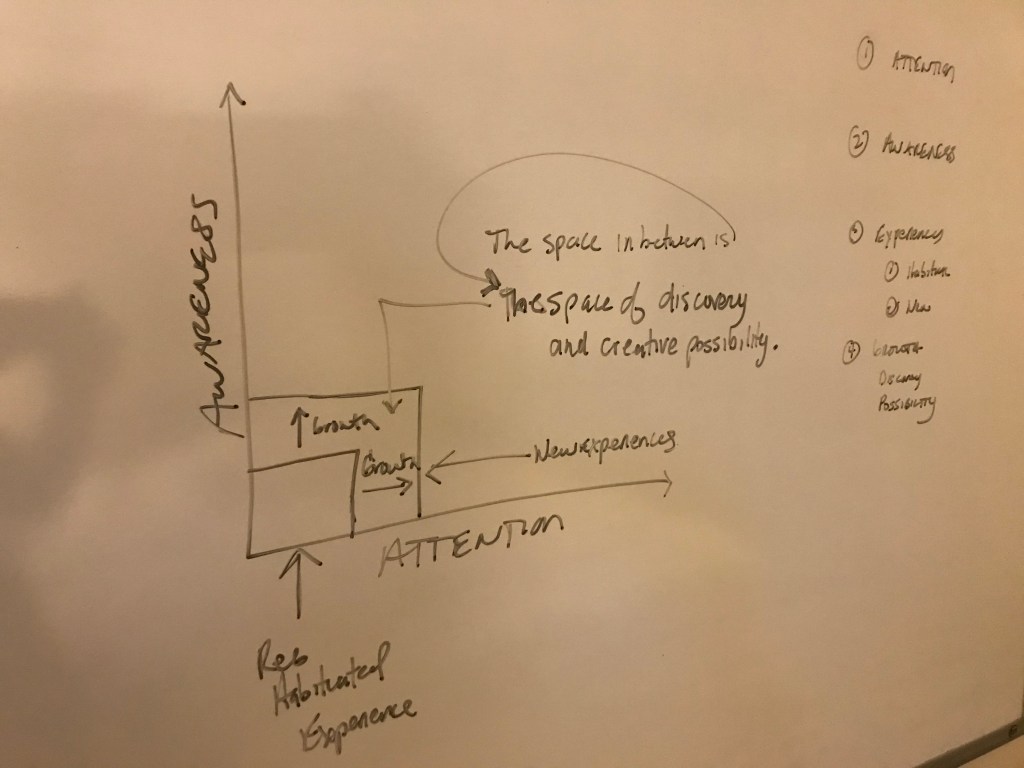
I ended up drawing an x and y axis, and though it was, in that moment, unclear exactly what I was trying to convey, upon reflection, it became much more clear. Hence, this post about growing your awareness and attention by getting outside of your comfort zone.
We all have differing levels of attention and awareness. These levels also shift, dependent on our experience, which we will discuss more in a minute.
There are three basic levels of attention and the awareness; what we know we know, what we know we don’t know, and what we don’t know we don’t know. The last of which is also called a blind spot. We all have them. Phew. Still with me. Good.
Basically, it is those blind spots that we are addressing in this article. What we don’t know we don’t know. Because, in fact, the only way to understand what we don’t know we don’t know, is to have someone or something point to it.
Of course, we must be open to new experiences, learning, and paying attention. If we are, our awareness about ourselves as human beings will increase, and our blind spot, in this area at least, will decrease.
Experiences
When we choose to have the same experiences every day, sticking to our normal routine, or habits, we miss out on the opportunity to grow our attention and awareness. Why?
Because, when we stay in our normal routine, we don’t pay as close attention to our environments, as we do when we are in a new experience. Think about the last time you did something new. Did you pay closer attention to the experience? The sights, sounds, smells, or information you were receiving? Yep.
We pay more attention in a context that is new to us, because we don’t know what to expect, and, most likely, are a little unsure and hesitant. That is getting outside of our comfort zone. That feeling of unease.
Yet, when we get outside of our comfort zone, our capacity to pay attention increases, as does our awareness. And, when our attention and awareness increase by way of the new context we’ve exposed ourselves to, our attention and awareness increase in others as well.
Growth
As we grow our attention and awareness in new contexts, we discover new things about ourselves, and about the world. Of course, discovery is hard. We must be vulnerable, willing to take risks.
Humans have a tendency to stay inside of their comfort zones; inside of their habits, where they feel safe. However, inside of our comfort zone, discovery is not possible. Why? Because we know about these experiences. We’ve been doing them for, well, in some instances, all of our lives.
However, when we are open to new experiences, we get to discover, and we get to create new possibilities. As we learn and grow, we also get to create. It’s inside of this creative space, where new possibilities exist for our lives. It is quite beautiful.
Here is what growing your comfort zone, as we’ve discussed it here, looks like to me visually.
Corvallis, Oregon, 2021
As you can see in this simple diagram, the space in between our normal experiences, and new experiences, is where we can grow our attention and awareness.
Our attention to the new experience, which will spill over into all of our experiences, and our awareness of who we are as human beings. The latter also translates into understanding all human beings. It’s how it works.
Alright, that is a new way to think about growing our attention and awareness by getting outside of our comfort zone.
And, as my colleague would say and I’ve written before, the size of the step we take outside of our comfort zone is entirely up to us. And, once outside, we always get to return to our comfort zone.
The important thing to remember is that when we choose new experiences that challenge us, we are growing. And, well, growth is a beautiful thing to be a part of, and to watch.













 Develop. Inspire. Transform.