A 3-minute Reflection on 3 Ways to Display and Visualize Linear Data

How Being Mindful About Our Learning Styles Creates Movement
Photo by You X Ventures on Unsplash

Several months ago, I wrote the article How We Learn, and Why it’s Important to Understand. Though I’ve always been interested in and engaged with learning styles, the pandemic has brought the need to consider new ways to continue to learn in a way that fits our particular learning styles even more present for me. And?

Well, I had an insight this week about visual learners, of which, I am one. And, thought about how important it is to ensure that no matter where we are called to work, or what data we are called to work on, that we can all access ideas and tools that can assist our efforts to continue to move ourselves forward.

Alright, so in this 3-minute reflection, I am including three ways that I create opportunities to feed the hyper-visual learner that I am. Ready? Good. Here we go.

Photo by Nareeta Martin on Unsplash

1. Print the Data and Display It

Much of the data our team uses is linear. Simply meaning that there is an order to whatever data we are handling, or using, such as step 1, 2, and then, 3. Simple.

Yet, when we are only looking at a set of steps, such as steps 1 through 3, for instance, we may not see how step 3 may be correlated, or, rather, affect step 17. And, it is important that we consider these other possible correlations.

I find great utility in printing and displaying data on an open surface. It allows me to see the data from a different perspective, and gets me away from the computer, which though very helpful, can become limiting. Limiting how? Good question. Here is an example.

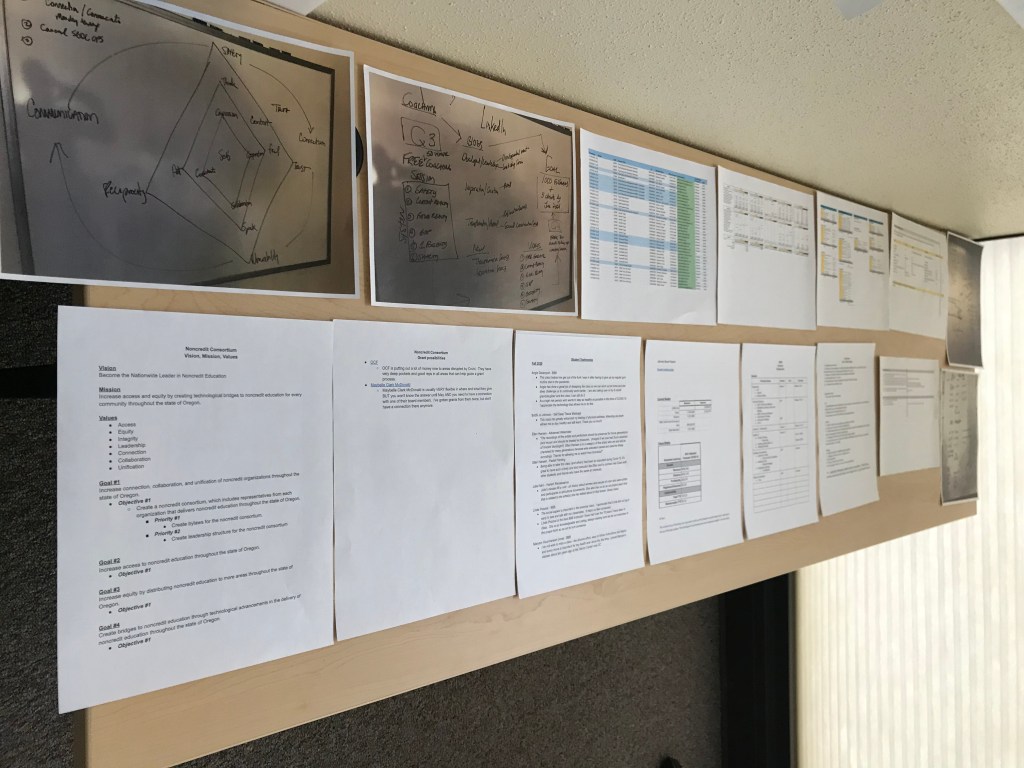
The team I work on has many projects going on at the same time, with different leads from different programs. And, just like other team members, I lead my share. Now, with my projects, I will print out an aspect of that project, it may be the latest iteration of some language or numbers I want to consider, and display each one with all of the other projects I’m working on. It looks like this.
December 17, 2012

The reason that the printing and displaying technique is so effective is that it also allows me to see across programs, to possible correlations between them. The intersections of which create more synergy and foster new outputs and outcomes for our team. Super fun.

2. Display the Data Differently

Another technique we like to use is to simply display data differently. An example? Sure.

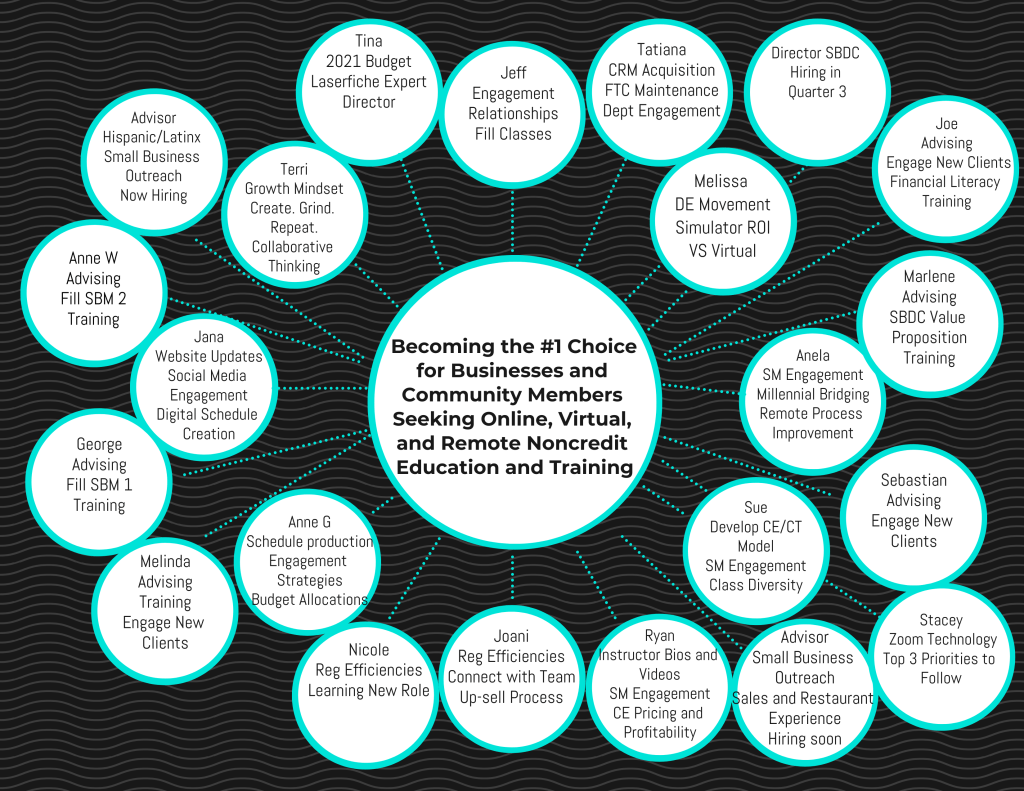
I’ve written previously about the vision we’ve created on this team, and have also written about department-level and individual-level priorities; and, how important it is that individual priorities connect to the department priorities and the larger departmental vision. These connections ensure that everyone is moving in the same direction, and that we are pointed towards our vision.

However, if you simply look at a list of priorities with a vision say as a header to a linear document, there is utility, yet it is rather lackluster. Meaning, we can do better to ensure that people see all of the priorities; and, fully understand how their priorities and the actions that live inside of those priorities are connected to the department.

Here is a very simple visual example of what that looks like.
December 17, 2020

This mind map was created using Venngage, which is a fun tool for taking linear data and making that data visual. Helpful.

These types of visualizations also let people see how their work is connected to their teammates. Especially teammates in other programs they might not see as much. Also helpful.

3. Whiteboards

Of course we’re going to discuss whiteboards, one of my favorite ways to display linear and nonlinear data and information. And, yep, it can go both ways.

Meaning, that you can start with linear data and then create nonlinear ideas and connections, just as you can start with nonlinear data and create a linear system that works for the project you are working on.

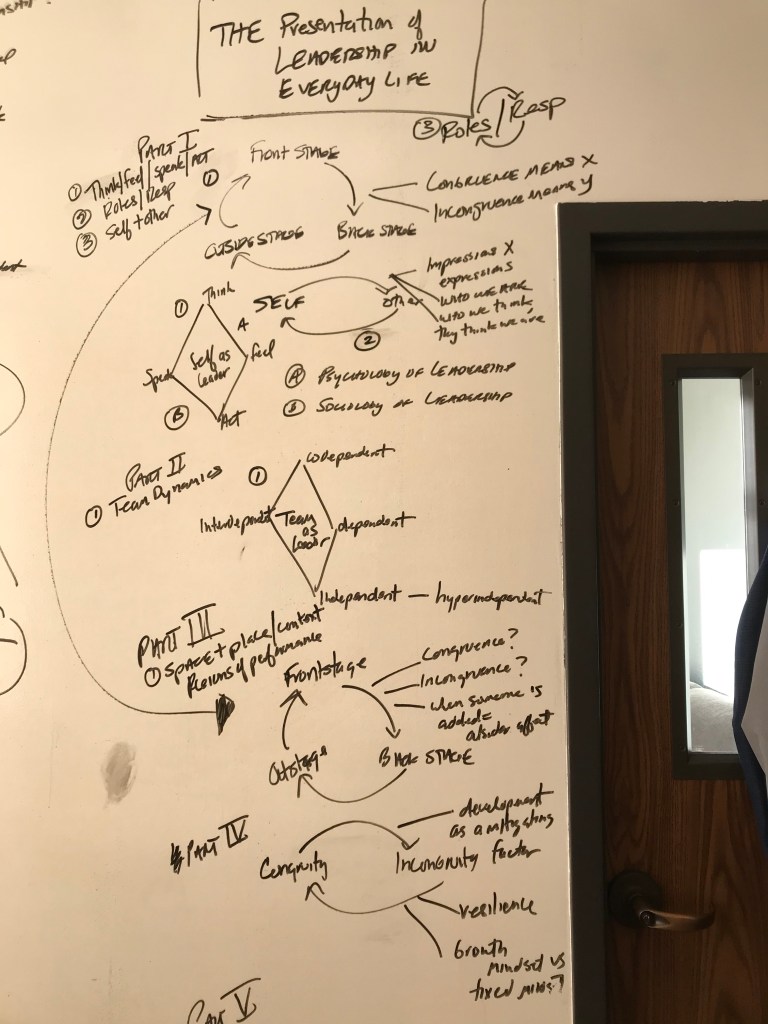
Here is an example of a linear and nonlinear whiteboard I did about some future writing I have in mind.
December 17, 2020

Here you can see the linear thinking in the sectioning off of information by parts, and then the nonlinear, which there is more of, in the variously, and in some ways haphazardly, written constructs and concepts. What am I doing? Good question.

I am getting ideas out of my mind and onto a medium that will allow me to continue to iterate these constructs and concepts for future use. As the work unfolds, there is always something I see differently and learn about, which would have been unavailable to me without working the whiteboard process as I do. Much fun.

How you manage to continue to feed your visual nature matters much less than you create the opportunity to visualize data and information in ways that continue to take your thinking, and that of your teams, further.

When we are mindful about how we learn, we can create all kinds of new possibilities that allow us to step outside of the limitations that are found in very helpful systems, like computer technology.

And, when we do so, we open up new ways to view, think, internalize, and reflect upon these data and information in ways that were previously unavailable to us, which can create more movement for ourselves and our teams.


#correlativedata, #data-and-information, #displaying, #intersectionswithinandbetweendata, #learningstyles, #linear, #movement, #nonlinear, #visualizing, #whiteboards

Sitting

Photo by Raychan on Unsplash

Though we run
After our thoughts often

And, feel behind

Know that this
Is only
A manifestation

Of the mind

Running after itself
In a
Convoluted loop
Expressed as so

Since the beginning of time

Though, as we begin
To pay attention
And have
The

Realization

That this is so
We learn
To sit
And

Notice our thoughts

As they come and go

They are
An expression
Of memories from afar

Which we need not
Trod to bring to heel

Rather, sitting
And watching can
Bring the freedom,
And healing

Which is such a natural
Feeling

So, friend, do sit
And partake in all
The splendor your mind
Can conjure

And release the burden
Which are brought
Without
A second thought

#poetry, #life, #love, #mind, #mindfulness, #poem, #poems, #sitting

Leaving

Photo by Andreas Dress on Unsplash

Sometimes
There is a leaving

A thing that happens,
Even when
We would rather

That things
Already in place
Would just
Stay the same

Where there is comfort
In knowing

What to expect,
Even when
What
We expect

Is not the best, and
Is flecked with
Anguish, and
Heartache

A natural occurrence

Yet, not the only way

That we can play
Within a life
Filled
With
A

Sense of mastery
And knowing
More

Sometimes, then
Leaving is necessary
My friend,

To
Learn more
About ourselves
And, our place on
This beautiful planet

So, when next
A leaving is needed,

Please remember,

That inside of a leaving
Already lives
Your returning

#poetry, #leaving, #life, #love, #poem, #poems

Simpler

Shche- Team @ Unsplash

Some things
Reminiscent
Of times gone by

As we try to keep up

With a never ending
Progression, and
A quite often felt
Concession

Of what we know
And want

Yet, we continue
The chase

Caught in a race
Started
Well Before
Our space was made

In this, yes,
Very beautiful place

We prioritize the
Next thing,
Without, maybe
Thinking

About the best thing
So
,

When the opportunity
Next arises,
Think twice, and
Maybe choose

A space
That reflects

A simpler life,
Which is always
Calling

Even when we
Resist, nay
Persist
In the chase

Allow yourself
The opportunity
To slow down,
And open up

To something
A little simpler

In response to WDYS#60 on Keep It Alive, by Sadje.

#poetry, #life, #love, #poem, #poems, #simple, #simpler, #writing

A Blogger’s Diary 12/13/20: On Writing, Reading, Videoing, and Vulnerability

Photo by Marcos Paulo Prado on Unsplash

Alright, another busy week, and, yep, also not busy. I’ve not started an entry that way before, have I? Nope. Why?

Well, it occurred to me this past week that in even the busiest times, when we feel like life is moving faster than we can follow along, there is always time. Now, granted, we have to create it, yet it does exist. In these pandemic days, I just wanted to make sure this is known. More time for yourself, for myself, is creatable.

Writing

Okay, now, into the writing that occurred this past week. Here we go.

  1. Tears
  2. Flight
  3. Ego
  4. A Developmental Moment #2: The 3 C’s of Authentic Productivity
  5. Silence
  6. The Reflection Series Part 6: Why is Creating Safety Important?
  7. Nature
  8. Breaking

And this week? Yep.

I’m currently working on a couple of new posts, which are.

  • The Social Construction Series Part 9: The Social Construction of Power
  • The Leadership Series Part 2.5: Why Developing the Self is Always the First Step in Leadership

I thought getting one of these published this week might happen, alas, that will not be the case. However, I do feel pretty confident about getting them both completed next week. We shall see. And, as I always say, or, rather, write, that is the fun part of the process. Not really knowing, and being at peace with that.

Now, let’s discuss the remote book club a little.

Photo by Jerry Wang on Unsplash

Reading

I’ve had so much fun with the remote book club. Last week, as we discussed in my last diary post, we finished Anxious People, and are now onto my choice, Killing Commendatore by Haruki Murakami. I’m a big Murakami fan, so I am super excited about this next book.

In my diary entry last week, I also wrote about connection and communication, and I’d like to report that having the additional connection and communication with the local folks in the remote book club has been amazing. Fun.

August, 2020

Videoing

Well, I’ve not written about creating videos in some time. Why? Well, I’ve been putting more time into my writing, and so the videos have been deprioritized. However, I have a whole new vision for video engagement, especially for LinkedIn, and so will be creating some new videos in the next quarter.

If you’ve not seen any of my videos, and are interested, due check out my Youtube channel. I’ve only had the channel for a short time, and find that creating videos is a beneficial way to connect with people from an audio/visual learning perspective.

You can also check out the videos on my site right here. Wow, I’ve not added a new video to the website since June. Phew. It’s been a little longer than I realized. Well, that just means there’s that much more to create!

Photo by Yukie Emiko on Unsplash

Vulnerability

I’ve written many articles on vulnerability. All of them intended to create the importance of actively being aware of how vulnerability can be transformational to both our personal and professional development. Seriously transformational.

I am resetting them here, as I do also believe that in the future we will need as much innovation as possible. And? Well, one of the gateways to unleashing creative potential is learning to be vulnerable. Alright, here are those articles.

  1. Vulnerability in Action: Three New Ways to Think About Vulnerability
  2. Writing and Life Series #1: On Writing and Vulnerability
  3. Living a Transformational Life: Authenticity and Vulnerability
  4. The Transformation Video Series – The 4 C’s of Vulnerability: Why Vulnerability is Transformational
  5. Vulnerability and Resilience
  6. 10 Reasons Why Embracing Vulnerability as a Strength is Important to Your Development
  7. The 4 C’s of Vulnerability: Why Vulnerability is Transformational

Wow. That’s fun.

Alright, that’s this week’s entry.

Please stay healthy and well, and have a wonderful week.

#blog, #blogger, #bloggers-diary, #blogging, #diary, #haruki-murakami, #innovation, #leadership, #leadershipdevelopment, #reading, #transformation, #videos, #vulnerability, #writing

Breaking

Photo by Hannah Gröbmüller on Unsplash

We hold ourselves
Together
In every type of weather

Stormy clouds, or
Cloudless skies
Full of never-ending
Setting suns

We resist
And hold true
To what we believe
Is the most important

Function
Of our desired reluctance

Sheltering ourselves
Against a foe
Feared
Of an imagined destructive

Compunction
Set to crack the
Facade
Created from the beginning

Of our earthly existence

And while we express
Our resistance
We move
Further
Away

From our true coexistence

You, me, and all of thee

Let the light shine
From within you
And give way
To all that
Beauty

Because my friend,
As we allow
Ourselves
To break

We begin to understand

That this is not the
Last stand, no
Rather
It is the beginning

Of a new life

Not predicated
On holding back
But, rather, only ever
On moving forward,

Creating
All that’s within us
And allowing ourselves
The freedom

To break as often as needed

Happy Sunday.

#poetry, #breaking, #creation, #life, #light, #love, #poem, #poems

Nature

This image has an empty alt attribute; its file name is blake-richard-verdoorn-cssvezachvq-unsplash.jpg
Photo by Blake Richard Verdoorn on Unsplash

Is profound in its bounty
A real and exquisite
Truth

Set
Before our
Very eyes,

As we continue to
Reconcile the truth
And become wise

Of the mystery
Hidden in plainview

Take, the flower,

Petals mirroring
Each other, and
Working

Together
While shimmering
In the bristling dawn

Of a new sun

Held together
By a single
Stem

One
Like all the rest

Imagination separates
You and I, yet
We are just like the flower

Where our power is
In the recognition
Of our hidden
Vision

Of a new structure
Like the stem
Only ever
Our

One true gem

The web
That connects us,
My friend, is as real

As you and I

A single beating heart
Pumping a life force
Some call God

It matters not
The Name
For it is
The

Reverence we hold
That’s the aim
Of our quest

For our true
Nature,
Not the nomenclature

It’s the feeling
Of that connection
That besets us upon
The road toward our very

Nature

Have a wondeful weekend, everyone.

#poetry, #connection, #imagination, #life, #love, #nature, #poem, #poems, #questanddestination, #writing

The Reflection Series Part 6: Why is Creating Safety Important?

A 3-minute Reflection on 4 Things Every Leader Can Do to Create Safety on Teams

Photo by Annie Spratt on Unsplash

Well, we are 9-months into a pandemic, actually much more than 9-months, yet, here locally, 9-months ago was when the restrictions started. And?

I’ve been thinking about and reflecting upon just how important creating safety on teams is all the time; and, now? Even more important.

Developing safety within a team creates a context where possibilities abound. Meaning, when people feel safe, there is trust, and where there is trust, well, anything is possible. Seriously. Anything. And, now?

Living inside the pandemic for the past 9-months has been unsettling in many ways. Though I’ve written about, and we’ve discussed many times before, how much more there is to know and learn, than is known.

It is equally true that when the foundation of someone’s belief system is shaken, it can be really hard, and can make people begin to question what they thought they knew about how the world works.

Meaning that for some people, they already know there is much more to know than they know, and now what they thought they knew has been up-ended. Hard.

Right, so what can we do? How can we make sure to continue to create safety on teams so people feel like they have solid ground to stand on? Good questions. Let’s take a look at 4 ways we can do just that.

Photo by Matthew Waring on Unsplash

Reality

Have you ever heard about managing the real and ideal? Yes, no? Either way, it simply means that when in a leadership role it is important to always strive for an ideal, think vision, while being very clear on the current reality.

Basically you are managing the tension between what is and what you are creating. Super important. Why?

Because even though the current reality might be hard to hear, people need confirmation that what they are seeing, thinking, and feeling is accurate. The very last thing they need is false hope. Nope. They need reality.

When you stand in the current reality, there is workability. Why? Because when you are clear and the team is clear, you can continue to create the ideal free from the distraction, what if.

You will get more focus, concentration, and organization when you are clear on the current reality while continuing to create the ideal future state. More focus, concentration, and organization from yourself and the team.

Photo by Clay Banks on Unsplash

Listen

We all know how important it is to listen. Very important. There might not be a more important leadership skill. Seriously. This is especially true when times are stressful.

People need someone they can come to, someone they can depend upon. Someone that is going to be present, listen, and give honest feedback. They need that, their team members need that, and, as the leader, you need that. From? From each of them. Yep.

There is immense power in being present and being an active listener.

Active listening simply means being mindful in your conversations. Be present, pay attention, empathize, and use your conversational skills to really understand, take in, and respond in kind to the person you are talking to. Important.

You will get much more back when you practice and coach people to practice active listening. More for yourself, for your teammates, and the entire team. When people really listen, they know what’s going on with their teammates, which makes for a much more productive work environment.

Photo by Edvin Johansson on Unsplash

Collaborate

When the team understands the current reality and the ideal state you are creating, is practicing active listening, the likelihood for collaboration increases. Why?

Because when people feel comfortable, are able to focus, and know how their teammates feel and what they think, they are immediately more approachable. And, when we are more approachable, collaboration is just easier.

And, what do you get when your team is able to collaborate more effectively? Yep. Innovation.

When your team works together, there is a synergy that occurs, and inside of that synergy, you get ideas that take the team further. You don’t get these types of synergistic innovations from silos. Just doesn’t happen.

Photo by Jakob Owens on Unsplash

Action

Of course, you cannot create an ideal reality from a very clearly defined current reality without taking action. Nope. Not possible.

Actually, the coolest thing about creating an ideal, and generating all of the innovative ideas, is seeing them executed upon. Amazing. It is one of the things I love the most about working on teams.

Yep, it is so much fun to create, and, yes, I am very creative. Yet, it is equally beautiful and fun to watch the transformation of what can be months of innovative work into a new system, process, program, training, or class. Really.

Wow, that was fun.

Alright, remember, creating safety on teams is a powerful leadership skill. Truly.

As we discussed, creating safety ensures that people can feel comfortable in the current reality, even a very stressful one, while continuing to strive for the ideal reality.

Practicing and modeling active listening also fosters safety by creating a context of respect and mindfulness, while collaboration and taking action ensures that the bridge between innovation and execution is clearly articulated and navigated.

And, when the bridge between innovation and execution is clear and ideas are being executed upon, the team will feel a sense of accomplishment, which increases the team’s morale and feelings of security and safety.

Creating safety on teams may be one of the most important things a leader can do, especially during times that are more stressful and unknown. The ability for everyone to feel safe is that important.

#activelistening, #collaboration, #covid-19, #creatingsafety, #currentreality, #humandwevelopment, #idealreality, #leadership, #leadershipdevelopment, #listen, #pandemic, #safeteams, #selfdevelopment, #takingaction, #teamdevelopment, #vision

Silence

Photo by Evgeni Tcherkasski on Unsplash

An
Empty space
Full of grace, and

Solitude

Created
For the multitudes

Of humanity

We each share
In this blessing
Which awaits

A discovery

Upon the recovery
Of our true

Nature

Which is
Quite compelling,
And, yes, often telling

A thing forgotten,
Yet not begotten, no

Rather, a reservoir
Full of light, and
Always delight

So, friend

When it’s time
Look inside
And you will find

A space
Already created
Awaiting your return

So take the turn, and
Reclaim the truth
Of your birth

Silence

Empty while full
Ever so subtle, and
Also quite grand

A paradox, yes
Quiet and also
Powerful
, and

Oh so very flowerful

#contemplation, #introspection, #life, #love, #poem, #poems, #slience

A Developmental Moment #2: The 3 C’s of Authentic Productivity

3 Reasons Why Being Authentic Will Increase Your Productivity

Photo by Arno Senoner on Unsplash

A few months ago I wrote the article, The Reflection Series Part 2: What Does it Mean to Live an Authentic Life?, where we discussed living an authentic life. The basic premise being how living an authentic life is an empowering experience.

Now, in this article, we will discuss how we can increase our productivity by simply being the human being we know ourselves to be. Yep. Ready? Good here. we go.

Have you ever seen behind the scenes of a theatrical production? Yes, no? Well, either way, there is a ton of work that goes into creating a stage production, even a small production at a local high-school.

I remember taking, what was then called stagecraft, in high-school, and that was our job. Creating the stage, or, in sociological terms, creating the visual context for the play. Was great fun.

Erving Goffman, an American-Canadian Sociologist from the 1950’s, talks about life in terms of a play. Noting that we all take on particular personas based on socialization, yes, the context we are working or living in, and the ideas we have about who we are, and, yep, the ideas we believe others hold of us. Phew. That’s a lot of information to hold, which, hint, hint, is part of the point of this article.

I digress, back on track. Here is a short, well, relatively short, synopsis of what Goffman terms dramaturgy.

Dramaturgy is a sociological perspective that is a component of symbolic interactionism and is used in sociological analysis of everyday life. Developed by American sociologist Erving Goffman in his seminal 1959 text The Presentation of Self in Everyday Life, dramaturgy uses the metaphor of theater to explain human behavior. According to this perspective, individuals perform actions in everyday life as if they were performers on a stage. Identity is performed through roles. Here, the term “role” works in two ways, referencing both the name for a theatrical character and the ways in which individuals fill roles in reality by acting as a mother, friend, husband, etc. Dramaturgy argues that the presentation of oneself through role is a way of engaging with society.

Social Science

Alright, now, you may be asking, okay, and?

Well, think about all of the roles you take on each day. Seriously. Count them real quick. Here, I’ll do it too. I came up with 7. And, that was just a quick inquiry. A more focused inquiry would reveal many, many, more. And, you? How many did you come up with? Yep. Good.

Now, with all of these roles, and what I will now term performances, how much preparation do you do to create, deliver, and sustain these performances? Hm. Quite a bit, I bet. And, time? Yep, preparation is time. And time is energy.

Alright, so we spend a lot of time backstage, in Goffman terms, preparing for our individual performances, even when we are unaware. Yep. And, then frontstage, delivering them? Exactly. We spend a lot of energy there too. True.

And, now, let’s add in being inauthentic. If we are, let us say, working even harder on our performances, because we believe we need to look, act, and behave a certain way, either because we feel we should, or, we feel that others expect that of us, that is even more tiring. Phew. That’s a lot of tiring. Yet, there is another way. How?

By being authentic. And, guess what? Yep. When we are authentic, we save energy.

Photo by Sharon McCutcheon on Unsplash

Authenticity and Productivity

When we are authentic, we save energy because, quite simply, we work less hard trying to convince ourselves and everyone around us that we are someone we’re not. As we’ve already seen, it takes a lot of time and energy just to perform our various roles, which does not include trying to perform them in ways we think we are supposed to.

Further, we all have a limited amount of energy to utilize throughout our day. We can think about our day in terms of exchanging units of energy for each task, project, or activity we take on.

As we exchange our units of energy, our stores become depleted. Now, we can recharge these energy stores by doing various things, such as taking a walk or sitting and breathing for a couple of minutes.

However, we should also covet these energy stores by being aware of our energy levels throughout the day. And? Well, when we are continuously thinking about our performances, our energy is depleted at a faster rate. Why?

Because we are distracted with thoughts and mentalizations that make the work we are engaged with more arduous. Pretty simple.

Photo by Brian Wangenheim on Unsplash

However, when we aren’t concerned about our performances, meaning we are being authentic and true to the person we know ourselves to be, our energy is saved from tasks such as worrying and overthinking. Important.

And, when we save our energy we can be more productive.

Alright, here then are three productivity byproducts that come from being authentic. Being who we really are. Just for fun, we will call these the 3 C’s of Authentic Productivity.

  • Capacity – when we are authentic, we have more energy for the aforementioned reasons, and we also have more capacity. More capacity to do the work we need to do, free from the constraints of spending time and energy concentrating on performing in ways that we think we are supposed to, or we think others expect us to.
  • Concentration – when we are authentic, we are also able to concentrate more easily. Our minds are not busy fretting about our performance. For instance, wondering what someone thinks about what we just said, or how we are acting in a particular context. When we are free from these mentalizations, we are much more clear.
  • Clarity – and, yes, when we have more capacity to concentrate on the work at hand, we are also more clear. We have more clarity in general about all things, and are able to complete tasks and projects with much greater efficiency and effectiveness.

There is one more bonus to being authentic. Insight.

Photo by Kyle Tran on Unsplash

When we have more capacity, are able to concentrate more effectively, and have more clarity, we create the possibility of receiving more insights. Insights occur when our minds are quiet. When we are quiet.

And, we are much more quiet when we are not in a continuous internal battle about who we are. When we are authentic, this battle drops away, and insights come more frequently.

Wow, that was fun.

Alright, that’s the 3 C’s of Authentic Productivity. Know there are many more benefits to being authentic. Seriously. Many more.

Pretty much everything we do, we do more effectively and efficiently when we are authentic. As we’ve seen in our discussion, worrying about our performances depletes our energy levels.

However, when we are authentic, we save our energy, and in doing so increase our capacity, ability to concentrate, and overall clarity.

You are already just as you are supposed to be. So be who you are, be authentic, embrace yourself, and enjoy each moment of every day.

Oh, yes, and, remember, when you do so, you’ll also enjoy more insights along the way. And, believe me, that’s super fun.

#authenticity, #authenticityandproductivity, #capacity, #clarity, #concentration, #energy, #humandevelopment, #insight, #leadership, #productivity, #selfawareness, #selfdevelopment, #selfimprovement