Poetry and Prose by #1 Amazon Bestselling Author of Nature Speaks of Love and Sorrow, Co-Author of #1 Amazon Bestseller, Wounds I Healed: The Poetry of Strong Women, and Jan/Feb 2022 Spillwords Press Author of the Month
We Are Poetry: Lessons I Didn’t Learn in a Textbook, by Kym Gordon Moore
I was elated to receive Kym Gordon Moore’s new book about a month ago, and though I’ve only read a few selected chapters thus far, I can write here that it is an amazing read. Here is an example:
I Am
“They say I am nothing
in my someone-ness
traverse into a flow
of the seen but not heard
nonexistent, divisible where liberty is not just
not considered worthy to speak,
or to be respected
just an invisible occupation of space,
you think that of me
yet my existence is more
than the archives of silence
I am.
Refusing to conform […]”
Absolutely stunning. If you’ve not yet picked up a copy of this amazing book, you can do so here.
Update on Me
It was great to catch up with many of you last night. I am doing very well, and enjoying the travels. There is so much beauty in the world, and it is a privilege, and a joy to get out and see it.
Today, I am off to see Justin, which will be a lot of fun. We will do some shopping, and farmer’s marketing on Sunday, and then we are going to see the Portland Trailblazers on Sunday night. I’ve not been to an event of this size in years, thus I’m filled with excitement and some anxiety. Very normal.
I look forward to catching up with all of you again next weekend.
I walked through the door once, and into a different land entirely, sky full of blood, torn in two, it was a wonder to feel the loss at the center of the vacuum…
thoughts racing, with a heart rendering love, an afterglow cast, inside my chest breathing fast, and then, in from the gloom
came you, sure-footed, with a love the size of the moon, dispelling the shadows in heart and mind, you did always remind me
of the aliveness living inside of moments won
as great clarity did come, and you and I settled in for an afternoon under the sun…
When I look inside, sometimes is found a diatribe, of ideas, which are moving and shaping experience without the knowledge of the receiver.
Egoic mind in motion, suffering extending roots from craving to attachment. Blinding light of awareness, are you afraid of the parallax light would perform?
Following these ideas from here to there is often pale, until that is, we get beyond the veil.
We often accessorize to people and ideas too comfortably with the gates to our heart unlocked with hope, the void of emptiness remains when the filled absence has dissolved.
We must then make headway, and, stay resolved, by being open to all that’s at our door, while we learn more about humanities very core.
Welcome others to be who they truly are, by mirroring and refracting off Self. Don’t force situations, solutions once submerged emerge, uncertainty is reality, delve into it.
Experience is a wise teacher, and can shed light on the ideas we struggle with, while we bundle close together, and pray for our very souls.
Detachment does not mean that you should own nothing, but that nothing should own you. Soaring above the high planes, be enrolled experience yet not of it.
Experience as the guide, please abide, and delight yourself in the fabric of reality within view, while ensconcing yourself in the mystery of all that is hidden within you.
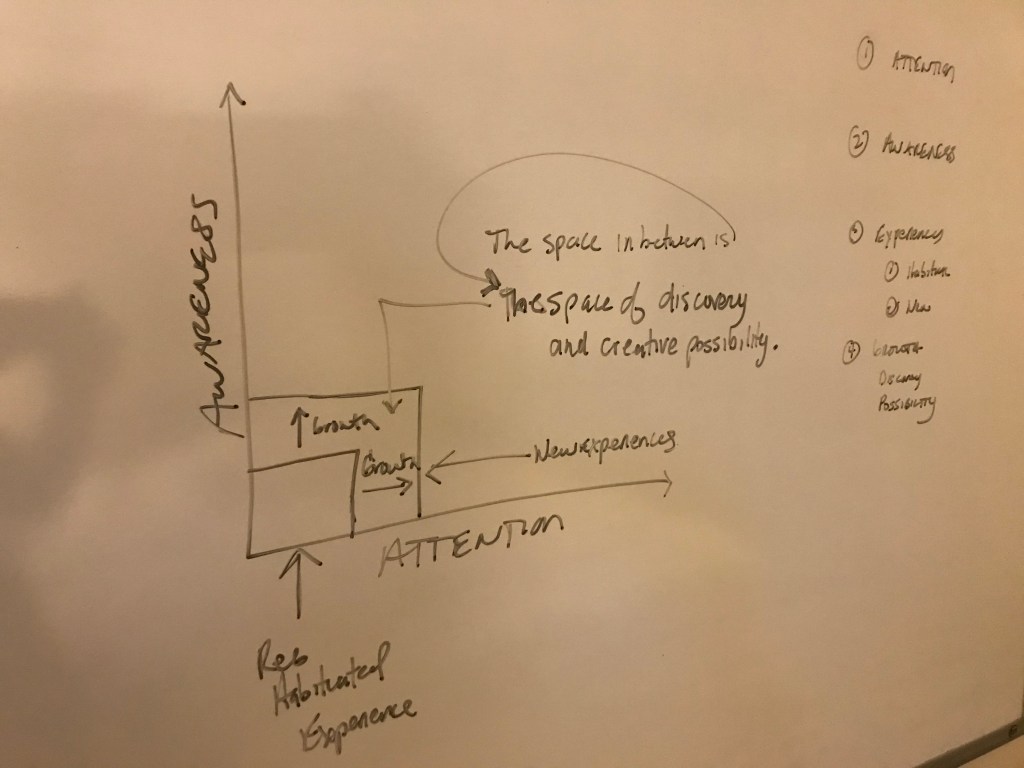
The other day I was reflecting upon a conversation I had with a colleague of mine. We were talking about an upcoming leadership training, and ideas for iterating portions of the training. And, what, prey, do you think happened? Yes, I, rather we, went straight to the whiteboard.
I ended up drawing an x and y axis, and though it was, in that moment, unclear exactly what I was trying to convey, upon reflection, it became much more clear. Hence, this post about growing your awareness and attention by getting outside of your comfort zone.
We all have differing levels of attention and awareness. These levels also shift, dependent on our experience, which we will discuss more in a minute.
There are three basic levels of attention and the awareness; what we know we know, what we know we don’t know, and what we don’t know we don’t know. The last of which is also called a blind spot. We all have them. Phew. Still with me. Good.
Basically, it is those blind spots that we are addressing in this article. What we don’t know we don’t know. Because, in fact, the only way to understand what we don’t know we don’t know, is to have someone or something point to it.
Of course, we must be open to new experiences, learning, and paying attention. If we are, our awareness about ourselves as human beings will increase, and our blind spot, in this area at least, will decrease.
Experiences
When we choose to have the same experiences every day, sticking to our normal routine, or habits, we miss out on the opportunity to grow our attention and awareness. Why?
Because, when we stay in our normal routine, we don’t pay as close attention to our environments, as we do when we are in a new experience. Think about the last time you did something new. Did you pay closer attention to the experience? The sights, sounds, smells, or information you were receiving? Yep.
We pay more attention in a context that is new to us, because we don’t know what to expect, and, most likely, are a little unsure and hesitant. That is getting outside of our comfort zone. That feeling of unease.
Yet, when we get outside of our comfort zone, our capacity to pay attention increases, as does our awareness. And, when our attention and awareness increase by way of the new context we’ve exposed ourselves to, our attention and awareness increase in others as well.
Growth
As we grow our attention and awareness in new contexts, we discover new things about ourselves, and about the world. Of course, discovery is hard. We must be vulnerable, willing to take risks.
Humans have a tendency to stay inside of their comfort zones; inside of their habits, where they feel safe. However, inside of our comfort zone, discovery is not possible. Why? Because we know about these experiences. We’ve been doing them for, well, in some instances, all of our lives.
However, when we are open to new experiences, we get to discover, and we get to create new possibilities. As we learn and grow, we also get to create. It’s inside of this creative space, where new possibilities exist for our lives. It is quite beautiful.
Here is what growing your comfort zone, as we’ve discussed it here, looks like to me visually.
Corvallis, Oregon, 2021
As you can see in this simple diagram, the space in between our normal experiences, and new experiences, is where we can grow our attention and awareness.
Our attention to the new experience, which will spill over into all of our experiences, and our awareness of who we are as human beings. The latter also translates into understanding all human beings. It’s how it works.
Alright, that is a new way to think about growing our attention and awareness by getting outside of our comfort zone.
And, as my colleague would say and I’ve written before, the size of the step we take outside of our comfort zone is entirely up to us. And, once outside, we always get to return to our comfort zone.
The important thing to remember is that when we choose new experiences that challenge us, we are growing. And, well, growth is a beautiful thing to be a part of, and to watch.
Jeff Flesch
8:00 am on January 17, 2021 Tags: clearandtrue, continuum, difficultconversations, experience, keepingthingssimple, meaningful, planned, strategy ( 10 )
When’s the last time you had a difficult conversation? If you are in a relationship with, well, anyone, it is likely you’ve had a difficult conversation recently. They are a part of being in a relationship with someone. Yes, difficult conversations are needed and necessary in the workplace, and they are also needed and necessary in our private lives.
It is through the most difficult conversations where growth for the people inside of the conversation becomes possible. When we avoid these conversations, nothing really happens. Actually, if anything, when we avoid difficult conversations, the relationships we have are built upon a shifting foundation.
Meaning, unstable, and unreliable. Why?
Because, we’re not being true to how we think and feel when we avoid things that are difficult; and, difficult conversations are not removed from this truth.
Many people struggle with having these conversations, just as I once did. Truth. And, yes, they are hard. I’ve had many in the past three years, and, yet, there is also something beautiful in the experience of being in that difficulty with another human being, and creating a way forward.
Alright, let’s first consider two concepts, which occur prior to the difficult conversation, and then a very simple, pun intended, as you will soon see, strategy, you can employ inside of a difficult conversation. Ready? Good. Here we go.
Even in the language, I’ve used thus far to describe a difficult conversation can appear binary. Meaning, either the conversation is in one way difficult, or the opposite, not difficult.
It is important to understand that difficult conversations, like all things in life, live along a continuum. This means that there are many types of difficult conversations, from, let’s say, conversations that are easier, yet still sensitive, to conversations, which are much more difficult.
We can think about them living along a straight line that continues forever, with sensitivity on the far left, and, in a workplace example, a corrective action conversation on the far right. In between?
Many types of conversations. Yet, regardless of the type of difficult conversation, there are several steps we can take to make sure we are ready. The first? Making sure you are clear and that what you understand about the context you are witnessing with the person you need to have a difficult conversation with is true.
What do I mean by clear and true? Let’s take a look.
Clear – that you’ve done the pre-work necessary to understand the context you are witnessing, and that indeed a difficult conversation needs to take place. Again a working example may suffice. Maybe someone on your team is having difficulties at home, or with another coworker, and does not yet have the tools needed to know how to talk about the issue. However, if the employee does not talk with someone about the issue, their work will suffer. In this instance, I would classify this difficult conversation as a sensitive conversation, somewhere toward the left of the continuum. However, it also depends on how long the team has been together, and how long you’ve worked with the employee. If the team is new, and or the employee is new, the conversation will be more difficult. Either way, knowing that the conversation needs to take place and that you are clear on the reasoning is key.
True – true meaning that we’ve taken time to watch the behavior, and reflected upon it. It is super important to avoid emotional reactions to situations as they arise. Taking time to witness behavior gives us a more three-dimensional view. Yes, there are times when we will need to have a difficult conversation at the moment. It happens. However, when we practice applying the clear and true principle, it helps us with planned and unplanned difficult conversations. Both.
Once you are clear and know that what you are seeing is true, you can deploy a very simple strategy to conduct a difficult conversation.
And, yes, I chose this acronym intentionally, as some people find themselves attracted to language. Meaning, they like to use a lot of language when in conversation with someone.
However, using more language than is necessary and needed in a difficult conversation will only make the conversation more difficult and less clear. It is very important to keep things simple.
Strategy – having a strategy for how you are going to have the conversation is important. Here are some questions to ask yourself prior to the conversation.
What are you going to say?
How are you going to say it?
Where will the conversation take place?
What is your goal for the conversation?
What questions might the employee ask, and what are your answers?
How long will the conversation last?
Intentional – you want to, at all costs, make sure this conversation is created intentionally, once you know your strategy. Again, sometimes these conversations happen at the moment, however, I’ve found that most often, you can take the time needed to watch, learn, strategize, and then create the conversational context. And that is doing things intentionally.
Meaningful – the conversation needs to be meaningful. When you create the goal of the meeting, also create the takeaway for the employee. For instance, how is this conversation going to create the possibility of a developmental step forward for the employee? It is important that the conversation includes this developmental step. It is up to the employee to take a hold of that developmental opportunity and do something with it. Just as it is your job as the leader to create the developmental possibility in the first place.
Planned – we’ve covered having a plan for the most part. Here I will simply add that taking the time needed to create your strategy and plan accordingly is important. For instance, making sure to clear your calendar leading up to and after the conversation, so you have time to do the necessary pre-work and decompress after. Difficult conversations are called such because they are difficult for everyone, the leader included.
Learning – once you’ve created the possibility of a developmental step forward for the employee, it’s time to make sure the theoretical development is pulled into practice or reality. It is your job as the leader to ensure this possibility also exists. Now, the developmental work is for the employees to do, however, you can assist them by implementing a timeline and due dates, and a follow up 1W1 to ensure you are supporting them in their development.
Experience – it’s also the leader’s job to ensure that the conversational context is an experience that is safe, and includes both empathy and compassion. Meaning, that everyone is in a different developmental stage as a human being; and people, all people, need safe spaces where they can learn new strategies they can employ in their life to move them forward as human beings. For this to occur, the context needs to be safe, and include both empathy and compassion. Empathizing with someone, simply means understanding where they are free of judgment, and compassion? Means remembering you, as the leader, are a human being just like they are, and have had very similar situations arise in your life.
Wow. That was fun.
Alright, there are several strategies you can employ prior to, during, and after a difficult conversation.
Remember, these conversations are needed and necessary. Really and truly. When we take the time necessary to create safe contexts where difficult conversations can occur, we are paying forward a part of ourselves, and helping someone else move forward in their life. And guess what?
When you create these contexts, you also learn more about who you are as a human being. Always. In every difficult conversation, I’ve ever had, I have always learned more about myself and my own development.
And that, my friend, is movement, and it is beautiful.
Sitting on the porch, rocking back and forth, I reflect upon the birth of my sons. It feels like yesterday. Just a moment ago. And, then, flash, I am 46, they are 20, and 16. What happened?
Life happened.
Growing up in Los Angeles was for a long time something that I took for granted. I remember the first time I traveled across the country, via car. I said something to my buddy like, wow, it all looks like San Bernardino.
If you’ve been to Southern California, and spent anytime at all in the desert areas, of which San Bernadino is a part, you will get that reference. If not. Well, let’s just say that I had an idea in my head that all places looked like Los Angeles. Not so.
I digress.
Justin was born in 2000. I was 26. At the time, I remember thinking, jeez, I’m old, better hurry up and have kids, buy a house, live that American Dream everyone’s talking about. Really. WOW. I was young, not old.
We lived in two different apartments when Justin was little. First halloweens, first christmas, first-time parents. Phew. At that time, I worked close. I did work long hours, however, the work was very flexible.
I remember when I got the call. I was on my delivery truck, called my boss and said, Justin’s coming. I’ve got to go. They covered me.
So excited, nervous, anxious, joyful. All at the same time. Justin was born quick. Very, quick.
Bringing him home was so nerve racking. What if I do something wrong? What if something happens? Well, my mother-in-law stayed with us for a week or two, and I called my mom regularly. Drawing upon the support we had. Very lucky to have it.
Anyway, we did end up purchasing a house when Justin was 4. Jason was born shortly thereafter. Only 4 years separate the two boys, and yet, we were completely caught off guard by having another child. Not prepared at all. Phew.
We did like many people do. We moved forward, did the best we could, and loved them both unconditionally.
I loved when they were little. Though I worked a lot, it was so much fun to see them play in the yard, play with our dog.
Though we only lived in that house for 4 years, we did so many things together there. My memories of that time are so vivid. Possibly those memories are so vivid, as we were building a life.
Just starting out. Knew very little about what we were doing, yet we drew upon what we were taught, and created the rest. Filled the gaps.
First house, first backyard, first garage, first-time having neighbors in a house. All so new. The house was so small, yet had a huge lot. Was so great for the boys. Tons of space to roam and play.
That house was quite a ways from our extended family. 46 miles. Which, at the time, was like 5,000 miles.
You have to understand that, especially for me, we grew up in families where most people stayed very local.
All good. We took the boys to LA regularly to see their grandparents. We even sent Jenn and the boys to AZ, where her parents lived, so they could also visit them.
I remember the first time I took the Amtrak. What a different experience. Was fun. Back then you could actually smoke on a train. In a smoking car. Yep, they had those then.
When Justin was 5 or so, and Jason was 1 or 2, we decided to sell and move to AZ. It was right before the housing crash. Really. Within two years that house we bought for $150,000 and sold for $370,000, was once again worth $150,000. Crazy.
We bought a house in Surprise AZ, and I went to work for US Foodservice. Huge company. Good training program, lots of work. During this time, Justin was in third grade, and Jason was spending portions of his day at a babysitter. We both worked, did, and still do. Normal.
Third grade was a difficult one for Justin. New school, new kids, new context, new State. Very different from where we were from. As with most things, there were those things we liked about AZ, and those we did not.
Beautiful winters, HOT summers. Still, there is something quite majestic about the desert. Really. If you’ve not spent a lot of time in the desert, check it out.
We were only in that house for 1.5 years. Housing crash. Foreclosure. Emotionally trying. Actually, in every way that time was challenging mentally, physically, and emotionally.
What does it mean to “lose” a home? Difficult. We were, of course, not alone. Many, many, people were in the same position in 2007 and 2008.
The home we ended up renting was only around the corner. Helped, in that Justin could stay in the same school. They both played outside a lot with the neighborhood kids. Fun, and fun to watch.
Next?
Well, let’s save that for Part 2. I’ll end with saying that being a father to two beautiful boys has been and is one of the greatest experiences of my life. And, I wouldn’t have shared it with anyone other than Jenn.
Being a father. Beautiful, wonderful, lovely, and hard, frustrating, and scary. Still is. More on that later. 🙂














 Develop. Inspire. Transform.